
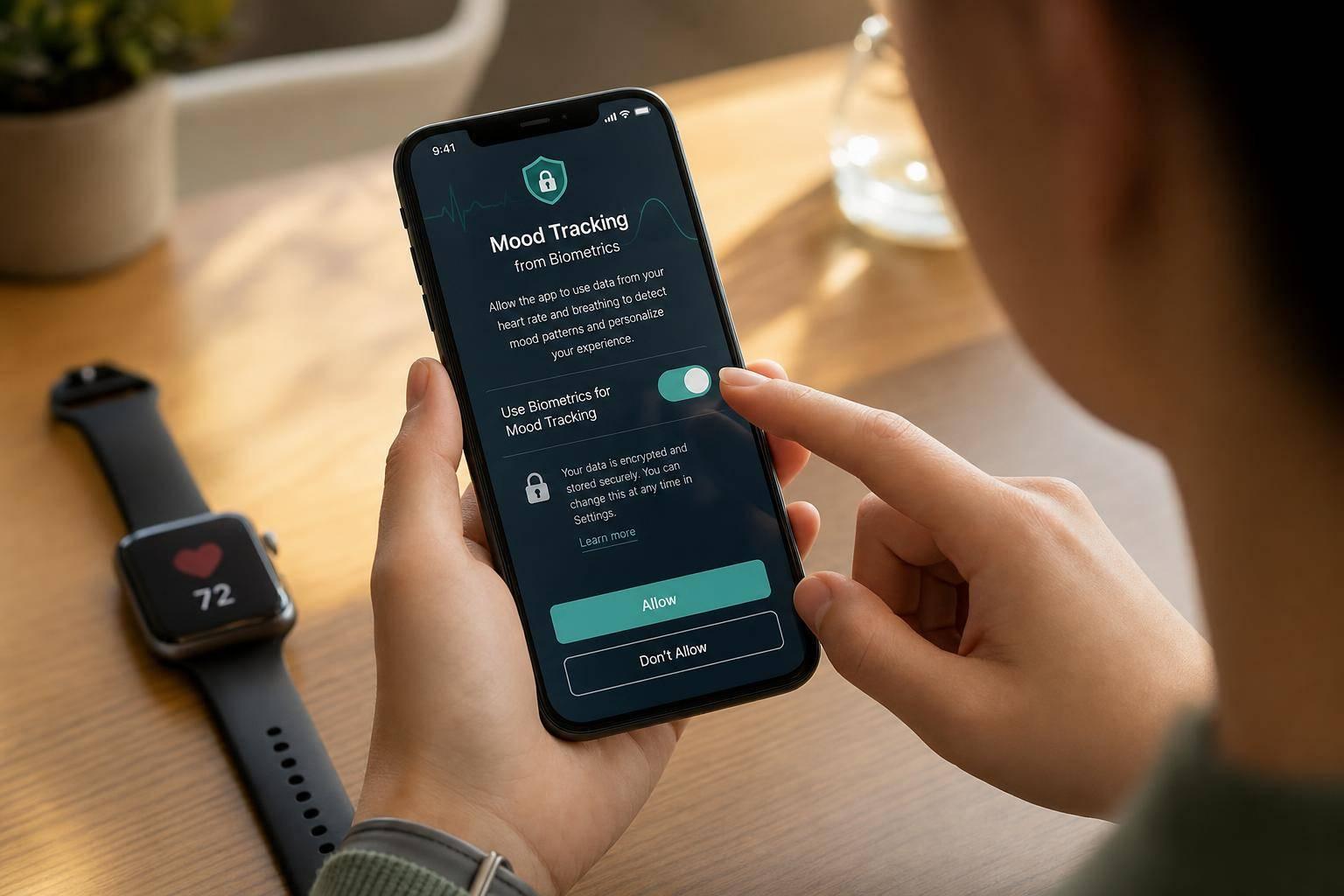
I’d sum it up like this: AI wellness apps can turn routine signals into guesses about your stress, mood, and behavior. And once that data is linked to your identity, the risks go far beyond a basic fitness log.
Here’s the short version:
- Emotional health data is more sensitive than standard wellness data because it can point to stress, burnout, anxiety, or other private mental states.
- AI often works by inference, not certainty. A heart rate spike, poor sleep, or location pattern can suggest stress, but it does not prove how you feel.
- Consent often fails when apps do not clearly explain collection, inference, sharing, storage time, and deletion rights.
- Privacy risks are high because leaks, re-identification, and third-party sharing can expose long-term behavior patterns.
- Bias and weak validity matter because these systems read proxies, not emotions themselves, and studies have found higher error rates for some groups.
- The main rule is simple: inferred emotions are not facts, so apps should use clear opt-in choices, easy revocation, short retention, and strict limits on sharing.
A few points stand out to me from the article:
- Passive monitoring can include tracking stress levels using wearable technology like heart rate, sleep, voice, text, GPS, and app use.
- Long-term logs can build profiles that show chronic stress trends and personal weak spots.
- Research cited in the piece notes racial and gender gaps in some emotion-reading systems, including inflated anger scores for Black faces in neutral expressions.
- If this data reaches insurers, employers, or brokers, the harm can include profiling, risk scoring, or coverage decisions.
If I were putting the article into one plain sentence, it would be this: the data is sensitive, the predictions can be wrong, and users need more control than most apps give them today.
Ana Catarina de Alencar: AI That Reads Emotions: What It Means for Data Privacy, Consent, Your Teams
sbb-itb-f5765c6
How AI apps collect emotional signals and where consent breaks down
After defining emotional health data, the next step is looking at how apps gather it and why consent often falls apart.
From self-reports to passive monitoring
Emotional data usually comes from two places: self-reports and passive monitoring. Self-reports are the things people enter themselves, like mood scores, journal entries, and life satisfaction ratings. Passive monitoring is different. It collects data without active input. Wearables and smartphones can keep tracking heart rate, sleep, GPS location, app use, and even voice or text data. That matters because once data is collected, it can be used for inference, shared, and kept for long-term profiling [1].
Why inferred emotions are not the same as confirmed feelings
Body signals can point to stress or low mood, but they don't prove what someone is feeling. AI models may use heart rate and sleep logs to estimate emotional states, but those outputs are still predictions, not confirmed feelings. The problem starts when those predictions get treated like facts and shared with third parties, such as insurers, employers, or data brokers, without the user ever knowing [1].
Misclassification isn't just a tech problem. If a model wrongly infers a chronic mental health issue from behavioral signals, that prediction can affect insurance coverage or job decisions. From there, discrimination isn't hard to imagine [1].
What meaningful informed consent should include
Meaningful consent has to cover collection, inference, sharing, and retention. It breaks down when terms fail to plainly explain that AI models can infer sensitive states, like stress levels or mood trends, from physical signals [1]. It should also spell out who is involved in the data ecosystem: device makers, third-party apps, insurers, and employers who may get access to that data for profiling or risk scoring [1].
People should know exactly how long their data will be stored. They should also have the right to trigger a full deletion or export of their records.
Those gaps in consent lead straight into the privacy and security risks that come next.
Privacy, security, and governance of emotional health data
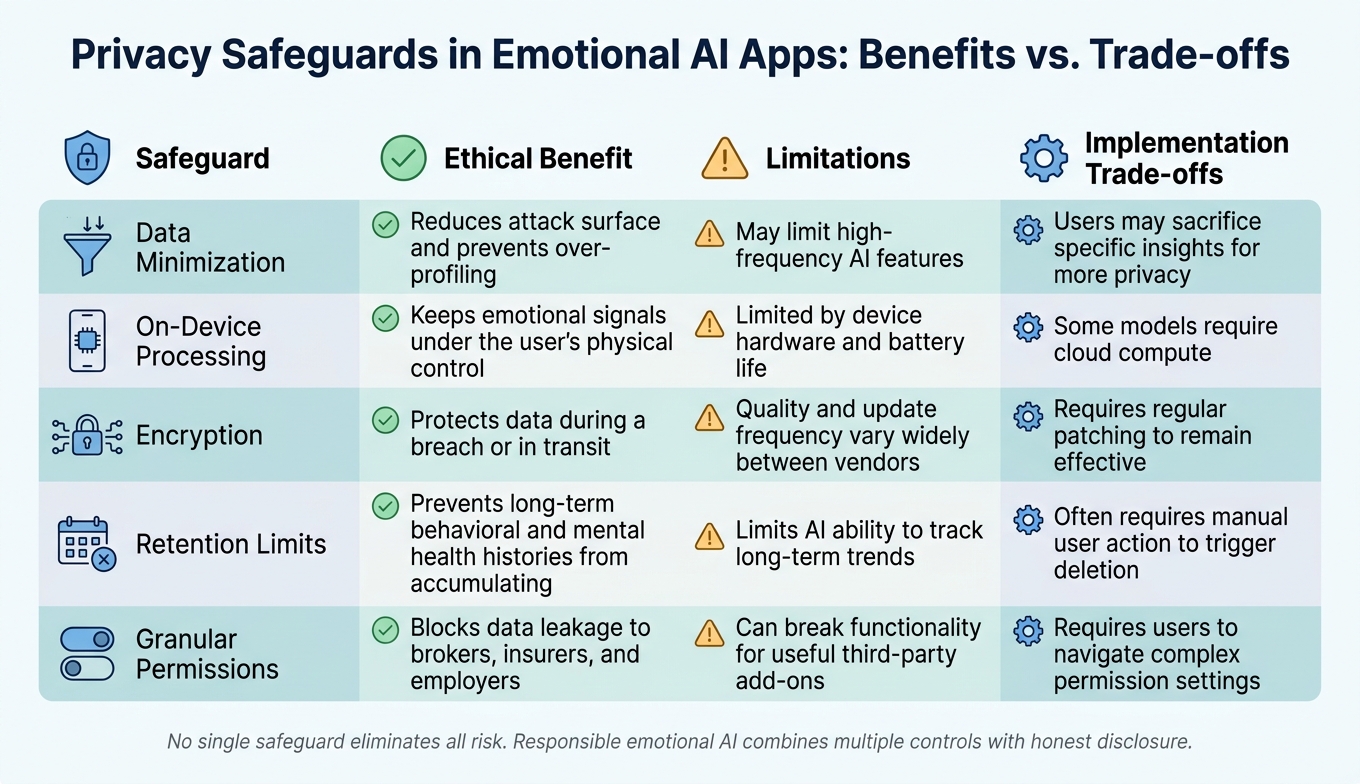
Privacy Safeguards in Emotional AI Apps: Benefits vs. Trade-offs
Once data leaves the device, governance matters just as much as consent. A user can say yes to sharing, and the risks can still be serious. The key issues are simple: where the data goes, who gets access to it, and what happens to it months or years later.
Main privacy risks in emotional AI
The biggest risk isn't just that a breach happens. It's what the breach reveals. Emotional AI systems can infer mood, stress, and behavior patterns from steady biometric streams. So one breach can expose an intimate behavioral profile.
Re-identification is another major concern. Long-term time-series data, such as months of sleep and heart rate logs, can carry behavior patterns that are highly specific to one person. When that data is matched with other datasets, people can often be identified again even after obvious identifiers are stripped out.
There's also secondary commercial use. Data doesn't always stay inside the original app. It can move to third-party services, data brokers, and insurers. From there, it may be used for underwriting, risk scoring, or decisions about coverage eligibility. Sometimes that permission is buried in long terms of service. In practice, the app vendor may control how the data is processed, often utilizing various AI tools, shared, and in some cases turned into revenue.
Safeguards researchers recommend
Researchers tend to point to the same core safeguards. If an app handles stress, sleep, or biometric data, it needs clear governance and firm limits on secondary use.
| Safeguard | Ethical Benefit | Limitations | Implementation Trade-offs |
|---|---|---|---|
| Data Minimization | Reduces attack surface and prevents over-profiling | May limit high-frequency AI features | Users may give up some specific insights in exchange for more privacy |
| On-Device Processing | Keeps emotional signals under the user's physical control | Limited by device hardware and battery life | Some models need cloud compute |
| Encryption | Protects data during a breach or in transit | Quality and update frequency vary widely between vendors | Needs regular patching |
| Retention Limits | Prevents long-term behavioral and mental health histories from accumulating | Limits AI's ability to track long-term trends or improvements | Often requires manual user action to trigger deletion |
| Granular Permissions | Blocks data leakage to brokers, insurers, and employers | Can break functionality for useful third-party add-ons | Requires users to navigate complex permission settings |
Privacy controls compared: benefits and trade-offs
No single safeguard fixes everything. Each one comes with limits that both developers and users need to understand. Data minimization can cut down exposure, but it may also reduce what the system can do. On-device processing gives users more direct control, yet hardware and battery limits can get in the way. Encryption helps if data is intercepted or exposed, but only if vendors keep their systems patched and up to date.
Retention limits help stop years of behavioral and mental health history from piling up. That sounds good on paper, but deletion can be messy in practice. Once data has been copied across partners and cloud systems, full deletion becomes hard. Granular permissions can slow data sharing, but they also put more burden on users to sort through dense settings menus.
So yes, these safeguards can reduce risk. But they don't make emotional inference reliable or fair. Even strong privacy controls leave a deeper problem untouched: emotional predictions can still be biased or just plain wrong.
Bias, validity, and the impact on users
Strong privacy safeguards can lower the risk that emotional data gets stolen or misused. But data security doesn't solve the bigger problem on its own: the emotional predictions can still be wrong. And when they're wrong, some groups often pay a higher price than others.
How bias enters emotional inference models
Bias in emotional AI usually builds up step by step across the pipeline, especially during data collection, labeling, and evaluation.
A lot of emotional inference models are trained on datasets that overrepresent Western, white, and neurotypical populations. If a model learns what stress or calm looks like from a narrow slice of humanity, it's more likely to misread people outside that group. Research on facial analysis systems has found racial and gender disparities, including higher misclassification rates for darker-skinned faces and women, and inflated anger scores for Black faces with neutral expressions.[5]
Labeling adds another layer of trouble. Emotion categories like sad, anxious, or calm are shaped by language and culture rather than fixed, universal buckets. Even common annotation tools can skew results. Research found that the SAM (Self-Assessment Manikin) labeling tool included masculine-coded visuals that influenced how different genders rated their emotional states.[9][8][11]
Why validity matters as much as bias
Even balanced data can't fix a basic limit: emotional AI reads proxies - heart rate, facial movement, speech, sleep - not emotions themselves.
That's a big deal. The same signal can mean different things in different settings, and even a neutral facial expression can carry different meanings across cultures.[6][10] So when a model treats those signals as stand-ins for feelings, it can sound sure of itself while getting the situation wrong. For users leaning on an app for sleep or stress guidance, that can turn into advice that sounds precise but rests on shaky ground, highlighting the need for patient-centered AI tools. It may pathologize normal mood shifts or push changes that don't match what's actually happening, rather than following personalized wellness protocols.[6][3][4]
User harms from wrong or intrusive emotional predictions
When models misread people, the harm doesn't stay abstract. It shows up in day-to-day use.
Constant emotional scoring can make people more anxious and nudge them to optimize for the score instead of their actual well-being. Someone might hide frustration, slow their speech, or change sleep habits just to satisfy the model.[10][3] That's the trap: the metric starts running the person.
Over-reliance on AI advice is another risk. If an app gives firm, prescriptive guidance based on weak inferences, users may doubt their own judgment or put off talking to a clinician.[6][4] Biased systems can also deepen stigma. If someone keeps getting labeled as high stress or at risk based on signals that don't match their lived experience, they may start to feel defective or watched. That can hit especially hard for people already dealing with mental health challenges.[10]
These harms don't land evenly. Studies show that emotional AI can misread the expressions of people of color, older adults, non-native English speakers, and people with chronic conditions more often than others.[5][7][10] In plain English, the people these systems read worst are often the ones who get hurt most.
Accountability and practical standards for responsible emotional AI
Who is responsible when emotional AI causes harm
Even strong privacy rules fall apart when no one is clearly on the hook.
Right now, responsibility is spread across device makers, cloud providers, third-party app developers, insurers, and employers. So when something goes wrong, it's often hard to tell who owns the damage. Device makers often act as data controllers because they decide how data gets processed and shared. But legal rules haven't kept pace with AI, which leaves gray areas where new emotional inference features can roll out without clear oversight. [1] That's why deployment standards matter just as much as the law.
This gets even messier in employer- or insurer-run wellness programs, where participation may look voluntary on paper but not feel optional in practice. If a wellness app is tied to health coverage decisions or workplace pressure, that power gap makes accountability slippery. It also opens the door to emotional data being used for discriminatory risk scoring or productivity monitoring. [1] And once that data is sent to a third party, the original platform no longer controls how it's stored or used. [2]
What responsible deployment looks like
Responsible emotional AI starts with hard limits, not vague promises.
That means using opt-in defaults, one-click revocation, limited third-party integrations, and plain-language disclosure of any data sale or sharing. [1] [2]
For users, a simple gut check helps: does the app keep control close to you, or does it ship data out the door? Pick apps that process data on-device, make export and full account deletion easy, and clearly say whether data is sold or shared with third parties or brokers. [1]
Conclusion: key ethical rules to remember
Emotional health data belongs in a different class than basic wellness metrics. It's deeply personal, easy to misread, and hard to pull back once it leaves a device.
The key rules are pretty simple: inferred emotions are not confirmed feelings. Consent must be specific and easy to revoke. Privacy controls need to match how sensitive this data is. And no app should present emotional predictions with more certainty than the science can support.
Responsible emotional AI is honest about what it measures, what it cannot know, and where data goes.
FAQs
How do AI apps infer emotions?
AI apps try to read emotion by pulling signals from several sources and piecing them together into a picture of how someone feels at a given moment. A lot of them use dimensional emotion recognition, which looks at valence, arousal, and dominance instead of stopping at simple tags like “happy” or “sad.”
They can scan text and speech for tone, word choice, and speech patterns. Some also track facial micro-expressions. Others bring in data from wearables, such as heart rate variability, skin response, and breathing rate, to spot signs of stress.
Why is emotional health data so sensitive?
Emotional health data is highly sensitive because it can leave a long digital trail. If that data gets exposed in a cyberattack or shared in ways people never agreed to, the damage can stick around for years.
And this isn’t like a stolen credit card number. You can cancel a card. You can’t just swap out your mental health history or biometric records once they’re out in the world. That’s part of why a single record can be worth as much as $250.
The fallout can hit from several angles at once. A breach may lead to employment discrimination, insurance issues, strained personal relationships, and long-term privacy problems. It gets even messier when AI can reconnect data that was supposed to be anonymous back to a specific person.
What should I check before using one?
Before you use an AI app for emotional health, take a close look at its data practices and how open it is about them. Check whether it gives you clear consent choices for specific kinds of data, like location or biometric data. Also read how long your information is stored and what steps you need to take if you want it deleted.
It also helps to confirm that the app clearly explains its security standards, collects only the data it needs, and keeps human oversight in place for critical decisions.