
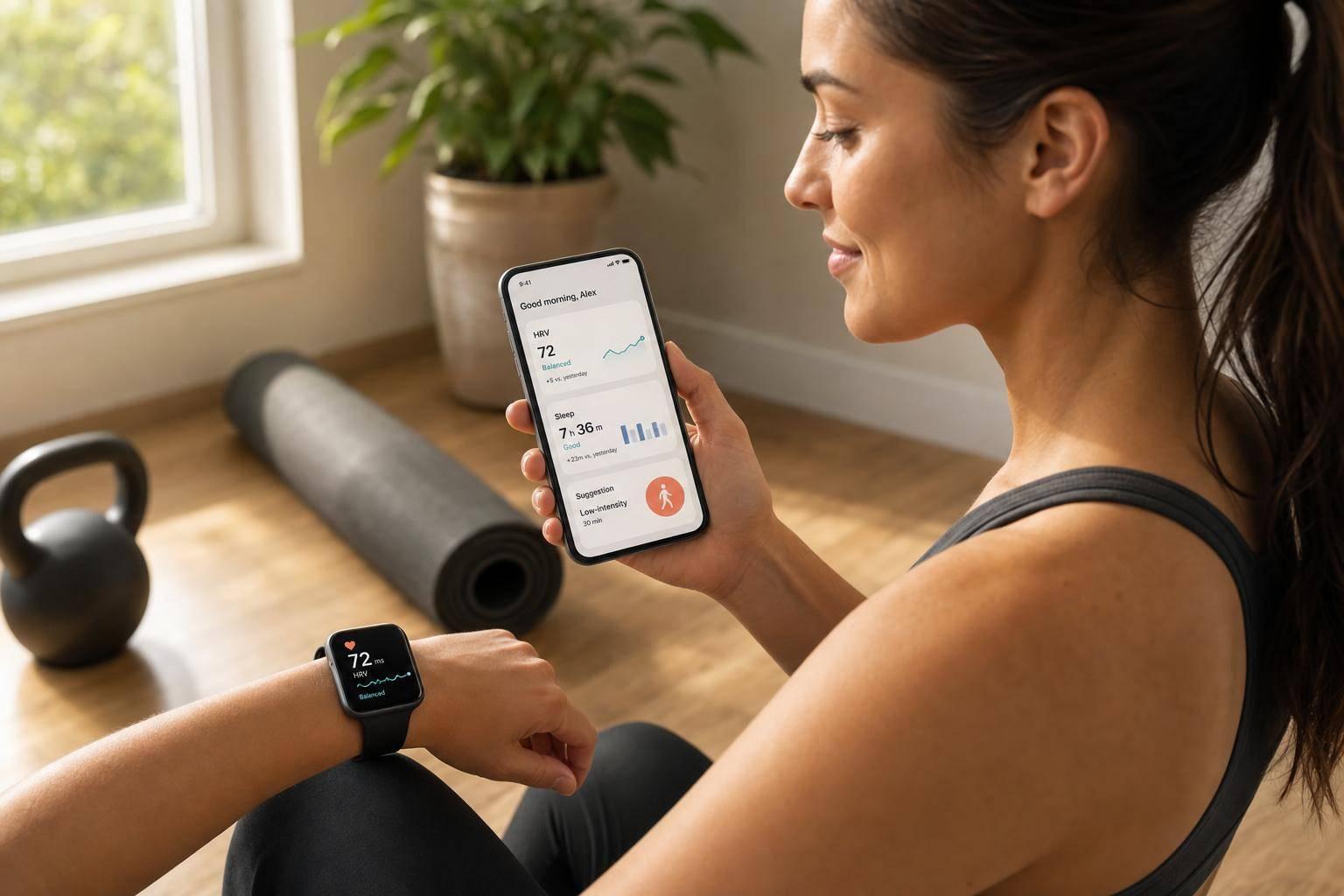
AI fitness works best when it uses your data over time, not a one-time reading. I’d sum up the article like this: track a few core signals, let AI adjust training based on your baseline, and treat the output as advice, not a rule.
Here’s the short version:
- Generic workout plans often miss the person. The article points to study data showing that many people on the same program do not improve in the same way.
- The most useful signals are usually HRV, resting heart rate, and sleep, along with training load. These help AI judge recovery, strain, and day-to-day readiness.
- Continuous tracking matters more than isolated checks. In one study cited, AI spotted signs of overtraining with 89% accuracy 5 to 10 days before performance dropped.
- AI can change workouts in the moment. That can mean slowing pace by 0.5–1.0 mph, lengthening rest from 60 seconds to 90–120 seconds, or swapping a hard session for lighter work.
- The article says mixed data gives better forecasts. Wearables plus sleep, stress, lifestyle inputs, and bloodwork can help spot fatigue or injury risk earlier than a single metric alone.
- There are limits. Sensor errors, small study groups, weak transparency, and data-sharing issues all make blind trust a bad idea.
- The bottom line: Use AI as a coach, not a boss.
What stood out to me most is how much the article leans on personal baselines. A low HRV score by itself does not say much. But a week of lower HRV, less sleep, and a higher resting heart rate can point to strain building up. That is where AI can help most: not by replacing judgment, but by spotting patterns that are easy to miss.
The article also makes a strong privacy point. It notes that 79% of popular health and fitness apps shared data with third parties in one Duke study, and only 28% of users knew it. So before using any tool like this, I’d check four things:
- what data it collects
- how long it keeps that data
- whether I can delete it
- how clearly it explains its advice
My takeaway: AI fitness has promise when the data is steady, the signals are clean, and the advice is easy to question. If not, the score on your screen may look precise while still missing what your body needs that day.
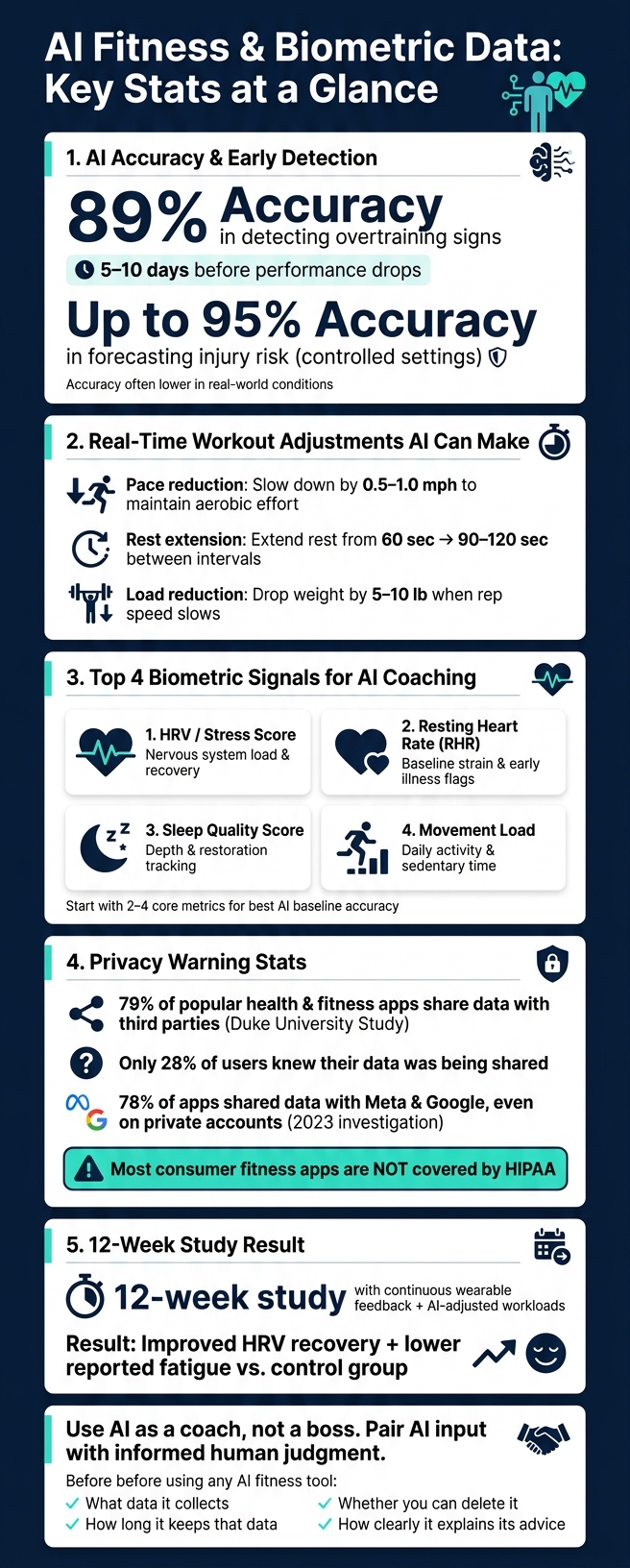
AI Fitness & Biometric Data: Key Stats at a Glance
Top 5 AI-Powered Personal Health Wearables for Real-Time Bio-Metric Monitoring
sbb-itb-f5765c6
What Studies Show About AI, Wearables, and Biometrics
Research keeps pointing to the same idea: steady wearable data beats one-off readings when you want fitness advice that fits your body. A single snapshot can miss the bigger picture. But when data stacks up over days and weeks, AI can spot patterns that short checks just can't.
Longer tracking windows also improve accuracy. That’s why long-term tracking matters more than isolated readings. It gives AI enough context to tell the difference between a bad day and a pattern that calls for a change.
How Continuous Tracking Builds Better Personal Baselines
As data builds over time, AI forms a personal baseline and starts flagging changes that matter. One rough night of sleep? That’s probably just noise. But a full week of lower HRV and shorter sleep starts to look like strain building under the surface.
That pattern matters because performance dips usually don’t come out of nowhere. In one study, AI systems that analyzed recovery data and HRV trends detected early signs of overtraining with 89% accuracy, 5 to 10 days before performance dropped [1].
Which Biometric Signals Are Most Useful for Personalized Guidance
Not every metric pulls its weight day to day. Research keeps favoring a small group of signals that give AI the clearest read on recovery, strain, and activity.
| Metric | What AI Detects | Practical Output |
|---|---|---|
| HRV / Stress Score | Nervous system load and recovery capacity | Flags high-stress phases; recommends recovery sessions |
| Resting Heart Rate (RHR) | Baseline strain, fitness trends, early illness | Flags if the body is under pressure before symptoms appear |
| Sleep Quality Score | Depth, continuity, and restoration, not just total hours | Identifies which evening habits hurt recovery |
| Movement Load | Daily activity volume and sedentary time | Identifies when to add movement or reduce inactivity |
Among these, HRV and RHR tend to be the most useful because they react fast to stress, fatigue, and recovery. AI systems then filter out short-term noise, so random blips don’t get mistaken for patterns that need a behavior change.
A good starting point is two to four core metrics. HRV, sleep quality, and RHR usually give AI enough signal to build a steady baseline and shape recommendations around your body, not someone else’s average. The best results often come from combining a few core signals into one baseline, which then feeds real-time workout adjustments.
Real-Time Coaching and Workout Adjustments
Once you have a personal baseline, AI can change intensity, pacing, rest, and even exercise selection in real time based on live biometric signals. Those changes matter in the moment, and they can also shape how well you recover later that day.
How Live Data Shapes Intensity, Pacing, and Recovery
When AI systems combine heart rate, HRV, and pace data, they can react as soon as your metrics drift outside your normal range. If your heart rate climbs too high for a given pace, the system may tell you to slow down by 0.5–1.0 mph so you can get back to an easy aerobic effort.[2][4]
Rest periods can change too. If your HRV or heart rate recovery between intervals is slower than usual, the AI may extend recovery from 60 seconds to 90–120 seconds and cut the total number of intervals so the session doesn’t pile on too much strain.[2][3] Research on combined wearable data shows that live feedback helps dial in training and keeps workload closer to what your body can handle that day.[3][4]
This also shows up at the day level. If your morning HRV is down and your resting heart rate is up after several hard days, AI can swap a planned high-intensity workout for low-intensity aerobic work or even a full rest day. In one 12-week study, continuous wearable feedback with AI-adjusted workloads led to improved HRV for exercise recovery and lower reported fatigue than a control group.[3] So this isn’t just about mid-workout pacing. It also guides day-by-day choices.
What Real-Time Feedback Looks Like Day to Day
In a strength workout, the system might prompt you to drop the load by 5–10 lb on the next set if rep speed slows and your heart rate jumps earlier than normal.[3][5] After a hard day, an end-of-day summary might suggest an easy 20-minute walk and an earlier bedtime based on last night’s 5.5 hours of sleep and today’s training load.[2][5][6]
Healify's AI health coach Anna uses wearables, biometrics, and lifestyle data to turn all of that into a simple next step, like choosing between a hard gym session and an easier recovery walk.
Over time, those same signals can also help flag fatigue and recovery patterns before your performance starts to slip.
Performance, Recovery, and Predictive Health Insights
Once AI can adjust workouts in the moment, it can also spot fatigue and recovery issues before performance starts to slip. The best results come from models that look at more than one stream of data at once, including wearables, bloodwork, sleep, and day-to-day lifestyle habits.
Where Evidence Is Strongest for Training Load and Fatigue Detection
The clearest support so far is in training load and fatigue detection. Multi-signal models can forecast injury risk with up to 95% accuracy in controlled settings.[7]
That said, there’s an important catch. Researchers point to a gap between lab testing and actual training: models built in controlled settings often don’t hold up as well in real athletic environments, where the data is messier, noisier, and less consistent.[7]
Why Combining Wearables, Bloodwork, and Lifestyle Data Improves Predictions
Prediction gets better when a model can see the whole picture instead of one metric in isolation.
Wearables on their own miss a lot of the context behind recovery. A low-readiness score, for example, doesn’t always tell you why an athlete is dragging. But when AI combines wearable data with biomarkers, bloodwork, sleep, stress, and lifestyle data, the picture gets sharper. Those models can make more precise calls and flag rising fatigue before physical symptoms show up.[8]
In plain English, that broader view turns scattered signals into earlier warnings and clearer recovery guidance.
Limits, Privacy, and What Comes Next
Current Research Gaps and Ethical Concerns
Those performance gains come with a tougher question: can the data be trusted, protected, and used in a fair way?
The gains are real, but study quality, bias, and privacy still get in the way of day-to-day use. Most AI fitness studies rely on small, narrow samples instead of populations that reflect the people who might use these tools at scale[11][15][18]. A lot of this work also happens in controlled lab settings, where results often look better than they do in daily life. Once people are out in the wild, wear-time drops, sweat interferes, movement adds noise, and signal quality slips. That makes it harder to apply the findings to older adults, people with chronic conditions, and other groups that show up less often in the data.
And that problem gets bigger when sensor accuracy changes from one user to another.
Bias is already a documented issue. Optical heart-rate sensors are less accurate on darker skin tones[10][14][17]. That can throw off heart-rate, calorie, and training-zone estimates, which are the same inputs many AI systems use for coaching. If the coaching depends on biometrics, then weak sensor performance can weaken the coaching too. On top of that, model bias can stack onto sensor bias when training data leans too heavily toward younger, healthier, or higher-income users.
Opacity is a product issue; data sharing is a privacy issue.
Transparency is still limited. Many commercial tools give users one readiness score without showing what data shaped it or how sure the model is about the result[9][11][15][18]. That makes a big difference. If you can't see what led to the advice, it's harder to judge when to follow it and when to ignore it.
Privacy is another major concern. A Duke University study found that 79% of popular health and fitness apps share data with third parties, while only 28% of users knew that was happening; a 2023 investigation found that 78% shared data with Meta and Google, even on private accounts[13]. In the U.S., most consumer fitness apps sit outside HIPAA, so they don't get the same protections as medical records[12][13][19]. The FTC's updated Health Breach Notification Rule, which took effect on July 29, 2024, expanded breach-notification duties to health apps and wearables. Even so, there is still no full federal consumer health-data law for this space[12][16][19].
Key Takeaways on the Future of Fitness
Taken together, the evidence points to cautious use, not blind trust.
The main takeaway is simple: AI works best as a decision aid, not a stand-in for judgment. Its strengths still depend on clean data and user trust. Big accuracy claims often weaken in free-living conditions, where data gets messy and adherence is uneven. Before using any AI fitness tool, it's smart to check a few basics:
- What data it collects
- How long it keeps that data
- Whether you can delete it
- How clearly it explains its recommendations
Fitness tech is heading toward personalized health guidance, but the best results are likely to come from pairing AI input with informed human judgment.
FAQs
How long does AI need to learn my baseline?
Healify usually needs 2 to 4 weeks of steady data to build your first health baseline. In that stretch, it looks at signals like resting heart rate, sleep duration, recovery patterns, and activity levels to figure out what’s normal for you.
That baseline doesn’t stay frozen. Your body, habits, and fitness can shift over time, so Healify keeps updating its read as new data comes in. That helps keep the coaching aligned with how you’re changing day to day and week to week.
Which biometric metrics matter most?
The biometric metrics that matter most are the ones that show your recovery, stress load, and overall readiness in a clear way. The main ones are HRV, resting heart rate, sleep stages and sleep quality, body temperature, and blood oxygen levels.
Taken together, these signals help Healify’s AI coach, Anna, turn your data into personalized, actionable insights instead of dumping a pile of raw numbers on you.
How can I protect my fitness data privacy?
Protecting your fitness data privacy is a top priority. Healify uses end-to-end encryption, HIPAA-compliant storage, and anonymized biometric processing to help keep your health information secure.
You also control your data-sharing settings. On top of that, regular security audits help spot and fix weak points, helping keep your health profile protected.