
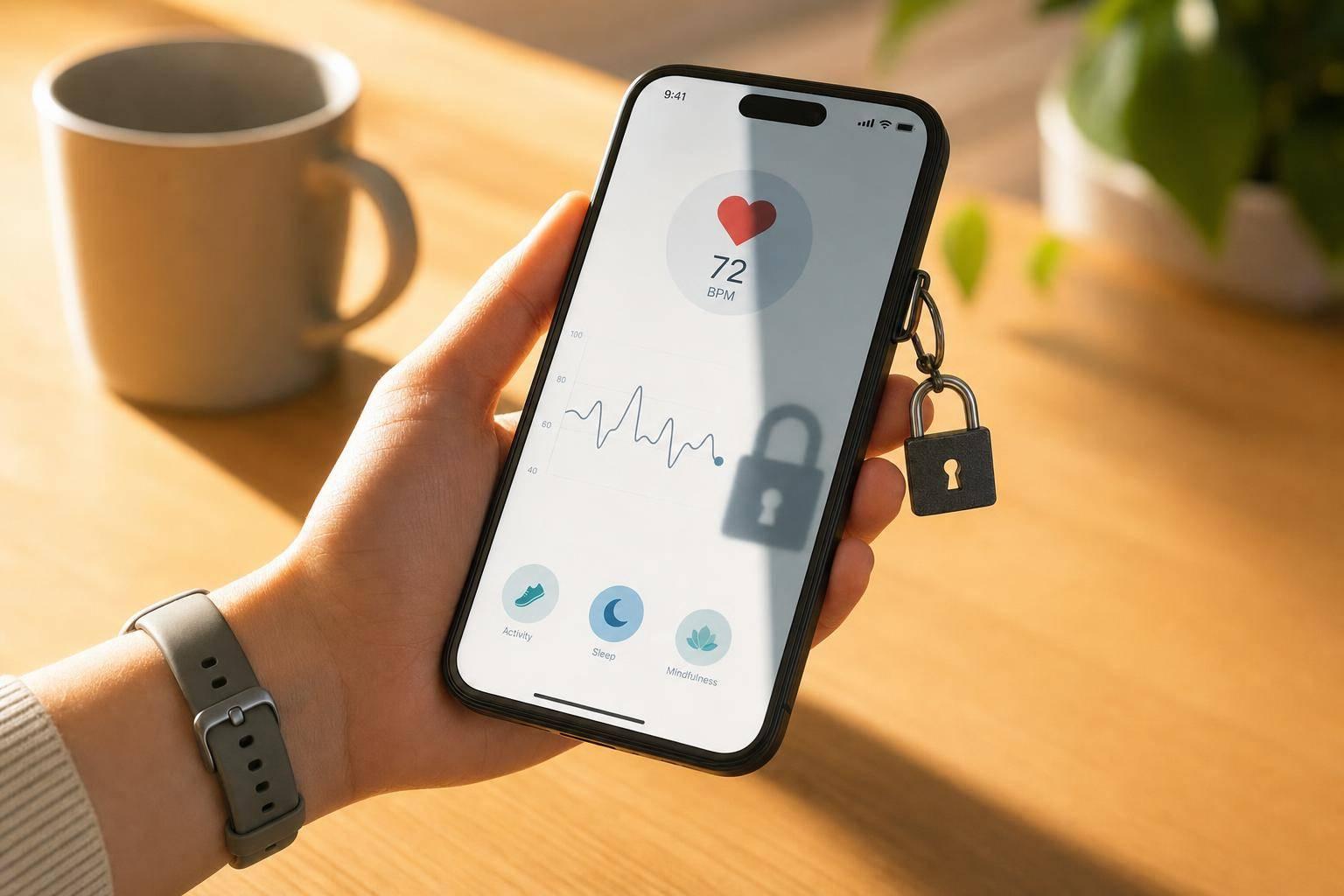
AI health apps can help you spot problems sooner, but they can also expose very personal data. In the U.S., many consumer health apps and wearables sit outside HIPAA, which means your heart rate, sleep, glucose, mood logs, and location-linked behavior may be shared, sold, or used in ways you did not expect.
Here’s the short answer:
- More data can improve AI health advice
- More data also means more privacy risk
- HIPAA often does not cover consumer apps
- Even "anonymous" health data may point back to you
- The safest tools ask for less data, explain why, and let me control sharing and deletion
A few facts stand out:
- In 2023, the FTC fined GoodRx for sharing health data with Facebook and Google for ad use
- Research cited here says nearly any American may be re-identified from an anonymous record with just 15 data points
- Daily tracking can expose far more than steps and calories; it can hint at pregnancy, mental health status, or chronic disease risk
If I were judging an AI health tool, I’d focus on three things first: what it collects, who it shares with, and whether I can delete it.
| Issue | What it means for you |
|---|---|
| Data collection | Apps may pull heart rate, sleep, ECG, glucose, blood pressure, mood, and habits |
| Legal coverage | Many consumer tools rely more on their privacy policy than HIPAA |
| Main risks | Re-identification, data sales, breaches, and weak consent controls |
| What to look for | Encryption, MFA, local storage, clear opt-in, and simple deletion |
So the tradeoff is simple: better health guidance can come with more exposure. The right balance is not less AI. It is limited data use, plain-language consent, and user control from the start.
The Privacy Expert's Confession: Health Data in the Age of AI | Jackie Kimmell, MSx ’26
sbb-itb-f5765c6
What AI Health Monitoring Collects and Why It's Sensitive
These tools collect far more personal data than most people think. That’s part of why they can give better guidance. It’s also why the privacy risk grows.
The Data Sources Behind AI Health Recommendations
Modern AI health tools pull from a wide mix of inputs. Wearables use optical and motion sensors to track heart rate, VO2 max, step counts, calories burned, blood pressure, skin temperature, and ECG readings [2]. Those signals can point to serious issues. An irregular ECG reading, for example, may show atrial fibrillation (AFib) before a person feels even one symptom.
It doesn’t stop with core vitals. AI tools also look at sleep stages, recovery scores, mood logs, stress markers, and journal entries [2]. Continuous glucose monitors track blood sugar patterns and long-term control, which can show how meals, workouts, and medication timing affect the body over time. On top of that, users often log medications, food intake, and daily habits by hand. Put all of that together, and the system can spot patterns in treatment adherence and long-term health risk.
The more data streams AI pulls together, the easier it becomes to infer conditions a user never entered directly.
Healify combines wearable, bloodwork, and lifestyle data into personalized guidance. That same level of connection is what makes AI coaching helpful - and what can make exposure more likely if the data is handled poorly.
Why U.S. Privacy Rules Treat This Data Differently
The issue isn’t only what these tools collect. It’s also who the law covers.
Many users assume HIPAA protects any health app. It doesn’t. HIPAA applies to covered entities such as doctors, hospitals, and insurers. Consumer wellness apps and wearables - even those collecting highly sensitive biometric data - usually sit outside HIPAA’s reach [1][2]. In practice, that means they’re governed mainly by the app’s own privacy policy, which may permit ad targeting or data sharing.
Here’s the short version:
- HIPAA-covered entities must follow federal privacy rules.
- Consumer health apps often rely mostly on their own privacy policies.
AI can also infer sensitive conditions - including pregnancy, mental health status, and chronic disease risk - by combining enough data points [2]. That’s where the legal gap starts to feel less abstract. The app may not ask a direct question, but it can still piece together a very personal picture.
"When states or other entities begin subpoenaing health app records, especially in sensitive contexts, it exposes a dangerous gap in our data governance." - Clyde Williamson, Senior Product Security Architect, Protegrity [2]
Because federal rules haven’t kept pace, some states have added consumer health data laws. But the coverage is still uneven. This makes following a wearable health data security guide essential for protecting your information.
That’s the tradeoff at the center of AI health monitoring: more data can improve support, but it also increases exposure.
AI Benefits vs. Privacy Risks in Daily Health Monitoring
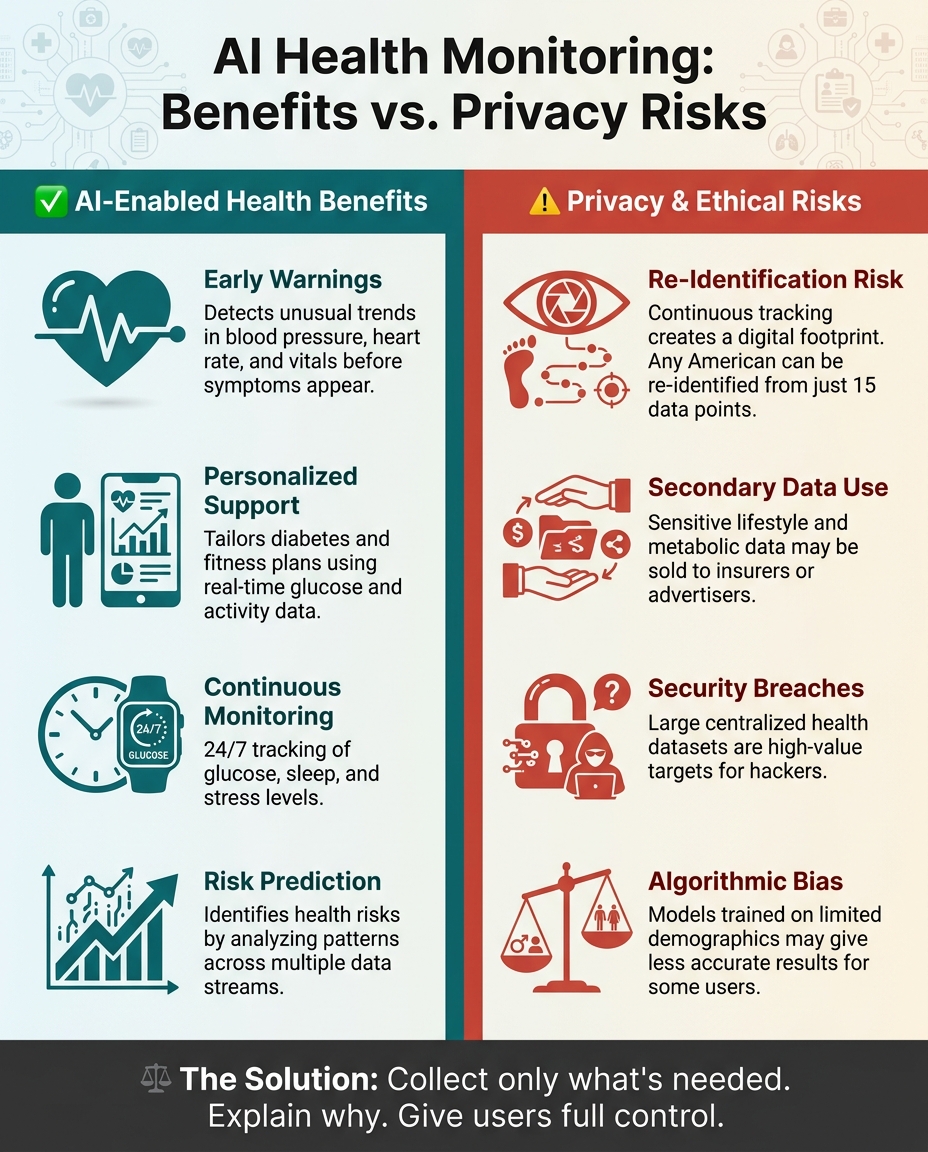
AI Health Monitoring: Benefits vs. Privacy Risks
Those same features create the biggest privacy risk. You can see that tradeoff most clearly in daily monitoring, where the exact same data stream fuels both early alerts and more exposure.
How AI Improves Early Warnings and Personalized Support
AI keeps watch all the time. It can spot unusual patterns in heart rate, sleep, blood pressure, glucose, and activity before most people would notice them on their own. That shifts the meaning of early warning. Instead of waiting for a clear problem, you get a day-by-day view of how your body reacts to stress, food, sleep, and movement.
Healify works in that same way. It pulls together wearable data, bloodwork, and lifestyle inputs so its AI coach, Anna, can give advice based on your patterns, not generic health tips. That’s the plain upside of detailed monitoring.
How Privacy Risks Grow as Monitoring Gets More Detailed
The same depth that makes guidance more personal also makes the data easier to misuse. One major risk is re-identification. Even if your name is stripped from a dataset, studies suggest that nearly any American can be re-identified from an "anonymous" record using just 15 pieces of information [1]. Hackers can also use linkage attacks to combine de-identified health data with public records like social media or voter registration data to reidentify you [1].
There’s also the risk of secondary use. Commercial health apps may legally sell sensitive data to advertisers or other third parties, depending on what their privacy policy allows [1]. So your glucose trends, sleep patterns, or stress scores might end up feeding ad targeting or some other third-party use.
The table below shows how the upside and the risk line up side by side:
| AI-Enabled Health Benefit | Associated Privacy or Ethical Risk |
|---|---|
| Early Warnings: Spotting unusual trends in vitals like blood pressure or heart rate. | Surveillance & re-identification: Continuous tracking creates a detailed digital footprint that can be linked back to an individual. |
| Personalized Support: Tailoring diabetes or fitness plans based on real-time glucose and activity data. | Secondary Data Use: Sensitive lifestyle and metabolic data may be sold to insurers or advertisers. |
| Continuous Monitoring: 24/7 tracking of glucose, sleep, and stress. | Security Breaches: Large centralized datasets act as high-value targets for hackers. |
| Risk Prediction: Identifying health risks based on patterns across multiple data streams. | Algorithmic Bias: Models trained on limited demographics may give less accurate results for some users. |
How to Protect Health Data Without Losing AI's Value
The risks are real, but AI health tools don't have to choose between usefulness and privacy. With tight security and clear rules, it's possible to keep most of the upside while cutting down who gets access to the data. The point isn't to use less AI. It's to cut unneeded exposure.
That matters because daily health tracking can get personal fast. Steps, sleep cycles, glucose readings, heart rate data - taken together, they can paint a very detailed picture of someone's life. AI can still help with daily monitoring without turning that picture into something too many people can see.
Technical Safeguards That Reduce Data Exposure
Start with the basics: AES-256 encryption in transit and at rest, plus MFA, role-based access controls, and audit logs to limit access and track misuse [3].
Some tools go further. Federated learning keeps raw data on the device instead of sending it all to a central server. Differential privacy adds noise, which makes it harder to tie records back to one person. For an app like Healify, which analyzes wearable data, bloodwork, and biometrics, these steps can lower exposure while still supporting personal health guidance.
One rule stands out more than the rest: collect only what you need. If a recommendation doesn't require a certain data point, the app shouldn't take it. Simple idea, big difference.
Security tools matter, but they can't do the whole job alone. Users also need legal limits on how data is collected, shared, and sold.
U.S. Legal and Policy Protections Users Should Know
For users, the main question is pretty simple: who can see the data, and what can they do with it? In many consumer apps, the privacy policy and state law matter more than HIPAA. Tools tied to a doctor, hospital, or health system are more likely to fall under federal health privacy rules.
State laws can cover part of that gap. California's CCPA gives residents the right to know what data is collected, ask for deletion, and opt out of data sales. Other states are moving in the same direction. It also helps to check whether the app or its cloud vendor has a BAA and whether the privacy policy blocks data sales and AI training without consent.
Before sharing heart rate, sleep, glucose, or other health data, check:
- The privacy policy
- The consent terms
- Any BAA
Conclusion: What Balanced Health Data Use Looks Like
AI can help people make sense of their health data and turn it into action. But as tracking gets more constant and more detailed, the chance of exposure goes up too. Those two things don't have to clash. They just need clear limits.
The best path isn't less AI. It's AI that uses only the data it needs and tells you why it needs it. In plain terms, that means collecting what's needed, explaining what that data is used for, and giving people real control over what gets shared, stored, or deleted. And that leads to a simple question: what should a dependable app show before it gets your data?
What Users Should Expect From AI Health Tools
Clear privacy terms and user control are the bare minimum.
Use this checklist to judge whether the tradeoff makes sense.
| What to Look For | Green Flag | Red Flag |
|---|---|---|
| Consent | Granular opt-in for specific features | "All or nothing" to use the app |
| Data Sharing | Explicitly states data is not sold for marketing | Vague language like "may share with partners" |
| Storage | Local, encrypted by default | Mandatory cloud sync for all data |
| Deletion | Clear process for permanent removal | Policy is silent on deletion |
Healify shows this balance in practice: personalized guidance works best when the data behind it stays tightly protected. Understanding how AI health coaching works is the first step in evaluating these privacy trade-offs.
If an insight doesn't need a data point, the app shouldn't ask for it. Helpful AI starts with limited, transparent data use.
FAQs
How can I tell if HIPAA applies?
First, figure out whether your organization is a covered entity. That usually means a healthcare provider, insurer, or healthcare clearinghouse. You should also check whether you're a business associate handling PHI for one of those groups.
HIPAA applies only to PHI. So if your AI tool creates, receives, maintains, or transmits PHI for a covered entity or business associate, HIPAA applies and you need a Business Associate Agreement.
If an app works on its own and not for a covered entity, it generally isn't subject to HIPAA.
Can deleted health data still be kept?
Yes. Deleting an app or removing a record doesn’t always erase health data from a company’s servers.
A company may still keep that data for reasons like legal duties, dispute resolution, or day-to-day business needs.
Even after you send a deletion request, a court can require the company to preserve or produce the data. And if that data was used to train AI models, pulling out one person’s information can be technically hard.
What data should an AI health app avoid collecting?
To protect privacy and follow data minimization, an AI health app should collect only the data it needs to deliver its health services.
That applies even more strongly to sensitive information, such as race, pregnancy status, or detailed mental health data. The app should not collect that kind of information unless it’s needed for the user’s specific health goals.
Data collection should also stay narrow enough to avoid building detailed personal profiles. Why does that matter? Because deeper profiles can increase the risk of re-identification, commercial profiling, or unauthorized third-party AI training.