
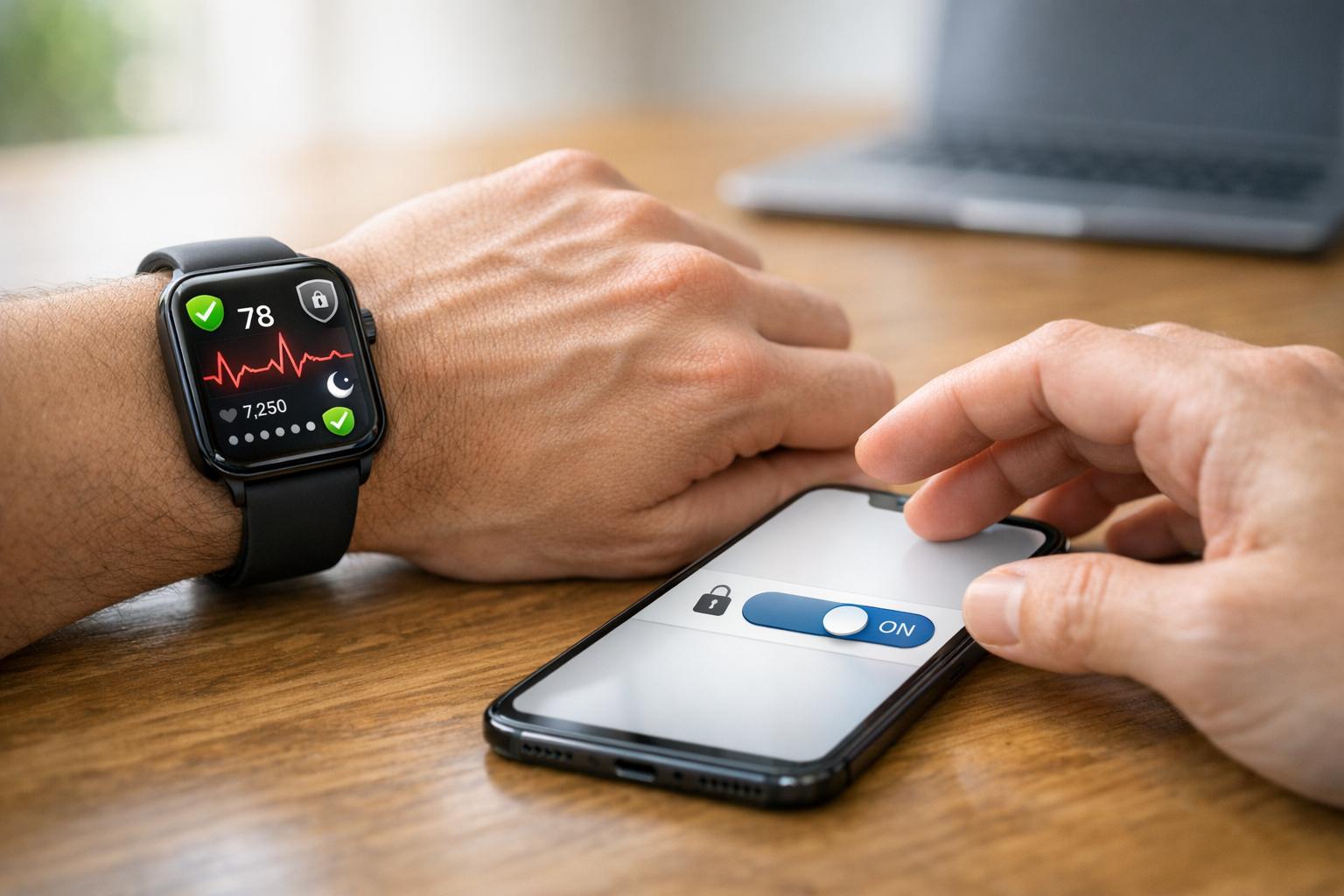
Wearable health devices are everywhere, tracking everything from heart rates to sleep patterns. But what happens to all that data? Here's the crux:
- Market Growth: The wearable tech market grew from $20 billion in 2015 to $109.3 billion in 2023.
- Privacy Concerns: 82% of Americans worry about how companies manage wearable health data.
- Regulatory Gaps: HIPAA often doesn't cover wearables, and only 20 U.S. states had laws on this by 2025.
- Data security risks: Health records can sell for up to $250 each on the Dark Web, making them prime targets for breaches.
Healify, a health coaching app, takes a privacy-first approach, focusing on user control and compliance. In contrast, most wearable platforms collect vast amounts of data, often with vague privacy practices. This often involves sharing data with third parties without explicit user consent.
Ultimately, the debate is clear: companies must balance innovation with responsible data handling to meet user expectations and regulatory demands.
What Are The Data Privacy Concerns For Telehealth Wearables? - Telehealth Care Expert
sbb-itb-f5765c6
1. Healify
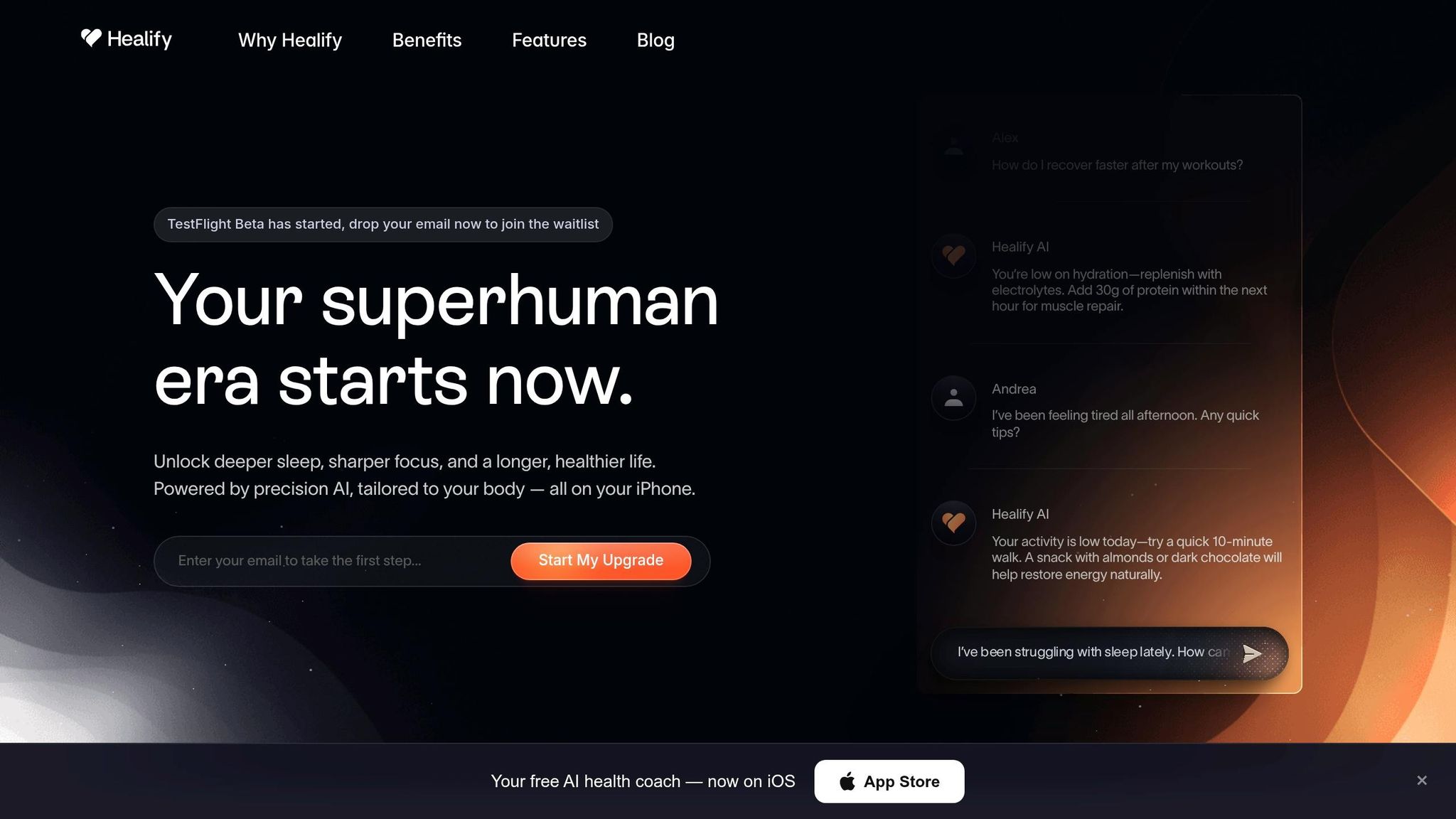
Healify is an AI-driven health coaching app designed for iPhone users. It combines data from wearables, biometrics, bloodwork, and lifestyle habits to offer round-the-clock, actionable health insights through its AI coach, Anna.
Data Collection
Healify takes a focused approach to data collection, prioritizing only the information necessary to deliver meaningful health insights. Instead of gathering excessive amounts of data, it zeroes in on biometrics, wearable metrics, and user-reported lifestyle details. This aligns with the "Privacy by Default" principle, ensuring that data collection is purpose-driven and starts with privacy-protective settings as the norm, not an afterthought[3].
User Privacy Controls
Users have full control over their health data with Healify. The app operates on a foundation of explicit consent, meaning health information is processed only when users provide clear, informed permission[3]. By default, targeted advertising is disabled, and data sharing requires users to actively opt in rather than opt out. This approach ensures users are in charge of their information while supporting compliance with regulatory standards.
Regulatory Compliance
Healify’s privacy-first design meets stringent U.S. regulatory standards, setting an example for health apps. It complies with the FTC's Health Breach Notification Rule, which mandates notifying both users and the FTC in the event of a breach involving personal health records[4]. Transparency is key - Healify’s privacy policies clearly outline its HIPAA status and data handling practices[4]. Currently available through a private beta, the app provides these protections for free ahead of its official launch on the Apple App Store.
2. General Wearable Health Platforms
General wearable health platforms vary widely in their approach to privacy practices. With the sheer amount of data being collected, there’s growing pressure on these platforms to handle it responsibly - but not all are meeting expectations.
Data Collection
Wearable devices go far beyond counting steps. They track a range of metrics like heart rate, sleep patterns, blood oxygen levels, and even provide clinical-grade estimates of blood pressure. This data is processed with AI and machine learning, then stored in cloud environments often shared with affiliates or third-party vendors. This sharing comes with risks - healthcare records are highly valuable on the Dark Web, fetching up to $250 per record compared to about $5.40 for a stolen payment card. For instance, in 2025, a breach involving a third-party syncing platform exposed more than 61 million fitness tracker records from Fitbit and Apple users [3].
User Privacy Controls
The level of user control over data differs significantly between platforms. For example, 94% of top manufacturers allow users to create accounts without a government-issued ID, and 71% offer personal data in a structured, downloadable format. However, only 65% let users opt out of targeted advertising, meaning nearly one-third of platforms enable ad tracking by default. Compounding this issue are lengthy privacy policies, which contribute to "privacy fatigue." Studies show that up to 97% of users accept terms without fully understanding them [3].
"Privacy fatigue - a condition where consumers are overwhelmed by frequent, lengthy privacy disclosures - leaves many disengaged." - Cailbhe Doherty, School of Public Health, University College Dublin [3]
These inconsistent privacy controls create significant challenges for both users and regulators.
Regulatory Compliance
The extensive data collection practices of wearable platforms have intensified regulatory scrutiny, as companies try to balance innovation with privacy laws. Compliance is a major hurdle. In the U.S., HIPAA generally doesn’t apply to consumer wearable companies, leaving a federal gap that only about 20 states have addressed with their own laws [1]. The FDA’s 2026 General Wellness Policy provides some guidance, but if a platform markets a feature as "medical grade", it transitions from being a general wellness product to a regulated medical device. For example, in July 2025, the FDA issued a Warning Letter to WHOOP, Inc. for promoting its "Blood Pressure Insights" feature without securing the necessary clearance, triggered by the use of the term "medical grade" [5].
Risk assessments reveal stark differences among companies. Google and Apple rank as the least risky, though even Apple's health features have limitations, while Xiaomi, Wyze, and Huawei are flagged as high risk due to poor transparency and weak breach notification practices [3].
| Company | Risk Score (lower is better) | Risk Category |
|---|---|---|
| 33 | Industry Leader (Low Risk) | |
| Apple | 35 | Industry Leader (Low Risk) |
| Garmin | 41 | Mid-Tier |
| Samsung | 44 | Mid-Tier |
| Huawei | 57 | High Risk |
| Wyze | 58 | High Risk |
| Xiaomi | 60 | High Risk |
A staggering 76% of manufacturers are classified as "High Risk" for transparency reporting, meaning they fail to clearly explain how or why they share data with governments or third parties. Additionally, only 12% have formal breach notification processes in place [3]. These gaps highlight the ongoing tension between rapid market growth and the urgent need for stronger privacy protections.
Pros and Cons
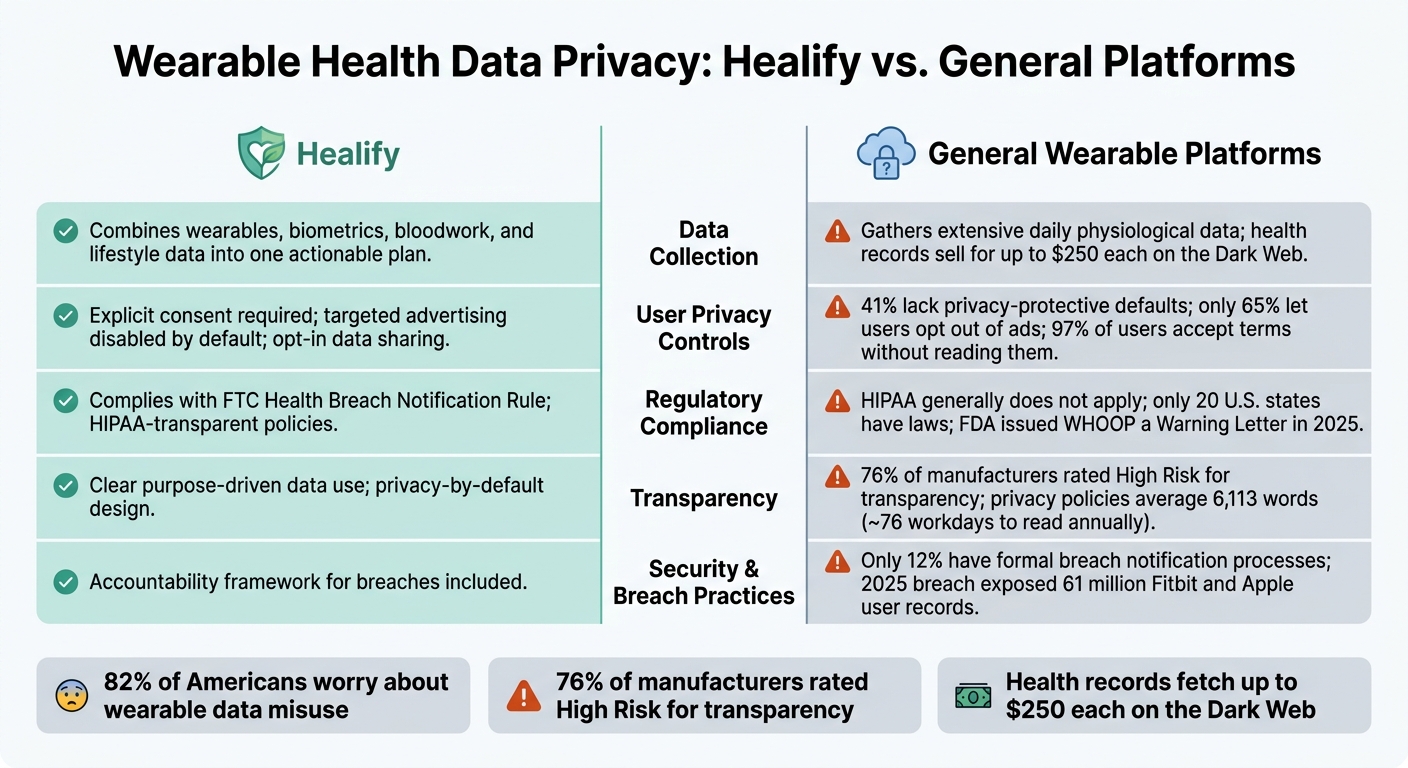
Wearable Health Data Privacy: Healify vs. General Platforms
Looking at the strengths and weaknesses of Healify versus general wearable platforms highlights key differences in their approach to health data and user experience. Here's a breakdown of how they compare in critical areas:
| Category | Healify | General Wearable Platforms |
|---|---|---|
| Data Collection | Combines wearables, biometrics, bloodwork, and lifestyle data into one actionable plan | Gathers extensive daily physiological data points |
| User Privacy Controls | Prioritizes personalized guidance without monetizing data | 41% lack privacy-protective defaults [2] |
| Regulatory Compliance | Built around privacy-conscious AI coaching | Often not covered by HIPAA, leaving data legally shareable in most U.S. states [1] |
| Transparency | Offers a clear purpose, avoiding high-risk practices [2] | 76% of manufacturers rated as "High Risk" for transparency reporting [2] |
| Security Practices | Includes an accountability framework for breaches | 59% of companies lack strong breach notification processes [2] |
This comparison highlights the trade-off between Healify's focus on privacy and personalized care and the broad data collection used by general wearable platforms, which often raises regulatory and privacy concerns.
General wearable platforms excel in scale, generating massive datasets that power research initiatives like the NIH All of Us program. But this scale comes with a downside. For example, privacy policies for these platforms average 6,113 words, requiring about 76 workdays annually to fully review [1]. That’s a far cry from what most would consider informed consent.
Healify, on the other hand, takes a targeted approach. Instead of collecting data broadly and figuring out its purpose later, Healify channels your health information directly into personalized guidance, delivered through its 24/7 AI health coach, Anna. While general platforms provide a broad overview of health metrics, this expansive approach can sometimes compromise clarity and user control.
"Brands that are transparent, that prioritize trust and building a relationship with you, they actually have the business advantage." - Nicky Watson, Founder, Syrenis [1]
This quote underscores the importance of trust and transparency in building meaningful user relationships, a principle Healify seems to embrace wholeheartedly.
Conclusion
The wearable health industry stands at a pivotal moment. With data privacy and compliance concerns reaching new heights, it's alarming that 76% of leading manufacturers are still rated as "High Risk" when it comes to transparency [2]. Meanwhile, the U.S. lacks a federal law to ensure wearable companies safeguard health data [1].
This gap between user expectations and industry practices is stark. A striking 82% of U.S. residents express concerns about data misuse, and with health records fetching up to $250 each on the Dark Web, the risks are undeniable [1][2]. This isn’t just a hypothetical issue - it’s a pressing reality that demands immediate action.
The good news? Privacy and compliance don’t have to clash. Companies that treat transparency as an afterthought - burying critical details in sprawling, 6,000-word policies or defaulting to opt-out settings - erode consumer trust. On the other hand, platforms like Healify show that it’s possible to integrate privacy into the very foundation of their design. By doing so, they prove that safeguarding user data and delivering personalized health insights can go hand in hand.
"Transparency should be viewed not as a best practice but as a regulatory obligation, mandated by frameworks such as the GDPR and the AI Act." - Petar Radanliev, Department of Computer Science, University of Oxford [6]
As wearables become more central to personal and public health, the companies that will thrive are those that make privacy straightforward, transparent, and uncompromising. It’s not about how much data they can collect - it’s about how responsibly they handle it. Platforms that prioritize privacy-integrated design are not just meeting regulatory demands; they’re aligning with the expectations of their users and setting the standard for the future. This evolution is particularly evident in the future of telehealth and wearable integration, where data security is paramount.
FAQs
Is my wearable health data protected by HIPAA?
Your wearable health data isn’t automatically covered by HIPAA unless it’s handled by a covered entity or business associate as defined under HIPAA regulations. Most consumer wearables and the data they collect are instead governed by other privacy laws or the company’s own policies. It’s important to check your device’s privacy terms to see how your data is managed and protected.
How can I tell if a health feature is regulated by the FDA?
The FDA typically regulates a health feature if it offers clinical recommendations, performs diagnostic functions, or influences clinical judgment, particularly when these involve risk-based oversight. On the other hand, many low-risk and non-invasive wellness features often fall under the FDA's enforcement discretion, as outlined in recent guidance.
What privacy settings should I change first in a health app?
To keep your health data safe, make sure it's shared only with trusted sources and take control of your privacy settings to limit unnecessary data sharing. Check app permissions to prevent access to sensitive biometric details, enable encryption for secure data transfers, and turn off features you don't need. Since U.S. regulations like HIPAA don't fully cover data from wearables, it's up to you to regularly review and update your privacy preferences for added security.