
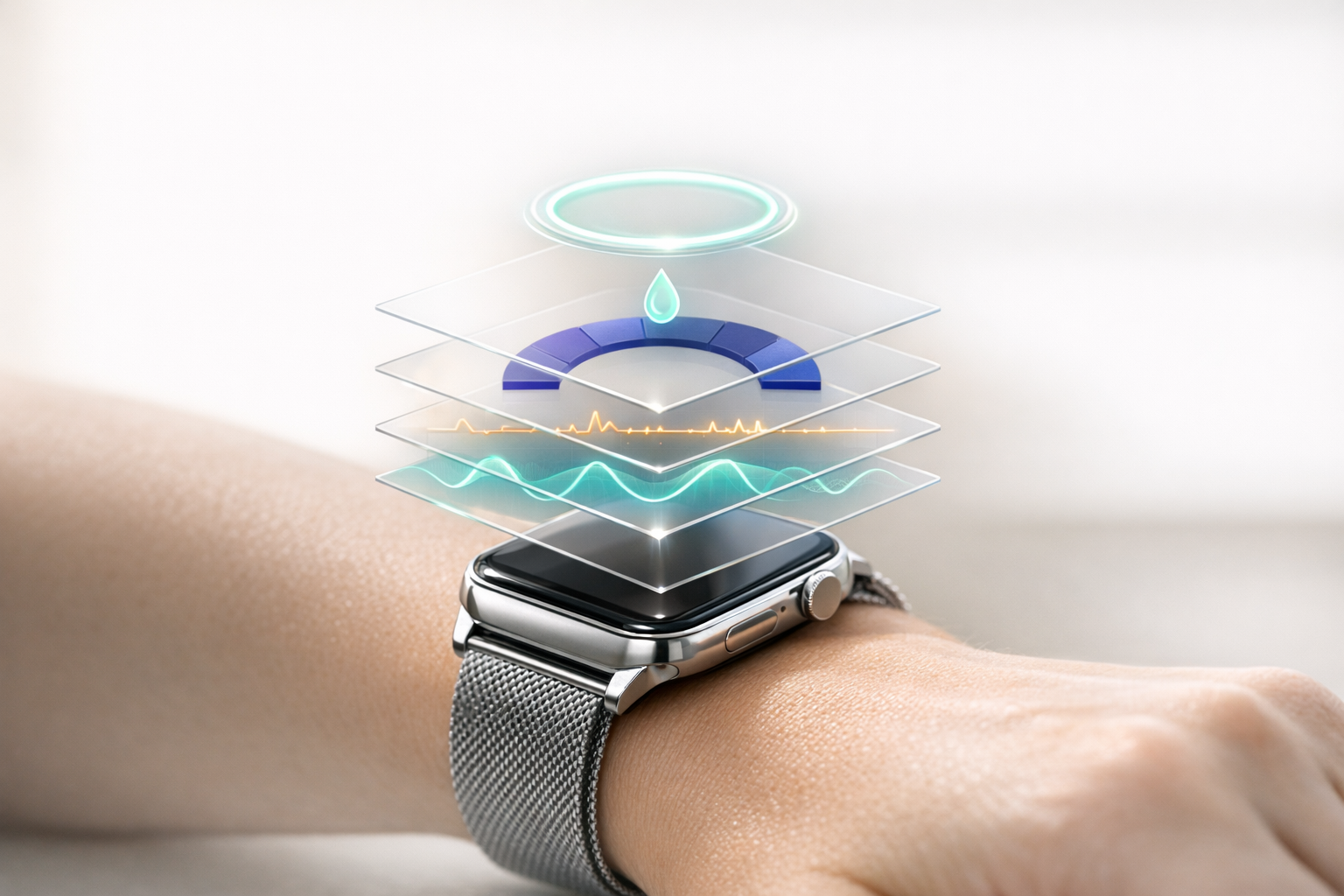
Wearables like smartwatches and patches can now track stress by analyzing multiple body signals, such as heart rate variability (HRV), electrodermal activity (EDA), sleep patterns, and even biochemical markers like cortisol in sweat. AI enhances this process by combining these signals, making stress predictions more accurate and personalized. For example, AI models using combined data have achieved up to 98.28% accuracy in stress detection. Sleep data is particularly influential, consistently providing reliable insights into stress levels.
Key takeaways:
- AI analyzes multiple signals: HRV, EDA, sleep, and other signals.
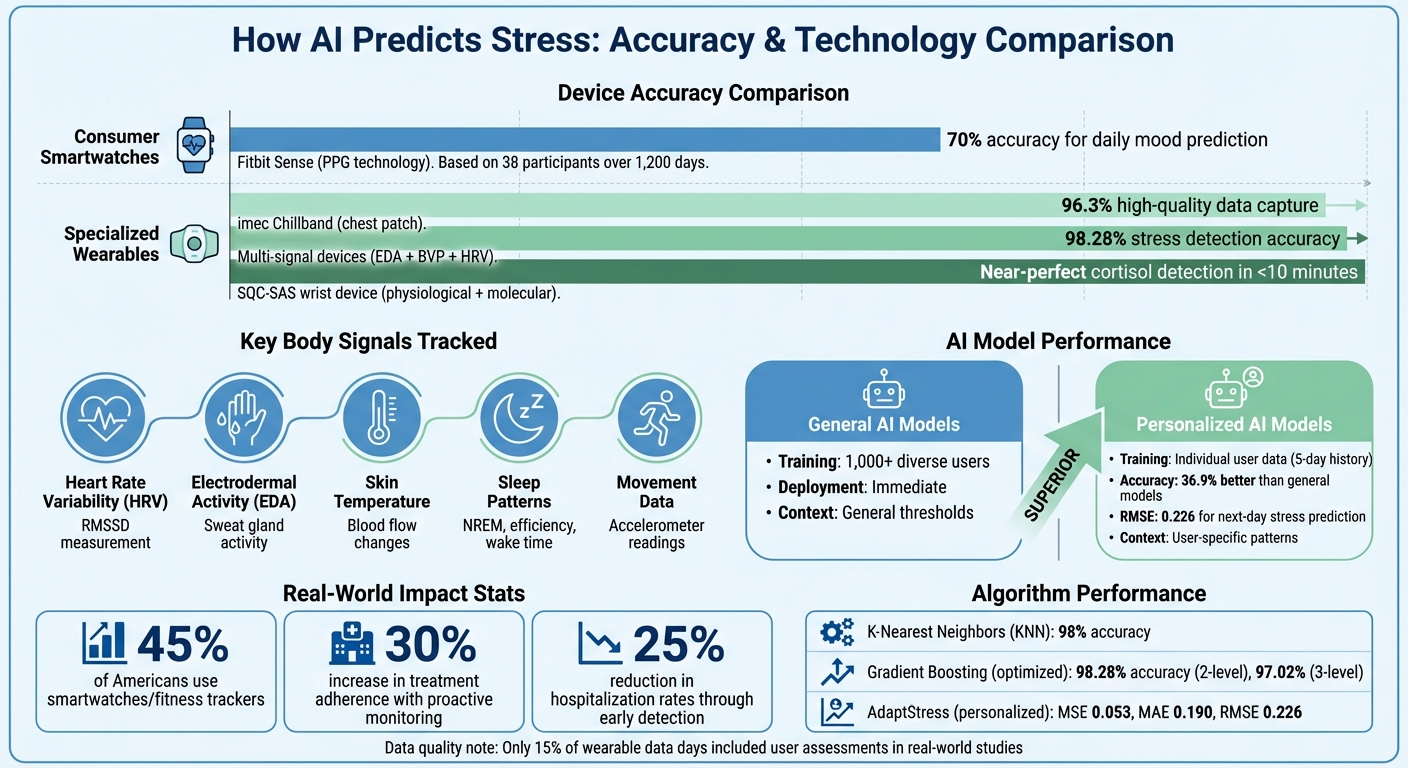
- High prediction accuracy: Up to 98% with advanced wearables; consumer devices like Fitbit show 70% accuracy for mood tracking.
- Personalized models outperform general ones: Tailored predictions based on individual baselines are more precise.
- Real-time alerts: AI-powered wearables can suggest timely actions like breathing exercises or mindfulness activities.
- Integration matters: Platforms like BondMCP unify data from wearables, lab results, and fitness apps for better stress management.
AI-driven stress monitoring is shifting how we understand and manage stress, offering tools to track and respond to it in real time.
AI Stress Detection Accuracy Across Wearable Devices and Models
GMR-118: Stress Detection by Wearable Devices
sbb-itb-f5765c6
How Wearables Track Stress Indicators
Wearable devices have evolved far beyond simple step counters. Today, they use advanced sensors to capture a variety of physiological signals that help map stress responses. These devices - whether watches, bands, or patches - monitor changes in systems like your cardiovascular activity, skin responses, and movement patterns. Stress impacts the body in multiple ways, so measuring several signals at once provides a clearer picture than focusing on just one.
Main Body Signals Measured for Stress
Stress detection relies on analyzing five key body signals. These signals are the foundation for precise AI-based stress monitoring. For example, heart rate variability (HRV), often measured using RMSSD, tends to drop when stress levels rise. Electrodermal activity (EDA) tracks sweat gland activity, which increases with stress-induced perspiration [4][7].
Skin temperature is another clue - it can shift subtly due to changes in blood flow triggered by stress hormones like cortisol and adrenaline [5]. Sleep patterns also play a major role. Metrics such as non-rapid eye movement (NREM) sleep, sleep efficiency, and time spent awake are closely linked to stress, as poor sleep often leads to heightened stress the next day [1]. Additionally, movement data from accelerometers helps differentiate between a racing heart caused by physical activity and one caused by anxiety [7]. Some wearables even analyze molecular biomarkers like cortisol levels in sweat. These biochemical markers provide direct evidence of stress and help minimize false readings caused by unrelated factors [2].
"Stress is not a single signal; it's a dynamic physiological and biochemical response. By measuring both molecular biomarkers and physiological signals at the same time, we can reduce ambiguity and move toward stress monitoring that's more specific, objective and informative." - Rahim Esfandyar-pour, Assistant Professor of Electrical Engineering and Computer Science, UC Irvine [6]
Types of Devices and Their Accuracy
Different devices offer varying levels of accuracy when it comes to stress tracking. Consumer smartwatches, like the Fitbit Sense, often rely on Photoplethysmography (PPG) - a method that uses light to measure blood volume changes. These devices are convenient for all-day wear and were shown to predict daily mood states (e.g., anxious versus happy) with 70% accuracy in a study involving 38 participants over 1,200 days [3]. However, factors like motion and ambient light can interfere with readings during intense physical activity.
On the other hand, specialized wearables, such as chest patches, deliver more precise data. For instance, the imec Chillband, used in the SWEET study with over 1,000 office workers, achieved 96.3% high-quality physiological data by sampling GSR and skin temperature at 4 Hz and accelerometer data at 32 Hz [7]. In January 2026, UC Irvine researchers introduced the SQC-SAS wrist-worn device, which combines a physiological patch (measuring ECG and GSR) with a molecular patch that detects sweat cortisol levels in under 10 minutes [6]. This device uses ultra-thin gold-coated polyimide (Au/PI) dry electrodes, which reduce skin irritation and maintain accuracy over long periods, unlike traditional wet electrodes that can dry out [2].
The choice of device depends on your needs. Smartwatches are great for continuous, passive tracking, while specialized patches offer up to 98.28% accuracy when combining signals like EDA, blood volume pulse, and HRV [4]. Up next, we’ll explore how AI processes these signals into actionable stress insights.
How AI Turns Wearable Data into Stress Predictions
AI transforms raw wearable data into meaningful stress predictions, offering actionable insights for better health management. By refining noisy sensor readings, it creates a clearer picture of stress signals.
Preparing and Extracting Data Features
Wearable devices collect a lot of raw data, but it’s often messy and full of inconsistencies. Before AI can make sense of it, this data has to be cleaned and standardized. For example, ECG readings are filtered to include heart rates between 40 and 180 BPM, excluding outliers caused by movement or sensor glitches. Similarly, the first 15 minutes of skin conductance data are often removed to account for irregular sweating when the device is first worn [5].
Once cleaned, the data undergoes feature extraction, which identifies patterns that AI can interpret. Tools like the tsfresh Python package can pull out over 70 mathematical features from each signal, such as averages, variability, and kurtosis [5][7]. For instance, Heart Rate Variability (HRV) is derived from the time intervals between heartbeats, while Electrodermal Activity (EDA) is split into two parts: tonic (baseline sweat gland activity) and phasic (short spikes linked to stress) [4][7].
To avoid false positives, AI systems also consider context. By integrating data from accelerometers and sleep monitors, the models can better distinguish between stress-related signals and those caused by physical activity or other factors [7]. This refined dataset becomes the foundation for building accurate stress detection models.
Training AI Models for Stress Detection
AI models are trained using labeled datasets like WESAD (Wrist-worn Exploratory Survey Data for Stress Detection) and SWEET, which collected data from over 1,000 office workers during a five-day period. Algorithms such as Random Forests, Gradient Boosting, Convolutional Neural Networks (CNN), and K-Nearest Neighbors (KNN) are then used to classify stress levels, achieving impressive accuracy rates - some as high as 98.28% [4][5][7]. For example, KNN models have demonstrated 98% accuracy in detecting stress in real-world settings [5].
One of the hurdles in this process is class imbalance - people spend much more time in a "not stressed" state than in a "stressed" one. This imbalance can lead AI models to favor predictions of "no stress." To counter this, researchers use techniques like SMOTE (Synthetic Minority Oversampling Technique) to balance the dataset, ensuring the model doesn’t just default to the majority class [5]. Additionally, tools like SHAP (SHapley Additive exPlanations) help pinpoint which features, such as HRV or sleep quality, are most influential in the AI's decisions [4].
"HRV and EDA are the most significant features for stress classification." - IEEE Access [4]
Individual vs. General AI Models
AI models can be broadly categorized into general and personalized approaches, depending on how they handle individual differences in physiological data. General models are trained on large, diverse datasets and can be deployed quickly. However, they may struggle to account for unique variations in individual users. Personalized models, on the other hand, are tuned to a specific user's baseline, offering higher accuracy but requiring a short "warm-up" period for data collection.
Personalized models adapt to your unique physiology. For instance, in February 2026, researchers Xueyi Wang, Claudine J. C. Lamoth, and Elisabeth Wilhelm introduced AdaptStress, an adaptive learning model. By monitoring 16 participants over 10–15 weeks and using a 5-day data history, the model predicted stress levels for the next day with a Root Mean Square Error (RMSE) of 0.226, outperforming standard CNN and LSTM models by up to 36.9% [1].
"Identical features can have opposing effects across users, validating [the model's] personalization capabilities." - Xueyi Wang, Lead Author, AdaptStress [1]
| Feature | General AI Models | Individual/Personalized AI Models |
|---|---|---|
| Training Data | Built using large, diverse populations (e.g., 1,000+ users) [7] | Fine-tuned with data from a specific user [1] |
| Accuracy | Can vary due to differences among users [1] | Higher accuracy by accounting for personal variations [1] |
| Scalability | Ready for immediate deployment | Requires a short data collection period [1] |
| Context Sensitivity | Relies on general thresholds for activities [7] | Recognizes user-specific patterns and differences [1] |
Tracking sleep metrics frequently stands out as a key predictor in stress detection [1].
Live Stress Monitoring and Response
AI systems excel at real-time stress monitoring by analyzing continuous data streams, like heart rate and skin conductance, through real-time data processing. This allows them to classify stress levels moment by moment, paving the way for immediate and actionable feedback [5][7].
Real-Time Alerts and Suggested Actions
When stress levels rise, AI systems can deploy just-in-time interventions (JITAIs) to provide instant, tailored support [3][4]. These interventions might include guided breathing exercises, quick meditation sessions, or mindfulness activities aimed at calming the user.
In February 2025, Psyche Health Inc., in collaboration with the University of Pittsburgh and Carnegie Mellon University, demonstrated how regularized regression could predict daily mood states using Fitbit data from 38 participants over 1,200 days. By analyzing factors like nightly skin temperature and sleep efficiency, the system delivered breathing prompts when participants showed signs of sadness, tension, or anxiety. It focused on detecting "fight-or-flight" responses such as increased heart rate, altered breathing, changes in skin temperature, or spikes in perspiration [3][5].
"Through passive detection we can identify stressful states and potentially deliver just-in-time interventions to help improve mood and prevent or reduce the likelihood of subsequent mental illness." - Helmet T. Karim, Department of Psychiatry, University of Pittsburgh [3]
To ensure precision, the system uses contextual filtering to reduce false alerts. For instance, if the AI detects a high heart rate but notices from accelerometer data that you're running, it suppresses the stress alert. This combination of real-time monitoring with contextual intelligence ensures that alerts are triggered only by genuine stress signals [7][1].
Connecting AI with Health Data Using BondMCP

The BondMCP platform takes stress monitoring to the next level by integrating fragmented health data into a unified system. While individual wearables provide valuable insights - like heart rate variability from a smartwatch or sleep quality from a tracker - they often operate in isolation. BondMCP bridges this gap by creating a cohesive intelligence layer.
This platform combines data from wearables, sleep trackers, fitness apps, lab results, and supplement protocols into a single, context-aware system. For stress management, this means the AI doesn’t just react to an elevated heart rate. It also considers factors like poor sleep, skipped workouts, or lab markers hinting at inflammation, offering a more comprehensive approach to stress management.
For developers and healthcare providers, BondMCP provides a structured protocol and SDK to build interoperable AI systems. This scalability allows for seamless integration of siloed data, supporting proactive and personalized care.
Measuring AI Accuracy in Stress Prediction
Performance Measurements for Stress Models
Stress prediction models rely on a variety of metrics to assess their accuracy. For binary classifications, metrics like accuracy, sensitivity, specificity, precision, and the F1 score are commonly used. For continuous predictions, measures such as Mean Squared Error (MSE), Mean Absolute Error (MAE), and Root Mean Squared Error (RMSE) help gauge prediction error. In essence, these metrics determine how well a model identifies stress versus non-stress states [4][5].
The lower the values for MSE, MAE, and RMSE, the better the model's performance. For instance, the AdaptStress model demonstrated strong results in 1-day stress forecasting, achieving an MSE of 0.053, MAE of 0.190, and RMSE of 0.226 - a 36.9% improvement compared to baseline models [1].
Another useful tool is the confusion matrix, which visually breaks down where a model misclassifies stress levels, such as low, medium, or high. A study published in IEEE Access in September 2024 by Shikha et al. used the Montreal Imaging Stress Task (MIST) to collect physiological data. By employing Gradient Boosting algorithms fine-tuned with Genetic Algorithms and Bayesian optimization, the study achieved 98.28% accuracy for 2-level stress classification and 97.02% accuracy for 3-level classification [4].
"Identical features can have opposing effects across users, validating [the model's] personalization capabilities." - Xueyi Wang, Lead Author [1]
Such metrics provide a foundation for evaluating stress prediction models while highlighting areas for improvement.
Practical Problems in Everyday Use
Even though stress models perform well in controlled settings, applying them in the real world introduces unique difficulties. For example, motion artifacts and physical activity can interfere with sensor readings, making stress detection less reliable outside the lab [7].
Another major challenge is individual variability. A heart rate pattern that signals stress for one person might represent a normal state for someone else [1]. This variability underscores the importance of personalized models, which can adapt to individual physiological differences by incorporating contextual data. Personalized approaches have shown a 36.9% improvement in performance compared to general-purpose models [1]. For instance, sleep metrics consistently predict stress (importance: 1.1), while activity features show much greater variability (importance: 0.1–0.2) [1].
Data quality also plays a critical role. Issues like loose straps or incorrect device placement can lead to sensor errors and incomplete data [5].
The LifeSnaps study, conducted in February 2025 by Helmet T. Karim, offers a real-world example. Researchers analyzed data collected over 1,200 days from 38 participants wearing Fitbit Sense devices. While the study achieved a 70% accuracy rate in predicting mood states, only 15% of wearable data days included user assessments. This lack of ground-truth data highlights a persistent challenge: training and validating AI models effectively in everyday environments [3].
These practical hurdles illustrate the gap between controlled testing and real-world applications, emphasizing the need for more robust and adaptable stress prediction systems.
Conclusion
AI-powered stress prediction using wearable data is transforming health management by shifting the focus from reacting to issues to addressing them before they even arise. By analyzing physiological signals such as heart rate variability, electrodermal activity, and sleep patterns, AI can detect stress early - often before you even notice any symptoms. The real game-changer here is personalization. Models trained on your unique physiological baseline outperform generic algorithms, as stress responses are highly individual.
This shift is already making waves. Studies show that proactive health monitoring through wearable data can boost treatment adherence by 30% and cut hospitalization rates by 25% through early detection [9]. With nearly 45% of Americans using smartwatches or fitness trackers [8], the tools for widespread stress monitoring are already in place. These benefits highlight the importance of systems that can unify and interpret diverse health data streams.
But the challenge isn’t just gathering data - it’s making it meaningful. A fragmented landscape of disconnected health apps often leaves users with incomplete insights. That’s why integrated platforms are so crucial. BondMCP tackles this issue head-on by consolidating data from wearables, lab tests, sleep trackers, and fitness monitors into a single, intelligent system. For example, sleep data can refine stress predictions, while activity patterns inform recovery plans. BondMCP demonstrates how combining wearable metrics with other health data creates a more cohesive and actionable approach to care.
Experts echo the importance of this integration:
"Wearable sensors combined with ML algorithms provide scalable, real-time stress monitoring solutions, emphasizing proactive healthcare management." - Computers in Biology and Medicine [10]
The future of stress management isn’t about collecting more data - it’s about smarter, seamless integration. When devices and AI systems work together to provide clear, personalized, and actionable insights, they empower you to take control of your health in real time. This integrated approach opens the door to a new era of individualized, proactive care.
FAQs
How long does a wearable need to learn my stress baseline?
Wearable devices typically need a few minutes to set up a personalized stress baseline. Studies show that with about 5 to 10 minutes of initial data collection, these models can start delivering accurate stress predictions.
How does the AI avoid confusing exercise with stress?
The AI leverages advanced machine learning to interpret various physiological signals from wearable sensors. By spotting specific patterns, it can distinguish between physical activity and emotional stress. For example, motion sensors are used to filter out noise caused by movement, while muscle contraction sensors pick up changes linked specifically to stress. Additionally, context-aware methods fine-tune the analysis by accounting for environmental factors, ensuring accurate stress detection without confusing exercise for stress.
What does BondMCP do with wearable, sleep, and lab data for stress?
BondMCP combines data from wearables, sleep trackers, and lab results to assess physiological signals alongside external factors. By doing this, it can predict stress levels with precision and provide tailored, real-time insights to help improve stress management.