
AI-powered wearables are transforming how stress is monitored and managed. These devices track physiological signals like heart rate variability (HRV), skin conductance, and breathing patterns in real time. By combining this data with contextual inputs - such as location, activity, and weather - AI algorithms can differentiate between physical and mental stress with increasing accuracy.
Key insights include:
- Real-time stress tracking: Devices gather millions of data points to analyze stress levels instantly.
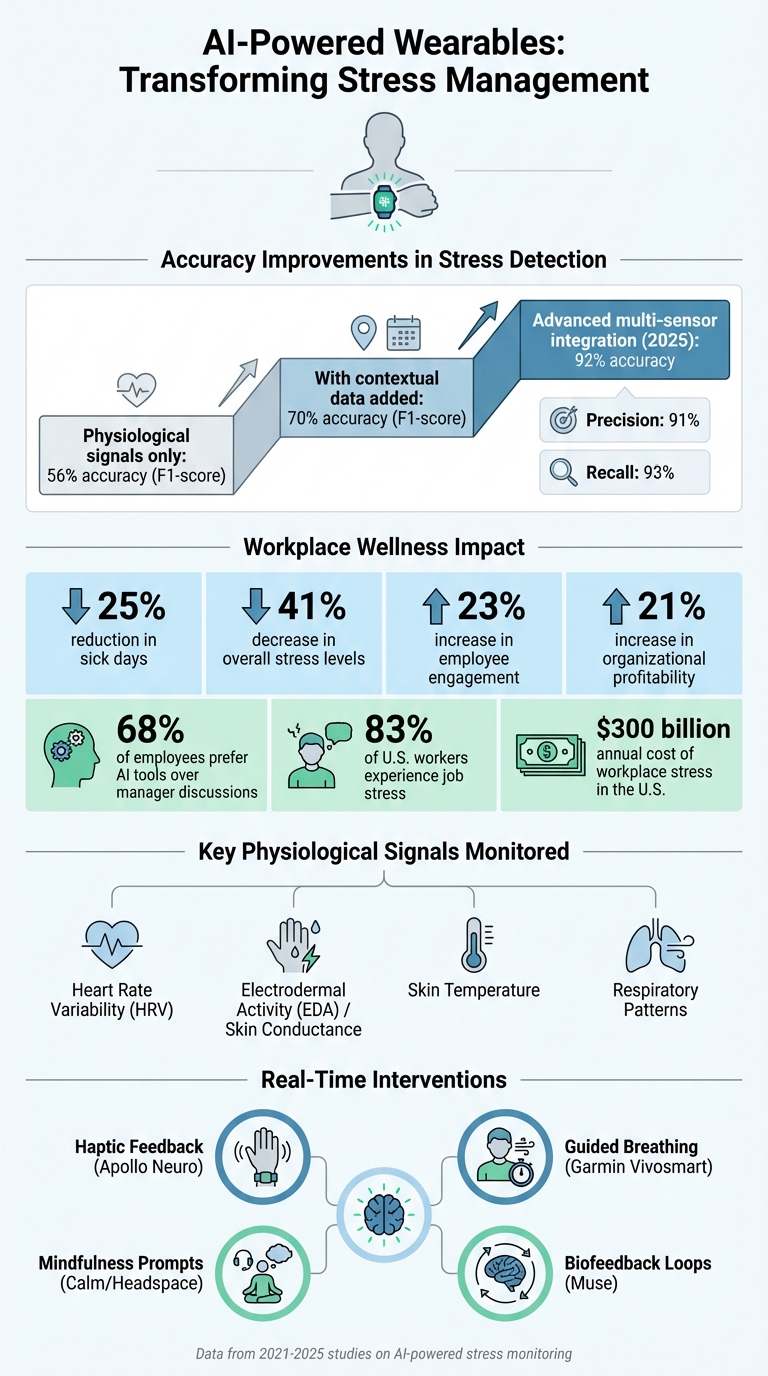
- Improved accuracy with context: Stress detection accuracy increased from 56% to 70% by integrating contextual data.
- Personalized interventions: Wearables provide tailored suggestions like guided breathing or mindfulness exercises during stress spikes.
- Workplace and healthcare applications: Companies report reduced sick days and higher employee engagement, while healthcare providers use wearables for early mental health interventions.
Despite these advancements, challenges remain, including motion artifacts, privacy concerns, and lack of integration with other health systems. Future systems aim to unify data across devices for seamless stress management, while ensuring user privacy and transparency.
AI Wearable Stress Detection: Accuracy Improvements and Workplace Impact Statistics
Startup: Moment real-time stress detection from voice + HRV | NLP, wearables, just-in-time prompts
sbb-itb-f5765c6
Physiological Signals Used to Detect Stress
AI-powered wearables rely on several key biometric markers to monitor how your body reacts to stress. These markers reflect automatic processes within your body, helping wearables detect stress even before you’re fully aware of it. Let’s break down the primary signals these devices track.
Heart Rate Variability (HRV)
HRV measures the subtle fluctuations in time between your heartbeats[4]. When you're calm, the parasympathetic nervous system (often called the "rest-and-digest" system) dominates, leading to greater HRV. On the flip side, when stress kicks in, the sympathetic nervous system (your "fight-or-flight" response) takes over, reducing HRV as your heart beats more consistently[4].
Wearables calculate HRV using metrics like SDNN and RMSSD, often derived from Photoplethysmography (PPG) sensors. These sensors, which use light to track your pulse, are widely used in smartwatches and fitness trackers due to their convenience for daily wear[2]. While ECG provides more precise HRV measurements, PPG is better suited for continuous monitoring, despite being more prone to motion-related inaccuracies[3].
Electrodermal Activity (EDA) and Skin Conductance
EDA measures changes in your skin's electrical conductance, which are tied to sweat gland activity. Since these glands are controlled by the sympathetic nervous system, an increase in EDA signals heightened arousal or stress[3]. This marker is particularly sensitive to emotional stress, with spikes in skin conductance occurring within seconds, making it ideal for real-time stress detection. However, factors like humidity and temperature can sometimes interfere with readings[3].
Skin Temperature and Respiratory Patterns
Stress causes your blood vessels to constrict, especially in your extremities, leading to noticeable drops in skin temperature. Wearables equipped with thermistors can pick up on these changes[3]. At the same time, stress often results in quicker, shallower breathing. Devices monitor your breathing rate and patterns, frequently estimating them using data from PPG or ECG sensors[3][2].
How AI Algorithms Enable Real-Time Stress Monitoring
AI algorithms have taken the concept of stress detection to a new level by transforming raw physiological data into real-time, actionable insights.
The process starts with collecting biometric data, but the real magic happens in how this data is processed. Modern stress detection systems rely on a three-layer architecture. First, the sensor layer - typically a wearable device - gathers raw signals like Photoplethysmography (PPG) and accelerometer data. Next, the edge layer, often your smartphone, performs initial processing and logs contextual details. Finally, the cloud layer handles advanced analytics and trains machine learning models using aggregated data. This structure ensures that real-time feedback is available while managing the heavy computational load required for AI processing.
Machine Learning Models for Stress Classification
Tree-based ensemble methods like Random Forest and XGBoost have proven highly effective in classifying stress. These models combine physiological and contextual data while minimizing overfitting. Another approach, K-Nearest Neighbor (KNN), uses patterns in nearby data points to classify stress levels.
For example, a 2021 study at the University of California, Irvine, led by Seyed Amir Hossein Aqajari, demonstrated the potential of these methods. Using Samsung Galaxy Gear Sport Watches, the researchers achieved a 70% F1-score by combining PPG data with contextual information - an improvement from 56% when using PPG data alone. Fast forward to 2025, and a study presented at the Global Conference in Emerging Technology in Pune showcased even greater advancements. By integrating HRV, GSR, and EDA sensors, this system achieved an impressive 92% accuracy, with precision and recall rates of 91% and 93%, respectively.
"Wearable technology equipped with sensors such as HRV, GSR, and EDA provides objective, continuous, and non-invasive real-time measurements of the physiological reactions linked to stress."
– Kuzhaloli S, IEEE
The success of these models often depends on how well raw data is preprocessed. For instance, PPG signals are cleaned using Butterworth band-pass filters (0.7–3.5 Hz) and moving average smoothing to eliminate motion artifacts. Toolkits like HeartPy then extract key metrics such as BPM, Inter-Beat Interval (IBI), and RMSSD, which provide insights into how the autonomic nervous system responds to stress.
Training Models with Ecological Momentary Assessments
Machine learning models need high-quality labeled data to accurately detect stress, and Ecological Momentary Assessments (EMAs) are central to this process. These self-reported stress ratings, collected throughout the day, serve as the "ground truth" for training supervised learning algorithms.
In the UCI study, researchers implemented a "Smart EMA" system that sent stress prompts strategically - seven times daily - when the device was actively in use. This ensured that the data was both timely and relevant. To address missing contextual data, KNN imputation was used to fill gaps by identifying patterns in existing information.
Personalization also plays a key role. Algorithms fine-tuned with individual data can adapt to unique physiological baselines, acknowledging that stress responses vary widely from person to person.
Challenges in Real-Time Processing and Accuracy
Despite the progress, real-time stress detection still faces hurdles. Motion artifacts, for example, can distort PPG signals during activities like typing or exercising, making it hard to differentiate between physical and mental stress. Environmental factors such as humidity and temperature can also interfere with sensors like EDA and skin temperature monitors.
Another challenge is the "appraisal gap." While AI systems excel at identifying physiological markers of stress - like a spike in heart rate - they often struggle to interpret the cognitive reasons behind these responses. For instance, a heart rate increase might stem from excitement, physical activity, or stress, making it tricky to pinpoint the exact cause.
To tackle this, UCI researchers incorporated accelerometer data and contextual logs to separate physical stress from mental stress. Their 70% F1-score highlights the potential of combining physiological and contextual data to deliver meaningful insights in everyday scenarios.
Real-Time Interventions: From Monitoring to Action
AI-powered wearables are stepping beyond just detecting stress - they're now turning biometric data into immediate, actionable interventions tailored to each user.
Personalized Feedback Mechanisms
Modern wearables are designed to act as real-time guides when stress levels spike. They use tools like haptic feedback, guided breathing exercises, or mindfulness prompts to help users regain calm. These interventions create what's called "biofeedback loops", where the device provides cues that help activate the parasympathetic nervous system, encouraging relaxation.
"The application sends out a warning recommending relaxation techniques like guided breathing, meditation, or physical activity when the user's stress level exceeds a certain threshold."
– IEEE Innovate [6]
Different devices approach this in unique ways. For example, Apollo Neuro uses gentle vibrations to promote relaxation, while Garmin's Vivosmart watches rely on HRV (heart rate variability) data to suggest breathing exercises. If you're using apps like Calm or Headspace, wearables can trigger specific mindfulness exercises when they detect elevated stress signals, such as increased skin conductance. These interventions happen in real time, providing immediate relief.
What makes these systems even smarter is their use of Behavioral Reinforcement Learning (BRL). Instead of sending the same notification every time, they adapt based on what works best for you. If guided breathing consistently lowers your stress, the device will prioritize that. If you respond better to movement suggestions, it adjusts accordingly. This learning process ensures the feedback becomes more effective over time.
By combining these personalized methods with data about your environment and daily activities, the interventions become even more precise.
Context-Aware Interventions
Biometric data alone doesn’t always tell the full story. For instance, a rapid heart rate could mean you're stressed - or that you're exercising or excited. To address this, advanced systems now pair physiological signals with contextual information, such as GPS location, calendar events, time of day, and activity levels. This approach makes the interventions far more relevant.
"By combining stress indicators with external data - calendar appointments, GPS location, time of day, or physical activity levels - the system generates actionable prompts, like hydration reminders, stretching cues, or digital wind-down rituals."
– Thryve Health [7]
This context-aware method prevents unnecessary alerts. For example, if you're running and your heart rate spikes, the system won’t assume you're stressed. But if you're sitting at your desk at 3:00 PM with elevated stress signals, it might prompt you to take a short break or step outside. Location data adds another layer of precision - at home, you might be nudged to relax with a warm bath, while at work, the suggestion could be a quick walk or some desk stretches.
Studies show that integrating factors like location, weather, and time of day improves the accuracy of stress detection, enabling better-timed interventions [2]. This level of detail helps systems adapt to your unique stress patterns and daily rhythms.
The Shift Toward Adaptive Systems
Wearables are evolving from passive monitors into active tools that predict and address stress in real time. This shift is driven by Just-in-Time Adaptive Interventions (JITAIs) - systems that function like a digital coach, learning your habits and responding accordingly.
Early devices primarily logged data for later review. Today's wearables detect stress and send alerts. The next generation, however, aims to predict stress before you even notice it. These systems analyze your physiological baselines, daily routines, and past responses to tailor preemptive support. For example, if your wearable notices a pattern of afternoon stress spikes, it might suggest a short walk or breathing exercise before you hit that point.
The main hurdle now is integration. Most people juggle multiple health apps and devices that don’t communicate with each other. Your sleep tracker operates separately from your stress monitor, and your fitness app doesn’t account for your recovery state. The future of stress management lies in unified systems where all these tools work together. For instance, your sleep quality could shape your stress interventions, your workout intensity could adjust based on your recovery, and your supplement schedule could align with your daily rhythm. Platforms like BondMCP are leading the way by syncing data across wearables, apps, and labs, creating a seamless ecosystem where everything works in harmony.
| Intervention Type | Trigger Mechanism | Example Device |
|---|---|---|
| Haptic Feedback | Real-time GSR spikes | Apollo Neuro [7] |
| Guided Breathing | HRV-based stress thresholds | Garmin Vivosmart [7] |
| Mindfulness Prompts | Elevated skin conductance | Calm/Headspace Integration [7] |
| Biofeedback Loops | real-time biomarker monitoring | Muse [7] |
Applications in Healthcare and Workplace Wellness
AI-powered wearables are making waves in healthcare and workplace wellness, offering practical benefits in both clinical and corporate environments.
Healthcare: Early Intervention and Mental Health Support
Wearables are transforming healthcare by shifting the focus from reactive treatments to proactive prevention. Instead of waiting for patients to report symptoms of stress, anxiety, or depression, these devices monitor physiological markers like heart rate variability (HRV) and electrodermal activity (EDA), along with behavioral patterns, to detect early warning signs. AI models can classify stress into low, moderate, and high levels, enabling timely interventions before conditions worsen [5].
A standout example is the Personal Health Insights Agent (PHIA), introduced in August 2025. This system uses a multi-agent framework to analyze wearable data, combining insights from data science and health coaching to deliver tailored interventions. PHIA has shown impressive results, achieving 84% exact-match accuracy on wearable data queries, far surpassing text-only approaches [8].
Studies emphasize the importance of context - such as location, weather, and activity - in improving stress detection. AI systems have reached 91% precision, 93% recall, and 92% overall accuracy in identifying stress [5]. This technology allows clinicians to remotely monitor patients, receive alerts during stress spikes, and act before a crisis unfolds. It's especially useful for individuals managing chronic issues like burnout or anxiety, providing a safety net that enhances mental health care.
These advancements naturally extend into workplace settings, where stress management is just as crucial.
Workplace Wellness Programs
Work-related stress is a significant issue in the U.S., with 83% of workers feeling stressed at their jobs. This stress costs businesses over $300 billion annually in lost productivity and healthcare expenses [9]. AI-powered wearables are helping companies tackle this by identifying how AI predicts stress using wearable data and providing actionable insights.
Organizations using AI stress tracking have seen tangible benefits: a 25% drop in sick days, a 41% reduction in stress levels, and a 23% increase in employee engagement [9]. These changes also boost profitability, with companies reporting a 21% rise in earnings [9]. The technology identifies stress spikes during demanding situations - like back-to-back meetings or tight deadlines - and suggests solutions such as breathing exercises or quick breaks.
Employees are showing a strong preference for these tools. Sixty-eight percent would rather use AI for stress management than discuss issues with a manager, and 80% are open to AI-based therapy tools [9]. AI therapy chatbots, for instance, have been found to reduce depression symptoms 64% more effectively than traditional methods [9].
Gamification is another trend gaining traction in workplace wellness. Adding game-like elements to wellness programs has boosted participation by 48%, with 90% of employees saying it improves their productivity [10]. However, only 43% of employees report that their health insurance covers mental health services [10], making AI wearables an accessible and consistent alternative for support.
One major hurdle is integration. Many workplace wellness systems operate in isolation - wearable data doesn't link with health records, and fitness apps don't sync with stress monitors. This lack of connectivity can frustrate users. Platforms like BondMCP aim to solve this by creating a unified system that ties together wearable data, health records, and wellness tools. For example, sleep metrics can inform stress management strategies, activity data can guide recovery plans, and biometric alerts can trigger personalized interventions. The result? Employees get seamless, tailored support, and companies benefit from more effective wellness programs.
| Workplace Wellness Metric | Impact of AI Stress Monitoring |
|---|---|
| Reduction in Sick Days | 25% decrease [9] |
| Overall Stress Levels | 41% decrease [9] |
| Employee Engagement | 23% increase [9] |
| Organizational Profitability | 21% increase [9] |
| Employee Preference for AI Tools | 68% prefer AI over manager discussions [9] |
Data Privacy, Ethics, and Integration Challenges
As real-time interventions grow more sophisticated, ensuring data security and smooth integration has become a critical concern.
AI-powered wearables gather an incredible amount of detailed physiological data - like heart rate variability, skin conductance, or even GPS location - often without users giving it much thought. This constant, passive monitoring presents a unique challenge for privacy. AI algorithms can infer highly sensitive information about both mental and physical health from this data, creating detailed personal profiles [12]. Yet, much of this information isn't classified as "health data" under regulations like HIPAA, leaving it in a gray area with fewer protections than many might assume [11][12].
A recent analysis of 17 leading wearable manufacturers found that 76% were rated as "High Risk" for transparency in their reporting practices, while 59% were flagged for inadequate breach notification processes [11]. Companies like Xiaomi, Wyze, and Huawei performed poorly in these areas compared to Google and Apple, which have stronger on-device processing and clearer user controls [11]. Even anonymized or de-identified data isn’t always safe; unique patterns, such as an individual’s heart rate signature, can often be used to re-identify users with alarming accuracy [12].
Consent and Transparency in Data Collection
The traditional "notice and choice" model - where users click "I agree" on privacy policies - has proven ineffective. Studies show that a staggering 97% of users accept terms and conditions without actually reading them [11][12]. When privacy policies are long, vague, or filled with legal jargon, users are left unable to make informed decisions about what they’re sharing or how their data might be used. This opens the door for manufacturers to gain deeper insights into the data lifecycle without users fully understanding the implications.
"Protecting privacy in the age of wearable trackers requires more than updating old laws. It demands a shift in how privacy is conceptualized, not as an individual choice, but as a condition shaped by design and systemic practices."
- Paula Pizzotti, Manager of Privacy Reviews and Consulting, Fraser Health Authority [12]
To address these challenges, a Privacy-by-Design approach is essential. This involves embedding privacy protections into the technology itself, rather than relying solely on user consent. For example, Fitbit uses AES encryption to secure data transfers, Apple Watch processes raw data locally to avoid cloud exposure, and Garmin offers granular opt-in controls for users [13]. A notable innovation came in November 2021, when researchers at the University of California, Irvine, developed a method to abstract GPS data into general categories like "at home" or "at work" directly on the device. This approach preserved privacy while still enabling accurate stress detection [2].
These measures highlight the importance of designing privacy safeguards from the ground up, laying the foundation for tackling broader integration challenges.
Interoperability and Integration with Health Systems
Even with robust privacy measures, data fragmentation remains a major obstacle for AI-powered health monitoring. Wearable data often fails to integrate with electronic health records, fitness apps don’t sync with sleep trackers, and stress monitors frequently operate in isolation. This lack of connectivity frustrates users and limits the full potential of wearable technology. Without consistent global standards, consumers face unclear data-sharing practices and inadequate protections [11].
Technical hurdles add another layer of complexity. Physiological signals require extensive filtering to ensure accuracy [2]. For example, distinguishing stress caused by a tough workout from anxiety-related stress demands contextual data - like location, activity, or time of day [2][3].
Emerging solutions like BondMCP aim to address these issues by unifying data streams. This system creates an intelligence layer that connects wearables, lab results, supplements, fitness data, and sleep metrics. Instead of juggling multiple apps with conflicting advice, users benefit from a cohesive system where their sleep tracker informs their fitness plan, lab results update supplement recommendations, and stress alerts trigger personalized interventions. This integrated approach not only improves health outcomes but also builds user trust by enhancing privacy and usability. It highlights the transformative potential of AI-powered wearables in real-time stress management.
Conclusion
AI-powered wearables are redefining stress management by moving from occasional clinical visits to continuous, real-time monitoring capable of identifying stress before it becomes a serious issue. For example, a study conducted in September 2025 reported a 92% accuracy rate using Random Forest classifiers, a noticeable improvement from the 85% accuracy noted the previous year [6]. With nearly 70% of Americans experiencing at least one stress symptom monthly [2] and stress-related issues costing the U.S. about $300 billion annually [1], the potential impact of these systems is enormous.
The true promise of these technologies lies in their ability to integrate and personalize data. While models relying solely on physiological signals achieve an F1-score of around 56%, incorporating contextual factors like location, weather, and activity increases performance to approximately 70% [2]. Personalized models that consider individual baseline variations further boost accuracy. This is where platforms like BondMCP play a pivotal role, combining data from wearables, lab results, fitness trackers, and sleep metrics to deliver real-time, comprehensive insights. Such advancements not only highlight the progress made but also open doors to new possibilities.
"The fusion of artificial intelligence (AI) with wearable health devices has transformed how patients and providers monitor and manage health."
- Capitol Technology University [14]
AI-driven wearables are heading toward a proactive approach to care, aligning with the "P4" model: Predictive, Preventative, Personalized, and Participatory [15]. As these devices transition from passive data collectors to active systems offering haptic feedback and context-aware prompts, they will bridge the gap between monitoring and actionable solutions. The ongoing challenge remains ensuring seamless integration, protecting user privacy, and consistently delivering tailored insights.
FAQs
How do AI-powered wearables tell the difference between physical and mental stress?
AI-powered wearables can now differentiate between physical and mental stress by analyzing physiological signals like heart rate variability (HRV), electrodermal activity (EDA), breathing patterns, and movement data. While both forms of stress may elevate heart rate and lower HRV, wearables rely on advanced algorithms to interpret the context by looking at additional patterns in the data over time.
Take EDA as an example - this often spikes during mental stress due to the activation of the sympathetic nervous system. On the other hand, physical stress is more commonly associated with movement or muscle activity tied to exertion. By continuously tracking these signals, wearables offer precise insights into the type of stress you're dealing with. This allows for tailored interventions, like relaxation exercises for mental stress or rest to recover from physical strain.
What privacy concerns should I be aware of when using AI wearables for stress monitoring?
AI-powered wearables designed for stress monitoring gather a lot of personal data, like heart rate, skin conductance, and other biometric details. If this information isn’t properly protected, it could be at risk of breaches or unauthorized access, leaving sensitive health data exposed.
Another concern revolves around how this data is handled. Without explicit user consent, it might be analyzed, shared, or even sold, leading to questions about transparency and trust. To tackle these challenges, it’s crucial for wearables to adopt privacy-by-design principles and offer clear, user-friendly policies that give individuals control over how their data is used.
How can AI-powered wearables enhance workplace wellness programs?
AI-powered wearables are reshaping workplace wellness programs by offering real-time stress monitoring through biometric data. These devices track metrics like heart rate variability, sleep patterns, and skin conductance, enabling continuous stress detection. With this data, employers can provide tailored support, such as guided breathing exercises, mindfulness sessions, or scheduled rest breaks, all designed to meet individual needs. This proactive approach helps lower stress levels, enhance job satisfaction, and cut down on absenteeism.
Wearables also offer organizations data-driven insights that allow them to refine wellness strategies for their teams. Tools like BondMCP make it easier to share data across platforms, creating a unified system for managing employee health. This seamless integration not only supports employees' well-being but also encourages a healthier, more engaged, and productive workforce.