

If you want to save time, AI meal planning usually wins. If you want full control, manual planning still has the edge. That’s the short answer.
I’d sum up the trade-off like this:
- AI meal planning is best if you want meal ideas, grocery lists, portion changes, and swaps done fast.
- Manual meal planning is best if you want to choose every recipe, double-check every ingredient, and plan around what’s already in your kitchen.
- AI helps most with time and decision fatigue.
- Manual planning helps most with control and careful allergy review.
- Neither method should replace a doctor or dietitian for diabetes, kidney disease, heart disease, or severe food allergies.
One reason this matters: the EPA estimates a household of four wastes about $2,913 per year in uneaten food, or about $56 per week. And Americans spend 6+ hours a week on meal planning, shopping, cooking, and cleanup. So the way you plan meals can affect both your time and your budget.
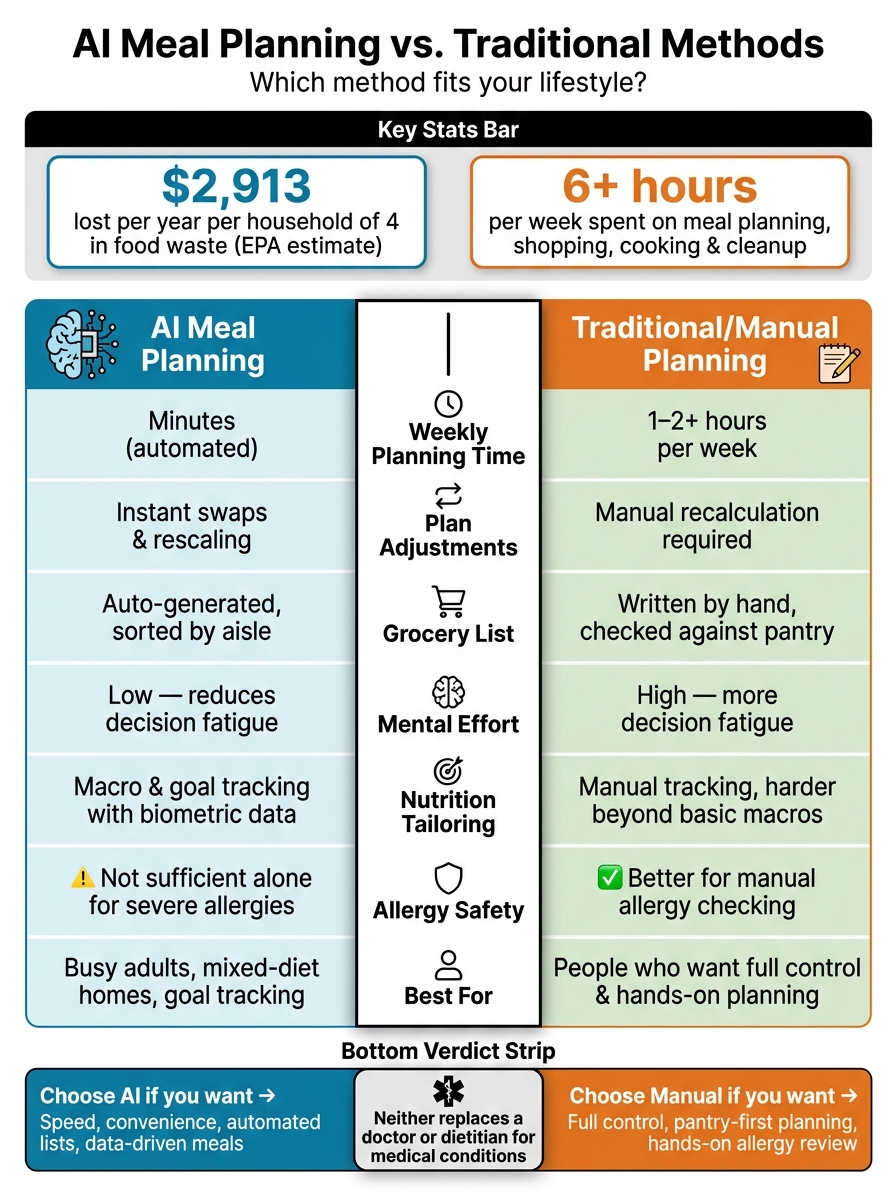
AI Meal Planning vs Traditional Methods: Side-by-Side Comparison
Pros and Cons of Using AI for Meal Planning
When evaluating these options, many users look for the top AI meal planners to see which tools best balance automation with nutritional accuracy.
sbb-itb-f5765c6
Quick Comparison
| Criteria | AI Meal Planning | Traditional Methods |
|---|---|---|
| Time to build a weekly plan | Usually minutes | Often 1–2+ hours |
| Grocery list creation | Auto-generated | Written by hand |
| Midweek changes | Easy to swap and rescale | More work |
| Nutrition targeting | Better for macro and goal tracking, but needs review | More manual tracking |
| Household preferences | Can combine multiple needs | Harder to coordinate |
| Allergy safety | Not enough on its own for severe allergies | Better for manual checking |
| Pantry-first planning | Possible, depends on inputs | Often easier by hand |
| Best for | Busy adults, mixed-diet homes, goal tracking | People who want control and hands-on planning |
My take: AI is the better fit for speed, while traditional methods are the better fit for hands-on control. The rest of the article breaks down that trade-off through three simple tests: efficiency, personalization, and ease of use. This comparison mirrors the shift seen in AI health coaching vs traditional personal training models.
AI Meal Planning: How It Works and What It Offers
AI meal-planning tools take your inputs and turn them into a weekly plan and grocery list in minutes. The list is usually sorted by aisle, and some tools can connect straight to grocery delivery. If you already track sleep, activity, or biometrics, the suggestions can feel more tailored to your day-to-day life. The main upside comes down to three things: speed, personalization, and less hassle.
Efficiency: Less Time on Planning and Grocery Lists
The biggest time savings come from choosing recipes and building the grocery list. If you plan meals by hand, you usually need to find recipes, check what’s already in the kitchen, and then write the list yourself in a notebook or notes app. AI cuts that work down to a few minutes.
You can see the difference most clearly in planning and list-building:
| Factor | AI Meal Planning | Manual Meal Planning |
|---|---|---|
| Weekly Time Spent | Minutes (automated generation) | Hours (searching and organizing) |
| Plan Adjustments | Instant swaps and portion changes | Manual recalculation required |
| Grocery List Creation | Automatic and sorted by aisle | Written by hand and checked against pantry items |
| Mental Effort | Low - AI reduces planning fatigue | High - more decision fatigue |
AI also helps when life changes midweek. Need to swap one dinner, cook for extra guests, or shrink portions? The plan can update on the spot without making you rebuild the whole week or rework the grocery list by hand.
Personalization: Meals Built Around Your Goals and Data
Most AI meal planners let you set goals such as macros, allergies, cooking time, and other limits. Some go further by pulling in live health data.
Healify is one example. It uses wearable, biometric, bloodwork, and lifestyle data to turn a messy mix of inputs into simple recommendations.
This can also help households where people eat differently. Instead of making separate plans, AI can build one combined meal plan and shopping list that takes multiple preferences into account at the same time.
Of course, personalization only helps if the tool still feels easy to use.
Ease of Use: Where AI Helps and Where It Falls Short
On a daily basis, AI meal planning is convenient. Swapping a recipe, scaling portions, or adjusting for a shorter cooking window can take seconds. You don’t need to start over each time something changes.
Still, these tools have limits. General-purpose chatbots can get precise macro math wrong. For example, an AI might say a chicken breast has 50g of protein when the actual figure is about 31g [1]. That kind of mistake matters if you’re following a strict medical diet or dealing with serious allergies. AI tools can also miss cross-contamination risks and gaps in labeling, so you should never rely on AI alone for a life-threatening allergy and should always check ingredient lists against FDA-regulated labels [1].
Those weak spots stand out most when you compare AI with a fully manual process. The next section looks at where manual planning still has the edge.
Manual Meal Planning: Strengths, Limits, and Daily Reality
Manual meal planning usually looks like this: you check the week’s schedule, see what’s already in the pantry, pick four to six dinners, and sort the grocery list by store section. A lot of families also lean on theme nights - tacos on Tuesday, pasta on Wednesday - because it cuts down decision fatigue. That sense of control is a big reason manual planning still works so well for many households.
What Manual Planning Does Well
The biggest upside is full control. You decide the recipes, ingredients, brands, portions, and cooking methods, similar to how AI nutrition for fitness goals automates these choices. That matters a lot if you follow kosher, gluten-free, or other specific eating patterns tied to family background or personal needs.
Manual planning also fits better with family recipes and cookbooks. You’re not forced into a preset system. If you notice brown rice, black beans, and bell peppers that are starting to go soft, you can turn that into a burrito bowl night and use food before it goes bad. That pantry-first habit can save money and cut waste. While manual methods rely on memory, AI nudges for better health habits can provide real-time reminders to use ingredients before they expire.
Where Manual Planning Takes More Time and Effort
The downside is simple: it takes time. The clock often starts with recipe search. Recipe searching alone can take 30 to 60 minutes before you even write a plan [2]. One survey found that 65% of people spend one to two hours a week on meal planning, and some spend up to five hours [2].
Then there’s the daily kitchen workload. Americans who cook at home on a regular basis spend about 62 to 63 minutes per day on food preparation and cleanup [3]. And when life shifts midweek - as it usually does - you have to move meals around and fix the grocery list yourself.
That’s the trade-off. Manual planning gives you freedom, but it also brings more friction when the week doesn’t go as planned. Those trade-offs stand out even more in a side-by-side look at time, customization, and day-to-day hassle.
Direct Comparison: Which Method Works Better and When
Both methods can work well. The better pick comes down to three things: how much time you have, how much control you want, and how much planning hassle you're willing to deal with.
Here’s the clearest side-by-side look at where each one comes out ahead.
Side-by-Side Breakdown: Time, Customization, and Friction
| Factor | AI Meal Planning | Manual Planning | Practical Takeaway |
|---|---|---|---|
| Weekly Planning Time | Minutes | Hours | AI is the better fit for busy professionals |
| Plan Flexibility | Instant swaps | Manual recalculation | AI makes mid-week changes easier |
| Nutrition Tailoring | Uses detailed inputs and biometric data[1] | Hard to track more than basic macros manually | AI works better for data-based wellness goals |
| Grocery Organization | Auto-generates lists sorted by store aisle | Requires manual writing and sorting; easier to miss items | AI cuts shopping hassle |
| Learning Curve | Low for simple chatbots; moderate for feature-rich apps | Easy to start, but high ongoing effort | AI needs a small upfront profile setup |
| Consistency | Reduces planning fatigue | Less consistent when schedules change | AI gives you a stronger backup for staying on track |
There is one big catch. General-purpose chatbots can still miscalculate nutrition, so medical diets and serious allergies need verified nutrition data and human review[1].
Which Method Fits Which Type of User
AI meal planning makes the most sense for busy professionals, mixed-diet households, and people tracking clear health targets. It helps most when you want the heavy lifting done for you: menu building, grocery lists, ingredient swaps, and recipe scaling. Advanced platforms even integrate AI recovery for fitness to align nutrition with physical activity.
Manual planning fits people who want full control, like cooking from scratch, or need allergy checks done by a person. For serious allergies, that human check matters. AI can miss hidden allergens, regional labeling differences, and cross-contamination risks[1].
At that point, the choice is pretty simple: do you care more about speed and ease, or hands-on control?
Conclusion: Key Differences and Your Next Step
AI meal planning is faster, more convenient, and shaped by data. Manual planning gives you more control and tends to feel more familiar. Neither one is better for everyone. The best option is the one that fits your habits and that you can keep doing week after week.
What matters most is the trade-off that works for you. Go with AI if you want planning to take less time and want your meals to adjust on their own. Stick with manual planning if you like choosing your own recipes and building meals from what’s already sitting in your pantry.
Either way, a quick budget and pantry check keeps things grounded. Before you shop, compare the plan with what you already have and what you want to spend.
If you track sleep, stress, or biometrics, Healify links meal guidance with wearable and lifestyle data. If you’re dealing with diabetes, kidney disease, severe food allergies, or cardiovascular disease, treat any plan - AI or manual - as a starting point to review with a healthcare provider, not a replacement for medical advice.
After you choose a method, try it in daily life before you commit. Test AI planning for two to four weeks, then compare how much time it saved and how much mental effort it took. Keep the parts that made life easier, change the parts that didn’t fit, and build from there. Consistency beats perfection.
FAQs
Is AI meal planning accurate enough for strict diets?
AI meal planning can work well for strict diets, including food allergies, gluten-free eating, vegetarian plans, and other complicated food needs. It can sort recipes, remove foods you can’t eat, and adjust macros by using standard nutrition databases.
That said, if you’re dealing with life-threatening allergies or a medical condition, AI should be a support tool, not the final call. Check ingredient labels yourself, review your key diet rules twice, and talk with a registered dietitian.
Can AI meal planning help reduce food waste?
Yes. AI meal planning can help cut food waste by building grocery lists around your meals for the week, so you buy only what you need.
Some tools can also suggest recipes based on ingredients you already have in your kitchen, especially food that’s close to expiring. That means fewer extra purchases and less food getting tossed out.
How do I choose between AI and manual planning?
Choose based on how much time, precision, and flexibility you want.
Traditional meal planning gives you more personal control, but it can eat up 1 to 2 hours per week between research, calculations, and building shopping lists. AI tools handle those steps for you and can put together personalized plans in minutes.
If you want real-time changes based on your lifestyle, activity, and biometrics, AI may be the better fit. If you prefer a simpler, hands-on approach, old-school planning can still work well.