
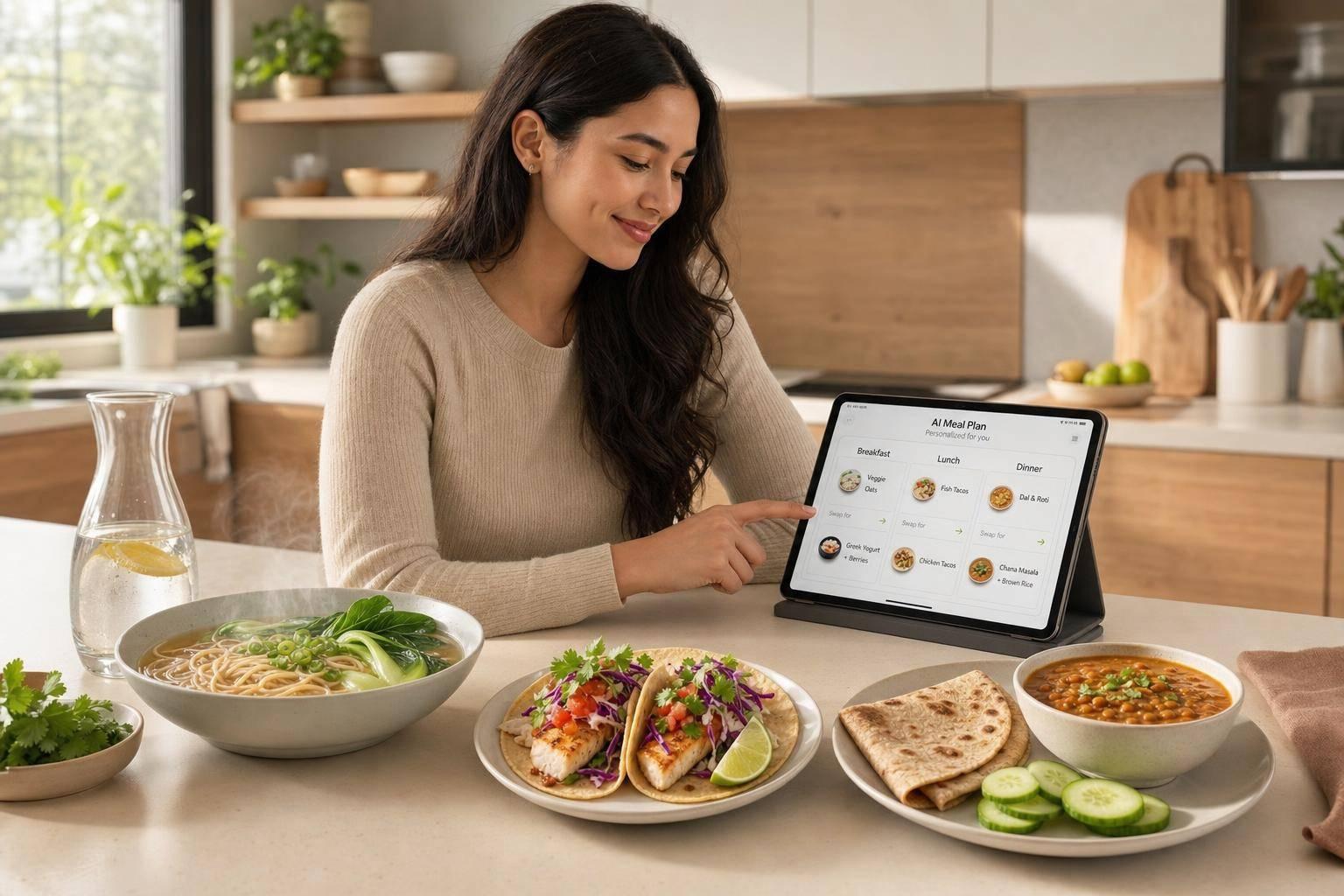
AI meal plans work best when they keep familiar foods in place and make small changes. Across the research, that usually means 1–3 ingredient swaps, portion changes, and diet rules that match faith, budget, cooking time, and local food access.
Here’s the short version:
- I found that meal-planning systems do better when they start with foods people already eat
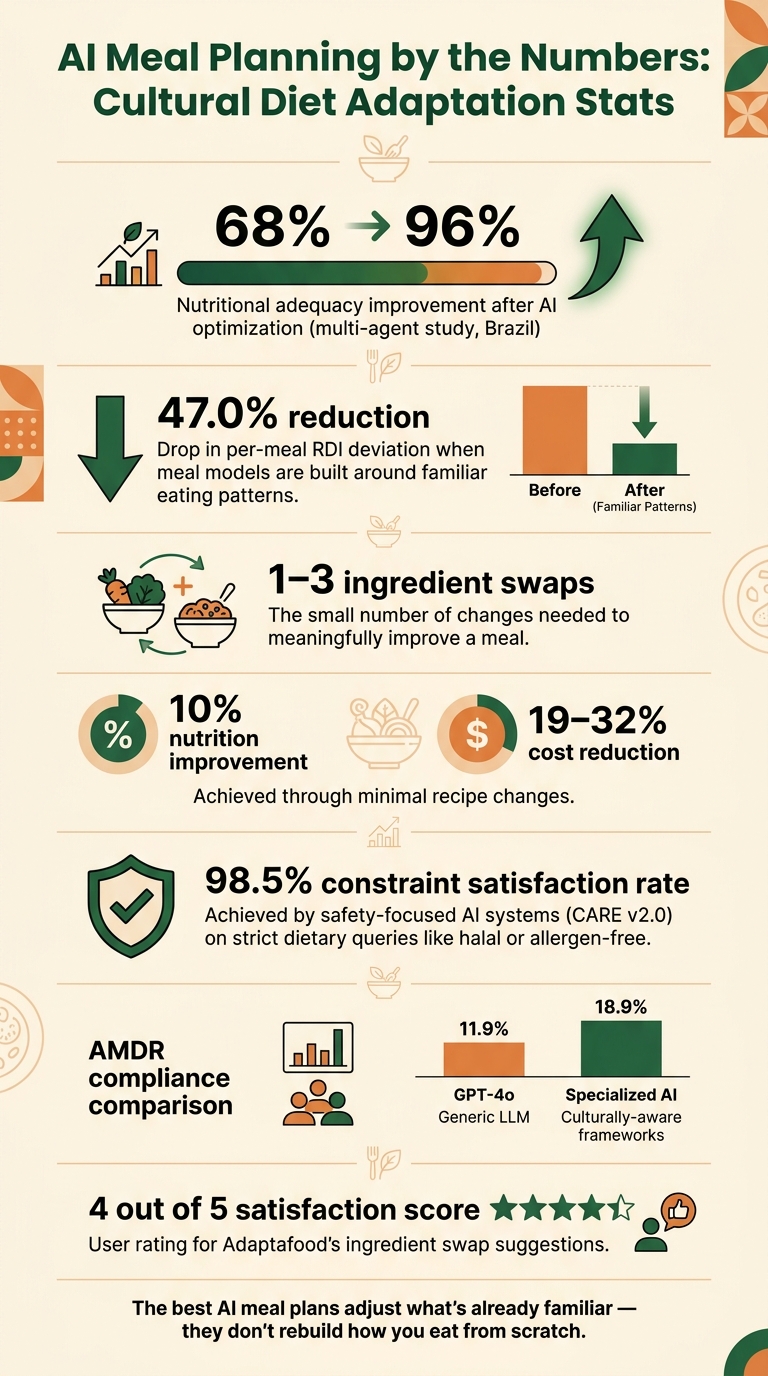
- Some research showed nutrition scores improving from 68% to 96%
- Meal models built around familiar meal patterns cut per-meal RDI deviation by 47.0%
- Small recipe changes improved nutrition by 10% and cut costs by 19%–32%
- Safety-focused systems reached 98.5% diet-rule compliance on stricter food requests
- Generic AI still struggles with food accuracy, recipe steps, and food habits that go beyond nutrients
The main idea is simple: nutrient targets matter, but dietary adherence matters more. If a meal plan looks good on paper but feels out of place at home, people are less likely to keep using it.
AI Meal Planning by the Numbers: Cultural Diet Adaptation Stats
CookFlow: AI Meal Planning for Real Families
sbb-itb-f5765c6
Quick comparison
| What AI uses | What it tries to do | Main limit |
|---|---|---|
| Health data, labs, wearables | Match calories, macros, and health needs | Can miss food habits and meal routines |
| Recipe databases and food tables | Suggest meals and swaps | Many datasets lean Western |
| Rule-based systems | Enforce halal, allergen, gluten-free, or vegan rules | Can feel rigid |
| Language-based systems | Understand requests like “light but filling” | Output can still be off |
| Meal-pattern models | Keep meals close to known eating habits | Needs better cuisine coverage |
| Image and OCR tools | Cut manual food logging | May misread ingredients or portions |
I’d sum it up this way: the best AI meal plans don’t rebuild how you eat from scratch. They adjust what’s already familiar, then check whether the result still meets nutrition goals.
What Research Says About AI Meal Plan Personalization
Research suggests AI can do a better job matching nutrients to a person’s needs. But there’s a catch: most studies still focus more on accuracy than on whether a plan feels familiar, practical, or tied to how people actually eat. The harder part now is turning nutrition data into meal plans that still reflect everyday foods and food traditions.
Health Data, Preferences, and Constraints AI Systems Use
Newer systems pull from a pretty wide set of inputs, including age, weight, lab results, diagnoses, budget, household size, food likes and dislikes, and available cooking time. [4][6] Tools like HumbleNutri and NutriGen use that mix of data to generate real-time recommendations based on a person’s actual circumstances, not just a one-size-fits-all starting point.
"Existing dietary recommendation systems often lack adaptability, fail to consider real-world constraints such as food ingredient availability, and require extensive user input, making them impractical for sustainable and scalable daily use." - Saman Khamesian, Arizona State University [6]
Some newer systems also take image input, voice notes, and optical character recognition (OCR), which can cut down on manual tracking. [5][6]
What Studies Get Right and Where They Fall Short
Some of the study results are strong. A multi-agent optimization study in Brazil improved nutritional adequacy from 68% to 96% in two iterations. [3]
At the same time, NutriGen's 2025 evaluation showed that calorie-estimation error can vary a lot from one model to another. [6]
| Model | Calorie Estimation Error |
|---|---|
| Llama 3.1 8B | 1.55% |
| GPT-3.5 Turbo | 3.68% |
| Claude 3.5 Sonnet | 4.85% |
| GPT-4o | 13.47% |
| GPT-4o Mini | 24.67% |
(Source: NutriGen Evaluation, 2025 [6])
That said, many studies still leave out parts of eating that matter just as much as nutrient math: mealtime rituals, emotional ties to food, seasonal availability, and time-honored preparation methods. [1] And that’s where things often break down. A plan can look accurate on paper and still feel out of place at the dinner table.
How AI Adjusts Meal Plans to Fit Specific Diets and Food Traditions
Recipe Databases, Food Composition Tables, and Data Gaps
Meal planning across food traditions starts with one simple thing: the data has to reflect the people using it.
Top AI meal planners pull from recipe datasets, dietary surveys, and nutrition databases. The problem is that much of this material still leans Western. So if a cuisine barely shows up in the training data, the system may miss the context it needs to make sound recommendations. That becomes a bigger issue when the goal is to keep familiar meals on the table, not just hit nutrient totals.
To close some of that gap, researchers are building food knowledge graphs, or KGs. These are structured databases that connect broad health ideas like "immune-boosting" or "Mediterranean" to actual ingredients and recipes. Systems such as CARE v2.0 and DietQA use these KGs to turn vague requests into food options that are tied to real eating patterns and dishes.[7][8]
Rules-Based and Language-Based Methods for Diet Adaptation
Once the data is there, the next step is turning diet rules into meal suggestions people can use.
AI systems tend to rely on two approaches: rules-based constraint models and natural language processing, or NLP.
Rules-based systems treat hard diet rules as non-negotiable. That includes things like halal certification, gluten-free ingredients, or allergen exclusions. Other goals, such as low-carb or high-protein, work more like preferences the system tries to meet without breaking those fixed rules.[7][8] DietQA, a Greek-language chatbot, uses a Neo4j knowledge graph to apply those constraints while suggesting ingredient swaps that keep recipes aligned with a user's diet profile.[8]
NLP goes further by handling the way people actually talk. CARE v2.0 uses a 4R framework - Refine, Retrieve, Rerank, Reason - to process requests like "something light but filling." It first interprets the request, then checks it against safety rules. On safety-critical dietary queries, it reached a 98.5% constraint satisfaction rate.[7]
Keeping Familiar Foods While Hitting Nutrition Targets
The hardest part of meal planning across food traditions usually isn't finding foods with the right nutrients. It's finding foods that still feel like your food.
That's why more research now focuses on small changes instead of total diet makeovers. The idea is to keep the meal pattern familiar and change only what nutrition calls for.
One method uses clustering algorithms such as HDBSCAN to find meal archetypes in national intake data. Think patterns like Mexican entrées or cereal breakfasts. Generative models built around those archetypes can then produce meals that follow known eating patterns while still meeting nutrition targets. In studies using this method, the median absolute deviation from per-meal recommended dietary intake, or RDI, targets dropped by 47.0% compared with real-world meals.[2]
Adaptafood takes a different route. It extracts ingredients from recipe images, then suggests swaps that keep the dish recognizable - for instance, replacing a non-vegan ingredient with a similar plant-based option that still fits the dish. In user testing, it received an average satisfaction score of 4 out of 5.[5]
And the gains don't always require a long list of changes. Research found that just 1–3 ingredient swaps can improve nutrition by 10% and reduce costs by 19%–32% without major changes to the recipe.[2]
Benefits, Risks, and Gaps in the Research
Those gains are real, but the evidence is uneven.
Where Diet-Adapted AI May Improve Adherence
The clearest upside of diet-adapted AI meal planning is adherence. People tend to stick with plans that feel familiar. Research shows that it works better to start with meals people already eat, then make small, practical changes, instead of asking for a full diet reset overnight. [2] Small swaps that fit daily life can improve both nutrition and cost.
Acceptability also tends to be higher when cultural fit stays in place. When people recognize the food on the plan, they’re more likely to keep using it over time. [10]
Where AI Gets It Wrong
The downsides are just as real. Generic large language models still have trouble with nutrition accuracy when cultural constraints aren’t built in. GPT-4o, for example, was only 11.9% compliant with Acceptable Macronutrient Distribution Ranges (AMDR) in meal generation tasks, compared with 18.9% for specialized frameworks built with cultural constraints in mind. [2] In chronic disease care, that gap matters. A plan may look fine on paper, but if it ignores familiar foods, people often won’t follow it.
AI tools also sometimes replace ingredients to match a diet profile but fail to update the cooking steps. The result is a recipe with directions that no longer line up with the food being used. [9]
The bigger problem is what AI still doesn’t measure well: the social and emotional side of eating. That’s often the part that decides whether someone follows the plan at all. Because of that, human review still matters, especially in higher-risk nutrition settings. This is why patient-centered AI tools are designed to bridge the gap between data and human needs. [2] Those weak spots help show what safer meal-planning systems still need.
Design Principles and Conclusion: What Better AI Meal Planning Requires
Research-Backed Features That Make Meal Planning Safer and More Useful
Taken together, the studies point to a simple rule: AI meal plans work best when they work around familiar foods, not against them. The best systems make small, familiar shifts instead of trying to rebuild someone’s whole diet from scratch.
That means portion sizes should change to meet nutrient targets while keeping familiar staples in place. And the design side matters just as much as the math. Community-informed systems tend to catch things standardized databases often miss, like traditional preparation methods, seasonal availability, and food-related rituals.[1] Multi-language support and region-specific ingredient availability also matter, especially for diaspora communities that are often overlooked by Western-centered platforms.
Adding real-time signals from wearables and bloodwork can make plans more precise over time. Instead of working from one frozen snapshot, AI can keep refining its suggestions as new data comes in.[1][11]
These choices matter for a simple reason: adherence matters more than accuracy alone. A plan can look perfect on paper and still fail if people won’t follow it day to day. Across the research, three principles stand out:
- small ingredient swaps
- targeted portion sizing
- community-informed design paired with real-time feedback
Key Takeaways
AI can personalize meal plans much better when it accounts for food traditions, not just macros. Better cultural fit often improves adherence, and adherence is what drives health outcomes in daily life. The research looks promising, but gaps in food data and cultural modeling still remain. AI meal planning works best when it keeps familiar foods in place, respects cultural context, and checks its advice against validated U.S. nutrition databases.[1][2]
FAQs
How does AI learn my cultural food habits?
AI can learn your food habits by looking at large datasets that include regional diets, recipes, and eating preferences. It spots patterns across cuisines and meal types, then uses those patterns to build meal plans that feel familiar instead of generic.
It can also draw on nutrition frameworks and long-standing food knowledge tied to different communities. That helps it reflect personal tastes, social norms, and regional customs, which can make personalized nutrition feel more relevant and useful.
Can AI meal plans respect religious or allergy rules?
Yes. AI meal plans can follow religious food rules and allergy limits by using dietary frameworks like halal and kosher and removing ingredients that clash with allergies or food restrictions tied to a person’s background or household habits.
Why are small ingredient swaps better than full diet changes?
Small ingredient swaps can make meals a bit better for you and easier on your budget, without changing the foods people know and love. That matters because familiar, culturally relevant meals are usually much easier to stick with.
Instead of asking someone to overhaul their entire diet, these small changes fit into what they're already cooking. The result is a simpler, less disruptive way to eat better.