Improve your health
Improve your health
Improve your health
10. Dezember 2025
Real-Time Anomaly Detection: How It Works
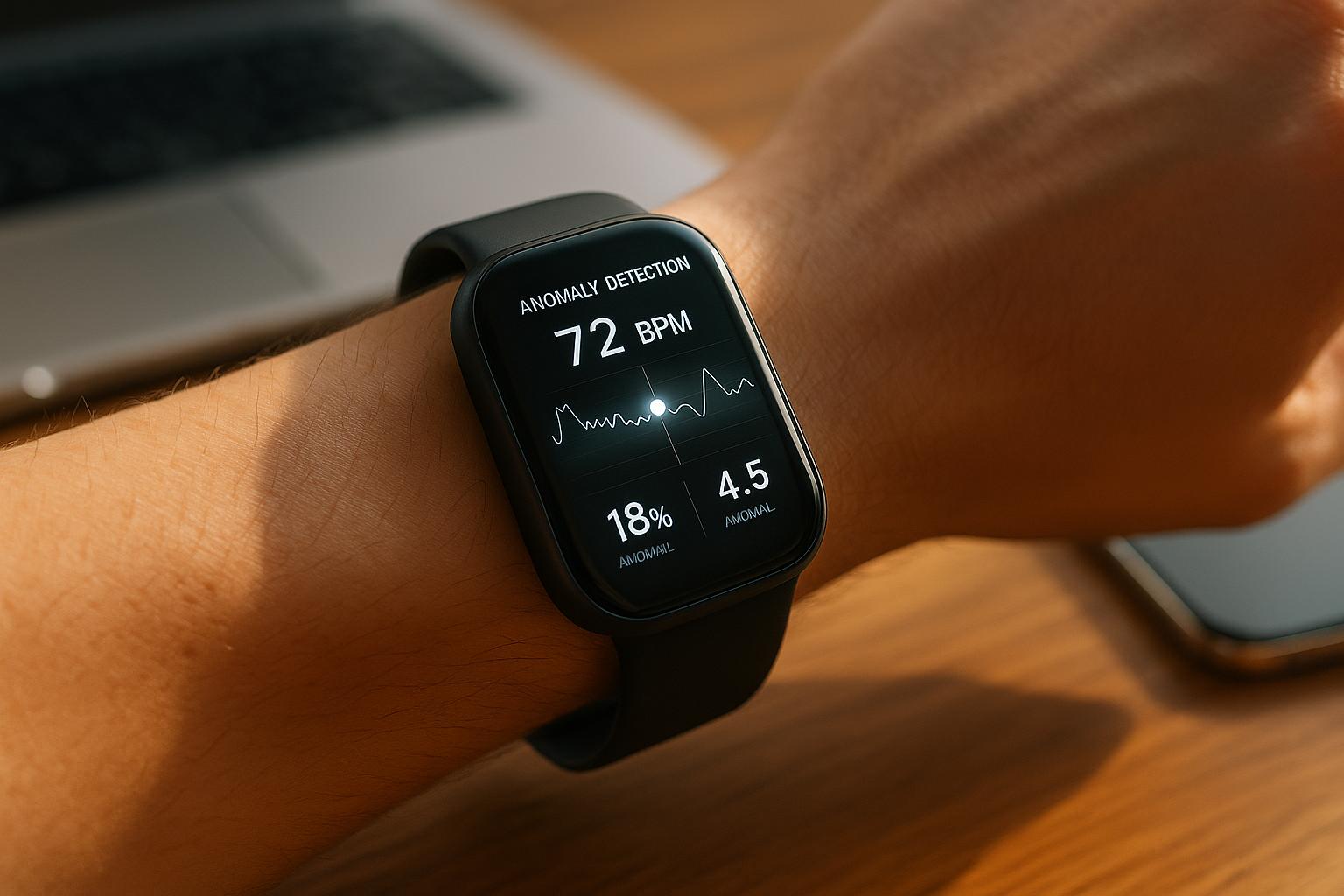
Real-time anomaly detection turns wearables into health alert systems. By analyzing data like heart rate, HRV, activity, and sleep patterns as it streams, these systems flag unusual changes instantly. This helps users address potential issues - like stress, overtraining, or early signs of illness - before they escalate.
Here’s how it works:
Data Collection: Wearable sensors track metrics like heart rate, sleep stages, and activity.
Transmission: Data is sent to paired smartphones or servers for processing.
Analysis: Algorithms detect anomalies by comparing current readings to personal baselines and medical thresholds.
Alerts: Notifications provide actionable advice tailored to your health and lifestyle.
For example, Healify’s app connects with devices like Apple Watch to analyze your patterns in real time. Its AI coach, Anna, sends personalized tips, such as adjusting workouts or improving recovery, based on detected anomalies.
These systems don’t diagnose but serve as early warning tools, encouraging users to consult healthcare providers when needed.
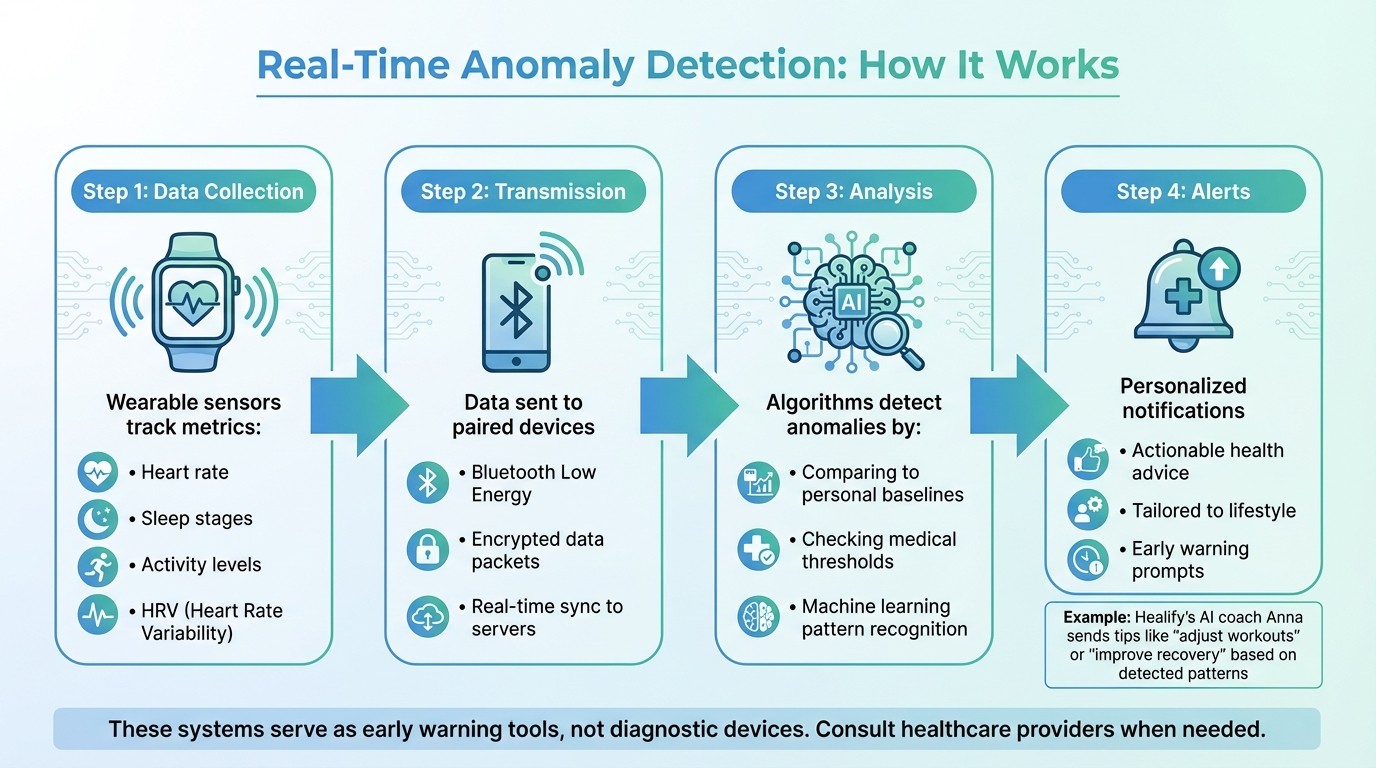
How Real-Time Anomaly Detection Works in Wearable Health Devices
Core Components of Real-Time Anomaly Detection
Wearable Sensors and Data Collection
At the heart of real-time anomaly detection are the sensors embedded in wearable devices. These sensors work around the clock, gathering a wide range of health data. For example, a photoplethysmography (PPG) sensor uses light to monitor blood volume changes, which helps calculate metrics like heart rate, heart rate variability (HRV), and blood oxygen levels (SpO₂). Many devices also feature an electrocardiogram (ECG) sensor, which records the heart's electrical activity and can detect irregular rhythms, such as atrial fibrillation [1].
In addition to these, accelerometers and gyroscopes track movement patterns - like steps, posture, sleep stages, and even falls - while filtering out noise caused by motion artifacts. Some wearables also include skin temperature sensors, which can identify continuous temperature changes that, when combined with other data, might indicate issues like infections or inflammation. By integrating data from multiple sensors, these devices create a comprehensive view of your health that’s far more dependable than relying on a single metric [1]. All this information is then sent to real-time processing systems for further analysis.
Data Transmission and Processing
Once the data is collected, it needs to be quickly transmitted for analysis. Your wearable device sends encrypted data packets to your paired iPhone via Bluetooth Low Energy, ensuring minimal delay and efficient battery usage [1]. The smartphone app then organizes these packets, computes key metrics like average heart rate or step counts, and synchronizes the data. If a Wi‑Fi or cellular connection is available, the app forwards the processed data to backend servers.
On the server side, a streaming pipeline processes this data in real time rather than waiting for batch uploads. This system keeps short, sliding windows of the most recent data - typically covering the last 5 to 30 minutes - allowing it to calculate rolling statistics, contextual markers (like whether you’re active or resting), and personal baselines. This real-time approach ensures that the sequence of events is preserved, enabling anomaly detection models to react to new data points in seconds [1]. With this seamless transmission, the focus shifts to detecting anomalies as they occur.
Anomaly Detection and Alerting
With robust data collection and transmission in place, the system uses a range of methods to identify unusual patterns. Rule-based checks act as the first line of defense. For instance, the system might flag a resting heart rate above 180 bpm or an SpO₂ level below 90% for more than two minutes [1]. Statistical techniques then compare current readings to personal historical data, using methods like z-scores or control charts to identify significant deviations from normal ranges.
Machine learning models add another layer of precision. Models such as one-class SVMs, autoencoders, and ResNet-LSTM analyze multivariate patterns in the data, identifying timeframes with high reconstruction errors or low likelihood as potential anomalies. To minimize false alarms, the system combines rule-based checks with machine learning confirmations. When an anomaly is verified, it triggers an alert on your iPhone. These alerts, delivered through Healify's AI health coach, Anna, provide actionable insights to help you address potential health concerns quickly [1].
How Real-Time Anomaly Detection Works
Defining Health Goals and Metrics
To kick off real-time anomaly detection, it’s essential to define your health goals - whether that’s improving sleep, managing stress, or tracking cardiovascular health. Each goal is tied to specific metrics from your wearable device. For instance, stress levels are monitored through heart rate variability (HRV), while sleep improvement relies on analyzing sleep stages, duration, and overall quality. Similarly, cardiovascular health focuses on resting and active heart rates, and activity tracking keeps an eye on step counts and movement patterns.
Healify translates these goals into prioritized physiological signals, ensuring the system focuses on what matters most to you. This approach avoids unnecessary alerts triggered by minor, irrelevant fluctuations. Once the key health parameters are set, the system immediately cleans and organizes the incoming data, preparing it for precise analysis.
Processing and Cleaning Wearable Data
Raw data from wearables is often messy and inconsistent. To make it usable, the system preprocesses it by removing noise, filling in missing values, and aligning timestamps across different sensors. For example, missing or corrupted data points are handled using techniques like Expectation-Maximization, ensuring no gaps interfere with the analysis.
Additionally, tools like Z-transformation are used to standardize the data to your unique patterns. What’s considered a normal heart rate during your sleep might be entirely different for someone else. By comparing new readings against your personal baseline instead of a generic average, the system ensures accurate and personalized anomaly detection. This clean, well-processed data is the foundation for meaningful insights.
Analyzing Data in Context
Context is everything when it comes to understanding anomalies. A heart rate of 120 bpm might be perfectly normal during a workout but could signal a problem if it happens while you’re asleep. Healify’s AI coach, Anna, takes a holistic approach by blending wearable data, biometric readings, and lifestyle information. This allows the system to separate expected variations from true anomalies.
When an anomaly is detected, you don’t just get an alert - you receive actionable insights tailored to your situation. For example, if your energy levels are dropping and your activity is low, you might get a suggestion like, “Take a 10-minute walk to boost your energy.” These personalized recommendations ensure that every notification is relevant and helpful for your health journey.
AI-Driven Personalised Care with Wearable Health Data | Manav Goel | Healthcare Meetup | GeekyAnts

AI Techniques for Wearable Anomaly Detection
Advanced AI techniques bring precision and adaptability to anomaly detection in wearable devices, building on core components to provide more accurate insights.
Rules-Based and Statistical Methods
Basic rules and statistical approaches are often the first line of defense in detecting anomalies. For instance, a resting heart rate exceeding 120 bpm for 3–5 minutes during inactivity might trigger an alert. Similarly, moving averages smooth out noisy data by identifying trends over time - if your current heart rate deviates by more than 2–3 standard deviations from your rolling average, it could indicate something unusual. Another example is monitoring your nightly resting heart rate over a 30-day period; if tonight's reading is 10–15% higher than your median, it might signal overtraining or illness.
These methods are efficient, require minimal computational power, and work well for on-device processing. However, they often lack personalization. For example, an endurance athlete with a naturally low resting heart rate - around 40 bpm - might be incorrectly flagged as abnormal due to generic thresholds.
Machine Learning and Deep Learning Models
When simple rules fall short, machine learning models step in to analyze complex patterns across multiple variables. Techniques like isolation forests partition health data - such as heart rate, step count, HRV, and skin temperature - and identify anomalies by how quickly they deviate from normal patterns. Similarly, one-class SVMs define a boundary around typical data and flag anything outside that range, making them useful when labeled anomaly data is limited.
Deep learning models, including LSTMs and autoencoders, excel at capturing time-based dependencies for more advanced detection. For example, an autoencoder is trained to reconstruct normal signal patterns from wearable data. If the reconstruction error spikes over a 5-minute window, it may indicate an anomaly. In 2022, the "AI on the Pulse" framework introduced a universal time-series model (UniTS) that surpassed 12 leading anomaly detection methods, improving the F1 score by roughly 22% [2][4]. This model effectively handled data from both high-fidelity ECG devices and consumer-grade smartwatches. Hybrid approaches, like ResNet-LSTM architectures, combine convolutional layers for feature extraction with LSTMs for temporal analysis, showing promise in continuous blood pressure monitoring and detecting anomalies linked to hypertension.
Personalized and Context-Aware AI
Personalization takes anomaly detection to the next level by tailoring systems to your unique baseline rather than relying on generalized population data. For instance, Healify's AI coach, Anna, spends 2–4 weeks learning your typical patterns - such as resting heart rate, daily activity, sleep duration, and HRV fluctuations - before setting personalized thresholds. During this calibration phase, the system collects data without issuing alerts, ensuring that future notifications are meaningful and specific to your health profile.
Context-aware models add another layer of sophistication by integrating multiple signals to better understand your activity. For example, a heart rate of 120 bpm during a workout is perfectly normal, but the same rate during sleep would raise concerns. By combining data like heart rate, step count, sleep stage, and time of day, these models differentiate between expected variations and true anomalies. This approach not only reduces false alarms but also minimizes alert fatigue, ensuring that the insights you receive are both timely and actionable, tailored to your unique health journey.
Designing Effective Anomaly Detection Systems
Creating an anomaly detection system that effectively identifies genuine health concerns while keeping false alerts to a minimum is no small task. It requires a thoughtful balance of precision, user experience, and privacy safeguards.
Balancing Accuracy and User Impact
Precision is the cornerstone of any reliable anomaly detection system, especially in health monitoring. To achieve this, successful systems often layer multiple validation methods. These include rule-based thresholds - like flagging a resting heart rate above 120 bpm sustained for 10 minutes - and machine learning models that refine detection accuracy [1][3]. Time-based smoothing techniques help filter out brief, insignificant data spikes, preventing unnecessary alerts [1].
The ultimate goal? To limit non-critical alerts to just one or two per week per user [2][3]. Personalizing baselines to align with each user’s unique health patterns further enhances accuracy [1][3]. These measures not only improve detection but also lay the groundwork for integrating robust privacy and safety protocols.
Privacy, Safety, and Regulatory Considerations
In the U.S., health systems handling identifiable data must adhere to HIPAA regulations, ensuring privacy, security, and breach notifications [6]. Strong privacy practices, like end-to-end encryption and multi-factor authentication, are essential for maintaining user trust [1][3][6]. Consent is another key element - users should have clear control over their data, including options to access, export, or delete it, in line with modern privacy standards [6].
Healify, for instance, prioritizes these aspects by embedding privacy and compliance measures developed in collaboration with healthcare experts. Alerts should be easy to understand, using plain language like, "Your resting heart rate has been above normal for several nights." They should also offer actionable next steps, such as hydrating, resting, or contacting a healthcare provider [1][3][5].
To ensure medical reliability, a clinical safety review board can guide which conditions the system addresses and verify that alert messaging is both clear and medically sound [1][6]. For high-risk scenarios, escalation protocols - like notifying care teams with user consent - add another layer of safety [2][4]. Together, these features ensure alerts are not only secure but also actionable and trustworthy.
Real-Time Deployment: On-Device vs. Cloud
Performance and user experience hinge on how the system processes data - on-device, in the cloud, or through a hybrid approach. On-device processing, like Healify's iPhone-based design, offers ultra-fast response times, offline functionality, and enhanced privacy [2][3]. However, it comes with limitations, such as battery and memory constraints. To address this, techniques like adaptive sampling can be used to activate high-frequency sensing only when necessary, conserving energy [1][3].
Cloud processing, on the other hand, supports more complex models and simplifies updates but can introduce delays and requires transmitting more data [2][6]. As a solution, many systems adopt a hybrid model. This approach combines lightweight, on-device anomaly detection for immediate alerts with more in-depth trend analysis and clinician dashboards hosted in the cloud [2][4]. The result? A balance of speed, privacy, and analytical depth, ensuring timely and accurate alerts without compromising user trust or detection quality.
Conclusion
Real-time anomaly detection is transforming how wearables support your health. By continuously analyzing sensor data from devices like smartwatches and fitness trackers - monitoring heart rate, sleep patterns, activity levels, and more - AI-powered systems learn your personal baseline and flag significant deviations early. This means potential health concerns like atrial fibrillation, irregular blood pressure, or chronic stress indicators can be identified before symptoms become obvious, allowing for timely action. It’s not just about handling emergencies; it’s also about making proactive adjustments to your daily routine.
These tools do more than sound alarms. They uncover subtle trends, such as a steadily rising nighttime heart rate, decreasing heart rate variability, or disrupted sleep patterns. By recognizing these cues, wearables can help you make informed decisions about your diet, exercise, sleep habits, and stress management - preventing minor issues from snowballing into bigger problems. What was once a simple step tracker now evolves into a dynamic health assistant, guiding choices that enhance energy, recovery, and overall well-being.
Take Healify, for example. It uses advanced anomaly detection to turn complex health data into straightforward, actionable advice. Instead of overwhelming you with alerts like "elevated heart rate detected", Healify’s AI coach, Anna, provides clear, practical suggestions. If your sleep data shows irregularities, Anna might recommend a calming nighttime routine. If recovery signals are off, she may suggest scaling back your workouts. When stress markers spike, you might get a gentle nudge to hydrate or take a moment to relax. By combining data from wearables, biometrics, bloodwork, and lifestyle factors, Healify simplifies health management, offering a plan that supports both physical and mental wellness.
It’s important to remember that these systems are not diagnostic tools. Instead, they’re designed to assess risks and offer proactive guidance. Alerts should serve as prompts for conversations with your healthcare provider, especially if patterns persist or align with other symptoms. With secure data practices, adherence to health regulations, and a focus on clear, actionable feedback, these technologies empower you to detect early warning signs, make informed adjustments, and collaborate with clinicians when necessary. While they don’t replace professional care, they encourage a culture of proactive health management.
FAQs
How do wearables detect health anomalies in real time?
Wearable devices rely on real-time anomaly detection to monitor your health data as it unfolds. By keeping tabs on patterns like heart rate, stress levels, or sleep cycles, these devices can spot irregularities - like an abnormal heartbeat or heightened stress - and alert you immediately.
This kind of technology allows for early identification of potential health issues, giving you the opportunity to act quickly or consult a healthcare professional. Plus, it offers a more tailored approach to tracking your health, helping you stay on top of your well-being.
What data do wearable sensors track for identifying anomalies?
Wearable sensors gather a wide range of biometric and activity data to monitor your health in real-time. These devices track heart rate, activity levels, sleep patterns, hydration status, and even cortisol levels.
By examining these metrics, wearables can spot irregular patterns or changes that might signal potential health issues. This provides helpful insights, enabling you to take a more active role in managing your well-being.
How does machine learning improve real-time anomaly detection in wearable health devices?
Machine learning takes real-time anomaly detection to the next level by analyzing complex health data from wearables and tailoring its insights to your unique baseline metrics. It doesn't just stop at understanding your current data - it continuously evolves, learning from new information to spot irregularities with greater precision while reducing unnecessary false alarms.
Through predictive modeling and real-time analysis, machine learning enables wearables to catch even the smallest shifts in your health. This means you get timely, personalized insights that empower you to stay ahead of potential issues and take charge of your well-being.
Related Blog Posts
Real-time anomaly detection turns wearables into health alert systems. By analyzing data like heart rate, HRV, activity, and sleep patterns as it streams, these systems flag unusual changes instantly. This helps users address potential issues - like stress, overtraining, or early signs of illness - before they escalate.
Here’s how it works:
Data Collection: Wearable sensors track metrics like heart rate, sleep stages, and activity.
Transmission: Data is sent to paired smartphones or servers for processing.
Analysis: Algorithms detect anomalies by comparing current readings to personal baselines and medical thresholds.
Alerts: Notifications provide actionable advice tailored to your health and lifestyle.
For example, Healify’s app connects with devices like Apple Watch to analyze your patterns in real time. Its AI coach, Anna, sends personalized tips, such as adjusting workouts or improving recovery, based on detected anomalies.
These systems don’t diagnose but serve as early warning tools, encouraging users to consult healthcare providers when needed.
How Real-Time Anomaly Detection Works in Wearable Health Devices
Core Components of Real-Time Anomaly Detection
Wearable Sensors and Data Collection
At the heart of real-time anomaly detection are the sensors embedded in wearable devices. These sensors work around the clock, gathering a wide range of health data. For example, a photoplethysmography (PPG) sensor uses light to monitor blood volume changes, which helps calculate metrics like heart rate, heart rate variability (HRV), and blood oxygen levels (SpO₂). Many devices also feature an electrocardiogram (ECG) sensor, which records the heart's electrical activity and can detect irregular rhythms, such as atrial fibrillation [1].
In addition to these, accelerometers and gyroscopes track movement patterns - like steps, posture, sleep stages, and even falls - while filtering out noise caused by motion artifacts. Some wearables also include skin temperature sensors, which can identify continuous temperature changes that, when combined with other data, might indicate issues like infections or inflammation. By integrating data from multiple sensors, these devices create a comprehensive view of your health that’s far more dependable than relying on a single metric [1]. All this information is then sent to real-time processing systems for further analysis.
Data Transmission and Processing
Once the data is collected, it needs to be quickly transmitted for analysis. Your wearable device sends encrypted data packets to your paired iPhone via Bluetooth Low Energy, ensuring minimal delay and efficient battery usage [1]. The smartphone app then organizes these packets, computes key metrics like average heart rate or step counts, and synchronizes the data. If a Wi‑Fi or cellular connection is available, the app forwards the processed data to backend servers.
On the server side, a streaming pipeline processes this data in real time rather than waiting for batch uploads. This system keeps short, sliding windows of the most recent data - typically covering the last 5 to 30 minutes - allowing it to calculate rolling statistics, contextual markers (like whether you’re active or resting), and personal baselines. This real-time approach ensures that the sequence of events is preserved, enabling anomaly detection models to react to new data points in seconds [1]. With this seamless transmission, the focus shifts to detecting anomalies as they occur.
Anomaly Detection and Alerting
With robust data collection and transmission in place, the system uses a range of methods to identify unusual patterns. Rule-based checks act as the first line of defense. For instance, the system might flag a resting heart rate above 180 bpm or an SpO₂ level below 90% for more than two minutes [1]. Statistical techniques then compare current readings to personal historical data, using methods like z-scores or control charts to identify significant deviations from normal ranges.
Machine learning models add another layer of precision. Models such as one-class SVMs, autoencoders, and ResNet-LSTM analyze multivariate patterns in the data, identifying timeframes with high reconstruction errors or low likelihood as potential anomalies. To minimize false alarms, the system combines rule-based checks with machine learning confirmations. When an anomaly is verified, it triggers an alert on your iPhone. These alerts, delivered through Healify's AI health coach, Anna, provide actionable insights to help you address potential health concerns quickly [1].
How Real-Time Anomaly Detection Works
Defining Health Goals and Metrics
To kick off real-time anomaly detection, it’s essential to define your health goals - whether that’s improving sleep, managing stress, or tracking cardiovascular health. Each goal is tied to specific metrics from your wearable device. For instance, stress levels are monitored through heart rate variability (HRV), while sleep improvement relies on analyzing sleep stages, duration, and overall quality. Similarly, cardiovascular health focuses on resting and active heart rates, and activity tracking keeps an eye on step counts and movement patterns.
Healify translates these goals into prioritized physiological signals, ensuring the system focuses on what matters most to you. This approach avoids unnecessary alerts triggered by minor, irrelevant fluctuations. Once the key health parameters are set, the system immediately cleans and organizes the incoming data, preparing it for precise analysis.
Processing and Cleaning Wearable Data
Raw data from wearables is often messy and inconsistent. To make it usable, the system preprocesses it by removing noise, filling in missing values, and aligning timestamps across different sensors. For example, missing or corrupted data points are handled using techniques like Expectation-Maximization, ensuring no gaps interfere with the analysis.
Additionally, tools like Z-transformation are used to standardize the data to your unique patterns. What’s considered a normal heart rate during your sleep might be entirely different for someone else. By comparing new readings against your personal baseline instead of a generic average, the system ensures accurate and personalized anomaly detection. This clean, well-processed data is the foundation for meaningful insights.
Analyzing Data in Context
Context is everything when it comes to understanding anomalies. A heart rate of 120 bpm might be perfectly normal during a workout but could signal a problem if it happens while you’re asleep. Healify’s AI coach, Anna, takes a holistic approach by blending wearable data, biometric readings, and lifestyle information. This allows the system to separate expected variations from true anomalies.
When an anomaly is detected, you don’t just get an alert - you receive actionable insights tailored to your situation. For example, if your energy levels are dropping and your activity is low, you might get a suggestion like, “Take a 10-minute walk to boost your energy.” These personalized recommendations ensure that every notification is relevant and helpful for your health journey.
AI-Driven Personalised Care with Wearable Health Data | Manav Goel | Healthcare Meetup | GeekyAnts
AI Techniques for Wearable Anomaly Detection
Advanced AI techniques bring precision and adaptability to anomaly detection in wearable devices, building on core components to provide more accurate insights.
Rules-Based and Statistical Methods
Basic rules and statistical approaches are often the first line of defense in detecting anomalies. For instance, a resting heart rate exceeding 120 bpm for 3–5 minutes during inactivity might trigger an alert. Similarly, moving averages smooth out noisy data by identifying trends over time - if your current heart rate deviates by more than 2–3 standard deviations from your rolling average, it could indicate something unusual. Another example is monitoring your nightly resting heart rate over a 30-day period; if tonight's reading is 10–15% higher than your median, it might signal overtraining or illness.
These methods are efficient, require minimal computational power, and work well for on-device processing. However, they often lack personalization. For example, an endurance athlete with a naturally low resting heart rate - around 40 bpm - might be incorrectly flagged as abnormal due to generic thresholds.
Machine Learning and Deep Learning Models
When simple rules fall short, machine learning models step in to analyze complex patterns across multiple variables. Techniques like isolation forests partition health data - such as heart rate, step count, HRV, and skin temperature - and identify anomalies by how quickly they deviate from normal patterns. Similarly, one-class SVMs define a boundary around typical data and flag anything outside that range, making them useful when labeled anomaly data is limited.
Deep learning models, including LSTMs and autoencoders, excel at capturing time-based dependencies for more advanced detection. For example, an autoencoder is trained to reconstruct normal signal patterns from wearable data. If the reconstruction error spikes over a 5-minute window, it may indicate an anomaly. In 2022, the "AI on the Pulse" framework introduced a universal time-series model (UniTS) that surpassed 12 leading anomaly detection methods, improving the F1 score by roughly 22% [2][4]. This model effectively handled data from both high-fidelity ECG devices and consumer-grade smartwatches. Hybrid approaches, like ResNet-LSTM architectures, combine convolutional layers for feature extraction with LSTMs for temporal analysis, showing promise in continuous blood pressure monitoring and detecting anomalies linked to hypertension.
Personalized and Context-Aware AI
Personalization takes anomaly detection to the next level by tailoring systems to your unique baseline rather than relying on generalized population data. For instance, Healify's AI coach, Anna, spends 2–4 weeks learning your typical patterns - such as resting heart rate, daily activity, sleep duration, and HRV fluctuations - before setting personalized thresholds. During this calibration phase, the system collects data without issuing alerts, ensuring that future notifications are meaningful and specific to your health profile.
Context-aware models add another layer of sophistication by integrating multiple signals to better understand your activity. For example, a heart rate of 120 bpm during a workout is perfectly normal, but the same rate during sleep would raise concerns. By combining data like heart rate, step count, sleep stage, and time of day, these models differentiate between expected variations and true anomalies. This approach not only reduces false alarms but also minimizes alert fatigue, ensuring that the insights you receive are both timely and actionable, tailored to your unique health journey.
Designing Effective Anomaly Detection Systems
Creating an anomaly detection system that effectively identifies genuine health concerns while keeping false alerts to a minimum is no small task. It requires a thoughtful balance of precision, user experience, and privacy safeguards.
Balancing Accuracy and User Impact
Precision is the cornerstone of any reliable anomaly detection system, especially in health monitoring. To achieve this, successful systems often layer multiple validation methods. These include rule-based thresholds - like flagging a resting heart rate above 120 bpm sustained for 10 minutes - and machine learning models that refine detection accuracy [1][3]. Time-based smoothing techniques help filter out brief, insignificant data spikes, preventing unnecessary alerts [1].
The ultimate goal? To limit non-critical alerts to just one or two per week per user [2][3]. Personalizing baselines to align with each user’s unique health patterns further enhances accuracy [1][3]. These measures not only improve detection but also lay the groundwork for integrating robust privacy and safety protocols.
Privacy, Safety, and Regulatory Considerations
In the U.S., health systems handling identifiable data must adhere to HIPAA regulations, ensuring privacy, security, and breach notifications [6]. Strong privacy practices, like end-to-end encryption and multi-factor authentication, are essential for maintaining user trust [1][3][6]. Consent is another key element - users should have clear control over their data, including options to access, export, or delete it, in line with modern privacy standards [6].
Healify, for instance, prioritizes these aspects by embedding privacy and compliance measures developed in collaboration with healthcare experts. Alerts should be easy to understand, using plain language like, "Your resting heart rate has been above normal for several nights." They should also offer actionable next steps, such as hydrating, resting, or contacting a healthcare provider [1][3][5].
To ensure medical reliability, a clinical safety review board can guide which conditions the system addresses and verify that alert messaging is both clear and medically sound [1][6]. For high-risk scenarios, escalation protocols - like notifying care teams with user consent - add another layer of safety [2][4]. Together, these features ensure alerts are not only secure but also actionable and trustworthy.
Real-Time Deployment: On-Device vs. Cloud
Performance and user experience hinge on how the system processes data - on-device, in the cloud, or through a hybrid approach. On-device processing, like Healify's iPhone-based design, offers ultra-fast response times, offline functionality, and enhanced privacy [2][3]. However, it comes with limitations, such as battery and memory constraints. To address this, techniques like adaptive sampling can be used to activate high-frequency sensing only when necessary, conserving energy [1][3].
Cloud processing, on the other hand, supports more complex models and simplifies updates but can introduce delays and requires transmitting more data [2][6]. As a solution, many systems adopt a hybrid model. This approach combines lightweight, on-device anomaly detection for immediate alerts with more in-depth trend analysis and clinician dashboards hosted in the cloud [2][4]. The result? A balance of speed, privacy, and analytical depth, ensuring timely and accurate alerts without compromising user trust or detection quality.
Conclusion
Real-time anomaly detection is transforming how wearables support your health. By continuously analyzing sensor data from devices like smartwatches and fitness trackers - monitoring heart rate, sleep patterns, activity levels, and more - AI-powered systems learn your personal baseline and flag significant deviations early. This means potential health concerns like atrial fibrillation, irregular blood pressure, or chronic stress indicators can be identified before symptoms become obvious, allowing for timely action. It’s not just about handling emergencies; it’s also about making proactive adjustments to your daily routine.
These tools do more than sound alarms. They uncover subtle trends, such as a steadily rising nighttime heart rate, decreasing heart rate variability, or disrupted sleep patterns. By recognizing these cues, wearables can help you make informed decisions about your diet, exercise, sleep habits, and stress management - preventing minor issues from snowballing into bigger problems. What was once a simple step tracker now evolves into a dynamic health assistant, guiding choices that enhance energy, recovery, and overall well-being.
Take Healify, for example. It uses advanced anomaly detection to turn complex health data into straightforward, actionable advice. Instead of overwhelming you with alerts like "elevated heart rate detected", Healify’s AI coach, Anna, provides clear, practical suggestions. If your sleep data shows irregularities, Anna might recommend a calming nighttime routine. If recovery signals are off, she may suggest scaling back your workouts. When stress markers spike, you might get a gentle nudge to hydrate or take a moment to relax. By combining data from wearables, biometrics, bloodwork, and lifestyle factors, Healify simplifies health management, offering a plan that supports both physical and mental wellness.
It’s important to remember that these systems are not diagnostic tools. Instead, they’re designed to assess risks and offer proactive guidance. Alerts should serve as prompts for conversations with your healthcare provider, especially if patterns persist or align with other symptoms. With secure data practices, adherence to health regulations, and a focus on clear, actionable feedback, these technologies empower you to detect early warning signs, make informed adjustments, and collaborate with clinicians when necessary. While they don’t replace professional care, they encourage a culture of proactive health management.
FAQs
How do wearables detect health anomalies in real time?
Wearable devices rely on real-time anomaly detection to monitor your health data as it unfolds. By keeping tabs on patterns like heart rate, stress levels, or sleep cycles, these devices can spot irregularities - like an abnormal heartbeat or heightened stress - and alert you immediately.
This kind of technology allows for early identification of potential health issues, giving you the opportunity to act quickly or consult a healthcare professional. Plus, it offers a more tailored approach to tracking your health, helping you stay on top of your well-being.
What data do wearable sensors track for identifying anomalies?
Wearable sensors gather a wide range of biometric and activity data to monitor your health in real-time. These devices track heart rate, activity levels, sleep patterns, hydration status, and even cortisol levels.
By examining these metrics, wearables can spot irregular patterns or changes that might signal potential health issues. This provides helpful insights, enabling you to take a more active role in managing your well-being.
How does machine learning improve real-time anomaly detection in wearable health devices?
Machine learning takes real-time anomaly detection to the next level by analyzing complex health data from wearables and tailoring its insights to your unique baseline metrics. It doesn't just stop at understanding your current data - it continuously evolves, learning from new information to spot irregularities with greater precision while reducing unnecessary false alarms.
Through predictive modeling and real-time analysis, machine learning enables wearables to catch even the smallest shifts in your health. This means you get timely, personalized insights that empower you to stay ahead of potential issues and take charge of your well-being.
Related Blog Posts

Endlich die Kontrolle über Ihre Gesundheit übernehmen

Endlich die Kontrolle über Ihre Gesundheit übernehmen
Endlich die Kontrolle über Ihre Gesundheit übernehmen