Improve your health
Improve your health
Improve your health
25. Januar 2026
Emotion-Aware AI vs. Traditional Coaching

Emotion-aware AI and traditional coaching each offer distinct ways to help people build healthier habits. AI uses data like heart rate and facial expressions to provide instant, personalized feedback 24/7, making it affordable and accessible. On the other hand, human coaches rely on empathy and personal connection to guide clients through complex, emotional challenges.
Emotion-aware AI: Fast, data-driven, and scalable, with costs as low as $10–$50/month. Ideal for routine support and habit tracking.
Human coaching: Rich in emotional depth, trust, and nuanced understanding, but limited by availability and higher costs ($400–$1,000/month).
Key takeaway: AI excels in consistency and accessibility, while human coaching thrives in emotional and situational complexity. Hybrid models combining both approaches are emerging as a powerful solution.
Quick Comparison:
Feature | Emotion-Aware AI | Human Coaching |
|---|---|---|
Cost | $10–$50/month | $400–$1,000/month |
Availability | 24/7 | Scheduled sessions only |
Emotional Support | Algorithm-based | Genuine human empathy |
Personalization | Data-driven | Relationship-focused |
Scalability | High | Limited |
Hybrid coaching blends AI's strengths in efficiency with the emotional insight of human coaches, offering a balanced, effective approach to health coaching.
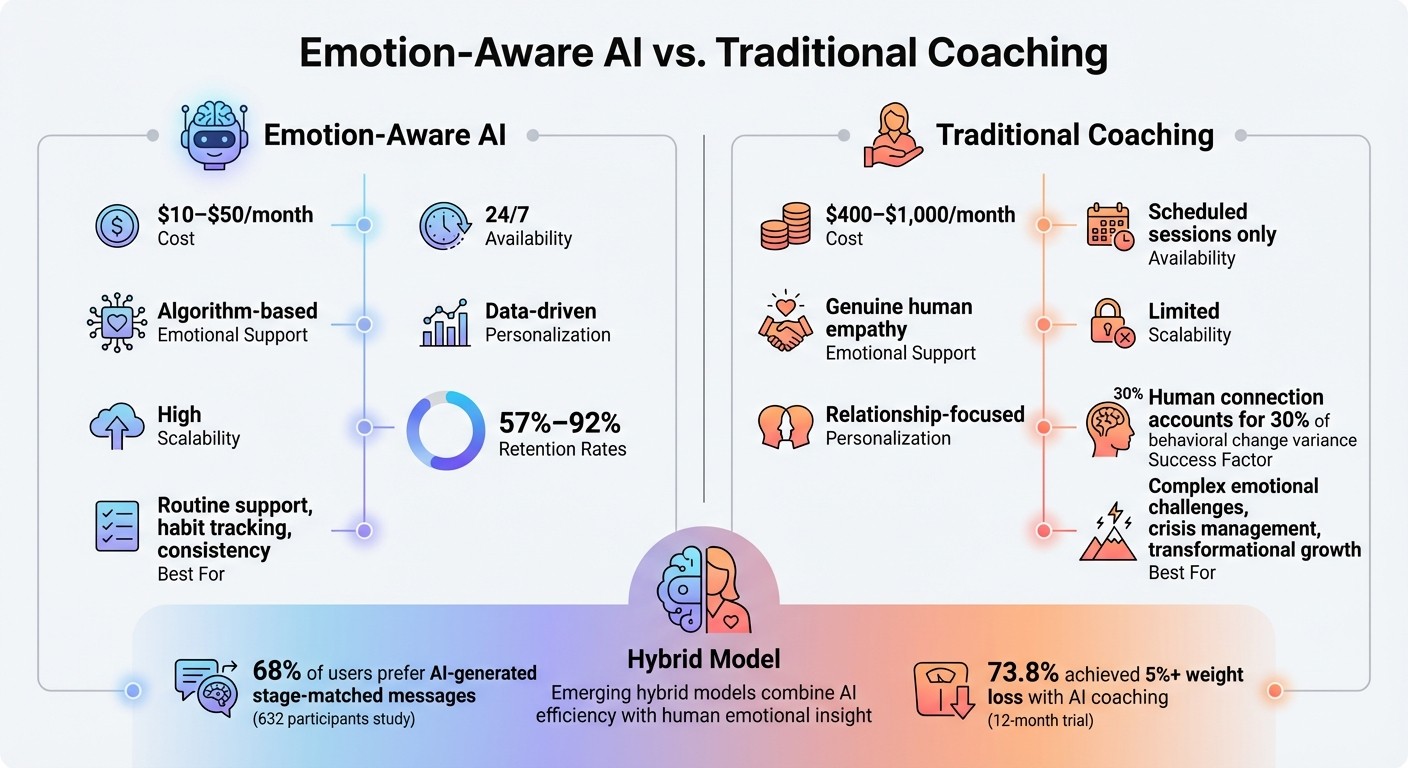
Emotion-Aware AI vs Traditional Coaching: Cost, Availability, and Features Comparison
Is AI coaching a better proposition to human in the loop in some situations?
How Emotion-Aware AI Supports Motivation and Habit Formation
Emotion-aware AI offers three key benefits: real-time emotional responsiveness, 24/7 availability, and personalized strategies. These features address the challenges that traditional digital health tools often face, such as the 43% dropout rate seen in interventions without active coaching support [2].
Real-Time Emotion Detection and Response
Emotion-aware AI can identify emotional states by analyzing facial expressions, tone of voice, physiological signals, and behavior patterns [1]. This combined data enables the AI to detect stress, frustration, or fatigue as they occur, rather than hours or days later.
Using these insights, the AI can adapt its interventions on the spot. For example, if it detects stress, it may suggest calming techniques right away. These Just-in-Time Adaptive Interventions (JITAIs) provide help precisely when it's needed most [5][7].
Some systems take it a step further by incorporating behavior models like COM-B (Capability, Opportunity, Motivation). These models allow the AI to interpret your responses and adjust its recommendations. For instance, if you mention being "too busy" to exercise, the AI identifies this as an Opportunity barrier and offers time-management tips instead of generic motivational quotes [7]. In April 2024, researchers introduced the Physical Activity Coaching Engine (PACE), a chat-based assistant built on Fogg's Behavior Model. Tested with 33 participants over 21 days, PACE delivered engagement and step-count results comparable to human coaches by adapting to users' motivation and ability in real time [7].
This ability to respond instantly creates a foundation for continuous, on-demand support.
24/7 Availability and Consistency
Beyond quick responses, emotion-aware AI is available around the clock, removing the limitations of traditional coaching, which often operates only during business hours. Tools like Healify's AI health coach, Anna, provide support whenever it's needed [8][9].
This constant availability is especially important because motivation doesn't stick to a schedule. During the COVID-19 pandemic, for example, 60% of users turned to mental health chatbots when traditional services were either overwhelmed or unavailable [10]. The ability to receive a response within seconds helps maintain momentum, something that can be lost when waiting days for a coaching session.
AI also offers unmatched consistency. Unlike human coaches, whose energy and mood may fluctuate, AI provides the same level of support every time. Users don't have to worry about judgment or fear of disappointing someone - factors that can often hinder open communication. As Vlade Legaspi from HelpSquad explains:
"Mental health crises don't follow a schedule, so round-the-clock help can make a huge difference." - Vlade Legaspi, HelpSquad [8]
Data-Driven Personalization
Emotion-aware AI doesn't just provide consistent support - it refines its strategies using detailed data analysis. Platforms like Healify use data from wearables, biometrics, and lifestyle patterns to create a dynamic health profile [5].
This approach enables stage-matched interventions. For example, researchers developed MHC-Coach by fine-tuning the LLaMA 3-70B model with 3,268 expert messages and Transtheoretical Model (TTM) principles. In a study involving 632 participants from the My Heart Counts Cardiovascular Health Study, 68% preferred the AI's tailored messages over those crafted by human experts. Behavioral science experts rated the AI messages significantly higher for effectiveness (4.4 out of 5) compared to human-written ones (2.8 out of 5) [11].
AI also excels at supporting habit formation. Retention rates for AI platforms range from 57% to 92%, far surpassing typical digital health interventions [5]. In a 12-month randomized controlled trial published in 2025, Joshi et al. evaluated a "Digital Twin" coaching system for obesity care. The study revealed that 73.8% of participants in the intervention group achieved over 5% body weight loss, and 41.6% achieved over 10% weight loss. In contrast, the control group saw an average weight change of only -0.4 kg (approximately -0.9 lbs). The AI system used predictive analytics and personalized feedback to achieve these results [5].
Daily interaction with an AI coach has been linked to a 0.8% increase in the likelihood of achieving a clinically significant 5% weight loss [5]. Whether it's a morning reminder, a pre-meal stress reduction technique, or a sleep optimization tip, the system learns what works best for you and focuses on those strategies.
These capabilities demonstrate how emotion-aware AI can play a transformative role in building and maintaining healthy habits.
How Traditional Coaching Supports Behavioral Change
Though emotion-aware AI leverages data to offer personalized support, traditional coaching thrives on authentic human connection. In fact, the relationship between a coach and their client accounts for 30% of the variance in predicting successful behavioral change [3]. This approach shines in fostering trust and guiding clients through meaningful, long-lasting transformations.
Empathy and Human Connection
Human coaches excel in building trust by using what researchers refer to as "relational intelligence." This involves picking up on subtle non-verbal cues - like micro-expressions, shifts in tone, and body language - that AI simply cannot replicate. Such attentiveness creates a psychologically safe, judgment-free environment where clients feel comfortable sharing their vulnerabilities and exploring new possibilities. This is especially crucial when clients are working to overcome deeply ingrained habits, which often require significant emotional, cognitive, and motivational effort [3][12].
A skilled coach also helps regulate a client's emotional state, guiding them through moments of overwhelm and into a mindset where real progress becomes achievable. Mike Szczesny, Vice President at EDCO Awards & Specialties, highlights this aspect:
"Human coaches guarantee safety, as well as the absence of judgment, leading people to feel free to express their ideas, problems and goals." [12]
By combining relational intelligence with empathy, traditional coaches are uniquely equipped to navigate life's unpredictable challenges.
Handling Complex Scenarios
Human coaches bring a unique ability to interpret unspoken cues, helping them understand a client’s deeper emotions and intentions. This makes them particularly effective in addressing unexpected challenges - like workplace stress, family issues, or interpersonal conflicts - that often disrupt efforts to build new habits [3]. Unlike AI, which relies on pre-programmed responses, human coaches can adapt dynamically to the complexities of real life [6][16].
Behavioral change is rarely a straight line, and this is where human coaches excel. Graham Ward, Adjunct Professor of Organisational Behaviour at INSEAD, explains it well:
"AI may offer the 'correct' answer. But coaching helps a person discover the needed answer – the one they're ready for." [13]
Human coaches also possess a natural "Theory of Mind", which allows them to understand how individuals process information differently and adjust their approach in real time [14]. This adaptability is particularly valuable during moments of personal crisis.
Crisis Management and Emotional Support
In times of crisis, traditional coaches provide what researchers call "psychological containment" - the sense of being truly seen and supported during difficult moments [15]. As the MIT Sloan Management Review notes:
"In moments of crisis, failure, or identity challenges, leaders need human coaches who can provide genuine empathy and psychological containment - something even advanced emotional-AI systems can't yet authentically replicate." [15]
Jessica Clarke, Global Head of Talent and L&D at Atlas Copco, underscores the unique role of human coaches:
"The human coach is about shifting mindsets, holding up the mirror, looking at the body language. It's the transformational space as opposed to the performance-based coaching of AI." [12]
This ability to guide clients through identity shifts and periods of uncertainty remains a cornerstone of traditional coaching. It’s this deeply personal, empathetic approach that drives profound behavioral change and sets human coaching apart.
Side-by-Side Comparison: Emotion-Aware AI vs. Traditional Coaching
A closer look reveals the strengths of emotion-aware AI in accessibility and consistency, while traditional coaching shines in emotional depth and personalized connection.
Comparison Table
Dimension | Emotion-Aware AI | Traditional Coaching |
|---|---|---|
Emotional Detection | Utilizes sensors (GSR, EEG), facial/vocal analysis, and text sentiment analysis | Relies on intuition, observation, and probing questions |
Availability | Available 24/7 for instant access | Limited to scheduled sessions based on human availability |
Emotional Depth | Empathy driven by algorithms; limited in depth | Genuine human empathy fostering deeper bonds |
Cost | $10–$50/month | $400–$1,000/month |
Personalization | Data-driven, using biometrics and pattern analysis | Relationship-driven, focusing on empathy and nuance |
Consistency | Highly consistent; follows protocols without variability | Varies with the coach's experience and mood |
Scalability | Easily scalable with low marginal costs | Limited by the number of available practitioners |
Contextual Awareness | Restricted to programmed data and sensor inputs | High, with a broader understanding of diverse scenarios |
Main Findings from the Comparison
This comparison highlights how emotion-aware AI and human coaching complement each other. AI stands out in terms of accessibility, affordability, and consistency, making it an excellent option for those who might not have access to AI health coaching vs traditional personal training or other forms of traditional coaching. With costs as low as $10–$50 per month, AI coaching opens up opportunities for millions who cannot afford traditional services, which range from $400–$1,000 per month. Considering there are only 109,000 accredited coaches serving a massive global workforce of 3.5 billion adults [12], AI is addressing a significant gap.
AI's strength lies in its ability to provide constant follow-ups and adhere to structured protocols, which are crucial for habit formation. Studies show retention rates between 57% and 92% when AI systems are used [5]. However, AI has its limits - it cannot replicate the genuine empathy and deep emotional bonds that human coaches provide. As Graham Ward from INSEAD puts it:
"AI may offer the 'correct' answer. But coaching helps a person discover the needed answer – the one they're ready for." [13]
Interestingly, a 10-month study revealed that both AI and human coaching delivered similar results in achieving goals [15][17]. However, human connection remains a key factor, accounting for 30% of the variance in coaching outcomes [18]. This underscores the irreplaceable role of traditional coaching in areas like transformational growth and crisis management.
AI coaching, with its lower cost and scalability, is especially impactful in underserved regions, where human coaches often charge around $100 per session [17][18][19]. Still, for deeper, life-changing work, human coaches remain essential. These findings suggest that hybrid coaching models, combining the strengths of both AI and human methods, could be the next step forward.
The Future: Combining AI and Human Coaching
Blending the strengths of emotion-aware AI with the personal touch of human coaching is shaping the future of this field. These hybrid models capitalize on the unique abilities of both, with AI taking care of routine tasks like tracking habits and providing motivation, while human coaches step in to handle more complex, emotionally charged situations that require empathy and understanding.
How Hybrid Models Work
In hybrid coaching systems, responsibilities are split: AI handles repetitive, day-to-day tasks, and human coaches focus on addressing deeper emotional or behavioral challenges. For instance, AI might monitor habits, send reminders, and analyze biometric data, while human coaches step in during moments of personal crisis or significant life changes.
This division works because AI is excellent at identifying patterns and details, while humans excel at interpreting context and intent [20]. Take Healify's AI health coach, Anna, as an example. Anna uses data from wearables, bloodwork, and lifestyle inputs to provide real-time insights, flagging concerns like elevated stress levels or poor sleep. While Anna offers immediate, data-driven suggestions, a human coach can step in to provide strategic guidance for more complex situations.
This collaboration allows AI to highlight key emotional and behavioral patterns that might otherwise go unnoticed. Human coaches, armed with this data, can skip the preliminary fact-gathering stage and dive straight into meaningful, impactful conversations [20][14]. As one coaching platform put it:
"The most effective approach is complementary rather than replacement. Surge9 works best when human coaches focus on complex, nuanced coaching conversations while AI handles high-volume skill development and practice" [14].
Interestingly, AI also provides a judgment-free space where users feel comfortable practicing new techniques or admitting failures before discussing them with a coach [14]. This safe environment encourages confidence and skill-building through repetition. Research even suggests that personalized attention like this can lead to significant learning improvements, with coached individuals outperforming 98% of their peers in traditional settings [14].
This integration paves the way for a new era of highly personalized health coaching.
Benefits of Hybrid Coaching
Hybrid coaching models offer a combination of affordability, constant availability, and emotional depth, making them highly effective. By relying on AI for daily interactions and reserving human coaches for more complex needs, these models reduce costs while maintaining high-quality support. For example, in September 2025, Sibly, Inc. shared results from their AI-supported, human-delivered text coaching service for employees. Their platform used machine learning to identify 40 specific topics and detect sentiment changes, helping human coaches respond effectively. Among 38 participants, reports of severe distress dropped from 33.3% to 6.7% - a 79% relative reduction. Additionally, workplace productivity increased by 18%, with a median response time of just 132 seconds [4].
Such responsiveness is hard to achieve with human-only coaching, where availability is limited to scheduled sessions. Still, the human element remains essential. Coaches review and validate AI recommendations to ensure interventions are personalized and safe [2][21].
However, there are challenges. AI's emotion recognition tools can misinterpret certain states - like mistaking focused concentration for negativity nearly half the time. Human coaches are crucial for filtering these cues and deciding which ones truly matter. As Vosaic emphasizes:
"AI can bring patterns to the surface, but not all of them bring significant meaning or should result in an action. This is where coaches play a huge role... they are the ones who must decide which cues matter" [20].
Conclusion: How Emotion-Aware AI is Changing Health Coaching
Key Takeaways
Emotion-aware AI is transforming how we approach motivation and habit-building by offering instant, scalable, and tailored support. While human coaches excel at navigating complex emotions and fostering authentic relationships, AI systems shine in delivering consistent, data-based guidance without the limitations of cost, location, or scheduling. The real game-changer lies in hybrid models, which combine AI's ability to analyze patterns and provide timely interventions with the emotional depth and expertise of human coaches.
For instance, a 2025 study with 632 participants from the My Heart Counts cardiovascular health program revealed that 68% of users preferred AI-generated coaching messages over those crafted by human experts when aligned with their specific stage of change [11]. This highlights the importance of receiving timely, relevant support - whether it’s a quick AI response or a meaningful conversation with a coach.
This synergy of fast, data-driven insights and personalized human touch is paving the way for a new era in health coaching.
Why Healify is Leading the Way
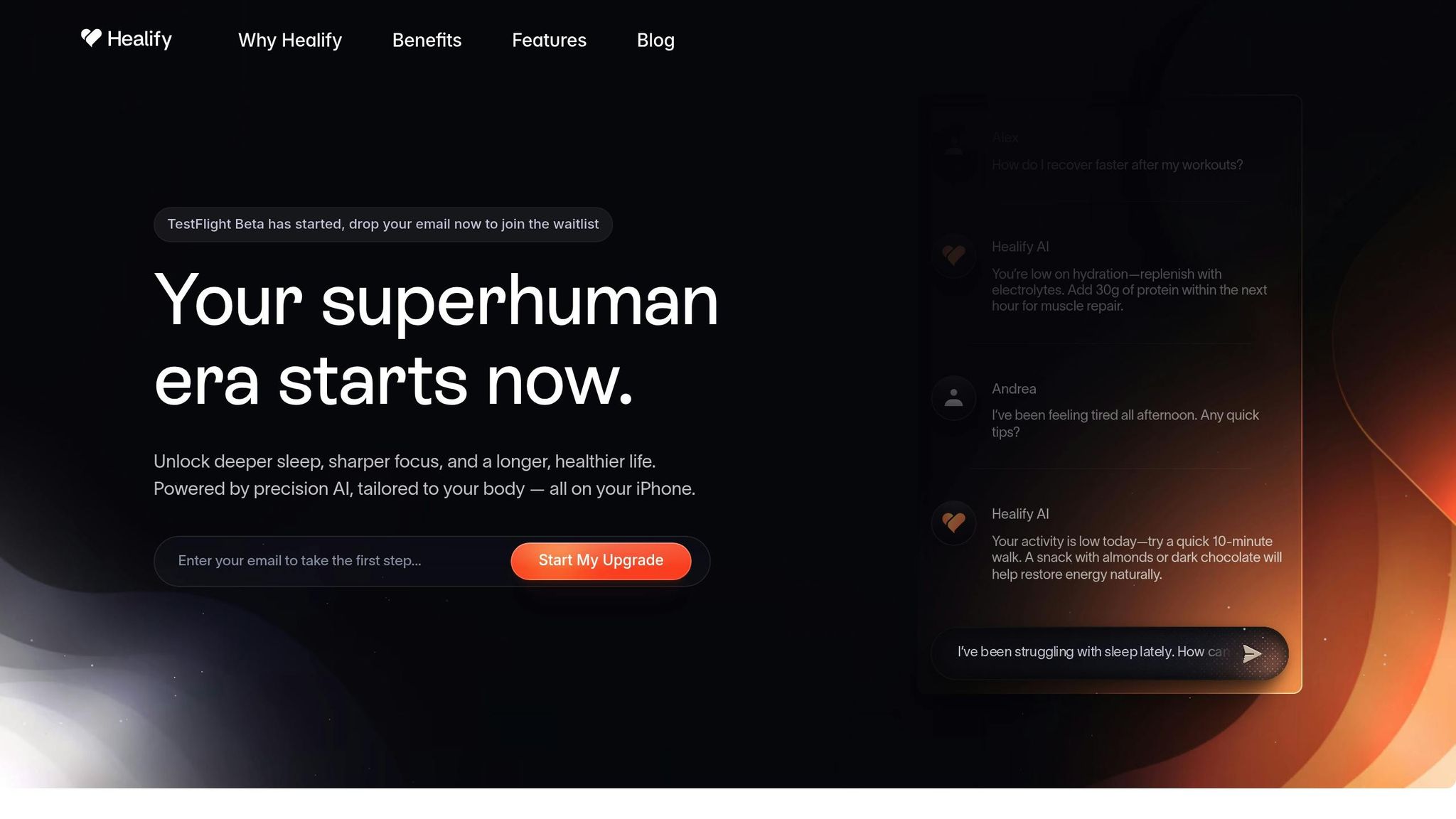
Healify is at the forefront of this evolution, redefining health coaching with its innovative approach. Anna, Healify’s 24/7 AI health coach, turns complex health data into simple, actionable recommendations. By analyzing inputs from wearables, biometrics, bloodwork, and lifestyle habits, Anna delivers real-time advice tailored to both your emotional and physical state. Whether it’s identifying elevated stress, recommending better sleep routines, or adjusting advice based on your current motivation, Anna offers round-the-clock, unbiased support.
What makes Healify stand out is its strong foundation in behavioral science. Using models like the Transtheoretical Model and COM-B, Anna doesn’t just track your progress - she understands your position in the behavior change process and adapts her guidance accordingly [11][7]. This ensures that the nudges you receive are relevant and resonate with where you are, whether you’re contemplating a change or actively sustaining new habits. As David Peterson, former Senior Director of Coaching at Google, once said:
"In 10 years, 90% of what coaches do today will be done by artificial intelligence" [3].
With Healify, that vision of the future is already a reality.
FAQs
How does emotion-aware AI offer personalized coaching compared to traditional methods?
Emotion-aware AI takes personalization up a notch by analyzing real-time data like biometrics, behavior patterns, and language cues to gauge your emotional state. This means it can offer immediate, customized support - whether you need stress-relief tips, a motivational boost, or help sticking to healthy habits - right when it matters most.
Unlike traditional coaches who work within set schedules and rely on limited observations, AI is available around the clock, constantly adjusting its guidance to match your evolving needs. Using data-driven insights, this technology delivers a more consistent and responsive coaching experience, making it easier to stay on track with your health goals.
What are the advantages of combining AI with human coaching for health improvement?
A hybrid approach that blends AI with human coaching creates a balanced and effective system. AI steps in with real-time insights by analyzing data from wearables, biometrics, and lifestyle habits. This means you get tailored recommendations and instant feedback designed to keep you aligned with your health goals.
Meanwhile, human coaches add a layer of empathy and understanding that technology simply can't replicate. They can navigate complex personal situations, offer encouragement, and provide the kind of motivation that resonates on a deeper level. Together, this partnership combines the precision of technology with the warmth of human connection, delivering a comprehensive and personalized health coaching experience that supports lasting success.
Can emotion-aware AI effectively support emotional challenges?
Emotion-aware AI has advanced considerably in recognizing and responding to emotional cues. By analyzing behavior and emotional patterns, these systems can provide tailored support, helping users stay motivated and adopt healthier habits.
That said, while these systems are great at offering consistent and personalized assistance, they often fall short when it comes to understanding the subtleties of more complex emotional situations. For addressing deeper challenges, human involvement or a mix of AI and human support might still be essential. Emotion-aware AI holds great potential, but it works best as a complement to traditional methods rather than as a standalone solution.
Related Blog Posts
Emotion-aware AI and traditional coaching each offer distinct ways to help people build healthier habits. AI uses data like heart rate and facial expressions to provide instant, personalized feedback 24/7, making it affordable and accessible. On the other hand, human coaches rely on empathy and personal connection to guide clients through complex, emotional challenges.
Emotion-aware AI: Fast, data-driven, and scalable, with costs as low as $10–$50/month. Ideal for routine support and habit tracking.
Human coaching: Rich in emotional depth, trust, and nuanced understanding, but limited by availability and higher costs ($400–$1,000/month).
Key takeaway: AI excels in consistency and accessibility, while human coaching thrives in emotional and situational complexity. Hybrid models combining both approaches are emerging as a powerful solution.
Quick Comparison:
Feature | Emotion-Aware AI | Human Coaching |
|---|---|---|
Cost | $10–$50/month | $400–$1,000/month |
Availability | 24/7 | Scheduled sessions only |
Emotional Support | Algorithm-based | Genuine human empathy |
Personalization | Data-driven | Relationship-focused |
Scalability | High | Limited |
Hybrid coaching blends AI's strengths in efficiency with the emotional insight of human coaches, offering a balanced, effective approach to health coaching.
Emotion-Aware AI vs Traditional Coaching: Cost, Availability, and Features Comparison
Is AI coaching a better proposition to human in the loop in some situations?
How Emotion-Aware AI Supports Motivation and Habit Formation
Emotion-aware AI offers three key benefits: real-time emotional responsiveness, 24/7 availability, and personalized strategies. These features address the challenges that traditional digital health tools often face, such as the 43% dropout rate seen in interventions without active coaching support [2].
Real-Time Emotion Detection and Response
Emotion-aware AI can identify emotional states by analyzing facial expressions, tone of voice, physiological signals, and behavior patterns [1]. This combined data enables the AI to detect stress, frustration, or fatigue as they occur, rather than hours or days later.
Using these insights, the AI can adapt its interventions on the spot. For example, if it detects stress, it may suggest calming techniques right away. These Just-in-Time Adaptive Interventions (JITAIs) provide help precisely when it's needed most [5][7].
Some systems take it a step further by incorporating behavior models like COM-B (Capability, Opportunity, Motivation). These models allow the AI to interpret your responses and adjust its recommendations. For instance, if you mention being "too busy" to exercise, the AI identifies this as an Opportunity barrier and offers time-management tips instead of generic motivational quotes [7]. In April 2024, researchers introduced the Physical Activity Coaching Engine (PACE), a chat-based assistant built on Fogg's Behavior Model. Tested with 33 participants over 21 days, PACE delivered engagement and step-count results comparable to human coaches by adapting to users' motivation and ability in real time [7].
This ability to respond instantly creates a foundation for continuous, on-demand support.
24/7 Availability and Consistency
Beyond quick responses, emotion-aware AI is available around the clock, removing the limitations of traditional coaching, which often operates only during business hours. Tools like Healify's AI health coach, Anna, provide support whenever it's needed [8][9].
This constant availability is especially important because motivation doesn't stick to a schedule. During the COVID-19 pandemic, for example, 60% of users turned to mental health chatbots when traditional services were either overwhelmed or unavailable [10]. The ability to receive a response within seconds helps maintain momentum, something that can be lost when waiting days for a coaching session.
AI also offers unmatched consistency. Unlike human coaches, whose energy and mood may fluctuate, AI provides the same level of support every time. Users don't have to worry about judgment or fear of disappointing someone - factors that can often hinder open communication. As Vlade Legaspi from HelpSquad explains:
"Mental health crises don't follow a schedule, so round-the-clock help can make a huge difference." - Vlade Legaspi, HelpSquad [8]
Data-Driven Personalization
Emotion-aware AI doesn't just provide consistent support - it refines its strategies using detailed data analysis. Platforms like Healify use data from wearables, biometrics, and lifestyle patterns to create a dynamic health profile [5].
This approach enables stage-matched interventions. For example, researchers developed MHC-Coach by fine-tuning the LLaMA 3-70B model with 3,268 expert messages and Transtheoretical Model (TTM) principles. In a study involving 632 participants from the My Heart Counts Cardiovascular Health Study, 68% preferred the AI's tailored messages over those crafted by human experts. Behavioral science experts rated the AI messages significantly higher for effectiveness (4.4 out of 5) compared to human-written ones (2.8 out of 5) [11].
AI also excels at supporting habit formation. Retention rates for AI platforms range from 57% to 92%, far surpassing typical digital health interventions [5]. In a 12-month randomized controlled trial published in 2025, Joshi et al. evaluated a "Digital Twin" coaching system for obesity care. The study revealed that 73.8% of participants in the intervention group achieved over 5% body weight loss, and 41.6% achieved over 10% weight loss. In contrast, the control group saw an average weight change of only -0.4 kg (approximately -0.9 lbs). The AI system used predictive analytics and personalized feedback to achieve these results [5].
Daily interaction with an AI coach has been linked to a 0.8% increase in the likelihood of achieving a clinically significant 5% weight loss [5]. Whether it's a morning reminder, a pre-meal stress reduction technique, or a sleep optimization tip, the system learns what works best for you and focuses on those strategies.
These capabilities demonstrate how emotion-aware AI can play a transformative role in building and maintaining healthy habits.
How Traditional Coaching Supports Behavioral Change
Though emotion-aware AI leverages data to offer personalized support, traditional coaching thrives on authentic human connection. In fact, the relationship between a coach and their client accounts for 30% of the variance in predicting successful behavioral change [3]. This approach shines in fostering trust and guiding clients through meaningful, long-lasting transformations.
Empathy and Human Connection
Human coaches excel in building trust by using what researchers refer to as "relational intelligence." This involves picking up on subtle non-verbal cues - like micro-expressions, shifts in tone, and body language - that AI simply cannot replicate. Such attentiveness creates a psychologically safe, judgment-free environment where clients feel comfortable sharing their vulnerabilities and exploring new possibilities. This is especially crucial when clients are working to overcome deeply ingrained habits, which often require significant emotional, cognitive, and motivational effort [3][12].
A skilled coach also helps regulate a client's emotional state, guiding them through moments of overwhelm and into a mindset where real progress becomes achievable. Mike Szczesny, Vice President at EDCO Awards & Specialties, highlights this aspect:
"Human coaches guarantee safety, as well as the absence of judgment, leading people to feel free to express their ideas, problems and goals." [12]
By combining relational intelligence with empathy, traditional coaches are uniquely equipped to navigate life's unpredictable challenges.
Handling Complex Scenarios
Human coaches bring a unique ability to interpret unspoken cues, helping them understand a client’s deeper emotions and intentions. This makes them particularly effective in addressing unexpected challenges - like workplace stress, family issues, or interpersonal conflicts - that often disrupt efforts to build new habits [3]. Unlike AI, which relies on pre-programmed responses, human coaches can adapt dynamically to the complexities of real life [6][16].
Behavioral change is rarely a straight line, and this is where human coaches excel. Graham Ward, Adjunct Professor of Organisational Behaviour at INSEAD, explains it well:
"AI may offer the 'correct' answer. But coaching helps a person discover the needed answer – the one they're ready for." [13]
Human coaches also possess a natural "Theory of Mind", which allows them to understand how individuals process information differently and adjust their approach in real time [14]. This adaptability is particularly valuable during moments of personal crisis.
Crisis Management and Emotional Support
In times of crisis, traditional coaches provide what researchers call "psychological containment" - the sense of being truly seen and supported during difficult moments [15]. As the MIT Sloan Management Review notes:
"In moments of crisis, failure, or identity challenges, leaders need human coaches who can provide genuine empathy and psychological containment - something even advanced emotional-AI systems can't yet authentically replicate." [15]
Jessica Clarke, Global Head of Talent and L&D at Atlas Copco, underscores the unique role of human coaches:
"The human coach is about shifting mindsets, holding up the mirror, looking at the body language. It's the transformational space as opposed to the performance-based coaching of AI." [12]
This ability to guide clients through identity shifts and periods of uncertainty remains a cornerstone of traditional coaching. It’s this deeply personal, empathetic approach that drives profound behavioral change and sets human coaching apart.
Side-by-Side Comparison: Emotion-Aware AI vs. Traditional Coaching
A closer look reveals the strengths of emotion-aware AI in accessibility and consistency, while traditional coaching shines in emotional depth and personalized connection.
Comparison Table
Dimension | Emotion-Aware AI | Traditional Coaching |
|---|---|---|
Emotional Detection | Utilizes sensors (GSR, EEG), facial/vocal analysis, and text sentiment analysis | Relies on intuition, observation, and probing questions |
Availability | Available 24/7 for instant access | Limited to scheduled sessions based on human availability |
Emotional Depth | Empathy driven by algorithms; limited in depth | Genuine human empathy fostering deeper bonds |
Cost | $10–$50/month | $400–$1,000/month |
Personalization | Data-driven, using biometrics and pattern analysis | Relationship-driven, focusing on empathy and nuance |
Consistency | Highly consistent; follows protocols without variability | Varies with the coach's experience and mood |
Scalability | Easily scalable with low marginal costs | Limited by the number of available practitioners |
Contextual Awareness | Restricted to programmed data and sensor inputs | High, with a broader understanding of diverse scenarios |
Main Findings from the Comparison
This comparison highlights how emotion-aware AI and human coaching complement each other. AI stands out in terms of accessibility, affordability, and consistency, making it an excellent option for those who might not have access to AI health coaching vs traditional personal training or other forms of traditional coaching. With costs as low as $10–$50 per month, AI coaching opens up opportunities for millions who cannot afford traditional services, which range from $400–$1,000 per month. Considering there are only 109,000 accredited coaches serving a massive global workforce of 3.5 billion adults [12], AI is addressing a significant gap.
AI's strength lies in its ability to provide constant follow-ups and adhere to structured protocols, which are crucial for habit formation. Studies show retention rates between 57% and 92% when AI systems are used [5]. However, AI has its limits - it cannot replicate the genuine empathy and deep emotional bonds that human coaches provide. As Graham Ward from INSEAD puts it:
"AI may offer the 'correct' answer. But coaching helps a person discover the needed answer – the one they're ready for." [13]
Interestingly, a 10-month study revealed that both AI and human coaching delivered similar results in achieving goals [15][17]. However, human connection remains a key factor, accounting for 30% of the variance in coaching outcomes [18]. This underscores the irreplaceable role of traditional coaching in areas like transformational growth and crisis management.
AI coaching, with its lower cost and scalability, is especially impactful in underserved regions, where human coaches often charge around $100 per session [17][18][19]. Still, for deeper, life-changing work, human coaches remain essential. These findings suggest that hybrid coaching models, combining the strengths of both AI and human methods, could be the next step forward.
The Future: Combining AI and Human Coaching
Blending the strengths of emotion-aware AI with the personal touch of human coaching is shaping the future of this field. These hybrid models capitalize on the unique abilities of both, with AI taking care of routine tasks like tracking habits and providing motivation, while human coaches step in to handle more complex, emotionally charged situations that require empathy and understanding.
How Hybrid Models Work
In hybrid coaching systems, responsibilities are split: AI handles repetitive, day-to-day tasks, and human coaches focus on addressing deeper emotional or behavioral challenges. For instance, AI might monitor habits, send reminders, and analyze biometric data, while human coaches step in during moments of personal crisis or significant life changes.
This division works because AI is excellent at identifying patterns and details, while humans excel at interpreting context and intent [20]. Take Healify's AI health coach, Anna, as an example. Anna uses data from wearables, bloodwork, and lifestyle inputs to provide real-time insights, flagging concerns like elevated stress levels or poor sleep. While Anna offers immediate, data-driven suggestions, a human coach can step in to provide strategic guidance for more complex situations.
This collaboration allows AI to highlight key emotional and behavioral patterns that might otherwise go unnoticed. Human coaches, armed with this data, can skip the preliminary fact-gathering stage and dive straight into meaningful, impactful conversations [20][14]. As one coaching platform put it:
"The most effective approach is complementary rather than replacement. Surge9 works best when human coaches focus on complex, nuanced coaching conversations while AI handles high-volume skill development and practice" [14].
Interestingly, AI also provides a judgment-free space where users feel comfortable practicing new techniques or admitting failures before discussing them with a coach [14]. This safe environment encourages confidence and skill-building through repetition. Research even suggests that personalized attention like this can lead to significant learning improvements, with coached individuals outperforming 98% of their peers in traditional settings [14].
This integration paves the way for a new era of highly personalized health coaching.
Benefits of Hybrid Coaching
Hybrid coaching models offer a combination of affordability, constant availability, and emotional depth, making them highly effective. By relying on AI for daily interactions and reserving human coaches for more complex needs, these models reduce costs while maintaining high-quality support. For example, in September 2025, Sibly, Inc. shared results from their AI-supported, human-delivered text coaching service for employees. Their platform used machine learning to identify 40 specific topics and detect sentiment changes, helping human coaches respond effectively. Among 38 participants, reports of severe distress dropped from 33.3% to 6.7% - a 79% relative reduction. Additionally, workplace productivity increased by 18%, with a median response time of just 132 seconds [4].
Such responsiveness is hard to achieve with human-only coaching, where availability is limited to scheduled sessions. Still, the human element remains essential. Coaches review and validate AI recommendations to ensure interventions are personalized and safe [2][21].
However, there are challenges. AI's emotion recognition tools can misinterpret certain states - like mistaking focused concentration for negativity nearly half the time. Human coaches are crucial for filtering these cues and deciding which ones truly matter. As Vosaic emphasizes:
"AI can bring patterns to the surface, but not all of them bring significant meaning or should result in an action. This is where coaches play a huge role... they are the ones who must decide which cues matter" [20].
Conclusion: How Emotion-Aware AI is Changing Health Coaching
Key Takeaways
Emotion-aware AI is transforming how we approach motivation and habit-building by offering instant, scalable, and tailored support. While human coaches excel at navigating complex emotions and fostering authentic relationships, AI systems shine in delivering consistent, data-based guidance without the limitations of cost, location, or scheduling. The real game-changer lies in hybrid models, which combine AI's ability to analyze patterns and provide timely interventions with the emotional depth and expertise of human coaches.
For instance, a 2025 study with 632 participants from the My Heart Counts cardiovascular health program revealed that 68% of users preferred AI-generated coaching messages over those crafted by human experts when aligned with their specific stage of change [11]. This highlights the importance of receiving timely, relevant support - whether it’s a quick AI response or a meaningful conversation with a coach.
This synergy of fast, data-driven insights and personalized human touch is paving the way for a new era in health coaching.
Why Healify is Leading the Way
Healify is at the forefront of this evolution, redefining health coaching with its innovative approach. Anna, Healify’s 24/7 AI health coach, turns complex health data into simple, actionable recommendations. By analyzing inputs from wearables, biometrics, bloodwork, and lifestyle habits, Anna delivers real-time advice tailored to both your emotional and physical state. Whether it’s identifying elevated stress, recommending better sleep routines, or adjusting advice based on your current motivation, Anna offers round-the-clock, unbiased support.
What makes Healify stand out is its strong foundation in behavioral science. Using models like the Transtheoretical Model and COM-B, Anna doesn’t just track your progress - she understands your position in the behavior change process and adapts her guidance accordingly [11][7]. This ensures that the nudges you receive are relevant and resonate with where you are, whether you’re contemplating a change or actively sustaining new habits. As David Peterson, former Senior Director of Coaching at Google, once said:
"In 10 years, 90% of what coaches do today will be done by artificial intelligence" [3].
With Healify, that vision of the future is already a reality.
FAQs
How does emotion-aware AI offer personalized coaching compared to traditional methods?
Emotion-aware AI takes personalization up a notch by analyzing real-time data like biometrics, behavior patterns, and language cues to gauge your emotional state. This means it can offer immediate, customized support - whether you need stress-relief tips, a motivational boost, or help sticking to healthy habits - right when it matters most.
Unlike traditional coaches who work within set schedules and rely on limited observations, AI is available around the clock, constantly adjusting its guidance to match your evolving needs. Using data-driven insights, this technology delivers a more consistent and responsive coaching experience, making it easier to stay on track with your health goals.
What are the advantages of combining AI with human coaching for health improvement?
A hybrid approach that blends AI with human coaching creates a balanced and effective system. AI steps in with real-time insights by analyzing data from wearables, biometrics, and lifestyle habits. This means you get tailored recommendations and instant feedback designed to keep you aligned with your health goals.
Meanwhile, human coaches add a layer of empathy and understanding that technology simply can't replicate. They can navigate complex personal situations, offer encouragement, and provide the kind of motivation that resonates on a deeper level. Together, this partnership combines the precision of technology with the warmth of human connection, delivering a comprehensive and personalized health coaching experience that supports lasting success.
Can emotion-aware AI effectively support emotional challenges?
Emotion-aware AI has advanced considerably in recognizing and responding to emotional cues. By analyzing behavior and emotional patterns, these systems can provide tailored support, helping users stay motivated and adopt healthier habits.
That said, while these systems are great at offering consistent and personalized assistance, they often fall short when it comes to understanding the subtleties of more complex emotional situations. For addressing deeper challenges, human involvement or a mix of AI and human support might still be essential. Emotion-aware AI holds great potential, but it works best as a complement to traditional methods rather than as a standalone solution.
Related Blog Posts


Endlich die Kontrolle über Ihre Gesundheit übernehmen

Endlich die Kontrolle über Ihre Gesundheit übernehmen
Endlich die Kontrolle über Ihre Gesundheit übernehmen