
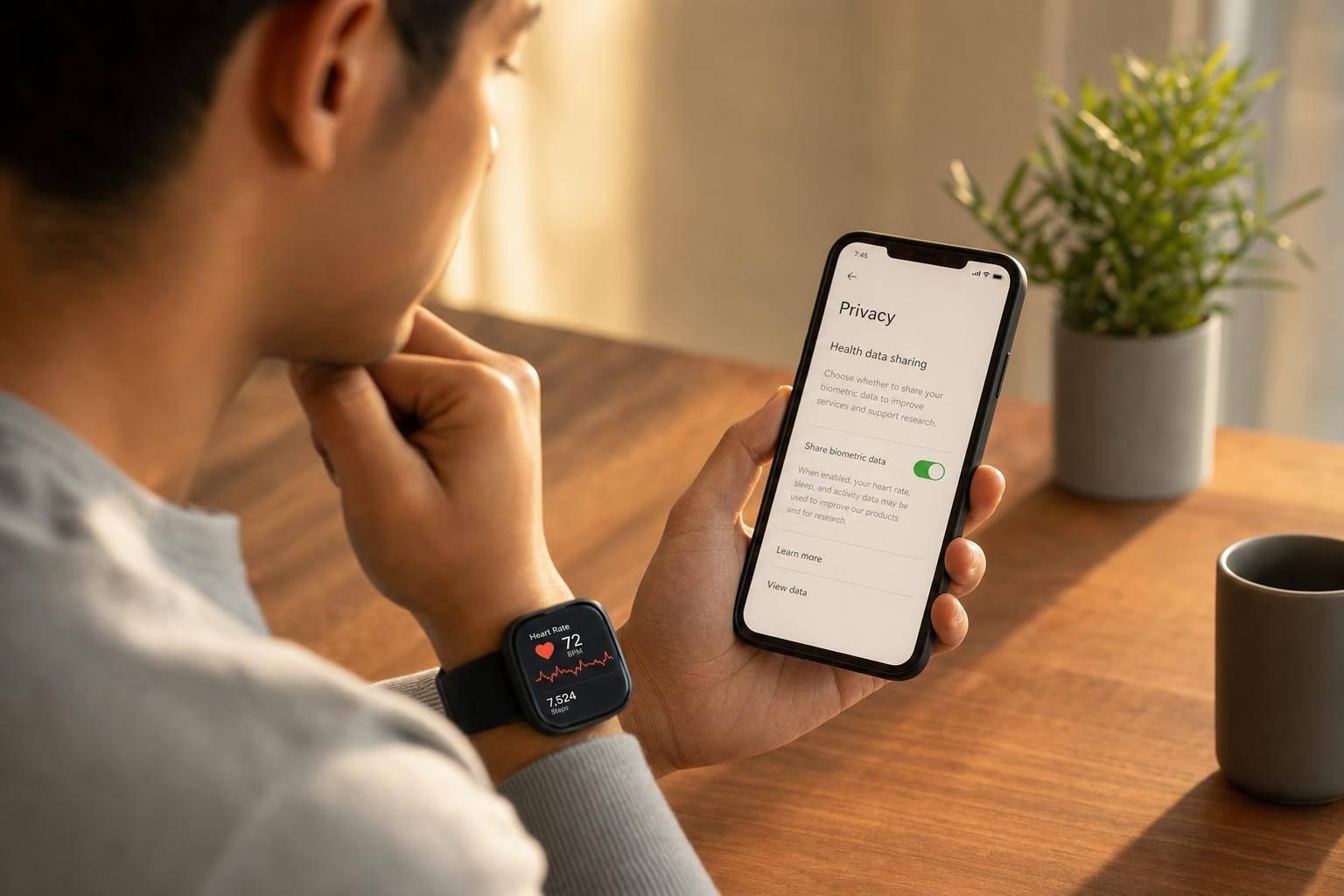
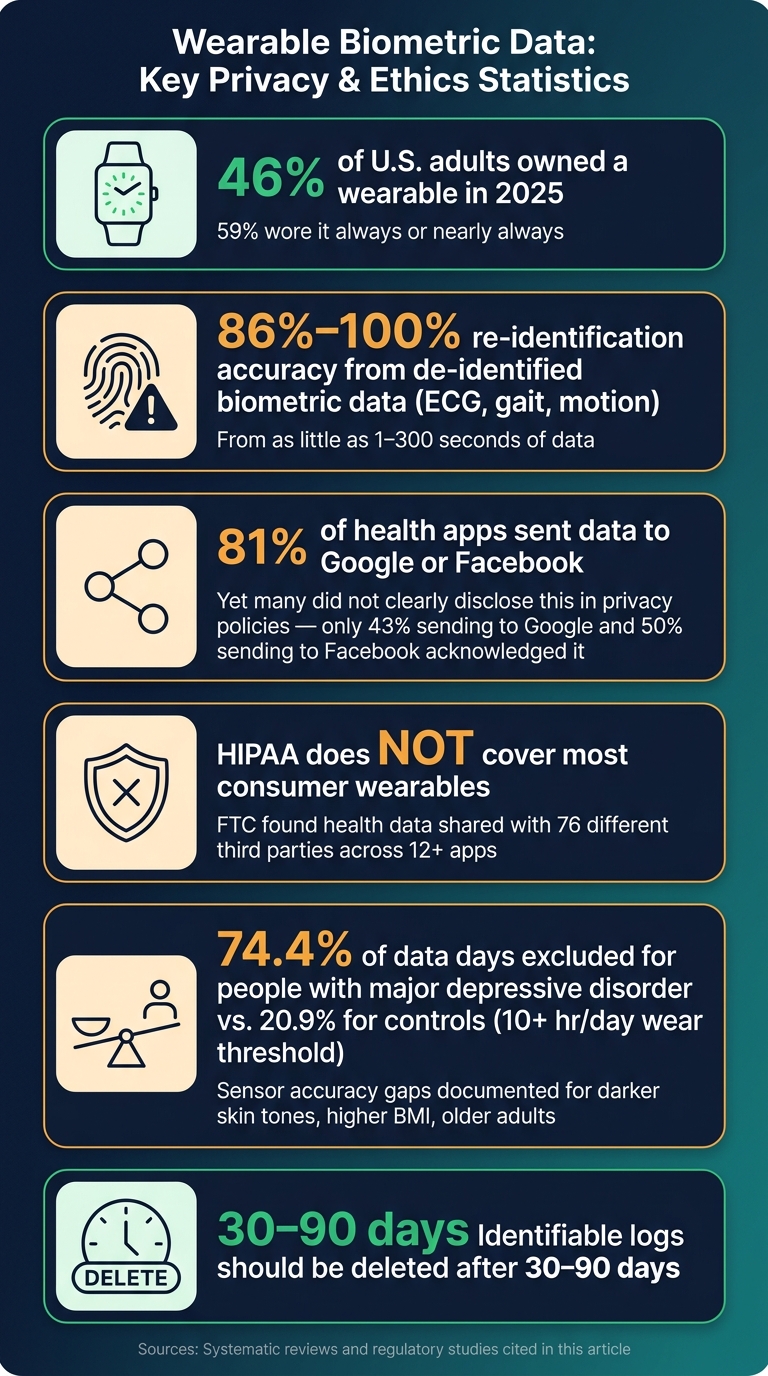
Your smartwatch may tell a lot more about you than your step count. In the U.S., 46% of adults owned a wearable in 2025, and 59% of owners wore one always or nearly always. That means these devices create a near-constant record of your body, habits, sleep, movement, and sometimes your location.
Here’s the short version: wearable data can be deeply personal, hard to anonymize, and easy to reuse in ways many people do not expect. Once AI starts using that data, the risks grow. A system can predict stress using wearable data by turning heart rate, sleep, and motion into guesses about mood, burnout, or health risk. That can help users. It can also go too far.
What I’d want you to know right away:
- “De-identified” does not always mean anonymous. Studies found biometric signals like ECG, gait, and motion data could re-identify people with 86% to 100% accuracy.
- Privacy policies often leave out key details. One study found 81% of health apps sent data to Google or Facebook for ads or analytics, yet many did not clearly say so.
- Consent can drift over time. Data shared for fitness can later be used for mood, stress, or risk scoring.
- AI can work unevenly across groups. Wearable sensors and training data may perform worse for some users, including people with darker skin tones, higher BMI, older adults, and people with irregular schedules.
- U.S. legal rules have gaps. HIPAA often does not cover consumer wearables used outside health care settings.
- Good product design matters. Clear controls, plain-language explanations, short data retention, and strong access limits help reduce risk.
If you use AI health coaching, this is the core issue: it’s not just about collecting data. It’s about how far that data can travel, what it can reveal, and whether you stay in control of it.
Wearable Biometric Data: Key Privacy & Ethics Statistics
What studies say about privacy, re-identification, and data sharing
Why de-identified biometric data can still identify a person
Many people think that if a dataset removes names, the data becomes anonymous. With wearable biometrics, that idea falls apart fast.
A review of 72 studies found identification accuracy ranging from 86% to 100% across ECG, EEG, gait, and inertial signals. In some datasets, it took only seconds of data to re-identify a person.[1] That matters because biometric signals can point to a person even when names and device IDs are gone. So, taking out a name does not remove identity risk.
And even when data can't be neatly linked back to a person's name, it can still be shared, sold, or used again in ways the user never expected.
What privacy policy research says about transparency and third-party sharing
Even if re-identification were off the table, there's still another problem: many users have little idea where their data goes after it leaves the device.
A living systematic review of privacy policies from 17 major wearable manufacturers found gaps across almost every area of transparency.[5] Policies often explain data use with broad phrases like service improvement or research and development. That sounds fine on the surface, but it tells users almost nothing about secondary uses like behavioral profiling, algorithm training, or data commercialization.[5]
Third-party sharing shows the same pattern. Policies often admit that sharing happens, but they rarely spell out who gets the data, what those parties do with it, or whether the data goes to advertising networks, analytics providers, or employer wellness programs.[5]
One study of 36 health apps found that 81% sent data to Google or Facebook for advertising or analytics. But only 43% of apps sending data to Google and 50% of those sending data to Facebook said so in their privacy policies.[6]
That lack of clarity gets more serious once AI systems start using wearable data for profiling, training, or prediction.
Why user comfort with sharing does not remove ethical risk
User comfort doesn't fix poor disclosure. Low concern is not the same thing as informed consent.
Many users don't know that wearables can infer stress, location, routines, or health status. And concern tends to go up once those inferences are made clear.[3][4] For AI-powered health analytics tools, that gap matters because personalization depends on data people may not fully understand they are giving away.
sbb-itb-f5765c6
Is Your Smartwatch Spying on You? We Analysed 17 Privacy Policies to Find Out.
The main ethical issues in AI-driven biometric monitoring
Privacy and security challenges are only part of the story. The deeper ethical problems are consent drift, bias, and surveillance. Studies point to these three risks again and again, and they get more serious when AI systems use wearable data to score, predict, and recommend things in real time.
Why constant monitoring makes consent harder
Wearables turn consent into something that should be ongoing, not a box you check once and forget. When a device tracks heart rate, sleep, and stress signals all day and all night, the data keeps moving long after that first agreement.[7][10]
Research points to a clear problem here: purpose creep. Data like step counts and heart-rate variability may start out as fitness data, then later get re-analyzed to infer mood, burnout, or health risk. After that, it can feed later AI predictions without any clear re-consent from the user.[7][8][11] That shift matters. Someone might agree to track workouts, but not to have the same data used to guess their mental state.
That’s why many scholars now argue that meaningful autonomy needs dynamic, ongoing consent. In plain terms, people need clear notices and real choices whenever their data gets used for a new purpose or when new AI features enter the picture.[10][13][17]
Bias and uneven outcomes in health predictions and recommendations
AI systems depend on the data used to train them. With wearables, that creates a serious weak spot.
Common optical sensors like PPG, which show up in wrist-worn devices and smartwatches, have documented accuracy gaps for people with darker skin tones or higher BMI.[12][14][16] And the problem doesn’t stop at the sensor. If the reading is off at the start, later AI predictions can also be off. That can distort stress scores, recovery indexes, and activity recommendations before the AI even makes a call.[12][14][16]
The training data adds another layer. A 2026 study on wearable device wear time found that using a threshold of 10 or more hours of daily wear excluded 74.4% of data days for individuals with major depressive disorder, compared with 20.9% for controls.[15] That kind of filtering doesn’t just trim the dataset. It systematically removes data from people who may need health monitoring the most.
The result is a pattern that can be easy to miss: decent average performance can still hide uneven outcomes. Studies show that AI wearables can be less reliable for Black users, people with chronic illness, older adults, and people with irregular schedules.[12][14][15][16]
Surveillance and sensitive inferences beyond the original purpose
Most people expect wellness data to stay in the setting where they shared it. If someone shares biometric data for personal health coaching, they expect it to stay there, not show up in a marketing profile, an insurance underwriting model, or an employer performance review.[9][11]
But that line gets crossed a lot. Wearables used in workplace wellness programs can shift into productivity monitoring, where heart rate, stress indicators, and sleep patterns are used to infer engagement or burnout risk.[9][11] What starts as wellness can turn into a quiet form of oversight.
Even when these programs are described as voluntary, the pressure can be hard to ignore. Employees may feel pushed to join so they don’t look uncooperative or miss out on benefits, which weakens real consent.[18][19][20]
These risks hit hardest when wearable data feeds AI health coaching and everyday recommendations.
What regulation and governance research recommends
Those ethical risks stick around because the legal setup is patchy. Wearables produce health data, but a lot of that data lives outside the toughest health-data rules.
Where U.S. rules apply and where they fall short
Many people think HIPAA covers data from their smartwatch or fitness band. In most cases, it doesn't. HIPAA usually does not cover consumer wearables bought or used outside a clinical setting, which means that data can often be shared more freely than medical records.[22][25] So a big chunk of wearable data ends up governed by company privacy policies, not health-record law.
An FTC study found that more than a dozen mobile health apps and devices sent health information to 76 different third parties. Of those, 18 received device-specific identifiers, and 22 got other health data that could be traced back to users.[21]
The FTC's Health Breach Notification Rule, or HBNR, was updated in July 2024. It now clearly covers fitness trackers and health apps outside HIPAA, and it requires companies to notify both users and the FTC when identifiable health data is exposed.[24][26][29] That's a step forward. But it mainly deals with breaches after they happen, not with how companies use data before anything goes wrong.
FDA oversight comes into play when a wearable makes disease-related claims, like ECG-based arrhythmia detection.[22][27] General wellness devices usually sit outside FDA review.
For companies working across borders, the rules get tighter. Under GDPR, wearable outputs that reveal health or biometric details count as special-category data. That brings requirements like explicit consent, purpose limits, stronger security, and other safeguards.[28][23][30] The EU AI Act pushes further by treating some biometric and health AI systems as high-risk. That means firms may need risk management, transparency, human oversight, and documentation.[28][23][30]
Governance practices studies recommend for wearable AI
Because law leaves holes, researchers also point to technical and company-level controls. The basic playbook includes role-based access control, encryption, audit logs, and strict limits on how long data is kept. For example, per-second heart rate data can be stored briefly and then downsampled, while identifiable logs can be deleted after 30–90 days. Hold onto data for too long, and the risk of re-identification goes up.
For the AI layer, the guidance gets more specific. Studies call for bias testing across demographic subgroups, explainability tools that show users why AI-driven nudges or recommendations appeared, and privacy-preserving methods like edge processing and federated learning. In plain terms, the system shouldn't just work. It should also show its reasoning and avoid exposing more user data than needed.
The table below sums up the main rules and safeguards.
| Rule or Framework | Relevance to Wearables | Main Gap | Recommended Safeguard |
|---|---|---|---|
| HIPAA | Covers wearable data flowing through covered entities in clinical settings | Most consumer wearables fall outside its scope | Map data flows; apply equivalent contractual protections for non-HIPAA data |
| FTC HBNR (updated July 2024) | Covers health apps and fitness trackers outside HIPAA | Addresses breaches after the fact; doesn't limit secondary use | Breach detection workflows; accurate privacy disclosures |
| FDA Medical Device Rules | Applies when a wearable makes disease-related claims | Doesn't cover wellness features making quasi-clinical inferences | Medical-device-grade cybersecurity when moving into clinical use and adopting AI tools for patient-centered treatment |
| GDPR | Treats health and biometric wearable data as special-category; applies to EU users | U.S. companies may underestimate extraterritorial reach | Explicit consent, data minimization, purpose limitation, deletion rights |
| EU AI Act | High-risk rules for biometric identification and health AI systems | Still maturing; enforcement timelines vary by risk tier | Risk documentation, bias testing, human oversight, transparency logs |
What this means for AI health coaching and key takeaways
How ethical research applies to AI health coaching apps
For AI health coaching, the ethical issue isn’t whether wearable data should be used. It’s how to use it without going too far. These apps sit right at the center of the risks covered in this review. They process continuous, deeply sensitive data streams that can reveal more than most users may expect, including stress, sleep, and other health-related inferences. That puts a lot of weight on product decisions around consent, transparency, and data access.
In product terms, the research points to three basics: granular consent, purpose-specific consent, and plain-language explanations that show which signals led to a recommendation and why.[32][2] An app that uses these signals should make choices clear and give users meaningful controls over each source of data.[2] It also makes sense to present AI coaching as decision support (rather than a traditional trainer), not a clinical substitute.
Key points readers should keep in mind
The studies point to three takeaways.
Wearable biometrics are more sensitive than they look. Heart rate, gait, and sleep data can reveal health conditions, habits, and even identity. Systematic reviews show de-identified ECG or heart-rate variability can re-identify people with 86%+ accuracy from as little as 1 to 300 seconds of data.[31][1]
AI raises both the value and the risk. It can turn raw sensor data into useful health insights, but poorly tested models can produce biased or misleading recommendations, especially for underrepresented users.[32] Continuous monitoring also makes meaningful consent harder, because a one-time sign-up agreement doesn’t fully cover what 24/7 data collection can infer over time.[2]
Continuous wearable data demands continuous accountability. Good guidance depends on clear rules for collection, retention, access, and explanation. Apps that make those answers easy to find and easy to control are in a better position to earn user trust.
FAQs
Can my wearable data identify me?
Yes. Wearable biometric data can identify you even when your name and other direct identifiers are removed.
Why? Because patterns in your heart rate, sleep, movement, and GPS data can form a kind of behavioral fingerprint. It’s a bit like recognizing someone by the way they walk or the route they take every day.
Studies show that even de-identified data can sometimes be re-identified using short sensor samples. That means a small slice of wearable data may be enough to connect the data back to a person.
Reducing this risk requires technical and organizational safeguards, including clear data controls and careful limits on access and reuse.
Does HIPAA protect smartwatch data?
No. HIPAA does not automatically protect data from consumer smartwatches.
It usually applies only to protected health information handled by covered entities such as healthcare providers, hospitals, and insurers.
That means data from your personal smartwatch often sits outside HIPAA. Instead, it may fall under state privacy laws or Federal Trade Commission oversight.
So before you sync, share, or store biometric data, check the device's privacy policy. That’s where you’ll usually find how your data is stored, who it’s shared with, and what control you have over it.
How can I control wearable data use?
Review app permissions and privacy settings so your wearable doesn't get more access than it needs. Pay close attention to data like location, biometrics, contacts, and background activity. If a feature isn't useful, turn it off. And if you connected third-party apps months ago and forgot about them, revoke that access.
Use strong passwords, multi-factor authentication, and device encryption. Those basics still matter. A fitness tracker or smartwatch might feel casual, but it can hold a lot of personal health data.
Because HIPAA may not cover all wearable data, it's smart to be selective about the platforms you use. Look for services that let you control who can see your data, explain their policies in plain English, and give you a way to export or delete old health records.