
Machine learning is transforming wearable health devices from basic trackers into tools that deliver personalized health insights and real-time adjustments. These devices now analyze continuous, real-world data to detect patterns, predict health risks, and offer tailored recommendations. Here’s what you need to know:
- Key Applications: Detecting irregular heart rhythms, predicting hospitalizations, monitoring sleep disorders, and assessing stress.
- Data Sources: Sensors like ECG, PPG, and accelerometers collect heart rate, blood oxygen levels, glucose, and more.
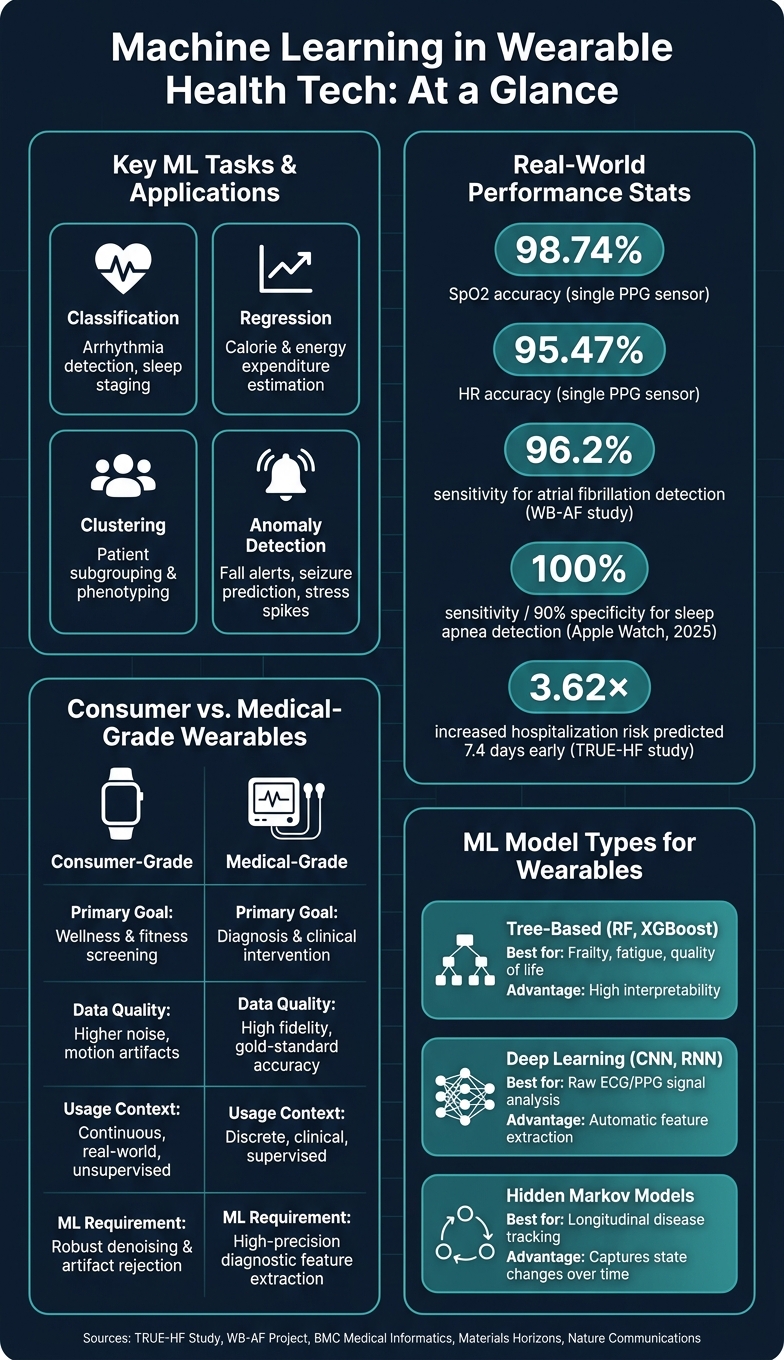
- ML Tasks: Classification (e.g., arrhythmia detection), regression (e.g., calorie estimation), clustering (e.g., patient subgrouping), and anomaly detection (e.g., fall alerts).
- Consumer vs. Medical Devices: Consumer wearables focus on convenience, while medical-grade devices offer higher accuracy for clinical use.
- Challenges: Small datasets, noisy signals, privacy concerns, and integrating wearable data with healthcare systems.
ML-powered wearables are narrowing the gap between daily health tracking and clinical-grade monitoring. With advancements in algorithms and sensor technology, these devices are becoming increasingly reliable for early detection and personalized care.
ML in Wearable Health Tech: Consumer vs. Medical-Grade Devices & Key Applications
Key Biometric Signals in Wearable Devices
Common Biometric Data Types
Modern wearable devices pack a variety of sensors into compact designs, capturing key biometric data like heart rate (HR), heart rate variability (HRV), blood oxygen saturation (SpO2), respiratory rate, skin conductance, and glucose levels. These measurements rely on different technologies.
For example, HR and HRV are typically measured using Photoplethysmography (PPG) - an optical method that detects changes in blood volume under the skin - or Electrocardiography (ECG), which directly records the heart's electrical activity [8][10]. SpO2 levels are determined by analyzing how red and infrared light (~660 nm and ~880 nm) is absorbed by vascular tissue [10]. Similarly, Electrodermal Activity (EDA), also known as Galvanic Skin Response (GSR), gauges sweat gland activity to assess stress and emotional states [4][9]. Meanwhile, biochemical sensors use microneedles or patches to monitor glucose and other metabolites directly from interstitial fluid or sweat [9][11].
A growing trend in wearable technology is the shift toward single-sensor, multi-parameter systems. For instance, a single PPG sensor like the MAX30102 can simultaneously estimate HR, SpO2, blood pressure, and respiratory rate. These systems achieve impressive accuracy levels: 98.74% for SpO2, 95.47% for HR, and 95.01% for respiratory rate [10].
What Makes Wearable Data Useful for ML
What sets wearable data apart is its ability to provide continuous monitoring. Unlike clinical tests, which capture isolated moments, wearables deliver a steady stream of real-world data. This long-term, time-series information is exactly what machine learning (ML) models need to identify patterns and insights.
"Machine learning proposes a powerful approach to analysing complex datasets and extracting meaningful patterns, enabling the prediction of patient outcomes." - Eloise Milbourn, Department of Biomedical Engineering, The University of Melbourne [2]
Because wearables integrate multiple sensors - like accelerometers, PPG, and ECG - ML models can combine these signals to create a more comprehensive view of a user’s health. This "multimodal" approach helps close gaps that might arise from relying on a single data source. It also eliminates recall bias, as wearables record what’s actually happening in real time, rather than relying on a patient’s memory.
These features influence both the design of wearable devices and the preprocessing steps for ML models. They also highlight the differences between consumer and medical-grade wearables, particularly in how they handle continuous, multimodal data.
Consumer vs. Medical-Grade Wearables
Wearables vary widely in their purpose and quality. Medical-grade devices are designed to meet rigorous international standards (like AAMI/ESH/ISO) and often feature high-precision sensors such as gel-assisted electrodes for ECG. On the other hand, consumer devices, like smartwatches, prioritize convenience and use technologies like PPG and flexible dry electrodes, which are less precise but more comfortable [13].
| Feature | Consumer-Grade | Medical-Grade |
|---|---|---|
| Primary Goal | Wellness, fitness, long-term screening | Diagnosis and clinical intervention |
| Data Quality | Higher noise; motion artifacts common | High fidelity; gold-standard accuracy |
| Usage Context | Continuous, real-world, unsupervised | Discrete, clinical, supervised |
| ML Requirement | Robust denoising and artifact rejection | High-precision diagnostic feature extraction |
The gap between these two categories is narrowing. For instance, consumer devices like the Omron HeartGuide and Samsung Galaxy Watch have received regulatory approval for blood pressure monitoring. These devices can achieve accuracy within ±5–8 mmHg of clinical standards [10]. This evolution in data quality and usage context directly impacts how ML models are developed and deployed for wearable health applications.
sbb-itb-f5765c6
How Machine Learning Is Applied to Wearable Data
Core ML Tasks in Wearable Studies
Machine learning applied to wearable data revolves around four main tasks. Classification assigns labels to data, such as identifying whether a heart rhythm is normal or irregular. Regression focuses on predicting continuous values, like estimating the calories burned during a workout. Clustering groups users based on shared patterns, even without predefined labels, which is helpful for identifying patient subgroups that might respond differently to treatments. This segmentation allows for personalized health nudges that encourage better daily habits. Lastly, anomaly detection highlights unusual events, like a sudden spike in electrodermal activity, an unexpected fall, or an irregular heartbeat, which deviate from a person’s usual baseline.
| ML Task | Common Health Applications | Key Sensors Used |
|---|---|---|
| Classification | Activity recognition, arrhythmia detection, sleep staging | Accelerometer, ECG, PPG |
| Regression | Energy expenditure estimation, tremor score prediction | Accelerometer, Gyroscope |
| Clustering | Patient phenotyping, treatment responder identification | Multimodal (ECG, PPG, EDA) |
| Anomaly Detection | Fall detection, seizure prediction, stress spikes | Accelerometer, EDA, HRV |
These tasks serve as the foundation for a variety of health-related applications.
Health Goals ML Models Address
Using these machine learning tasks, researchers have made strides in areas like cardiovascular monitoring, sleep analysis, and seizure prediction. Cardiovascular monitoring is a key focus, often relying on ECG and PPG sensors to detect arrhythmias or assess heart failure risks. For example, the TRUE-HF study trained a deep learning model on Apple Watch data from 217 heart failure patients. The model predicted peak oxygen uptake (pVO2) with a Pearson's correlation of 0.85 when compared to in-clinic tests. A 10% decrease in wearable-derived pVO2 was linked to a 3.62-fold increased risk of unplanned hospitalizations, with the model identifying this risk an average of 7.4 days before the event [7].
Wearable data is also transforming sleep and neurological health monitoring. In a February 2025 pilot study, an Apple Watch-based Random Forest classifier achieved 100% sensitivity and 90% specificity in detecting moderate-to-severe sleep apnea [15]. For seizure prediction, a study involving 69 epilepsy patients monitored electrodermal activity, body temperature, and blood volume pulse over 2,311 hours. Using Long Short-Term Memory (LSTM) networks, the study identified patterns across 452 recorded seizures [8].
"Machine learning plays a crucial role in biosignal analysis by improving processing capabilities, enhancing monitoring accuracy, and uncovering hidden patterns and relationships within datasets." - Inhea Jeong et al., Department of Materials Science and Engineering, Yonsei University [12]
From Raw Sensor Data to Health Insights
Turning raw sensor data into meaningful health insights requires several steps. First, the data is cleaned to remove interference, such as ambient light or noise, using techniques like bandpass filters. It’s then normalized and segmented into manageable time windows. From these windows, features are extracted.
These features fall into different categories. Time-domain features, like Mean Absolute Value (MAV), can measure muscle contraction strength. Frequency-domain features, such as Power Spectral Density (PSD), provide insights into energy distribution and signs of fatigue. For more complex signals like ECG and EMG, methods like Empirical Mode Decomposition (EMD) are used to break the signal into components called Intrinsic Mode Functions (IMFs). This makes it easier to identify meaningful patterns [8]. By structuring the data in this way, machine learning models can transform raw sensor streams into actionable insights for health monitoring and recovery intervention.
ML Model Types and Their Uses
Model Families Used in Wearable Research
Different machine learning (ML) models are better suited for specific tasks in wearable health research.
Tree-based models, like Random Forest (RF) and XGBoost, are the most commonly used. A review of 76 peer-reviewed studies found these algorithms to be the go-to choice for chronic disease monitoring [16]. Why? They’re not only accurate but also provide insights into their predictions through feature importance scores. This transparency is especially important in clinical settings. As highlighted in a review published by BMC Medical Informatics and Decision Making:
"Model interpretability as achieved by, e.g., white-box models, feature importance, or decision trees is essential for establishing ML in a clinical decision support system (CDSS) as it addresses safety concerns." - BMC Medical Informatics and Decision Making [16]
On the other hand, deep learning models like Convolutional Neural Networks (CNNs) and Recurrent Neural Networks (RNNs) take a different route. Instead of relying on pre-defined features, they learn directly from raw sensor data, such as ECG or PPG signals. However, their "black box" nature makes them harder to adopt in clinical environments. Meanwhile, Hidden Markov Models (HMMs) excel at tracking changes over time. For example, they outperform Random Forest (p < 0.05) when monitoring evolving health states, making them ideal for longitudinal applications [2]. This is particularly effective for monitoring kidney disease with wearables, where tracking fluid status and blood pressure over time is critical.
Here’s a quick overview of how these models stack up:
| Model Family | Best Use Case | Key Advantage |
|---|---|---|
| Tree-Based (RF, XGBoost) | Frailty, quality of life, fatigue | High interpretability via feature importance |
| Deep Learning (CNN, RNN) | Raw signal analysis (ECG, PPG) | Automatic feature extraction |
| Hidden Markov Models | Longitudinal disease tracking | Captures state changes over time |
| Logistic/Ridge Regression | Binary recovery outcomes | Low computational cost; useful as a baseline |
Each model family has strengths and limitations. Choosing the right one depends on the specific needs of the wearable application.
How to Choose the Right Model for Wearables
Selecting the right model for wearable research goes beyond accuracy. The context of the task and the constraints of wearable devices play a huge role. Here are three key factors to consider:
- Interpretability vs. performance: In clinical settings, trust and understanding often outweigh small gains in accuracy. For example, researchers working with the Toledo Study for Healthy Aging (TSHA) used XGBoost to predict frailty metrics from just 48 hours of accelerometry data. The model achieved a Spearman p-value of 8.70×10⁻³⁶. They chose XGBoost for its strong track record, ease of use for subject matter experts, and ability to handle mixed or missing data [6].
- Edge computing constraints: Wearable devices have limited processing power and battery life. While deep learning models might excel on servers, they’re often too resource-intensive for real-time, on-device use. As noted in Materials Horizons, "effective ML-driven biosignal analysis requires careful model selection, considering data preprocessing needs, feature extraction strategies, computational efficiency, and accuracy trade-offs" [12]. This has led to a push for lightweight architectures that can run directly on wearable hardware.
- Temporal structure: The nature of the data also matters. If you’re analyzing a single snapshot, models like Random Forest or logistic regression may work just fine. But when tracking symptoms or health metrics over time, sequence-aware models like HMMs or Long Short-Term Memory (LSTM) networks are better suited. These models can process sequential data and capture patterns that unfold over days or weeks.
Clinical and Consumer Applications
Key Use Cases by Category
Machine learning (ML) is transforming wearable technology, enabling applications that range from hospital-grade monitoring to everyday fitness tracking. Here's a breakdown of how ML is being utilized across different health and fitness areas:
| Application Area | ML Function | Primary Signals |
|---|---|---|
| Cardiovascular | Estimates peak oxygen uptake (pVO2); detects arrhythmias | Heart rate, step count, ECG |
| Fitness & Activity | Assesses readiness, fatigue, and energy expenditure | Activity intensity, resting HR, sleep |
| Sleep & Stress | Detects sleep disorders; assesses stress resilience | HRV, sleep stages, behavioral markers |
| Elderly Care | Predicts frailty and fall risk from movement data | 3-axis accelerometry |
| Remote Patient Monitoring | Flags early signs of deterioration before hospitalization | Multi-sensor fusion |
The potential of ML in healthcare is vividly demonstrated by studies like the TRUE-HF study, which used a deep learning model to predict hospitalization risk in heart failure patients a median of 7.4 days in advance [7]. Similarly, the WB-AF research project (2022–2023) at Kuopio University Hospital showcased ML's precision in detecting atrial fibrillation (AF). Using a Movesense Medical chest strap, a deep neural network achieved an impressive 96.2% sensitivity and provided AF burden estimates with an intraclass correlation of 0.96, closely aligning with physician-interpreted Holter ECGs [3].
What ML Adds to Wearable Health Monitoring
ML fundamentally changes how wearable devices contribute to health monitoring. Instead of relying on periodic tests like the 6-minute walk test or cardiopulmonary exercise testing (CPET), ML turns raw data into continuous, real-time insights. This shift allows for earlier detection of potential health issues and more dynamic monitoring.
"Wearable-derived daily pVO2 provides earlier and improved risk discrimination compared with existing wearable fitness estimates and established clinical markers." - TRUE-HF Study Authors [7]
For example, a 10% drop in wearable-derived daily pVO2 has been linked to a 3.62-fold increased hazard ratio for unplanned healthcare events [7]. Such insights are impossible to glean from annual clinical check-ups, making ML-powered wearables a game-changer. These advancements also lighten the workload for healthcare providers:
"This AI-driven approach enables automated and accurate rhythm analysis, supporting clinical decision-making." - JMIR mHealth and uHealth [3]
How Healify Uses Wearable and Biometric Data
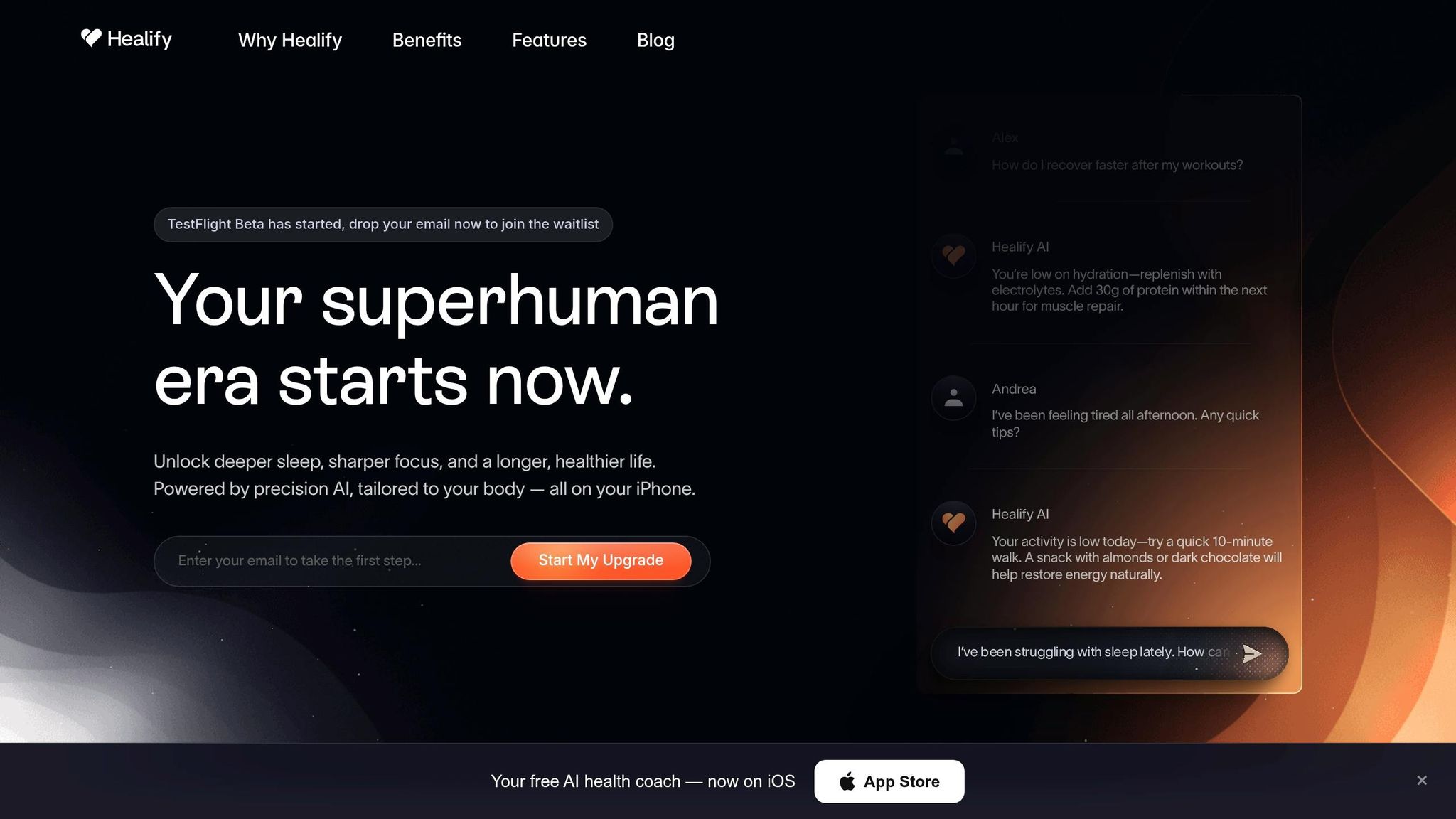
Platforms like Healify are leading the way in using ML to provide meaningful, user-centric insights. Healify's AI health coach, Anna, takes data from wearables, biometrics, bloodwork, and lifestyle inputs to create personalized, actionable health plans.
Rather than overwhelming users with raw numbers, Anna simplifies the data. For instance, she might connect a drop in heart rate variability (HRV) with declining sleep quality and explain how this could affect your energy and stress levels - all in clear, easy-to-understand language.
This approach aligns with research on AI health systems like the Personal Health Insights Agent (PHIA). Studies show that users respond better when AI provides advice based on their specific metrics rather than offering generic recommendations [1]. Healify follows this principle, ensuring that the guidance you receive is tailored to your data, your patterns, and your goals - not a one-size-fits-all solution.
Challenges and Gaps in Wearable ML Research
Common Limitations in Current Studies
Wearable ML research is grappling with several notable hurdles. One major issue is the reliance on small sample sizes - the average study involves just 188 participants, with some including as few as six. This often leads to overfitting, making it hard to translate findings into practical applications. On top of that, sensor signals are frequently noisy or incomplete, further complicating analysis. This makes it difficult to extract personalized health insights from wearable anomaly data effectively.
"The high volume and complexity of long-term biosignal data, along with noise, missing values, and environmental artifacts, present significant challenges for accurate analysis." - Inhea Jeong et al., Yonsei University [12]
Another recurring problem is patient compliance. Studies report adherence rates ranging from 59% to 85% [2][7], which introduces gaps in the data and weakens longitudinal studies. These issues are compounded by concerns over data privacy and system integration.
Privacy and Integration Concerns
Privacy in wearable ML isn't just about protecting basic health metrics. Advanced ML models can infer deeply personal information, such as mental health conditions, cognitive decline, or dementia, from seemingly routine data like sleep patterns [17]. In the U.S., this is further complicated by regulatory gaps. While HIPAA safeguards data within hospitals and insurers, most wearable manufacturers fall outside its jurisdiction [17].
Adding to this complexity is the "black box" nature of many ML models. High-accuracy predictions are often opaque, leaving clinicians in the dark about how decisions are made. This lack of transparency creates tension between predictive accuracy and the need for clinical accountability.
Integration is another sticking point. Most wearable ML systems operate independently, making it difficult to align their data with existing electronic health records or hospital systems [14][2].
Areas for Future Research
Overcoming these challenges opens the door to critical advancements in wearable ML. One key focus is real-world validation. Without testing in free-living environments, accuracy claims in controlled studies may not hold up in practical settings [14].
Another area of emphasis is dataset diversity. Expanding datasets and leveraging massive amounts of unlabeled data for pretraining could improve how models generalize across populations.
"Converting low-level sensor data into representations capable of characterizing higher-level states is difficult due to high phenotypic diversity and variation in individual baseline health, physiology, and lifestyle factors." - Girish Narayanswamy et al. [5]
A promising approach involves pretraining on vast datasets, such as one initiative that utilized over a trillion minutes of sensor data to address labeled data shortages across health prediction tasks [5]. Additionally, emerging agentic AI frameworks, which apply multi-step reasoning, may help tackle the computational challenges of processing raw time-series data [1].
AI for Health with Wearables, Chenyang Lu, Washington University in St. Louis

Conclusion: Where Machine Learning in Wearable Health Tech Is Headed
The research discussed here highlights a clear trend: wearable technology powered by machine learning is shifting from simply gathering data to delivering personalized health insights. Advanced models are now transforming raw, noisy sensor data into continuous, clinically relevant information. This represents a significant shift - machine learning isn't just collecting data anymore; it's actively shaping health decisions.
The numbers tell the story. A foundational model, trained on over 1 trillion minutes of sensor data from 5 million users, showed consistent improvements across 35 health prediction tasks [5]. Similarly, the TRUE-HF study revealed that a deep learning model using Apple Watch data could predict a 3.62-fold increase in hospitalization risk - a median of 7.4 days before the event - by analyzing daily changes in estimated peak oxygen uptake [7].
The future likely lies in the development of next-generation agentic AI systems. These systems go beyond simply reporting data; they interpret and reason over it. As researchers behind PHIA explained:
"This work can advance behavioral health by empowering individuals to understand their data, enabling a new era of accessible, personalized, and data-driven wellness for the wider population." - Nature Communications [1]
These AI-driven tools are already narrowing the gap between raw sensor outputs and actionable health advice. With smarter algorithms, larger datasets, and frameworks designed to handle the messy realities of daily life, these systems are becoming more effective. While challenges like privacy, integration, and transparency remain, they are being tackled with promising solutions.
For users, this means their wearable devices are no longer just trackers - they're becoming tools for early warnings, personalized health baselines, and proactive management. The data you’re already collecting is now working harder than ever to support your health.
FAQs
How accurate are smartwatch readings compared to medical-grade wearables?
Smartwatches can be surprisingly precise, but their accuracy depends on the metric and the situation. For example, when it comes to resting heart rate, they’re typically within ±2-5 bpm compared to ECG standards - a solid performance. However, the story changes during intense workouts or rapid movements, where accuracy tends to decline noticeably.
Other metrics, like energy expenditure, are known for having much larger error margins. Some devices go a step further, offering FDA-cleared features like ECG or AFib detection. But it’s important to note that these tools are designed for screening purposes, not for making a medical diagnosis.
That’s where Healify steps in, helping you make sense of all this data and translating it into an actionable, easy-to-follow health plan.
What happens when my wearable data is noisy or missing?
Noisy or incomplete data from wearables can happen for a variety of reasons - like poor sensor contact, connectivity issues, or simply a drained battery. These gaps can impact the accuracy of the health insights you rely on. To tackle this, methods such as data imputation (filling in missing values) or confidence-weighted outputs (highlighting uncertain data) come into play. Healify works to make sure that even with these challenges, your biometric and lifestyle data is transformed into clear, actionable health plans you can trust.
How can wearable ML insights be used safely without risking my privacy?
To make the most of machine learning insights from wearables, it's crucial to choose platforms that prioritize transparency and secure, consent-driven data handling. Sensor data collected at high frequencies, such as motion patterns, can sometimes serve as unique identifiers, even if anonymized.
Healify takes your wearable data and turns it into tailored health plans, all while maintaining a strong focus on privacy and security. They ensure your data is handled responsibly, helping you improve your well-being without compromising your trust.