
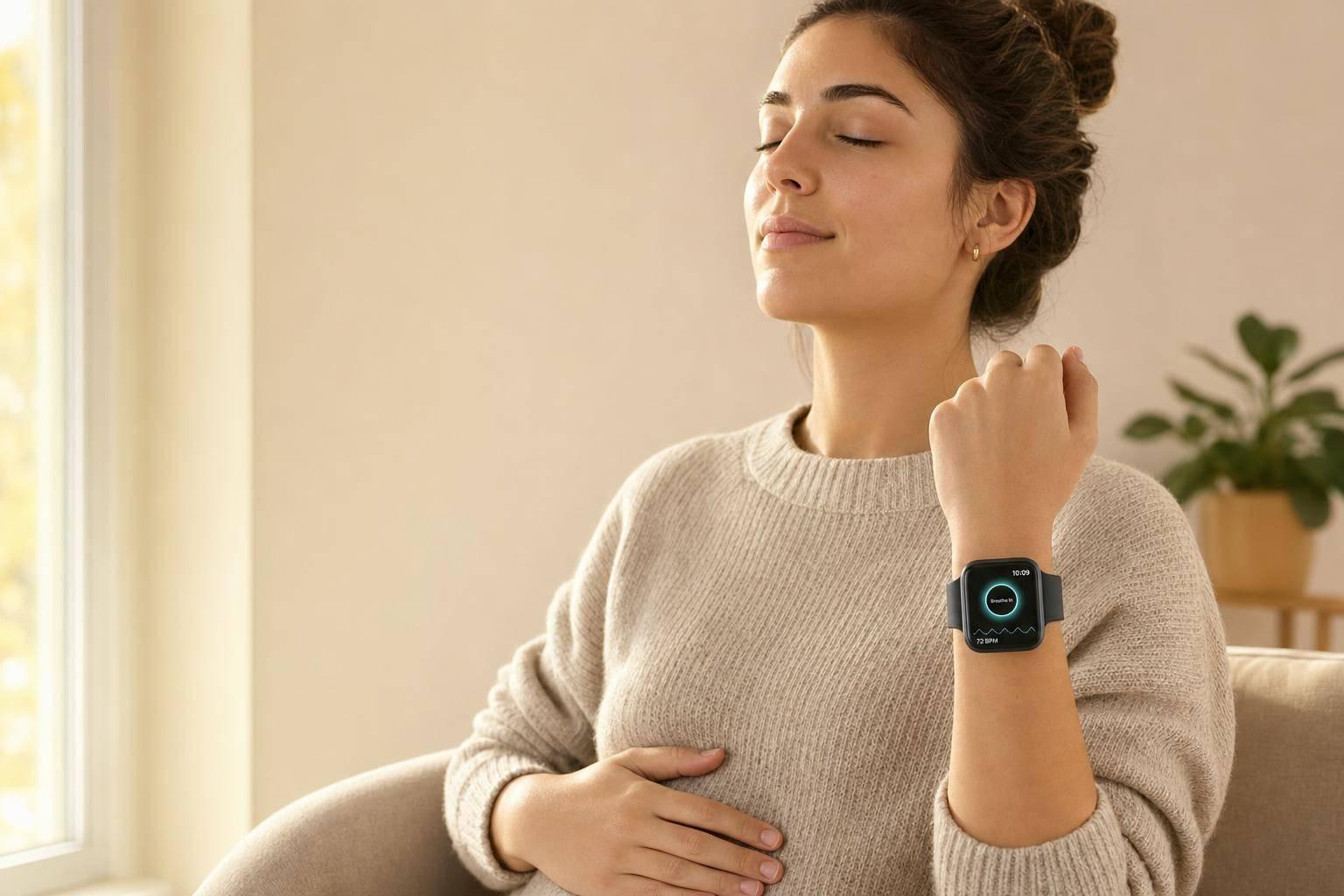
Wearable biofeedback can help you catch stress before it turns into a bad reaction. In plain terms: your watch, ring, strap, or breathing device reads body signals like heart rate, HRV, breathing, and skin conductance, then nudges you to pause and reset.
Here’s the short version:
- Emotional regulation starts with early notice. If you spot stress sooner, you have a better shot at changing your response.
- Wearables turn body signals into prompts. That can mean a vibration, a breathing guide, or a trend view in an app.
- HRV, breathing, and EDA are the main signals. HRV often points to recovery, breathing shows tension fast, and EDA can flag arousal before you fully feel it.
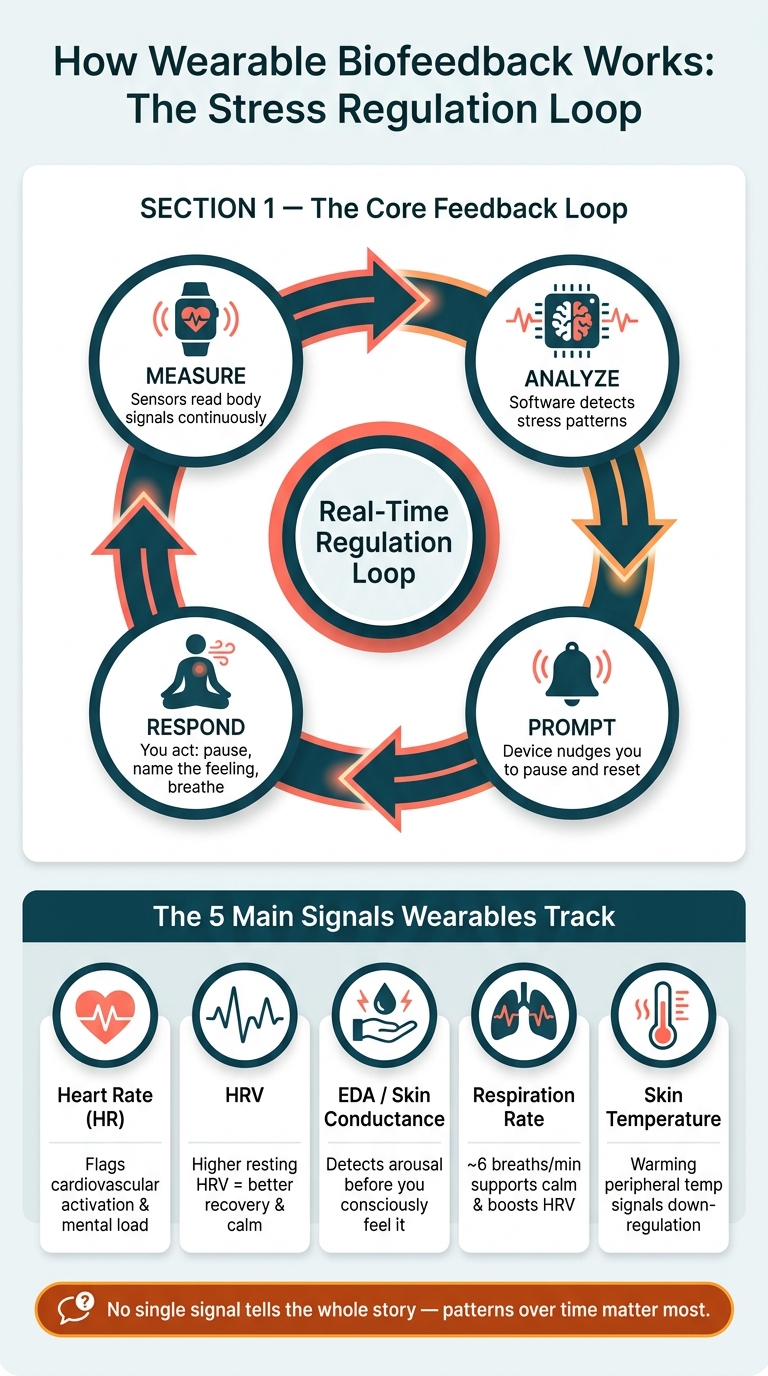
- The main loop is simple: measure → analyze → prompt → respond.
- Short breathing sessions work. About 5–6 breaths per minute for 5 to 20 minutes a day can help with stress, sleep readiness, and recovery.
- You do not always need a high-end device. In one comparison, paced breathing alone moved breathing rate from 12.5 to 6.1 breaths per minute and HRV amplitude from 4.2 to 8.0.
- Different wearables do different jobs. Some are best for short guided sessions, while others are better for all-day trigger tracking.
- Alerts help most when you act on them. A good response is: pause, name the feeling, and do 2–3 minutes of slow breathing.
- Pattern tracking matters more than one odd reading. Caffeine, poor sleep, illness, movement, and weak sensor contact can all skew the data.
- AI health coaching can help turn data into a next step. Instead of just seeing a low HRV score, you get a plain-language suggestion tied to your habits.
- These tools are support, not treatment. If anxiety, stress, or sleep problems stick around, clinical care may be the next step.
UbiComp/ISWC 2023 Affective Touch as Immediate and Passive Wearable Intervention

sbb-itb-f5765c6
Quick Comparison
| Device type | Main signal | Best use | Feedback style |
|---|---|---|---|
| HRV wearables | HRV from PPG/ECG | Daily reset practice | App views, haptics |
| Breathing wearables | Breathing rate and depth | Fast stress interruption | Guided breathing, alerts |
| EDA wearables | Skin conductance | Early arousal warning | Stress alerts, scores |
| Multimodal devices | HRV + EDA + breathing | Better stress read across signals | Combined prompts |
| Haptic systems | HR, HRV, or EDA | Public or busy settings | Vibrations |
| Smart textiles | HRV, EDA, temperature | Long wear and body tracking | Passive review |
| Immersive systems | HRV, EDA, breathing | Short training sessions | VR/game feedback |
Bottom line: I’d sum it up this way - tracking stress levels with wearable technology is most useful when it helps you notice stress early, practice calm when you’re already okay, and make small changes before a rough moment gets worse.
How Wearable Biofeedback Works
How Wearable Biofeedback Works: The Stress Regulation Loop
At its core, wearable biofeedback runs on a simple loop: measure, analyze, prompt, respond. Sensors keep reading body signals, and the software turns those readings into prompts you can use right away. That creates a real-time regulation loop. The whole point is to spot dysregulation early enough to do something different.
The Main Signals Wearables Track
Modern wearables usually follow a small group of body signals linked to stress and recovery. Heart rate (HR) shows cardiovascular activation. If your resting heart rate climbs without physical effort, that can signal stress or mental load. HRV looks at beat-to-beat variation. Higher resting HRV usually points to better regulation and more parasympathetic activity. Electrodermal activity (EDA), or skin conductance, tracks sweat gland activity driven by the sympathetic nervous system, which makes it a sensitive marker of emotional arousal.
Respiration rate adds another clue. Fast, shallow breathing often shows up with anxiety, while slower, steady breathing at about 6 breaths per minute can support calm and increase HRV.[4][1] Skin temperature at the hands or feet often drops during a stress response, so steady or warming peripheral temperature can suggest down-regulation. Movement data helps the device tell the difference between a stress-related heart rate spike and plain physical activity.
No single signal tells the whole story. Motion, caffeine, illness, dehydration, and poor sensor contact can all skew readings.[5][6] That’s why it makes more sense to watch patterns over time than to overreact to one moment. Looking at signals together, like higher EDA and lower HRV while you’re sitting still, gives a better read than any one metric on its own. The point isn’t the number itself. It’s noticing dysregulation early enough to respond in a better way.
The next step is turning those signals into prompts you can use.
How Devices Turn Body Data Into Feedback
Wearables take raw body data and turn it into simple actions. Many devices convert physiological signals into quick snapshots of stress and recovery, so you get a fast read on how regulated your body seems overall.
For in-the-moment regulation, the real-time feedback loop is where things get useful. The device spots a stress pattern, nudges you to do a breathing reset, and then checks whether your signals settle down. Over time, that repeated detect → prompt → respond → confirm cycle can help you notice what regulation feels like even before the device buzzes.
Different types of feedback fit different moments:
- Haptic prompts tend to work best during the day
- Breathing guides fit short reset sessions
- Dashboards help you notice weekly patterns
Used well, the goal is earlier action, not more screen time.
The Main Types of Wearable Biofeedback for Stress and Mood
Wearable biofeedback tools do different jobs. Some coach you during short practice sessions. Others track stress in the background all day. The big split is simple: do you want a device that helps right now, or one that shows you patterns over time?
HRV, Breathing, and Arousal-Focused Wearables
HRV-focused devices - including smartwatches, rings, chest straps, and ECG patches - track HRV to gauge stress and recovery. Studies tie regular use over several weeks to lower anxiety and better HRV [8][12][13]. These devices are a good fit when you want to learn what a calmer state feels like during a reset, especially in scheduled 10- to 20-minute paced-breathing sessions where you can watch your HRV change in real time.
Respiration-based wearables track breathing patterns. They can pick up shallow or uneven breathing and send a vibration or alert early, which makes them useful for stopping a stress spiral before it builds. Like HRV tools, they work well in guided sessions, but they can also run quietly through the day as passive monitors [14].
EDA-based wearables track skin conductance, which reflects sympathetic activity. EDA can rise before stress feels obvious, so these devices are good at flagging arousal early [7][11]. Pairing EDA with HRV can improve accuracy even more. In one evaluation, a consumer-grade Garmin Forerunner 55 reached an AUROC of up to 0.961 for mental arithmetic stress detection when both signals were used together [16].
These are the most common signal-based tools. The next set shifts the focus from what gets measured to how the feedback reaches you.
Haptic Systems, Smart Textiles, and Immersive Training
Haptic biofeedback systems use vibration patterns to guide breathing and help correct stress responses in the moment. They're most useful when you need a nudge during meetings, commutes, or any setting where looking at a screen just isn't practical. Early studies suggest haptic breathing systems can boost awareness of breathing patterns, lower stress, and improve HRV [15]. Longer-term effects on emotion regulation still need more study.
Some wearables take a different route by building sensors into clothing. Smart textiles place sensors in shirts, belts, or other garments to track HRV, skin conductance, and body temperature across the day [9][10]. Because they can pick up breathing and body tension more fully than wrist-based devices, they make sense for continuous tracking. That said, washability and adherence issues keep them mostly niche for now.
Immersive training systems - such as VR environments or adaptive games that react to your HRV, breathing, and EDA in real time - make the mind-body link easier to feel. As the virtual setting changes based on whether you're settling down or tensing up, you get direct feedback on your state. Pilot studies show gains in anxiety symptoms and HRV metrics [8][9][13]. These systems tend to work best in short training sessions built around stress resilience.
Comparison Table: Signals, Feedback Type, and Best Use Cases
Use this table to match each device to the kind of regulation support you need most.
| Category | Signals Measured | Feedback Style | Primary Outcome | Best Setting | Evidence Level |
|---|---|---|---|---|---|
| HRV-focused wearables | HRV derived from PPG/ECG | Visual, in-app, haptic | Lower anxiety, better recovery | Scheduled daily sessions | Moderate to strong |
| Respiration wearables | Breathing rate, depth, regularity | Haptic alerts, visual guides | Stress interruption | Guided sessions + passive monitoring | Moderate |
| EDA-focused wearables | Skin conductance | Alerts, stress scores | Early arousal detection | All-day passive monitoring | Promising; fewer long-term trials |
| Multimodal devices | HRV + EDA + respiration | Combined in-app feedback | Stress management across signals | High-demand workdays | Strong classification accuracy |
| Haptic systems | HRV, heart rate, EDA | Vibration patterns | In-the-moment calm | Meetings, commuting, public settings | Early/pilot stage |
| Smart textiles | HRV, EDA, skin temperature | Passive data, delayed review | Continuous body monitoring | Sleep, exercise, long workdays | Experimental |
| Immersive training | HRV, EDA, respiration | Adaptive VR/game environment | Stress resilience skill-building | Structured training blocks | Pilot-level; promising |
How to Use Wearable Biofeedback to Build Emotional Regulation Skills
Wearables can help you build emotional regulation in two simple ways: they guide short daily practice, and they warn you when stress is starting to climb. The best approach is straightforward. Practice when you're calm, then use the device when stress shows up.
HRV and Breathing Routines That Fit a Busy Schedule
Three moments tend to work well for most people: right after a stressful meeting, just before your commute home, and during your evening wind-down. In each case, slow paced breathing at about 5–6 breaths per minute can help you come down from stress faster.
Each session does a slightly different job. A post-meeting reset of about 5 minutes helps you recover from acute stress. A pre-commute session of 5–10 minutes can lower arousal before traffic or a packed train. An evening wind-down of 10–20 minutes helps your body get ready for sleep. Even 10–20 minutes a day can improve recovery, stress control, and sleep readiness over time.[21][22]
There's also a helpful point here: you don't need a fancy device to make this work. In one comparison, people using simple paced breathing cut their breathing rate from 12.5 to 6.1 breaths per minute and saw HRV amplitude go from 4.2 to 8.0. Those gains were comparable to the HRV biofeedback group.[23]
Once that breathing pattern starts to feel natural, alerts can help you catch stress earlier in the day.
Using Wearable Alerts to Spot Triggers and Shift Reactions
A wearable alert works best if you treat it like personalized health nudges to check in, not just another buzz to ignore. Pause for a moment. Notice any tension. Name the feeling. Then do 2–3 minutes of guided breathing.[18][3][2] Putting a label on the feeling can lower reactivity and make your next move easier.[17][20]
It also helps to log what was happening around the alert. Track the time, your activity, sleep, caffeine, and the setting. After a while, patterns usually start to show up. Maybe it's back-to-back video calls. Maybe it's late-night screen time. Maybe it's poor sleep the night before.[19]
Comparison Table: Pros and Cons of Common Biofeedback Techniques
Match the method to the situation you need to handle most often.
| Technique | Ease of Use | Learning Curve | Time per Session | Best for Immediate Stress | Best for Chronic Stress | Best for Mood Awareness |
|---|---|---|---|---|---|---|
| HRV training | Moderate | Moderate - short orientation needed | 5–20 min | ✓ Strong | ✓ Strong | ✓ Strong |
| EDA monitoring | High (passive) | Low for alerts; moderate for patterns | Passive / ongoing | ✓ Useful for early warning | ✓ Good for trigger tracking | Moderate |
| Respiration feedback | High | Low - follow a pacer | 5–10 min | ✓ Strong | ✓ Good entry point | Moderate |
| Haptic cues | High | Very low - follow vibration | 1–5 min | ✓ Good in real-world settings | ✓ Supportive | Low |
HRV training has the strongest evidence. Respiration feedback is the easiest place to start. EDA monitoring is a good fit for passive trigger tracking. Haptic cues make the most sense when you're in public or on the go.
Using Wearable Data With AI Coaching for Better Daily Decisions
Wearable data matters most when it leads to a clear next step. A low HRV score or a short sleep duration can tell you something is off. But for most people, that still leaves the main issue: what should I do now? That’s where AI coaching helps. It bridges the gap between noticing stress and picking a response that fits the moment.
How Healify Turns Biofeedback Into Actionable Guidance
One example is Healify, which turns wearable trends into daily actions. Healify’s AI coach, Anna, translates signals into plain-language guidance. So instead of showing separate data points, it connects them. For example, a week of dropping HRV plus a late-night screen session can turn into one clear suggestion, like starting your wind-down earlier.
Wearable Data Alone vs. Wearable Data With AI Coaching
The difference tends to show up first in everyday decisions. Here’s how the two approaches play out in daily use.
| Scenario | Wearable Data Alone | With AI Coaching (Healify) |
|---|---|---|
| Low HRV on Monday morning | Shows a low score | Links it to high weekend load; suggests a lighter start |
| Late-night screen use | Flags shorter sleep duration | Recommends an earlier wind-down |
| Back-to-back afternoon meetings | Shows elevated heart rate | Prompts a short breathing break between sessions |
| Post-workout recovery | Displays resting heart rate trends | Suggests adjusting next-day workout intensity |
Frequent check-ins help the system spot patterns, not isolated spikes.[24][25][26]
The pattern is simple: data helps most when it changes behavior.
Conclusion: What Wearable Biofeedback Can and Cannot Do
Wearable biofeedback can help with emotional regulation by making stress easier to notice and act on sooner. But these tools are guides, not clinical care. If stress, anxiety, or sleep problems are severe or stick around, professional support is the right next step.
FAQs
How accurate are wearable stress alerts?
Wearable stress alerts are getting better. Systems that combine signals like heart rate variability, skin temperature, and activity data can reach up to 98% detection accuracy. By contrast, many consumer devices sit closer to 70% accuracy for mood tracking.
That gap matters. A smartwatch might notice that something’s off, but the setting still shapes how well it reads the moment. A hard workout, a rushed walk to catch a train, or a tense meeting can look similar on the surface.
This is where personal patterns come in. Personalized baselines and AI models help cut down on false positives by separating actual stress from plain physical effort. Healify builds on that idea with more personalized, actionable stress insights.
What should I do when my device flags stress?
When your wearable flags stress, take it as a nudge to stop for a moment and do something before things start to pile up. The goal is simple: step in early, not after you already feel overloaded.
Most devices will guide you through a few short actions to help you settle down and keep stress from snowballing. That might be a 60-second breathing exercise, a grounding move like naming five things you can see, or a brief mindfulness check-in. Your personal plan might also point you toward a 10-minute walk or a calming snack.
Can biofeedback help if I do not feel stressed yet?
Yes. Using biofeedback when you feel calm helps you set your physiological baseline. That gives you a clear starting point, so it’s easier to spot changes when stress begins to creep in later.
Practice matters here. When you use it on a regular basis, biofeedback can build emotional resilience and improve emotional regulation. In plain English: you may bounce back faster after stress hits and have a better shot at stopping it before it snowballs.