
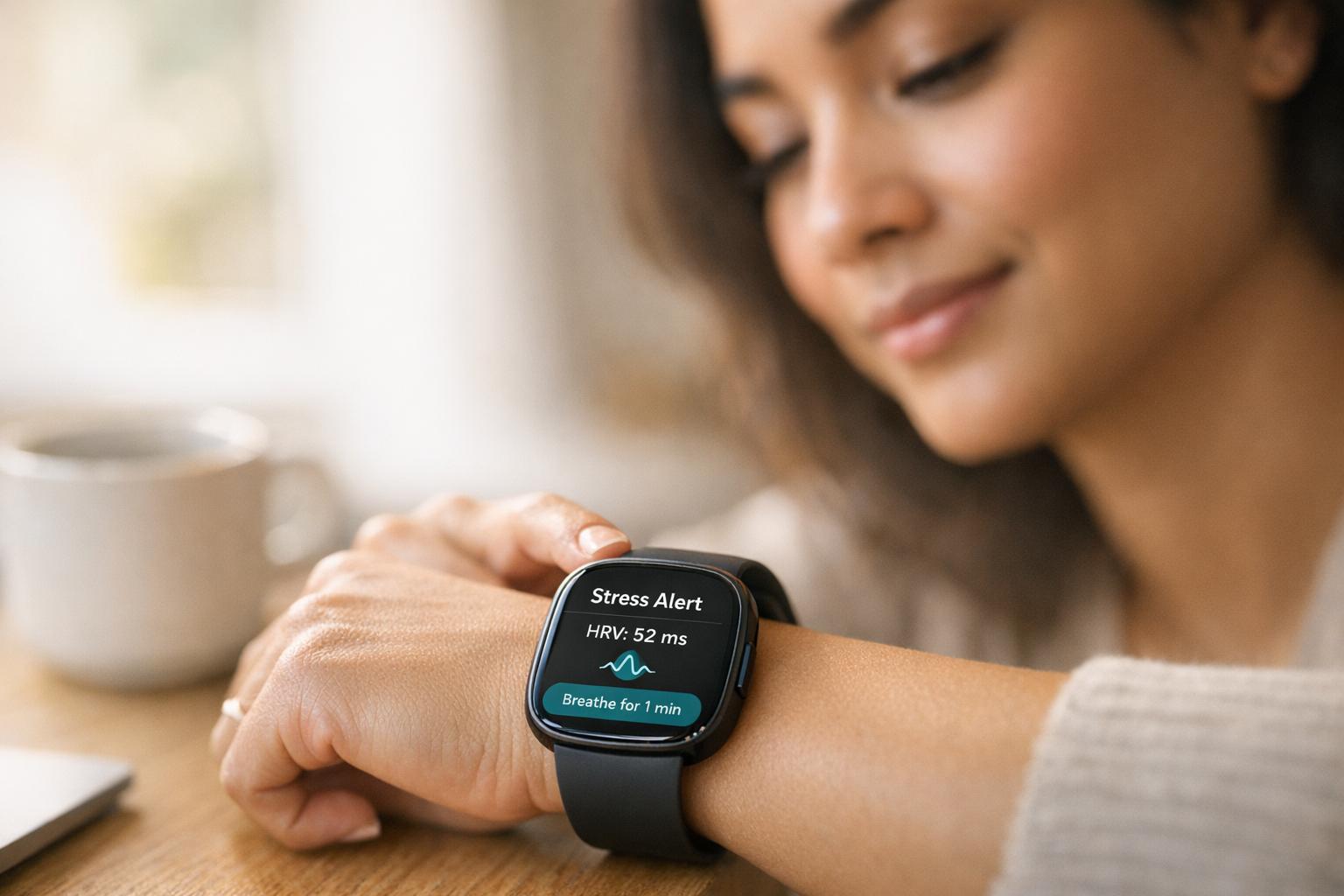
AI is changing how we monitor stress by analyzing real-time physical signals like heart rate, skin conductivity, and cortisol levels. Wearable devices equipped with sensors and powered by machine learning can now provide continuous insights into your stress levels, helping you manage it more effectively. Here's what you need to know:
- Stress Signals Tracked: Heart rate variability (HRV), electrodermal activity (EDA), cortisol in sweat, skin temperature, and breathing patterns.
- Wearable Devices: Tools like Fitbit's Sense 2 and UC Irvine's SQC-SAS device monitor these signals with high precision.
- Personalized Monitoring: AI establishes a baseline for your body and adjusts to individual patterns, ensuring accurate stress detection.
- Actionable Insights: Apps like Healify analyze data in real time and offer tailored recommendations, such as guided breathing or activity changes.
- Advanced Accuracy: Systems combining multiple data points achieve up to 92% accuracy in identifying stress-related changes.
This technology moves beyond traditional methods, offering a smarter way to understand and address stress.
Startup: Moment real-time stress detection from voice + HRV | NLP, wearables, just-in-time prompts
sbb-itb-f5765c6
How Your Body Shows Stress
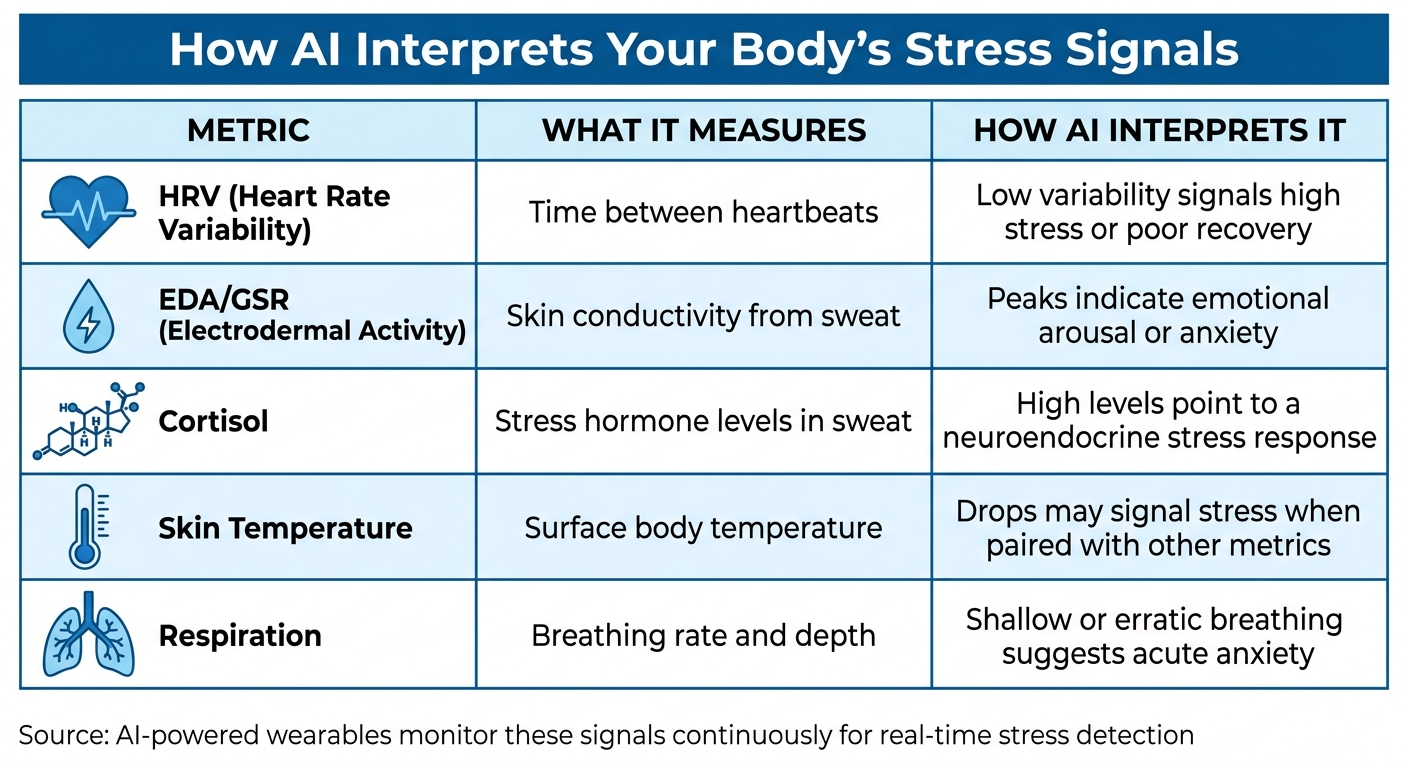
5 Key Biometric Stress Indicators and How AI Interprets Them
Your body sends out clear signals when you're under stress, and those signals can now be tracked in real time using AI-powered tools. These tools monitor physiological changes to provide insights into your stress levels.
Key Biometrics That Indicate Stress
One major indicator is Heart Rate Variability (HRV), which measures the time between heartbeats. When you're relaxed, these intervals vary more, reflecting the activity of your parasympathetic nervous system (the "rest and digest" mode). Under stress, HRV decreases as your body shifts into "fight or flight" mode. AI systems analyze these variations to assess your stress resilience and balance within your autonomic nervous system [3].
Another important metric is Electrodermal Activity (EDA), also called Galvanic Skin Response (GSR). This measures changes in skin conductivity caused by sweat gland activity. When you're anxious or emotionally charged, your skin's conductivity increases, and AI tools can identify these spikes as moments of heightened stress or anxiety [4].
Cortisol levels, a direct chemical marker of stress, are also being tracked in new ways. While cortisol was traditionally measured through blood tests, cutting-edge wearables now use microfluidic sensors to detect it in sweat. For instance, the SQC-SAS device can monitor cortisol continuously by inducing sweat through carbachol iontophoresis, eliminating the need for physical activity [1].
Other measurable signs of stress include skin temperature (which can drop during acute stress), respiratory patterns (often becoming shallow or irregular), and changes in the radial artery pulse, which reflect cardiovascular stress responses. Wearables combine these metrics to paint a detailed picture of stress levels.
| Metric | What It Measures | How AI Interprets It |
|---|---|---|
| HRV | Time between heartbeats | Low variability signals high stress or poor recovery |
| EDA/GSR | Skin conductivity from sweat | Peaks indicate emotional arousal or anxiety |
| Cortisol | Stress hormone levels in sweat | High levels point to a neuroendocrine stress response |
| Skin Temperature | Surface body temperature | Drops may signal stress when paired with other metrics |
| Respiration | Breathing rate and depth | Shallow or erratic breathing suggests acute anxiety |
These biomarkers are continuously monitored by wearable devices, which use AI to analyze the data in real time.
How Wearables Capture Real-Time Data
Wearable technology translates these biometrics into actionable insights. Devices equipped with specialized sensors continuously monitor stress signals. For example:
- Optical sensors (like PPG) measure blood volume changes to calculate HRV.
- Electrodes track EDA by measuring skin conductivity.
- Thermistors monitor changes in skin temperature.
Some advanced devices feature ultra-thin, skin-conforming electrodes (e.g., gold-coated polyimide) that provide stable monitoring for up to 12 hours [1].
In June 2023, Fitbit introduced the "Body Response" feature on its Sense 2 device, which uses continuous EDA (cEDA) sensors to track autonomic arousal throughout the day. This feature was developed using machine learning algorithms trained with controlled stress tests, such as mock interviews and surprise math challenges. By analyzing data like cEDA, heart rate, HRV, and skin temperature, Fitbit can identify stress patterns more accurately [4]. Elena Perez, Group Product Manager at Fitbit, explained:
"The body's response to stressors causes rapid changes in hormonal and physiological functioning across the body, known as autonomic arousal" [4].
Wearables transmit this data wirelessly - often via Near-Field Communication (NFC) - to smartphones, where AI processes it instantly. Modern stress-sensing patches achieve a high signal-to-noise ratio (up to 20.8 dB) even during physical activity, thanks to multi-island electrode designs [1]. This helps distinguish between genuine stress and reactions caused by exercise or environmental factors. Tools like Healify use this real-time data to create personalized stress profiles, offering users tailored insights and recommendations.
How AI Personalizes Stress Monitoring
Creating Individual Baselines
AI tailors stress detection by establishing a baseline unique to each individual. For the first month, the system tracks your typical heart rate, skin temperature, and sweat levels, creating a personalized reference point. This allows it to detect when something deviates from your norm.
Recent advancements in wearables have embraced this approach. Over a 30-day period, devices gather data to define each user's baseline for heart rate and skin temperature. Senior Research Scientist Samy Abdel-Ghaffar contributed to this innovation, with Fitbit's Group Product Manager Elena Perez explaining:
"Over the first month of being on your wrist, the algorithm uses more and more of your data to determine your baseline activity to more accurately detect acute changes from that baseline" [4].
This level of personalization is critical because everyone's body reacts differently. For example, a rapid heart rate could signal stress for one person but excitement for another. Research supports this need for individualization. In February 2026, Xueyi Wang and colleagues published the "AdaptStress" study, which monitored 16 participants over 10–15 weeks using consumer-grade smartwatches. Their findings highlighted the importance of accounting for personal differences:
"The model captures individual-specific patterns where identical features can have opposing effects across users, validating its personalization capabilities" [6].
Interestingly, the study also found that sleep metrics were the most reliable indicators of stress. These metrics had an importance rating of 1.1 and a consistency score ranging between 0.9 and 1.0 [6]. In contrast, activity-related features showed much higher variability (0.1–0.2) across participants, further emphasizing the need for personalized baselines [6].
To avoid false alarms, the system filters out non-stress signals, such as heart rate spikes caused by exercise. This contextual awareness ensures alerts are triggered only by genuine stress-related changes. With this tailored baseline in place, the system can continuously refine its accuracy through machine learning.
Improving Accuracy with Machine Learning
Once your baseline is established, machine learning takes over to adapt to changes in your physiology and lifestyle. Advanced systems use "online adaptive learning" to update their understanding. Whether you've lost weight or started a new fitness routine, the AI adjusts to reflect these changes.
The AdaptStress model showcased this adaptability, outperforming traditional time-series models like TimesNet and PatchTST by 21.5% to 36.9% in predicting stress. It achieved a Mean Squared Error (MSE) of just 0.053 when forecasting stress levels based on a 5-day input window [6]. This level of precision stems from the system’s ability to track how your unique patterns evolve over time.
Accuracy is further enhanced by combining multiple data streams. For instance, a system using Random Forest classifiers achieved 92% accuracy and a 93% F1-score by integrating heart rate variability, skin temperature, and electrodermal activity. Traditional systems, by comparison, peaked at 80–85% accuracy [2].
To help the AI differentiate between stress and excitement - both of which can produce similar physiological responses - you can manually log your emotional state when prompted. This feedback trains the algorithm to distinguish between positive and negative arousal. Tools like Healify use this adaptive learning approach to refine your stress profile, transforming raw biometric data into actionable insights that improve with continued use.
Combining Multiple Data Sources for Better Insights
Using Behavioral and Contextual Data
Measuring heart rate alone falls short of capturing the full complexity of stress and its effects on the body. As Changhao Xu, Ph.D., from the California Institute of Technology, puts it:
"Stress manifests as a complex biological response, engaging the nervous, endocrine, and immune systems - a multifaceted nature that is not fully captured by physical sensors alone." [5]
To address this, modern AI systems combine data from various sources, such as sleep patterns, voice tone, facial expressions, and even digital behaviors like email frequency and keystroke dynamics. When paired with Galvanic Skin Response (GSR) data, this approach boosts stress detection accuracy to an impressive 92% [7]. Advanced wearables have even introduced features like "Symptom Radar", which identifies subtle shifts in data that may indicate early signs of strain or illness [8].
This broader perspective allows these systems to distinguish between eustress (positive, motivating stress) and distress (negative, harmful stress), even when both cause similar physical reactions like an elevated heart rate. By factoring in environmental data - such as ambient temperature, location, and workload - these technologies create a more complete picture of what’s influencing your body. This level of integration enables platforms like Healify to provide personalized, real-time stress management solutions.
How Healify Offers 24/7 Stress Monitoring
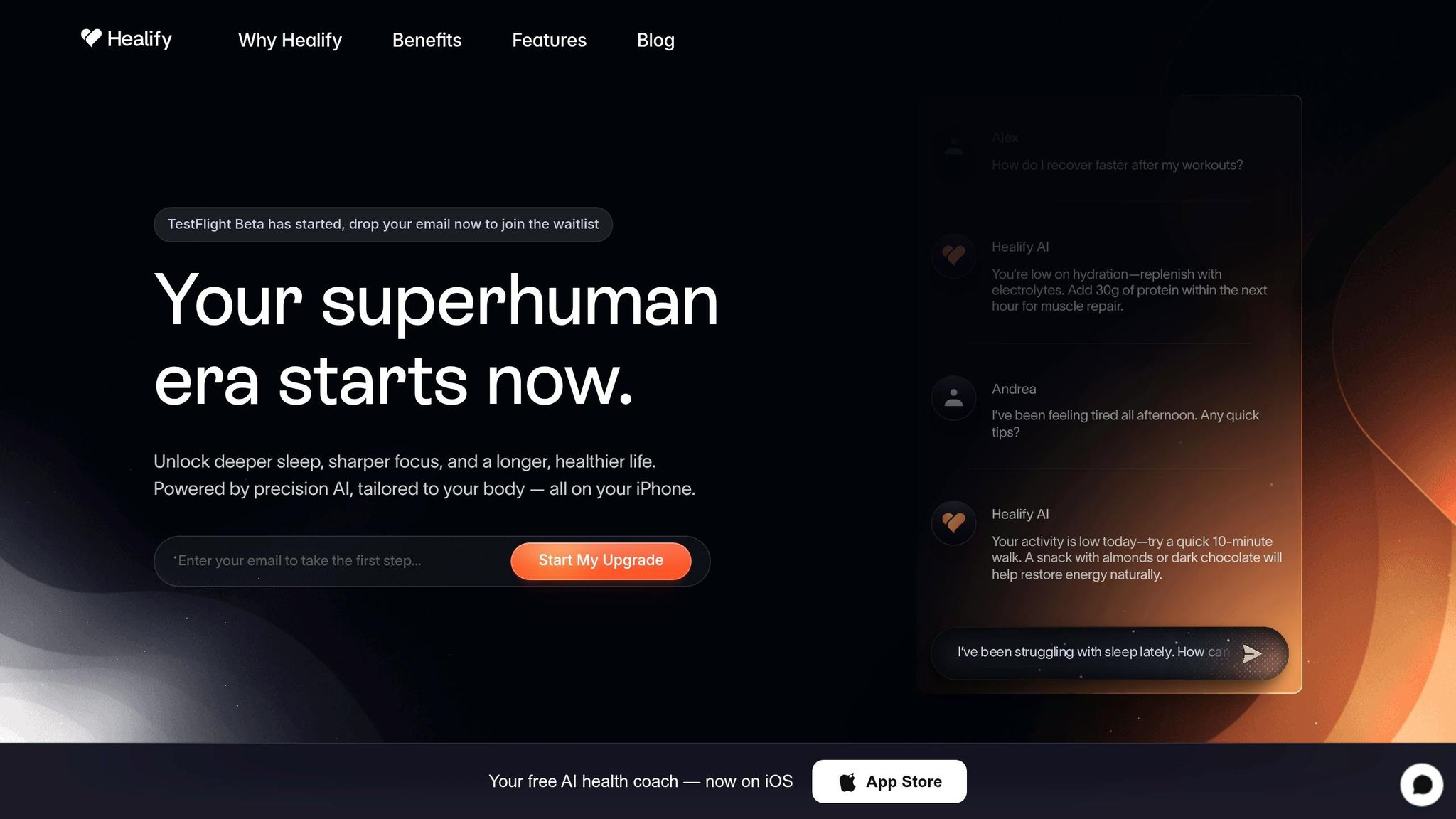
Healify takes this multi-source data approach to the next level, combining wearable, biometric, and lifestyle inputs to deliver continuous stress tracking. Its AI health assistant, Anna, processes this data in real time, turning complex patterns into easy-to-understand insights.
Instead of bombarding users with raw data, Healify simplifies the experience by sending alerts when stress levels hit predefined thresholds - low, moderate, or high. When these thresholds are crossed, the system recommends tailored interventions, like guided breathing exercises or activity adjustments [2]. Powered by cloud-based machine learning models, Healify analyzes high-dimensional physiological data instantly and sends notifications directly to your iPhone, ensuring timely and actionable feedback [2].
How to Use AI-Powered Stress Tools
Once you've set up continuous monitoring, here’s how to manage your stress effectively using AI-powered tools.
Step 1: Connect Your Wearables
Start by pairing your wearable device with your iPhone via Bluetooth. After pairing, enable cloud syncing in the Healify app. This ensures that real-time data - like HRV (heart rate variability), GSR (galvanic skin response), and EDA (electrodermal activity) - is securely stored in the cloud. This setup helps create a baseline for stress detection tailored specifically to you [2][5].
Make sure your wearable is snug and properly positioned. A loose fit can lead to motion artifacts, which may cause false stress alerts [5].
Step 2: Turn On Real-Time Monitoring
Enable real-time monitoring within the Healify app to receive instant stress alerts. These alerts are categorized as low, moderate, or high, depending on your stress levels. The app uses Random Forest models, which boast an impressive 92% accuracy rate, to assess your stress in real time [2].
Step 3: Act on AI Insights
Once your wearable is connected and real-time monitoring is active, take immediate action when you receive alerts. If Anna, the AI assistant, detects elevated stress levels, follow her personalized suggestions. These might include guided breathing exercises, meditation sessions, or adjusting your current activity [2].
Anna’s recommendations become smarter over time, thanks to Behavioral Reinforcement Learning. This technology adapts based on your responses, ensuring the techniques offered are increasingly effective for you. Additionally, review long-term trends in your synced data to identify patterns or triggers behind frequent high-stress alerts. By combining real-time analytics with these insights, you can stay ahead of stress and manage it before it becomes overwhelming [2].
Conclusion
AI is changing how we understand and manage stress by turning complex biometrics into clear, measurable insights. By tracking signals like heart rate variability and electrodermal activity in real time, these systems achieve impressive accuracy - up to 92% - eliminating the uncertainty of traditional self-reporting methods [2]. This precise data allows for timely and targeted responses.
What makes this technology even more impactful is its ability to close the feedback loop. AI doesn't just collect data; it transforms it into actionable insights, acting as an early warning system that helps prevent stress from escalating.
Healify takes this concept a step further by integrating AI-driven stress management directly into your iPhone. With Anna, your always-available AI health coach, the app combines data from wearables, bloodwork, and daily habits to provide tailored recommendations. For example, if your cortisol levels spike or your health score drops by 7%, you’ll receive specific advice to help regain balance [9].
This shift from passive data collection to active interpretation means you’re no longer left to decipher confusing health metrics on your own. Instead, Healify delivers clear, actionable steps that adapt over time through Behavioral Reinforcement Learning. By pairing continuous monitoring with machine learning, the app helps you take control of stress before it spirals out of control.
FAQs
How does AI tell stress from exercise?
AI distinguishes between stress and exercise by examining physiological signals such as heart rate variability, skin temperature, and electrodermal activity. Through machine learning, it detects specific patterns tied to stress that differ from those triggered by physical activity.
How long does it take to learn my baseline?
It only takes a few minutes to figure out your baseline. With the help of AI-powered tools and wearable devices, physiological data is tracked over time to accurately identify your typical stress levels.
Can wearables measure cortisol without a blood test?
Wearable devices can estimate cortisol levels through sweat sensors, offering a non-invasive way to monitor this stress hormone. However, they cannot directly measure cortisol in the bloodstream without invasive methods. While these tools provide helpful insights, they aren't a replacement for blood tests when accurate cortisol measurements are needed.