
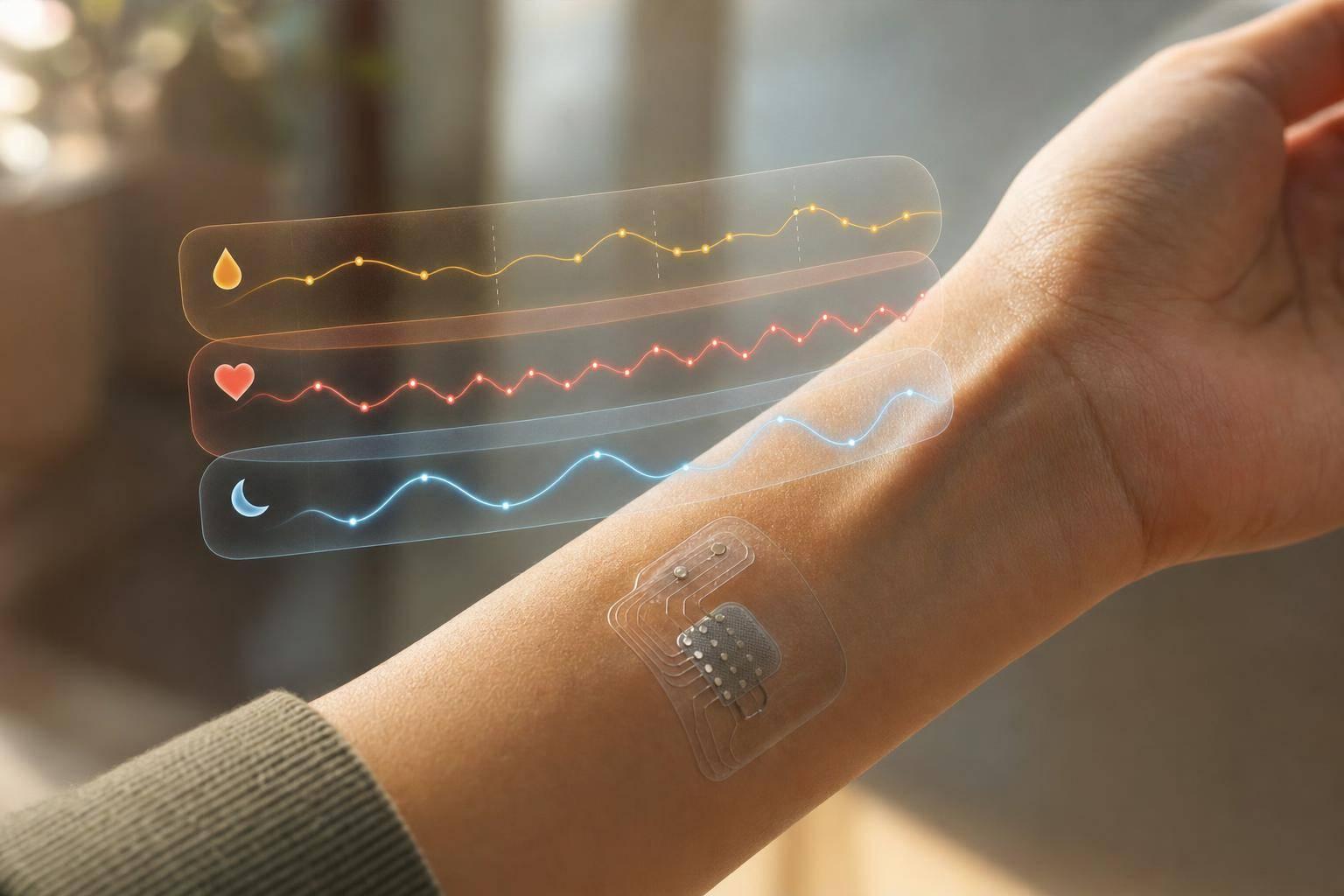
Sweat sensors can help track stress, but they work best as part of a bigger picture, not as a stand-alone score. They can pick up signals tied to fast nervous-system arousal and slower hormone changes, including cortisol. But heat, exercise, hydration, skin location, and time of day can all shift the reading.
If I wanted the short answer, it would be this:
- Sweat cortisol may help track stress trends
- One reading means little without context
- HRV, sleep, mood notes, and activity data help make sweat data more useful
- Low sweat does not mean low stress
- Most current devices are wellness tools, not medical tests
A few numbers show why this matters:
- 75% of Americans report physical or emotional stress symptoms
- 24% of U.S. adults rate their stress at 8 to 10 out of 10
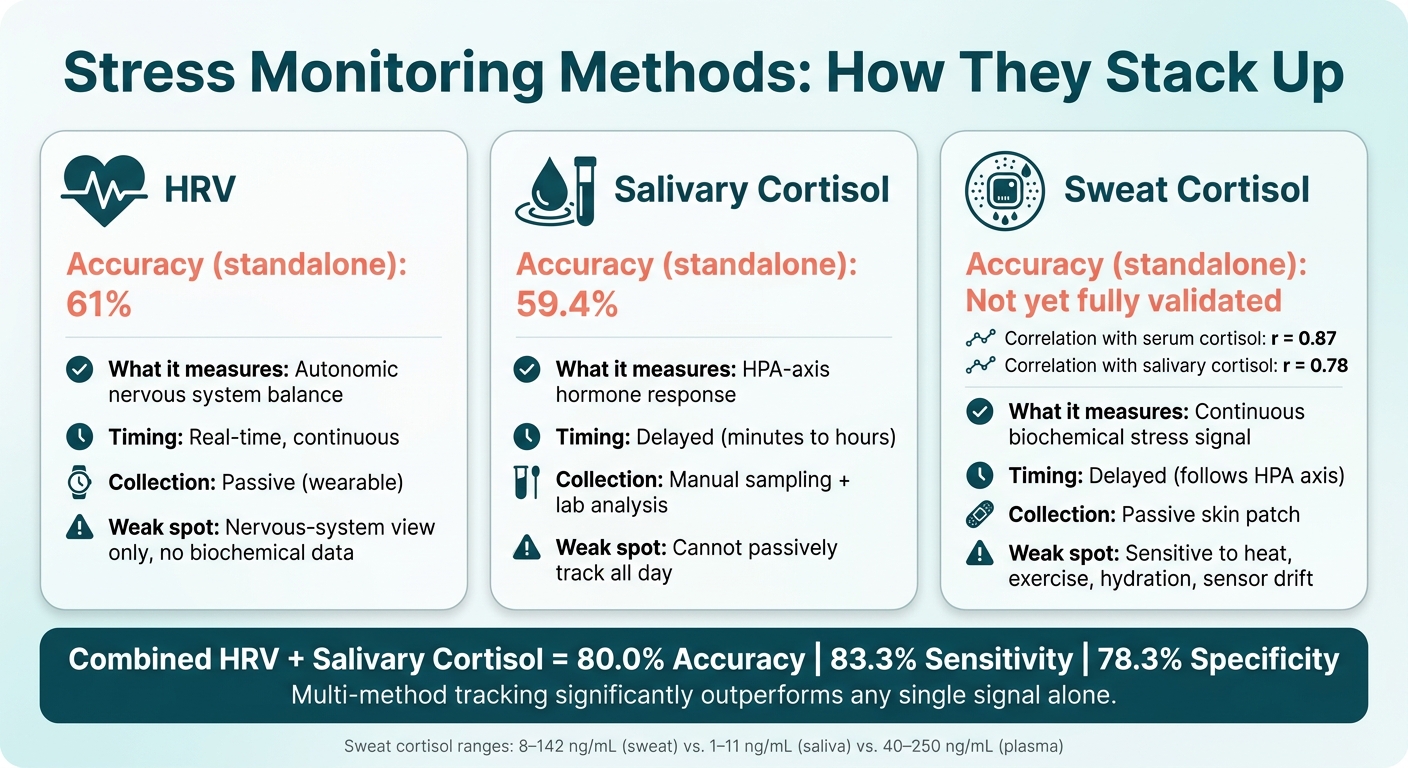
- A pilot study found sweat cortisol correlated with serum cortisol at r = 0.87
- In one study, HRV and cortisol levels reached 80.0% accuracy, versus 61% for HRV alone
What I take from that is simple: the signal is useful, but the setting matters just as much as the sensor. Sweat sensors are better for spotting patterns over 7 to 14 days than for judging one tense moment. They also look more useful during calm evening periods, light daily activity, or repeat time blocks than during hard workouts or hot outdoor work.
If you’re reading this to figure out whether sweat sensors can monitor stress, the answer is yes, to a point. They can add biochemical data that watches can’t give on their own, but they still need good calibration, careful use, and side-by-side data from things like HRV, sleep, and your own notes.
Sweat Sensors vs. Other Stress Tracking Methods: Accuracy & Use Cases
Wearable Tech Detects Stress
sbb-itb-f5765c6
The science: which sweat biomarkers reflect stress
Stress moves through two main pathways. The SNS kicks in within seconds. The HPA axis takes longer, usually minutes to hours. Sweat sensors can pick up signals from both systems, but there's a catch: they usually detect signals linked to stress, not stress itself. So the big job is sorting out which sweat markers point to stress and which mostly reflect exercise, heat, or hydration.
Cortisol, catecholamines, and sweat gland activity
Cortisol is the main sweat biomarker tied to the slower HPA-axis response. It also follows a strong daily rhythm, with higher levels shortly after waking and lower levels later in the day.[18][20] In sweat, cortisol ranges from about 8 to 142 ng/mL. For comparison, it's around 1–11 ng/mL in saliva and 40–250 ng/mL in plasma.[20] One pilot study found that sweat cortisol correlated with serum cortisol at r = 0.87 and with salivary cortisol at r = 0.78.[18]
That gives you a useful signal. But one reading on its own still leaves a lot unsaid. Higher cortisol could come from stress, sure. It could also reflect exercise, hydration shifts, or simply when the sample was taken.
Epinephrine and norepinephrine also rise during acute stress, but sweat levels are often tough to measure in a steady way outside research settings.[14][4] Electrodermal activity (EDA) tracks sympathetic arousal through changes in skin conductance. It responds fast, which is part of its appeal, but it also reacts to heat, exercise, excitement, and anxiety.[9][10][11][12]
Lactate, glucose, and electrolytes in context
Some sweat markers line up with stress chemistry. Others mostly reflect how the body handles exertion, heat, and fluid balance. Lactate, glucose, sodium, potassium, and chloride fit more in that second group. Wearable sensors often measure them, but they make more sense as markers of exertion, hydration, and heat stress than of mental stress.[7][8][15]
For example:
- Higher sweat lactate usually reflects exercise intensity
- Shifts in sodium and chloride track hydration and sweat rate
- Average sweat sodium is about 35 mmol/L, with a broad range of 10–70 mmol/L depending on the person and the conditions[7]
The main takeaway is simple: no single analyte cleanly maps to mental stress. Sweat composition changes with temperature, humidity, skin site, hydration, and time of day. A high lactate reading after a run does not mean the same thing as that exact reading during a tense meeting.
How sweat data compares with HRV and saliva testing
Each method has its own timing and its own weak spot. HRV reflects autonomic balance and is often easier to collect continuously, but it gives you a nervous-system view rather than a biochemical one. Salivary cortisol is well validated and correlates with blood cortisol, but it needs manual sampling and lab analysis, so you can't passively track it all day.[16][18] Sweat cortisol may help with continuous passive tracking, though the method is less mature and more sensitive to sensor design and calibration.[13][16][18]
Stress signals become much easier to read when you combine methods instead of relying on just one. In one classification study, pairing HRV with salivary cortisol reached 80.0% accuracy, 83.3% sensitivity, and 78.3% specificity for identifying stress responses. That was well above HRV alone (61% accuracy) or cortisol alone (59.4%).[19][17]
That difference matters. EDA can shift within seconds. Catecholamines reflect acute responses. Cortisol moves more slowly. And some sweat analytes lag behind the event that set them off. When multiple channels point in the same direction, it's easier to separate a real stress signal from plain noise. That's why sensor design and calibration matter so much, and why collection method can make or break real-world use.
How sweat-based stress sensors work
From skin to sensor: patches, microfluidics, and sweat collection
Most sweat sensors come as flexible skin patches that collect your normal sweat. Some can also use iontophoresis to stimulate sweat when there isn’t enough on its own.[2][1]
From there, microfluidic channels guide fresh sweat to the sensing area and help keep older sweat out of the mix. That part matters. If sweat sits too long or gets contaminated, the reading becomes a lot less useful. Placement matters too. The forearm, upper arm, chest, and back all produce sweat at different rates, and the sweat itself can vary by location.
Sensor chemistry and device formats
Once sweat reaches the sensing area, electrochemical sensing does the heavy lifting. Electrodes coated with a recognition element react with the target biomarker and convert that reaction into an electrical signal.
Common approaches include:
- Antibody-based sensors
- Aptamers
- Molecularly imprinted polymers (MIPs)
- Color-changing patches
Aptamer-based sensors use engineered DNA or RNA sequences that bind cortisol with high specificity. One flexible aptasensor reached a detection limit of 0.2 pM and tracked cortisol continuously for up to 90 minutes during induced stress.[1]
MIPs take a different route. They use synthetic cavities shaped to match a target molecule, which makes them a good fit for wearables that need to handle bending and daily movement. Colorimetric patches work by changing color when they detect a biomarker. They’re simpler to read at a glance, but they’re usually less precise and tougher to use for continuous tracking than electronic devices.
For day-to-day use, the big test is pretty simple: the sensor has to stay selective, stable, and comfortable.
How raw sensor data becomes usable stress insight
After the sensor detects a biomarker, the next job is turning that raw signal into something people can use. The sensing surface translates a biomarker change into a measurable shift in current, voltage, or impedance. Small on-board electronics then process and calibrate that signal before sending it wirelessly.
The usual setup looks like this:
- Bluetooth for continuous data streaming
- NFC for lower-power patches that you check from time to time
The app layer matters just as much as the patch itself. A single stress-related reading can be noisy, so the best systems compare sweat data with sleep, activity, and heart rate to screen out false stress signals. Healify can combine sweat data with sleep, activity, and other biometrics to surface stress patterns and recovery guidance. In practice, trends tell you more than one isolated reading.
The next question is how to read those signals without overreacting.
Using sweat sensors day-to-day for stress management
Best use cases for work, workouts, and recovery
Once a sensor is on your skin, context is what makes the reading useful. Sweat sensors tend to work best in steady, low-noise situations like light exercise, brisk walking, or normal indoor activity. In those settings, it's easier to separate stress-related changes from heat or physical effort.
In an air-conditioned office, a sensor can run quietly in the background. The catch is simple: low sweat rates mean less data on a given day, and brief stress spikes may not appear right away. That's why multi-day trends usually matter more than one isolated reading. The same idea fits shift workers, caregivers, and students during exam season. Instead of comparing random days, log readings in steady time blocks like start of shift, mid-shift, and end of shift, or pre-exam, during, and after. Then compare those blocks from week to week.
During workouts and training, sweat is easy to get, but the signal gets messier. Exercise data is often more useful for understanding training strain and recovery than for judging psychological stress. A cortisol spike during hard intervals doesn't say much by itself. If cortisol stays high during a rest-day walk, though, that tells you more.
Outside training, recovery windows often give the cleanest stress signal. Evening readings are often the clearest recovery baseline. If your sensor keeps showing high readings while you're sitting quietly at home over several weeks, that's a pattern worth noticing.[18][24]
How to read your results without overreacting
How you read the data matters more than any single number. Morning highs are normal. What matters is whether your evening readings tend to come down when you're relaxed.[18][22][23]
Coffee, dehydration, heat, and skin products can all throw off a reading. So when any of those apply, label them in the app and compare only against similar conditions. Put sensors on clean, dry, product-free skin to avoid sticking problems and detection errors.
A simple rule helps here: don't change your routine because of one spike. Look for patterns that last at least 7–14 days, then check what else was happening that day. A short mood note helps a lot too, especially when paired with AI nudges for better health habits. Try a 1–10 stress rating plus one line of context. That small habit can make the data much easier to use.
Comparison table: when sweat stress data is most reliable
Use this table as a guide for when to trust the reading most.
| Scenario | Sweat Availability | Cortisol Reading Reliability | Main Confounders | Pair With |
|---|---|---|---|---|
| Air-conditioned office | Low | Moderate; trends over days matter more than single readings | Low sweat rate, caffeine | HRV, mood log, sleep data |
| Outdoor summer work | High | Lower; heat independently elevates biomarkers | Heat, humidity, dehydration | Label "heat exposure"; compare only against similar conditions |
| Workout session | High | Lower for psychological stress | Lactate surge, physical fatigue, hydration | HRV; use for recovery and overtraining signals |
| Evening wind-down | Low–Moderate | Higher in calm, cool conditions | Earlier caffeine, residual exercise | Sleep quality, EDA, mood rating |
| Night shift / caregiving | Variable | Moderate; chronic patterns more useful than single readings | Irregular schedule, sleep disruption | Compare shift-to-shift blocks over weeks; pair with sleep data |
Limits, privacy, and what comes next
Even strong sweat data comes with limits, privacy tradeoffs, and calibration gaps. The previous section covered how to use sweat data well. This section explains when not to lean on it too hard.
Current limitations and measurement challenges
Sweat sensors can fall short when sweat output is too low, especially at rest or in cool conditions. If the sensor stays dry, that does not mean stress is low. It means the device does not have enough fluid to read.[25][28][29]
That makes raw readings heavily dependent on context and weak when used as stand-alone scores. During exercise, heavy sweating can dilute some biomarkers even while total output climbs. So a change in concentration can point you in the wrong direction if you read it without context.[26][21] On top of that, sensor drift can reduce accuracy over time, especially in antibody- and aptamer-based designs after extended wear.[26]
Sweat cortisol is also not a stand-alone diagnostic tool. Validation across different populations against serum free cortisol is still unfinished, and standard calibration is still being worked out.[26][27] The best way to think about it: it’s a useful signal, not a lab result.
Because these signals can reveal more than stress by itself, data handling matters just as much as sensor accuracy.
U.S. privacy and regulatory considerations
In the U.S., wellness wearables can report trends, but they cannot claim to diagnose, treat, or prevent disease without FDA review.[37][38] The FDA draws a line between wellness tools and medical devices. A wearable that surfaces stress insights sits on the wellness side of that line.
Stress sensors do more than track body signals. They can also infer mental state. HIPAA usually does not protect consumer wearable data collected at work unless that data is tied to a group health plan.[34][35][36] So if your employer wants to roll out a sensor-based program, ask a few direct questions:
- Who can access the data?
- How long is it stored?
- Can you delete it?
That push for better privacy sits alongside a push for better sensing: more specific markers, tighter calibration, and multi-marker tracking.
Key takeaways and the future of personalized stress tracking
Sweat sensing is moving past single markers and toward multi-marker systems. A 2025 Science Advances study, Stressomic, showed a wearable biosensor that captured dynamic profiles of cortisol, epinephrine, and norepinephrine at the same time, with sequential sampling intervals of about 6 minutes.[6][33][5] That gives a good sense of where the field is going.[3][31]
The next step is better specificity, stronger calibration, and more context-aware interpretation. In plain English, sweat biomarkers are most useful as one steady layer inside a broader multimodal picture, not as a stand-alone answer.[15][30][32] Apps like Healify can combine wearable signals with lifestyle data to turn that layered picture into stress guidance and personalized next steps.
FAQs
How accurate are sweat sensors for stress?
Sweat sensors give people a non-invasive way to estimate cortisol levels. That makes them useful for tracking daily stress patterns and circadian rhythms without a blood draw.
That said, accuracy can vary. A lot depends on the sensor technology and how well the device is calibrated. Reliability can also shift because of antibody instability, interference from other hormones, and plain old skin contact issues.
There’s also an important limit here: these devices measure sweat, not blood. So while they can help with day-to-day tracking, they do not replace clinical blood tests.
When should I trust a sweat stress reading?
A sweat stress reading means the most when it fits into a system that tracks and reads your biometric data on a steady basis. These sensors pick up physical signals tied to your emotional state, so they work best when paired with regular monitoring tools like Healify.
For the most useful takeaways, look at the reading as one part of your broader health picture. Healify brings together sweat biomarkers and lifestyle data to build a personalized stress management plan.
Can sweat sensors diagnose chronic stress?
No. Sweat sensors can't diagnose chronic stress or replace a clinical diagnosis.
What they can do is track biomarkers in sweat, such as cortisol and electrodermal activity, to show your body's stress response in real time. That can help you spot patterns, notice triggers, and get a better sense of what may be affecting how you feel.
Healify can use that data to turn those signals into personalized, actionable guidance that supports your well-being.