

If I were building a wellness or AI health app today, I’d treat consent as a live control system, not a notice screen. The article’s main point is simple: if I can’t tie each data use to a rule, store proof of each choice, and stop data flows after revocation, I have a compliance gap. That gap can get expensive fast, with FTC civil penalties up to $51,744 per violation and HIPAA penalties up to $2,067,813 per violation category per year.
Here’s the short version:
- Consent is not the privacy policy. It has to track what data is used, for what reason, by whom, for how long, and when a user changed their mind.
- Different rules can apply at once. A single app may touch HIPAA, 42 CFR Part 2, CPRA, GDPR, and FTC rules depending on the data and the users.
- Bundled consent is a common mistake. If I mix care-related flows with marketing, analytics, or model training, the permission may not hold up.
- One source of truth matters. If mobile, web, vendors, and analytics tools each keep their own consent state, revocation can fail.
- Special data needs extra care. SUD records, minor data, biometrics, and external sharing need tighter handling.
- AI adds one more layer, requiring specialized AI tools for personal health management. I need separate rules for coaching, model training, and third-party sharing, plus a clear plan for what happens after revocation.
A simple way to think about it: notice tells people what may happen; consent control decides what is allowed to happen right now.
| Area | What I need in place | What goes wrong without it |
|---|---|---|
| Legal basis | One purpose tied to one rule | Data gets used under the wrong permission |
| Recordkeeping | Master consent record with timestamps and versions | I can’t prove what the user agreed to |
| Enforcement | Runtime checks across apps, APIs, and vendors | Data keeps moving after consent is withdrawn |
| AI use | Separate choices for coaching, training, and sharing | User data ends up in uses they did not expect |
So if I wanted the shortest path to a consent program that holds up, I’d do 4 things first: map each data use, collect granular choices, store them in one master record, and enforce them at request time across every system.
Patient Privacy & Data Ethics Explained | HIPAA Compliance
sbb-itb-f5765c6
The Main Compliance Problems in Health Data Consent Systems
Most failures come back to three issues: the wrong legal basis, broken records, and uneven enforcement.
In practice, those failures tend to show up in the same three patterns.
| Problem | Key Rule(s) | Compliance Risk |
|---|---|---|
| Using consent as a catch-all or bundling optional uses into required care flows | HIPAA Privacy Rule, GDPR Art. 6 & 9 | Unlawful processing of PHI for marketing or analytics; invalid or misleading authorization |
| Fragmented records and blanket permissions | HIPAA, GDPR Art. 5(1)(b), state privacy laws | Weak audit trails; inability to prove lawful processing or honor revocation |
| Interoperability failures and edge case gaps | 42 CFR Part 2, HIPAA, GDPR, state privacy laws | Inconsistent enforcement; continued processing after revocation; unlawful disclosure of SUD or minor records |
Using Consent for the Wrong Purpose or as the Wrong Legal Basis
In digital wellness, one of the first things that goes wrong is simple: teams mix optional analytics and marketing into care flows.
A common mistake is using consent as a catch-all legal basis when a more specific basis already applies. Another is slipping optional uses into required care steps, where patients may feel they have no real choice.
Under HIPAA, covered entities usually do not need patient authorization to use or disclose PHI for treatment, payment, and health care operations (TPO).[11][12] But trouble starts when a product team folds marketing opt-ins or behavioral analytics into the same onboarding screen as care-related data flows. That can include wearables, onboarding, and coaching analytics. Once optional processing is presented like a condition of care, it starts to look coercive, and any consent gathered that way may be invalid.[3][6]
The risk gets worse when research or secondary analytics are described as if they were part of routine operations. Many research uses need either an IRB waiver or a specific written authorization. If an organization presents those uses as standard care, the paper trail gets weak fast, and that can lead to findings of unlawful processing.[2][3]
Fragmented Records, Blanket Permissions, and Poor Auditability
Blanket consent for all health data and all product improvements does not meet the rules. It clashes with GDPR's purpose limitation principle, which says data must be collected for specific, explicit, and legitimate purposes.[13][15][16] It also creates a mess when a user tries to pull consent back.
Here’s the plain-language problem: if consent is gathered across mobile apps, web portals, paper intake forms, and real-time health dashboards, there often isn’t one source of truth. One system may show consent revoked while another keeps processing the same data based on an old record.[14][17] During an investigation, that kind of mismatch is hard to explain and even harder to defend.
The problem doesn’t stop there. If data is not tagged by purpose when it enters analytics or AI pipelines, a withdrawal request cannot shut down one specific use. The data keeps moving, but the control the user thought they had doesn’t travel with it.
That same issue turns into a systems problem the moment consent has to pass from one platform to another.
Interoperability and Edge Cases That Break Enforcement
Even a consent system that looks solid on paper can fail at the handoff points between systems. A user may revoke consent in one app, but a downstream system tied to a different ID across the app, EHR, and vendor systems never gets the update. Processing keeps going, and the revocation never lands where it needs to.[9][10]
Data scope mismatches create a similar gap. A wearable consent might mean one set of data fields in one system and something broader in another. That kind of mismatch can lead to processing of more sensitive data than the patient reasonably understood they were agreeing to.
Special categories make enforcement even harder. Substance use disorder (SUD) records under 42 CFR Part 2 have stricter consent rules than standard PHI, and many disclosures need specific written consent.[1][4][7][8] If a single consent interface treats SUD data the same way it treats general health data, it can violate Part 2. The same goes for systems that automatically give parents access to a minor's full record, including SUD treatment data, without Part 2-compliant consent. That gap is already well known.[1][4][5]
How to Design a Compliant Consent Workflow
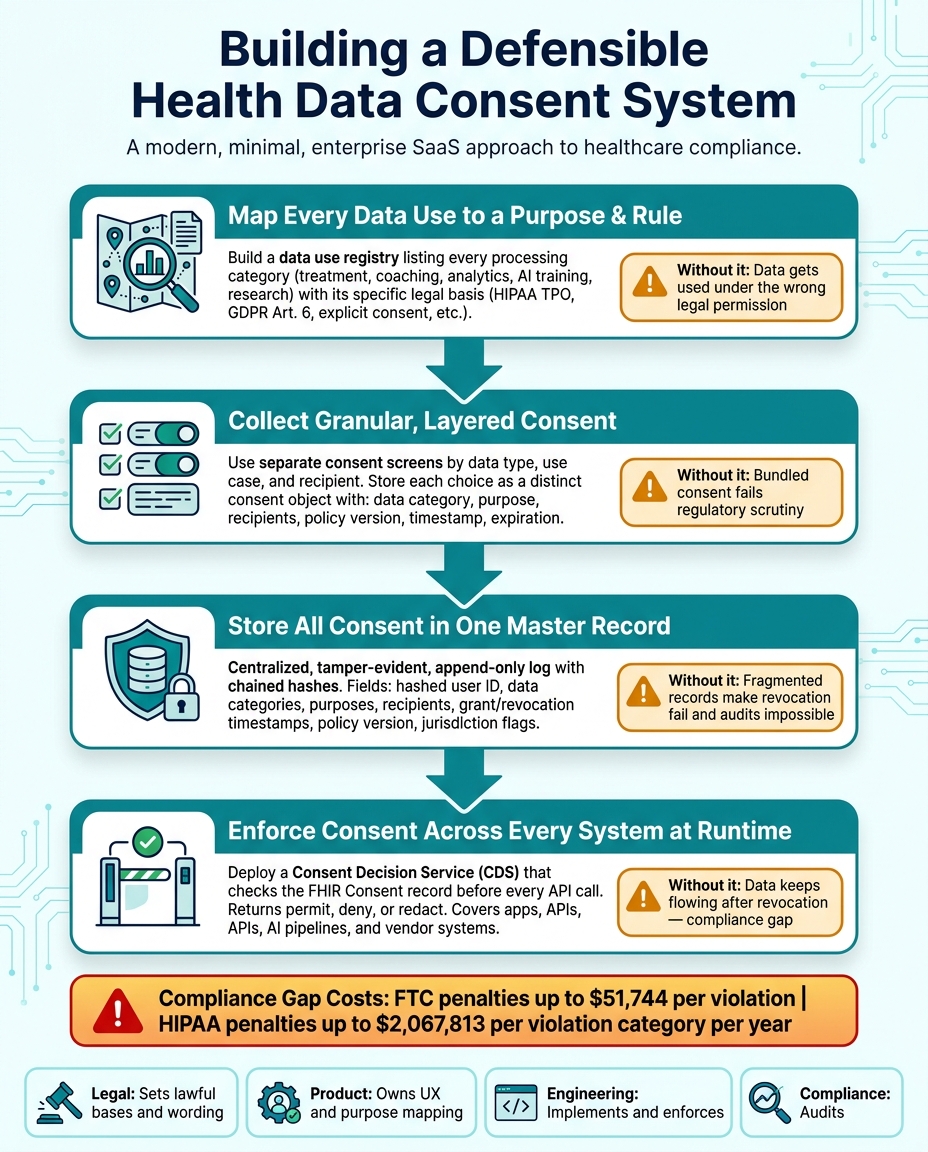
Health Data Consent Compliance: 4-Step Framework for Defensible Systems
You fix these failures with a governance model that turns legal duties into product and engineering rules before launch. In plain terms, each legal requirement needs to be built into the consent workflow itself.
Map Every Data Use to a Specific Purpose and Rule
Start with a data use registry: a living document that lists every processing category and its legal basis.
Keep treatment support, wellness coaching, research, product analytics, and AI model improvement separate, because each one follows a different legal path.[19][26]
No feature should ship until product assigns the purpose, legal confirms the basis, and the UI matches the action required: consent, authorization, or opt-out.
Once each use has a legal basis, the interface can show only the choices the law permits. That keeps the product from asking for the wrong thing - or skipping a required step.
Capture Granular Choices and Make Withdrawal Easy
Use layered consent screens. Users want control by data type, use case, and recipient.
For iPhone users in the U.S., organize screens by data type, use case, and recipient group. Each card should explain what data is used, why it is used, and whether it is shared with advertisers. Every choice should be stored as a separate consent object with fields for data category, purpose, recipients, policy version, timestamp, and expiration.[21][22]
Withdrawal has to be just as easy as agreeing. A single Data & Consent hub - available from the main menu and account settings - lets users view all active consents and revoke specific ones without contacting support.[20][24] Revocations must update the master consent record at once and flow to all downstream systems.
That last part matters. If a user revokes permission but the data keeps moving through one forgotten service, the control is mostly theater.
Build a Master Consent Record with Audit-Ready Governance
A master consent record should keep each user's permissions in one place. Store hashed user ID, data categories, purposes, recipients, grant and revocation timestamps, policy version, UI version, jurisdiction flags such as CPRA-applicable California users, and enforcement state.[18][20]
| Dimension | Centralized Log | Decentralized Log |
|---|---|---|
| Auditability | Single source of truth; easier to produce for regulators | Fragmented; requires reconciliation across systems |
| Revocation enforcement | One update propagates everywhere | Risk of missed updates in individual services |
| Regulatory defensibility | Stronger; clear chain of custody | Weaker; gaps between systems are harder to explain |
| Revocation handling | Automated; event-driven propagation | Often manual; slower and error-prone |
Use tamper-evident, append-only logs with chained hashes.[25] Version control should work at two levels. One is the consent record itself, where each change creates a new version linked to the prior one. The other is the policy text, where the exact notice the user saw is stored as a versioned object next to the consent event.[23]
Ownership should also be clear:
- Legal sets lawful bases and wording
- Product owns UX and purpose mapping
- Engineering implements
- Compliance audits[18][20]
That record then becomes the source of truth the technical architecture has to enforce.
Standards and Technical Architecture That Support Compliance
Once governance is in place, standards make consent enforceable across apps, APIs, and downstream workflows. They turn policy into controls that work across every system that touches health data.
Start with the consent record. Then limit app access. Then enforce those choices at runtime.
| Standard/Component | What It Standardizes | Compliance Need Supported |
|---|---|---|
| HL7 FHIR Consent | Data structure for recording permit/deny decisions and data scopes | Auditability, granularity, and portability of choices |
| SMART on FHIR | App authorization and data exchange through OAuth2 | Secure access and user-approved scopes |
| HEART (Health Relationship Trust) Profiles | Patient-controlled authorization and relationship management (UMA) | Right to restrict and patient-centric control |
| Consent Decision Service | Logic for evaluating rules and enforcing decisions at runtime | Dynamic consent and real-time policy enforcement |
Each one covers a different layer: the consent record, the access method, the relationship model, and the rule enforcement point.
Use HL7 FHIR Consent to Represent Patient Choices
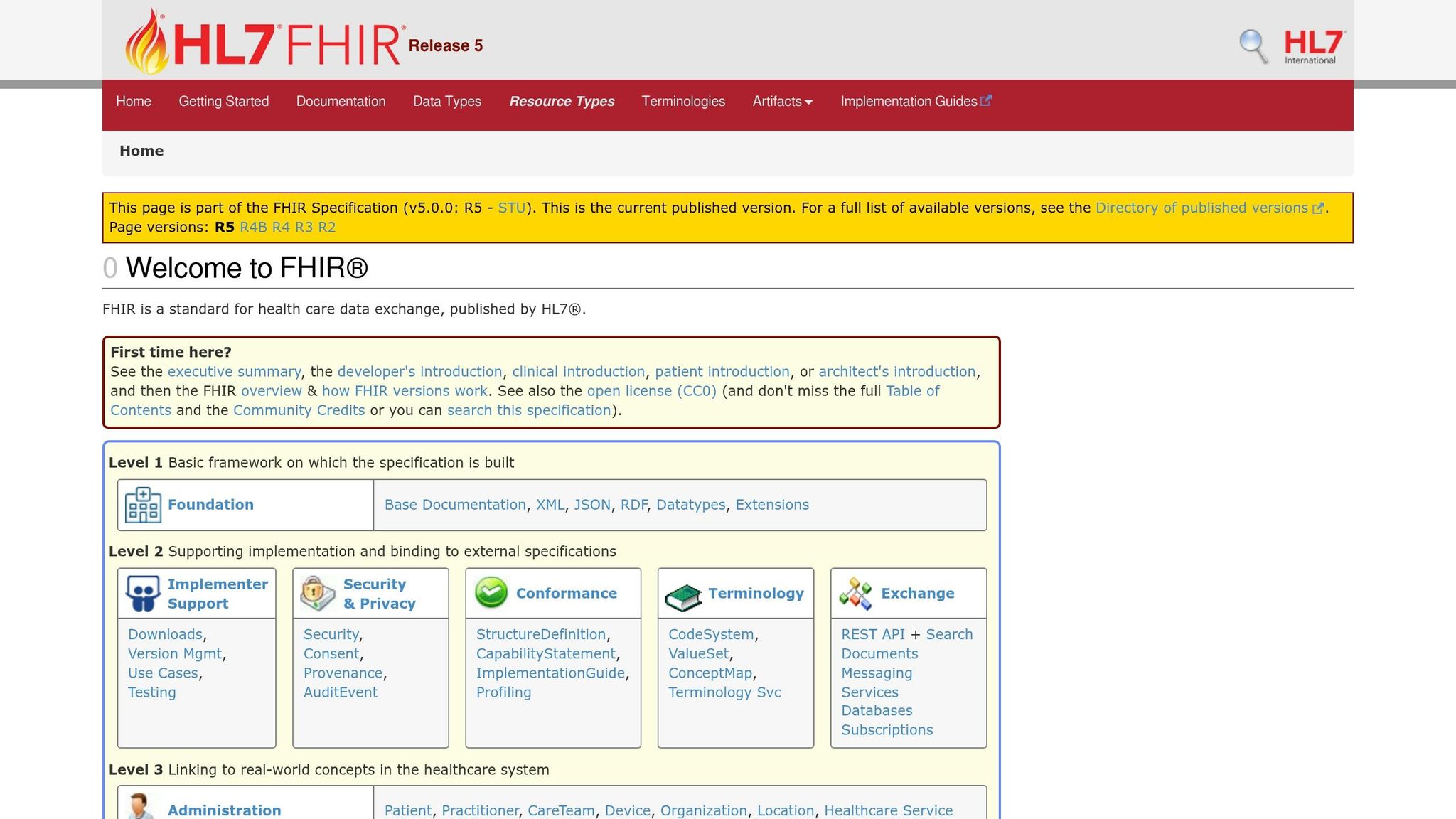
The HL7 FHIR Consent resource is the machine-readable format for storing a user's consent choices. Each resource records a permit or deny decision, the data categories involved, the approved recipient, and the purpose of use, such as treatment or research.
That matters because different systems can read the same consent record in the same way. You don't need custom mapping for every app, which saves a lot of pain later.
Once consent is recorded, the next job is making sure apps can only ask for what the user allowed.
Connect Consent Capture to Secure App Authorization
SMART on FHIR limits app access through OAuth2 scopes. Those scopes should match the user's consent choices.
A simple rule helps here: map SMART scopes to the same data categories used in FHIR Consent. That way, apps can request only the data the user approved. No more, no less.
Authorization sets the boundary. The decision service checks that boundary each time data is requested.
Add a Consent Decision Service for Real-Time Enforcement
A Consent Decision Service (CDS) sits between a data request and the data itself. Before an API call returns health data, the CDS checks the current FHIR Consent record and returns permit, deny, or redact restricted fields.
This setup has one big advantage: it separates enforcement from individual endpoints. Without a CDS, every API, every AI workflow, and every data export needs its own consent check. And when the rules change, every one of those checks has to change too. That's a mess.
With a CDS, you update the rules in one place, and every downstream system picks up the change. The CDS also enforces revocation at request time, so if consent is withdrawn, data access stops right away.
Real-time enforcement only works when one decision point controls access. If each service checks consent on its own, gaps show up fast.
Applying These Rules to AI-Powered Health Coaching
These controls matter most when AI turns consent into a live data pipeline.
Consent for Wearables, Biometrics, Bloodwork, and Lifestyle Data
List every connected data source and explain, in plain English, what each one is for. Users should know from the start whether wearable data is used for coaching, model training, or both. Those are separate uses, so they need separate consent records.
If the coaching feature only needs a limited set of inputs, collect only those data types unless there is a clear, disclosed reason to ask for more. Healify combines wearables, biometrics, bloodwork, and lifestyle data to generate personalized guidance. Each of those data categories comes with its own consent burden and regulatory weight, especially under frameworks like GDPR.
Each data source also needs its own purpose, lawful basis, and revocation path. The table below shows how common AI coaching features line up with legal basis, compliance duties, and what revocation means in practice:
| AI Coaching Feature | Legal Basis / Consent Type | Key Regulatory Obligations | Revocation & Retention Needs |
|---|---|---|---|
| Wearable & Biometric Sync | Explicit Consent | Data minimization, transparency | Stop data flow immediately; retain de-identified trends only |
| Personalized Coaching & Guidance | Documented lawful basis, with consent where required | Purpose limitation | Stop future insights; exclude revoked data from the recommendation engine |
| AI Model Training & Product Improvement | Consent or another disclosed lawful basis | Anonymization, right to object | Move data into aggregate reporting only after de-identification; exclude revoked data from future training and document how existing model artifacts are handled |
| External Sharing (e.g., downstream integrations) | Optional Consent | Disclosure of third-party risk | Revoke access immediately; notify users that the app cannot control external copies once shared |
Handling Revocation and Effects on Future Recommendations and Training
Once consent is withdrawn, that decision has to hit both the user interface and the model pipeline. In plain terms, the front end can't keep showing the user as opted in while the back end keeps pulling data. Active data collection stops right away. Any external access should be revoked at the same time, and users need a clear notice that the app cannot control external copies once shared.
Set the rule now for what happens to revoked data. Will it be deleted, de-identified, or blocked from future training? Pick one path and write it down. If your policy allows it, keep only de-identified, aggregated outputs.
If a user's data has already been used in model training, your policy should spell out what happens next. Explain whether that data will be left out of future training, how existing model artifacts are handled, and the user's right to object to that use. This is the part teams often push off until later, but that's where the trouble starts.
Conclusion: The Shortest Path to a Defensible Consent System
That is why AI-specific uses should run through the same master consent record and decision service as every other health data use. AI coaching needs separate, disclosed legal bases for model training, behavioral analytics, and personalized recommendations. Plan for revocation before launch, not after.
FAQs
How do I know which data uses require separate consent?
Ask for separate consent each time the purpose for using health data changes or goes past your service’s main functional needs.
Consent should be clear and specific for each use. For example, personalized health coaching is not the same as third-party sharing or research, so each one should have its own consent choice.
Granular controls help here too. They let users grant or revoke access to individual data streams - like sleep patterns or heart rate - on their own, instead of giving one blanket approval for everything.
What should happen technically when a user revokes consent?
When a user revokes consent, the system must stop using that user’s data at once across all active processing pipelines, with no manual action required. That update should sync across all connected systems in real time.
Each revocation should also be logged with a precise timestamp and a unique user identifier, creating a clear audit trail for compliance, audits, or legal review.
How should AI training data be handled after consent is withdrawn?
When users withdraw consent, AI systems should immediately remove their information from active processing pipelines to support compliance.
With dynamic consent frameworks, those changes are tracked in real time, so data access and use stay limited to the permissions the user currently allows. That kind of automation helps platforms like Healify maintain strong regulatory standards without manual delays or extra complexity.