
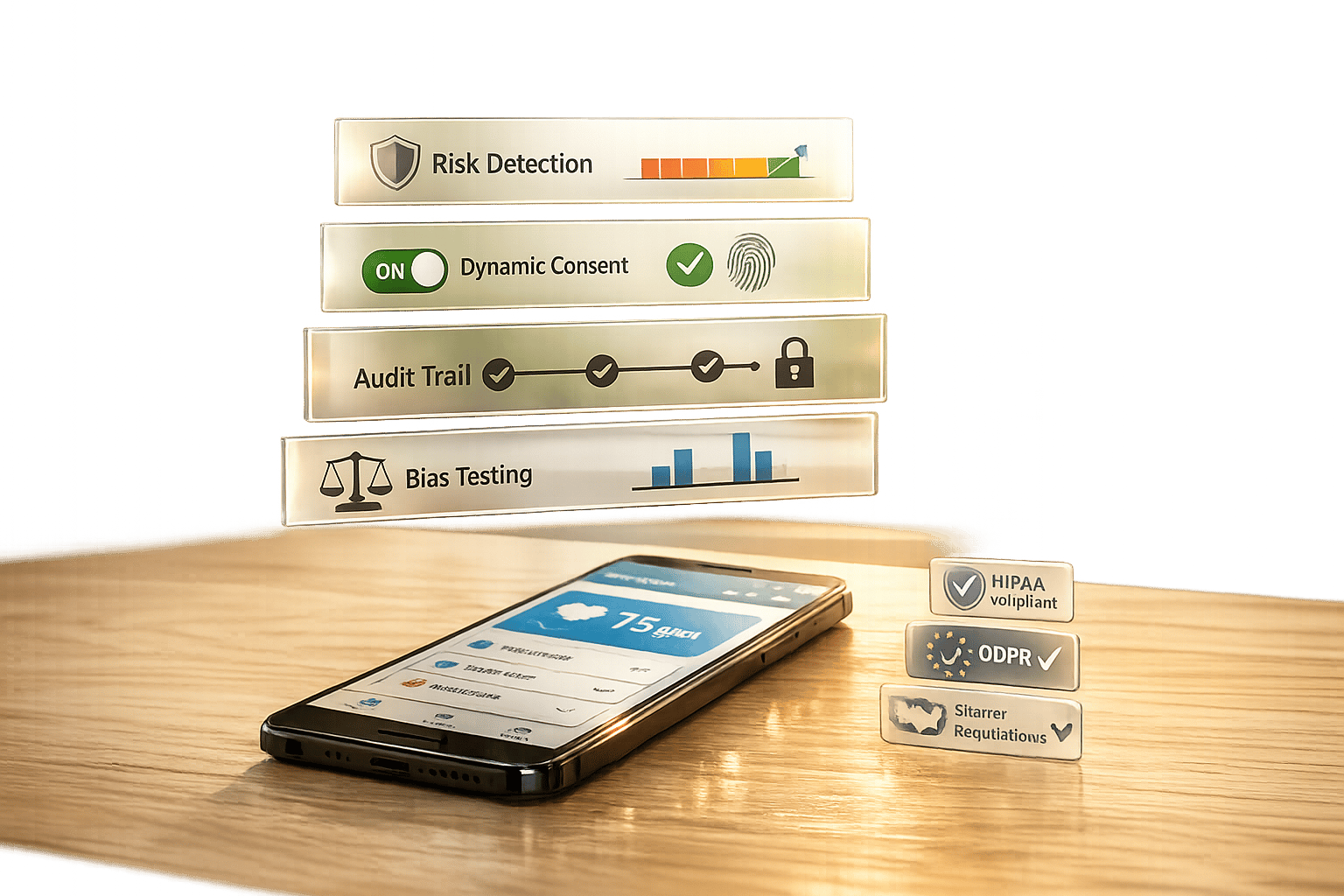
AI is transforming how health apps handle strict regulatory requirements, especially for managing chronic condition data. Here's what you need to know:
- AI streamlines compliance by automating tasks like risk detection, audit trails, and consent management.
- HIPAA regulations require robust data privacy safeguards, such as encryption, multi-factor authentication, and breach notifications.
- AI governance rules emphasize transparency, bias testing, and human oversight for AI-driven decisions.
- Non-compliance is costly: a single HIPAA violation can cost up to $1.5 million annually, while healthcare data breaches averaged $10.22 million in 2025.
Preparing Health Care Compliance Programs for AI-Driven Enforcement
sbb-itb-f5765c6
Key Regulatory Requirements for Health Apps
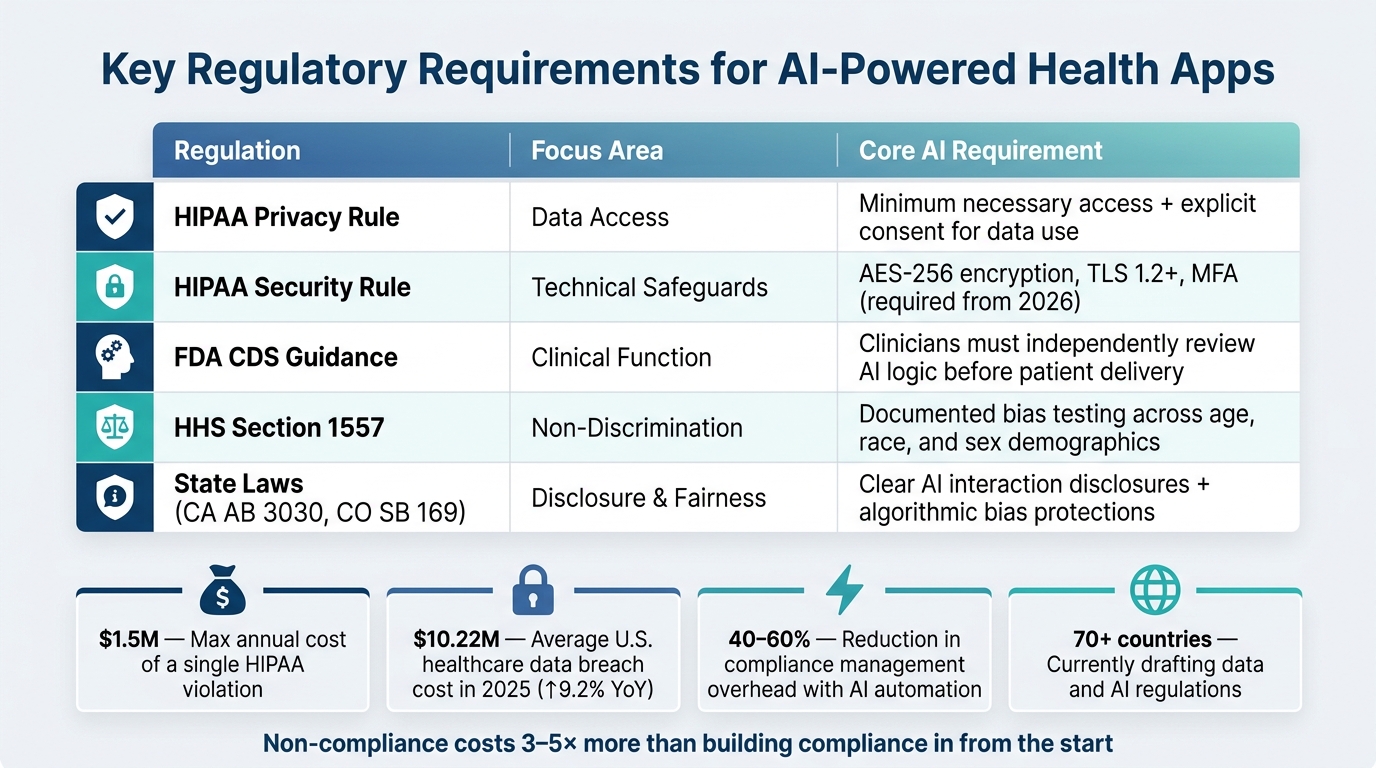
AI Compliance in Health Apps: Key Regulations & Requirements
Health apps that manage chronic condition data operate within one of the most heavily regulated sectors in technology. To navigate this landscape, it's crucial to understand which rules apply and what they demand. These regulations directly shape the compliance strategies for health apps.
HIPAA and Data Privacy Obligations
HIPAA is the cornerstone of federal regulations governing how health apps handle sensitive user data. It includes several critical rules that influence app design and operation.
The Privacy Rule outlines what qualifies as Protected Health Information (PHI) and enforces a "minimum necessary" standard. For instance, an AI tool verifying drug interactions must only access the PHI relevant to its task. The Security Rule mandates key technical safeguards like AES-256 encryption for data at rest, TLS 1.2+ encryption for data in transit, unique user identification, and automatic session logoff. Starting in 2026, new HHS rules will also require multi-factor authentication.
The Breach Notification Rule is becoming stricter. Proposed updates aim to reduce the notification window for affected individuals and HHS from 60 days to 30 days. This change could pose challenges for teams without automated detection systems in place.
Another critical requirement is Business Associate Agreements (BAAs). Any third party handling PHI - such as cloud providers, AI APIs, or transcription tools - must sign a BAA. These agreements should explicitly prohibit vendors from using PHI to train their models and must include any subcontractors they work with.
"The compliance question most healthcare IT teams get wrong is treating it as a vendor problem. Your AI vendor secures the platform – but who revokes access when an employee leaves? ... Those are your responsibilities, and no BAA in the world transfers them." - Eyal, Director of Professional Services, Synthflow
It's worth noting that HIPAA isn't the only framework in play. Apps that don't meet HIPAA's definition of a "covered entity" may still fall under the FTC Health Breach Notification Rule, which requires notifying both consumers and the FTC of any unauthorized access to health data. State-level regulations, such as California's AB 3030 and Colorado's SB 169, also come into play, addressing issues like clear disclaimers for AI-generated communications and protections against algorithmic bias.
AI Governance and Ethical Use in Health Apps
Regulations are not just focused on data privacy; they are increasingly concerned with how AI systems make decisions. Transparent and ethical AI governance is now a key priority.
The FDA's Clinical Decision Support (CDS) guidance is particularly relevant for apps managing chronic conditions. It requires that clinicians be able to independently review the logic behind AI-generated recommendations before they are presented to patients. This "provider-in-the-loop" approach ensures clinical oversight and helps differentiate wellness apps from regulated medical devices.
"The key is maintaining a qualified human in the loop between AI outputs and patient care." - Konstantin Kalinin, Head of Content, Topflight Apps
Additionally, HHS Section 1557 extends non-discrimination requirements to AI-driven tools in healthcare. Health apps must conduct documented bias testing to ensure their training data is representative and does not lead to discriminatory outcomes. AI systems should also provide clear, plain-language explanations to clinical users.
Here’s a summary of key AI-related regulatory requirements:
| Regulation | Focus Area | Core AI Requirement |
|---|---|---|
| HIPAA Privacy Rule | Data Access | Minimum necessary access and explicit consent for data use |
| HIPAA Security Rule | Technical Safeguards | AES-256 encryption, secure transmission, and multi-factor authentication |
| FDA CDS Guidance | Clinical Function | Clinicians must independently review AI logic |
| HHS Section 1557 | Non-discrimination | Documented bias testing |
| State Laws (CA, CO) | Disclosure & Fairness | Clear disclosures on AI interactions and protections against algorithmic bias |
Even when AI outputs are validated, they cannot replace human review. If a clinician cannot independently verify a recommendation's reasoning, the system remains at risk of compliance challenges. Building in routine human oversight from the start - rather than as an afterthought - is critical for meeting these evolving requirements. By aligning with these regulations, health apps can also leverage AI to automate compliance tasks, detect risks, and maintain audit trails. These foundational steps set the stage for AI-driven automation in compliance, which will be explored further in the next sections.
How AI Supports Compliance in Health Apps
Understanding regulations is one thing. Applying them effectively, consistently, and at scale is another. This is where AI steps in, transforming compliance from a tedious checklist into an integral part of an app's operations.
Automated Risk Detection and Monitoring
AI doesn't wait for scheduled audits to identify compliance risks - it works continuously. It scans deployments for hardcoded secrets, patterns of Protected Health Information (PHI), and known software vulnerabilities. Middleware powered by AI logs every API call involving PHI, capturing details like access attempts, status codes, and IP addresses in secure, unchangeable records.
To ensure compliance even after updates, AI validates encryption standards (e.g., AES-256, TLS 1.2+) and session timeout settings, confirming they remain intact.
"The fastest teams in this space treat compliance as a design constraint, not a review stage." - Sathavalli Yamini, Content Writer, GeekyAnts [8]
Beyond identifying risks, AI simplifies the documentation and reporting processes, providing a comprehensive view of compliance efforts.
Automated Documentation and Reporting
Manual documentation can bog down compliance workflows. AI eliminates this bottleneck through compliance-as-code, which automatically generates audit trails during normal app operations. Every database write, user action, or PHI-related API call triggers an unchangeable log entry stored in a secure, write-protected location. This approach ensures health apps meet U.S. regulations like FDA 21 CFR Part 11, which mandates time-stamped, non-overwritable audit trails for electronic records.
For AI models, tools such as MLflow and DVC record details like model versions, confidence scores, and human actions taken afterward. This makes it possible to fully reconstruct the system's decision-making process during audits.
AI also strengthens compliance by dynamically managing user consent.
Consent Management and User Transparency
Static consent forms are outdated. AI enables dynamic consent, allowing users to control data access in real time instead of agreeing to a one-time policy during onboarding.
"Instead of a simple checkbox under the privacy policy, you should implement a Granular Dynamic Consent architecture solution, which allows the user to control access in real time." - Denis, Head of Backend department, Wezom [10]
When users revoke consent, AI systems instantly exclude that data from active processing pipelines - no manual action required. AI-driven NLP models, with over 99% accuracy, identify PHI to ensure only user-approved data is processed [9]. Additionally, techniques like SHAP (Shapley Additive Explanations) provide clear, easy-to-understand explanations for AI-generated insights, moving away from opaque "black box" outputs. These automated processes help apps like Healify maintain high compliance standards while scaling operations efficiently.
Data Security and Audit Trails with AI
AI plays a crucial role in protecting sensitive health data while maintaining an unchangeable record of data activity. To meet regulatory standards, health apps must go beyond simple monitoring and documentation - they need to ensure data integrity through advanced AI-driven methods. By automating processes, AI strengthens data security with powerful anonymization techniques and transparent audit trails.
Data Anonymization and Threat Detection
AI doesn't just automate compliance - it also fortifies data security. For example, AI-powered Identity and Access Management (IAM) systems can set user-specific access rules. These systems differentiate between roles, like a physician and a billing clerk, and flag or block any unusual activity that doesn't align with those patterns [9].
When processing data, AI enforces HIPAA’s "minimum necessary" rule by removing unnecessary patient details before use [5]. This is particularly vital for vector databases in AI-driven health apps, where patient histories can leave traces in embeddings. These traces must be encrypted and handled as electronic Protected Health Information (ePHI) [5].
"The exact clinical narrative and patient telemetry that make AI transformative are the same data vectors that can trigger massive enforcement penalties if mishandled." - Amrit Saluja, Technical Content Writer, GeekyAnts [5]
The stakes are high: U.S. healthcare data breaches cost an average of $10.22 million per incident in 2025 - a 9.2% rise from the previous year [2]. However, implementing AI-driven compliance automation can cut management overhead by 40–60% within the first year [9].
Building and Maintaining Audit Trails
A reliable audit trail provides a tamper-proof record of every data access and decision. For AI-driven health apps, these logs should include more than just timestamps. They must also capture the inbound data, system prompts, AI-generated confidence scores, and the clinician's final actions [5][11].
To ensure the integrity of these logs, they should be stored in write-once storage, making them immune to modifications. This prevents both administrators and automated processes from altering or deleting entries [2]. Cryptographic hashing adds another layer of security, creating a verifiable chain that confirms data hasn’t been altered since its creation. These measures can cut audit response times by over 70% and reduce compliance challenges by 60% [11].
Health apps like Healify adopt these practices to not only meet regulatory demands but also build user trust. By enhancing data security and maintaining transparent audit trails, these apps lay the groundwork for smooth, step-by-step compliance processes.
How to Use AI for Compliance in Health Apps: A Step-by-Step Guide
When developing health apps, compliance isn't something to tack on at the end - it needs to be part of the process from the very beginning. By integrating compliance early, alongside robust data security and audit trails, teams can streamline development. In fact, AI-first approaches can make compliance up to 10–20× faster than traditional manual methods [2]. But this efficiency only comes with a disciplined, step-by-step approach.
Validating AI Models for Regulatory Use
Start by determining whether your AI functionality qualifies as a regulated medical device. According to the FDA's 2026 guidance, patient-facing AI that provides diagnostic or treatment recommendations is classified as Software as a Medical Device (SaMD) [12]. The FDA explains:
"In general, if a software function is intended for use in performing a medical device function... it is a medical device, regardless of the platform on which it is run." - FDA Guidance (2022/2026) [12]
Once you've identified your app's regulatory classification, human oversight becomes non-negotiable. Model confidence alone isn’t enough - you need qualified human review for all outputs. As Konstantin Kalinin, Head of Content at Topflight Apps, puts it:
"The real question was never whether your AI is smart enough. It is whether your product keeps a qualified human between the model and the patient." [1]
Additionally, ensure your training data meets HIPAA standards by using "Safe Harbor" or "Expert Determination" methods [6]. Conduct bias audits across key demographic groups, including age, race, and sex [3]. And don’t forget to maintain a Software Bill of Materials (SBOM), which documents all components, such as AI SDKs and mobile libraries, as required by FDA Section 524B [12][13].
With models validated and oversight in place, it’s time to translate these regulatory requirements into actionable development steps.
Compliance Implementation Checklist
After validating your AI models, focus on these specific actions to maintain compliance. The table below connects key compliance areas with practical steps your team can implement right away:
| Compliance Area | Action Required |
|---|---|
| Intended Use | Document exactly who uses the app and what medical claims it makes [12]. |
| BAA Coverage | Ensure every third-party API, including LLM providers like Azure OpenAI or AWS Bedrock, has a signed Business Associate Agreement [2][6]. |
| Data Privacy | Verify encryption at rest and in transit, and enforce automated PII scrubbing [2][6]. |
| AI Governance | Log every model version in production and attribute outputs to specific versions [3]. |
| Bias & Hallucinations | Test your LLM for vulnerabilities like prompt injection and PHI leakage; include source citations and confidence framing [6]. |
| Clinical Escalation | Create a clear pathway to human care navigators or emergency services for patient-facing AI [3]. |
| Audit Trails | Store immutable, timestamped logs of all inference calls, data transformations, and user access [2][6]. |
To manage regulatory risk effectively, consider launching an initial version of your app that focuses on wellness and education. These areas carry lower regulatory requirements. Once you've built a solid evidence base and regulatory strategy, you can introduce higher-risk features, such as clinical decision support, in future updates [14].
Mayank Pratap Singh, Founder & CEO of EngineerBabu, offers a simple but powerful piece of advice:
"Build the guardrails first. Optimize the efficiency second." [3]
Conclusion: What AI Means for Health App Compliance Going Forward
Compliance is evolving from being a last-minute checklist to becoming a core part of the design process. Teams that approach regulatory requirements as an ongoing discipline, rather than a one-time audit, will be better equipped to adapt as rules shift across HIPAA, FDA guidance, and new AI-specific frameworks.
In 2025, U.S. healthcare data breaches averaged $10.22 million, marking a 9.2% increase from the previous year [2]. Retrofitting compliance after a breach or regulatory issue can cost 3–5× more than building it into the platform from the start [2]. These figures highlight the financial and operational risks of neglecting compliance early on. It’s clear that integrating governance from the beginning is not just smart - it’s essential.
"Governance should be integrated into the DNA of platform development. Organisations that succeed will treat regulatory controls as a living capability, rather than a static checklist." - Oneeb Mian, Associate Director of AI Strategy and Implementation, IQVIA [4]
But it’s not just about avoiding costs. Compliance can also be a competitive edge. Kishore Pendyala, Founder and CEO of KPi-Tech Services, emphasizes this point: "Compliance is the competitive moat that most startups underestimate." [7]. Health systems and enterprise payers are increasingly rejecting apps that fail to show explainable AI outputs, maintain traceable audit logs, or provide documented human oversight. AI-first development makes these requirements easier to meet, giving compliant apps a distinct advantage.
For apps handling chronic condition data, these safeguards are critical for maintaining secure and trustworthy operations. Key strategies include automating audit trails, enabling dynamic consent, and ensuring that a qualified human oversees AI-generated insights. With over 70 countries now drafting data and AI regulations [4], continuous monitoring of these changes is crucial. By establishing these processes early, teams can avoid penalties, streamline development, and build lasting trust with users and stakeholders.
FAQs
Does my health app fall under HIPAA or the FTC Health Breach Notification Rule?
Your app must comply with HIPAA if you are a covered entity - like a healthcare provider or health plan - or a business associate acting on their behalf. If your app doesn't fall under HIPAA, it may instead be subject to the FTC’s Health Breach Notification Rule. This rule mandates that vendors of personal health records notify both users and the FTC in the event of security breaches. Carefully assess your app’s role to determine which regulations apply.
When does an AI feature turn a health app into an FDA-regulated medical device?
A health app equipped with AI becomes an FDA-regulated medical device if it’s designed to diagnose, treat, cure, mitigate, or prevent disease. The FDA doesn’t focus on the technology itself but evaluates the app based on its claims, marketing materials, and how the software functions.
Apps that analyze physiological data, offer clinical insights, or recommend treatments - especially without input from a healthcare professional - usually fall under FDA oversight. While some low-risk tools might be exempt, any app making diagnostic or treatment claims is likely to face FDA regulation.
What logs should we capture to create a compliant, tamper-proof audit trail for AI outputs?
To maintain a tamper-proof and compliant audit trail for Healify, it's crucial to log every AI output with full context. Here's what should be included:
- Precise timestamp: Record the exact time, down to sub-seconds, for accuracy.
- User identity and authorization scope: Log who accessed the system and the permissions they held.
- AI model version: Specify the version of the AI model used for generating the output.
- Full prompt and response: Capture both the input provided to the AI and its corresponding output.
- Tamper-evident hash: Generate a cryptographic hash to ensure data integrity and detect any changes.
- PHI classification and patient identifier: Clearly label any Protected Health Information (PHI) and associate it with the correct patient.
- Governing policy version: Document the version of policies or regulations that apply to the logged interaction.
Each record must be signed immediately to comply with HIPAA and FDA 21 CFR Part 11 standards, ensuring both security and regulatory adherence.