
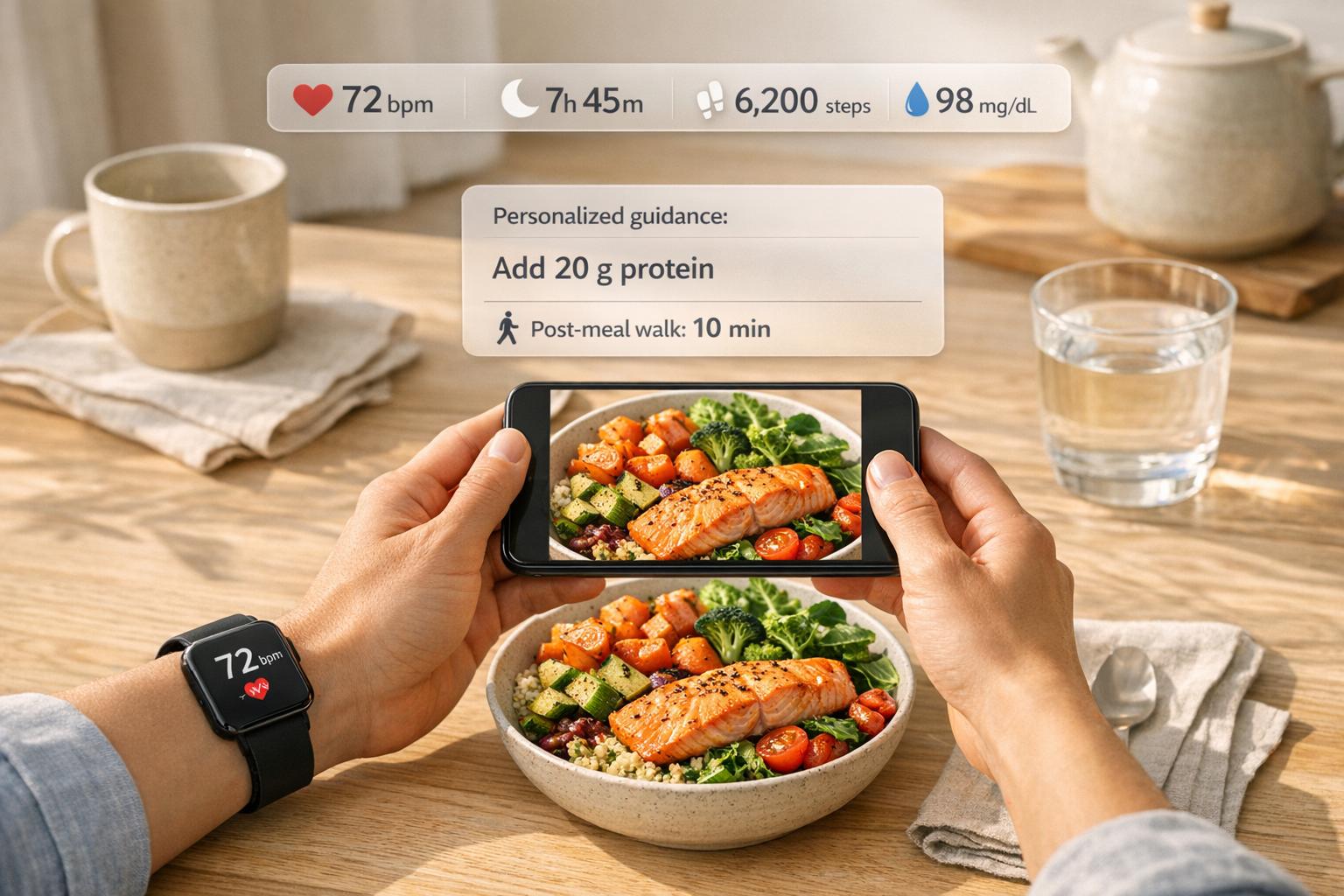
AI-powered wearables are changing how we track and improve nutrition. They use real-time data like heart rate, sleep, activity levels, and even glucose monitoring to offer tailored meal recommendations. Unlike static meal plans, these systems provide real-time meal plan adjustments based on your daily needs, making healthy eating simpler and more personalized.
Key Takeaways:
- What It Does: AI analyzes wearable data to create specific dietary advice.
- Why It Matters: Saves time, boosts consistency in meal tracking, and accounts for factors like sleep and stress.
- How It Works: Devices track metrics like calories burned, sleep stages, and glucose levels, while AI turns this into actionable diet plans.
- Example Tools: Apps like Healify sync with devices like Apple Watch to provide real-time suggestions.
This technology simplifies tracking, reduces errors, and helps build sustainable habits by linking food choices to health outcomes. AI nutrition tracking is fast, efficient, and tailored to your lifestyle.
Hate Tracking Calories? This AI Camera Tracks Macros Automatically! (Amazfit V1TAL Tested!)
sbb-itb-f5765c6
How Wearables Collect and Share Nutrition-Related Data
Your smartwatch or fitness tracker does much more than count steps. These devices constantly gather data from multiple sensors, and when this information feeds into an AI system, it creates a detailed picture of your metabolic health.
Key Data Types Wearables Track
Modern wearables track a variety of data points that tie directly to nutrition. Heart rate variability (HRV) and resting heart rate provide insights into how well your body is recovering. These metrics influence your daily needs for carbohydrates and protein. Accelerometers and GPS track movement type and intensity, helping AI estimate calories burned with precision. Then there’s sleep stage tracking - monitoring REM, light, and deep sleep stages. Poor sleep can lower insulin sensitivity, altering how your body processes food.
For those managing blood sugar, Continuous Glucose Monitors (CGMs) like Dexcom or FreeStyle Libre add another layer. These tiny sensors measure interstitial glucose levels in real time, showing how specific foods impact your body - not just in terms of calories but their metabolic effects. As Stanford genetics professor Michael Snyder explains:
"Different people spike to different foods, whether that be pasta, potatoes, or bread, in a highly personalized manner." [4]
On the food-logging front, AI-powered photo recognition simplifies tracking. Instead of manually entering every ingredient, you can snap a photo of your meal. The AI estimates portion sizes and nutrient density automatically, removing the hassle that often causes people to stop tracking altogether. These combined metrics pave the way for AI’s ability to transform raw data into actionable insights.
How AI Integrates Wearable Data
AI takes these diverse data streams and builds a comprehensive model of your metabolic health. It doesn’t treat sleep, activity, and glucose data as separate pieces but cross-references them to uncover patterns that would otherwise go unnoticed. Within just two weeks, AI models can predict your glucose response to meals with up to 85% accuracy [5]. This allows for real-time adjustments to your nutrition targets based on current conditions. For instance, users who follow AI-recommended post-workout meals have seen recovery metrics improve by up to 19% [5].
This marks a shift from passive data logging to what researchers call proactive metabolic optimization. The AI dynamically fine-tunes your nutrition targets based on factors like your training intensity, sleep quality, and physical stress levels. Apps such as Healify connect to wearable platforms like Apple HealthKit, using the continuous data stream to provide meal recommendations tailored to your body’s needs that day - rather than relying on a generic meal plan.
How to Set Up Your Wearables and AI App for Nutrition Tracking
Getting your wearable device and AI app working together smoothly is key to turning your data into actionable advice. Spending a few minutes on setup can make a big difference in the quality of insights you receive.
Connecting Your Wearable and Enabling Data Sharing
Most AI nutrition apps rely on Apple Health as a central hub to collect data from devices like Apple Watch, Fitbit, Garmin, or Samsung wearables. During the onboarding process, make sure to grant "Read" and "Write" permissions for activity, workouts, body measurements, and nutrition data. These permissions are essential for syncing your data. If you notice that syncing isn’t working, go to Settings → Privacy & Security → Health on your iPhone, select your app, and enable all the necessary categories. [7]
For example, apps like Healify integrate directly with Apple HealthKit. This allows the app's AI coach, Anna, to analyze your real-time activity and recovery data instead of relying on estimates.
Adjusting Settings for U.S. Users
Once your device is connected, head to the app's Settings or Preferences menu and adjust it to U.S. standards, such as pounds, calories, and °F. Incorrect units can throw off your calorie and macro recommendations from the start. Wear your device consistently and log your meals for at least one week. This helps the AI calibrate to your baseline, enabling features like Dynamic Calories to function accurately. [7]
With this calibration complete, you’re ready to move on to setting your health goals.
Setting Goals for Personalized Recommendations
After your baseline is established, define your main health goal - whether it’s losing weight, building muscle, or boosting energy levels. This input helps the AI analyze your wearable data and craft its nutritional recommendations to match your objective. Be sure to choose a pace that feels sustainable, so the AI has time to adapt to your habits. This ensures its suggestions become more tailored as it learns your patterns over time. [7]
Turning Wearable Data into a Daily Diet Plan
Wearables do more than just track your steps or heart rate - they now help shape your daily nutrition. By syncing your device and calibrating your baseline data, AI jumps in as your personal coach. It takes metrics like steps, heart rate, sleep quality, and stress levels to create a diet plan tailored to your day.
Matching Nutrition to Your Activity Level
What your body needs on a rest day is very different from what it craves after a tough workout. AI bridges this gap seamlessly. By analyzing active caloric burn and training load, it adjusts your macronutrient goals in real time. After a hard workout, it may increase your protein and carbohydrate intake to aid recovery, while on rest days, it scales back to support recovery without overloading. This flexibility makes it far more effective than a static meal plan. [3][1]
Using Sleep and Stress Data to Shape Your Diet
Sleep and stress don't just affect your mood - they also play a major role in your nutrition. AI uses sleep quality and heart rate variability (HRV) to guide food choices, emphasizing nutrient-dense options that restore energy and steering clear of high-glycemic foods that could lead to mid-morning crashes. [3]
When stress levels spike, AI responds differently. Instead of simply adjusting calories, it might recommend magnesium-rich foods to help manage the physiological toll of stress and build resilience. This level of precision and context-awareness is something traditional meal plans just can't replicate.
"By integrating modern tools - such as biological biomarkers and digitally assisted reporting - we can dramatically improve accuracy while reducing the burden on participants." - Dr. Thomas Wilson, Department of Life Sciences, Aberystwyth University [6]
This approach ensures your diet adapts to your current needs, offering advice that's both timely and actionable.
Real-Time Suggestions from Your AI Coach
Imagine having a coach available 24/7. Apps like Healify make this possible with AI coaches like Anna. Just finished a morning run? Anna might suggest a recovery meal to eat within the hour. Didn’t sleep well? She’ll adjust your nutrition plan before you even grab breakfast.
As Tribe AI explains, "AI moves beyond simply tracking past food intake to predicting future physiological responses to new foods." [8] This predictive capability is what transforms AI into a true coach rather than just a calorie tracker. Every suggestion is tailored to your unique lifestyle, making your diet feel personalized rather than one-size-fits-all.
Building Better Habits with AI-Driven Insights
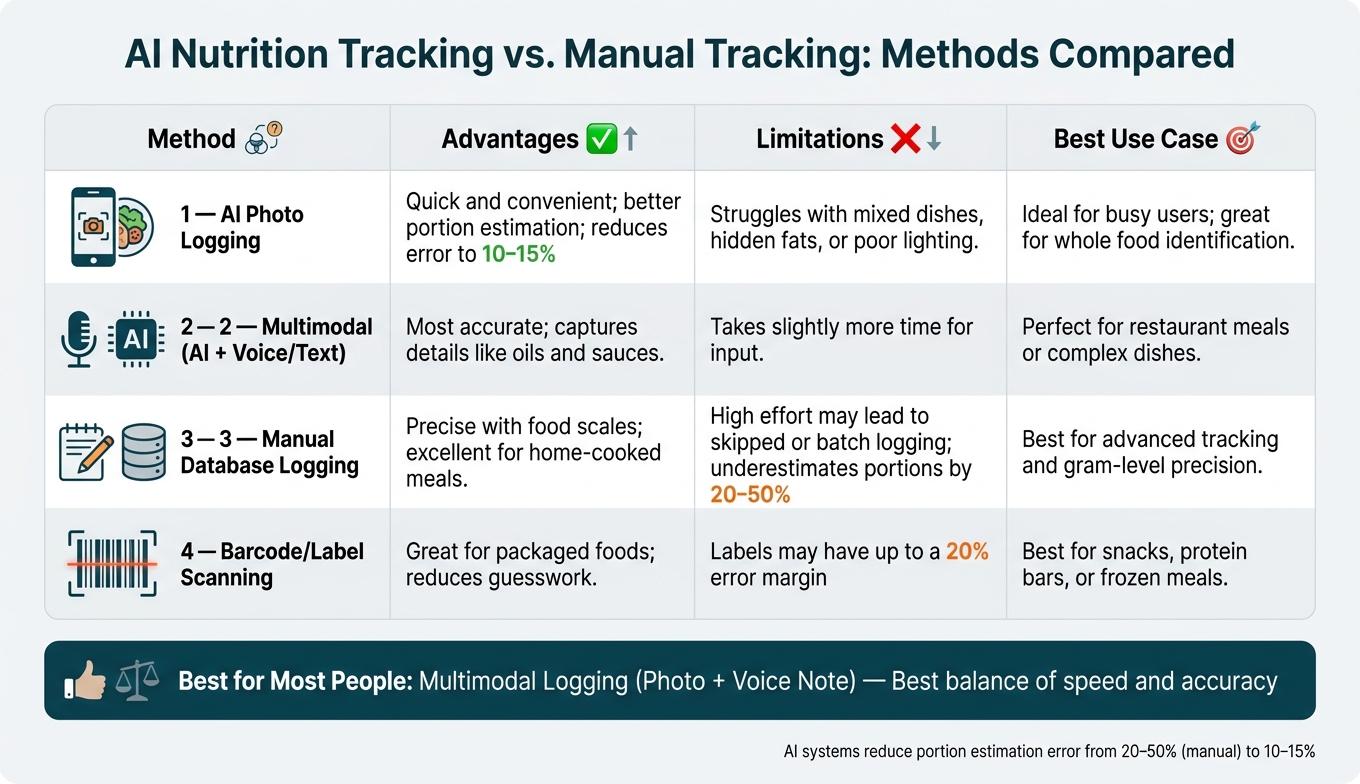
AI Nutrition Tracking vs. Manual Tracking: Methods Compared
Creating lasting healthy habits isn’t just about making quick adjustments to your meals. It’s about using the data you collect over time to build consistency. Real-time coaching is a great starting point, but the real magic happens when you use that data to shape long-term behaviors.
Improving Accuracy by Reviewing Your Logs
The effectiveness of AI nutrition tracking depends heavily on the quality of the data you provide. A common pitfall? Underestimating portion sizes. Research shows manual tracking often underestimates portions by 20%-50%, while AI image systems reduce that error to 10%-15% [9][11].
Other frequent logging mistakes include missing hidden fats, misjudging compressed portions, or confusing raw and cooked food measurements [11]. To fine-tune your logs, try snapping a photo and jotting down quick notes like “cooked in butter” or “half dressing” to capture details the camera might miss [11][12].
"Recognition looks better than intake estimation. A system can identify ramen, chicken curry, or a burrito bowl and still miss calories by a lot because the sauce, oil, edible portion, and portion size remain uncertain." - Stephen M. Walker II, Product Leader and AI Founder [11]
Here’s a simple habit to improve your accuracy: once a week, compare a recurring meal - like your go-to breakfast or daily protein shake - against the food label or a food scale. Updating just one regular entry can significantly improve your weekly totals, and saving the corrected version prevents future errors [11].
Accurate tracking is the foundation for meaningful insights that can help refine your eating habits.
Using AI Insights to Build Healthier Eating Habits
While precision matters, the real power of AI lies in its ability to guide better decisions. Apps like Healify go beyond logging your meals by linking your food choices to outcomes like energy levels, sleep quality, and recovery. Weekly summaries can highlight patterns - like how high-carb dinners might disrupt your sleep or how skipping fiber could lead to an afternoon energy slump. These insights encourage small, manageable changes over time [12][13].
AI doesn’t just tell you what to eat; it suggests actionable tweaks. Examples include adding 10 grams of fiber, timing protein intake with workouts to reach fitness goals, or opting for lower-glycemic snacks [12][13]. These micro-adjustments are far easier to stick with than rigid meal plans, and their impact builds over time.
"The overarching benefit of food-tracker apps is that they help with awareness of and accountability around what we're eating." - Meridan Zerner, Registered Dietitian [9]
Consistency is the key to long-term nutritional success, and AI makes it easier to stay consistent by reducing the time and effort needed for logging. By cutting meal entry time from minutes to seconds, AI ensures tracking doesn’t feel like a chore [14][15].
With these tools in hand, it’s worth comparing how AI-based tracking stacks up against traditional manual methods.
AI Nutrition Tracking vs. Manual Tracking: Pros and Cons
| Approach | Advantages | Limitations | Best Use Case |
|---|---|---|---|
| AI Photo Logging | Quick and convenient; better portion estimation [11][12] | Struggles with mixed dishes, hidden fats, or poor lighting [10][11] | Ideal for busy users; great for whole food identification |
| Multimodal (AI + Voice/Text) | Most accurate; captures details like oils and sauces [11][12] | Takes slightly more time for input | Perfect for restaurant meals or complex dishes |
| Manual Database Logging | Precise with food scales; excellent for home-cooked meals [11] | High effort may lead to skipped or batch logging [9][11] | Best for advanced tracking and gram-level precision |
| Barcode/Label Scanning | Great for packaged foods; reduces guesswork [11] | Labels may have up to a 20% error margin [11] | Best for snacks, protein bars, or frozen meals |
For most people, multimodal logging - combining a photo with a quick voice note - offers the best balance between speed and accuracy. While manual logging is great for those who need precise measurements, AI-assisted methods are much more practical for forming everyday habits [11][12].
Conclusion: Better Nutrition Tracking with AI and Wearables
AI-powered wearables are transforming how we track nutrition. Gone are the days of manual logging, guesswork, and relying on memory. Now, real-time data - like heart rate, sleep patterns, and activity levels - pairs with fast, intuitive meal tracking to create a smarter, more seamless experience.
The numbers back it up: AI-driven systems improve logging consistency by 40%, and photo-based meal recognition makes entries three times faster [2]. By reducing these barriers, what once felt like a chore can now become a lasting habit. This technology connects detailed data to everyday dietary choices, making it easier to stay on track.
What makes this approach stand out is its ability to adjust. Unlike static meal plans, AI adapts to the realities of your day - whether it’s a tough night of sleep or an intense workout. Tools like Healify combine wearable data and food logs to deliver insights tailored to you, not a one-size-fits-all model.
"The future of nutrition is data-driven. We are moving away from the era of trial-and-error and into an age of precision health." - Neura Health [3]
This shift signals a broader move toward proactive, personalized health. Features like continuous glucose monitoring (CGM), circadian-based nutrition timing, and predictive nutrient deficiency alerts are already taking shape. By syncing your wearable with AI, you can align your diet with your unique biology and take control of your health like never before.
FAQs
Do I need a CGM for AI nutrition tracking to work well?
A continuous glucose monitor (CGM) isn't necessary for AI-based nutrition tracking to function well. AI can process information from different wearable devices and even analyze food images to deliver insights. That said, for people managing diabetes or prediabetes, using a CGM can add another layer of precision. It offers detailed blood sugar data, which can help refine and personalize nutritional recommendations.
How long does it take the AI to personalize my calorie and macro targets?
The AI needs roughly 15 minutes to process your real-time health data and insights from wearables. This helps it create personalized calorie and macro targets that align with your specific needs and lifestyle.
What should I do when the app misreads my meal photo or portions?
If the app misinterprets your meal photo or portion sizes, think of the AI's food logging as a starting point. Take a moment to review its estimates for calories, macros, and micronutrients. If something seems off, adjust the details to ensure your records are accurate. This is especially important when dealing with unclear inputs, like blurry photos or uncertain portion sizes. Double-checking before saving your entries will help you maintain precise nutrition tracking.