
Wearable devices like smartwatches and fitness trackers are becoming essential for health monitoring, but syncing their data quickly and reliably is critical. Delays in data updates can lead to missed health alerts or inefficient monitoring. AI is changing this by enabling faster data processing directly on devices, reducing dependency on cloud systems. Here's how:
- Edge AI: Processes health data locally on wearables, cutting transmission delays by up to 90%.
- Smart Algorithms: Prioritize urgent health alerts while saving bandwidth and battery life.
- Federated Learning: Protects privacy by training AI models on devices without sharing raw data.
- Event-Based Syncing: Sends data only during significant health events, reducing power consumption by 50%.
- Conflict Resolution Tools (CRDTs): Ensure accurate data when syncing multiple devices.
Platforms like BondMCP integrate these advancements, delivering real-time insights with high accuracy and efficiency. These technologies are transforming wearables into reliable tools for real-time biomarker monitoring and emergency response.
149 AI in Wearables in the Healthcare Industry with Raj Sangroula
AI Methods for Faster Wearable Data Sync
The demand for real-time health alerts has led to advancements in AI methods that significantly improve how wearables enable real-time data sync. By reducing data transfers and optimizing communication timing, these AI-driven approaches ensure faster and more efficient synchronization. Let’s dive into the specific techniques making this possible.
Edge AI for Local Data Processing
Edge AI enables wearables to process data directly on the device, cutting out the need for constant server communication. For instance, a smartwatch detecting an irregular heartbeat can analyze the data locally and send an immediate alert, even without network access. By handling much of the processing on the device itself, Edge AI can slash data transmission by up to 90%, sending only critical updates or summaries to the cloud[3][5].
Lightweight Machine Learning for Small Devices
Wearable devices often operate with limited resources, which is where lightweight machine learning (ML) models come in. These models use techniques like quantization and pruning to function efficiently on microcontrollers without draining battery life. For example, wearable glucose monitors now use quantized LSTM models, running on platforms like TensorFlow Lite or ONNX Runtime, to deliver real-time predictions of blood sugar trends right on the device[5][3][6].
Smart Algorithms for Dynamic Data Sync
Smart algorithms play a key role in optimizing how and when wearables sync data. These algorithms assess factors like network quality, bandwidth, and battery levels to decide the best time and method for data transmission. For example, during periods of poor connectivity or low battery, non-critical data uploads are delayed, while urgent health alerts take priority. Event-based synchronization - where data is sent only when significant changes or anomalies occur - further minimizes unnecessary sync operations, conserving both bandwidth and battery life[2][4].
A standout example of this approach is the BondMCP - Health Model Context Protocol, which uses a consensus engine to process health data from multiple sources. This platform achieves consensus validation in under 3 seconds, with an average response time of just 1.8 seconds. Such intelligent algorithms ensure timely and reliable medical insights without compromising efficiency[1].
Additionally, adaptive resource allocation enhances synchronization by dynamically adjusting processing frequencies based on the device's current conditions. This ensures that critical health data always gets top priority. These advanced methods highlight the progress in reducing sync delays, paving the way for more effective health monitoring systems.
Core Protocols and Systems for Wearable Data Sync
Fast data synchronization in wearable devices relies on protocols like the Model Context Protocol designed to enhance efficiency, accuracy, and privacy. These systems form the backbone of how advanced AI integrates with health-focused wearables, making them more practical and effective for users.
Federated Learning for Private Data Sync
Federated learning brings a new way to train AI models on wearable devices without exposing personal health information. Instead of sending sensitive data - like heart rate, sleep patterns, or glucose levels - to a central server, each device processes and trains AI models locally. The devices then share only the learned insights and improvements with others in the network.
This approach works similarly to edge AI, ensuring data stays on the device, which is crucial for privacy. For instance, continuous glucose monitoring (CGM) systems now use federated learning to predict blood sugar trends. Each CGM patch collects data, trains its own prediction model, and shares updates with a central server. This method has shown a 70% reduction in data transmission latency, while accuracy improves as the system learns from a broad range of user patterns - all without compromising personal data[2].
Research also highlights that federated learning can reduce data transmission by up to 90% compared to traditional cloud-based systems, cutting down on latency and power usage[1][3]. For users, this means longer battery life and quicker responses during critical health events.
Event-Based Synchronization for Better Efficiency
Event-based synchronization builds on earlier advancements in smart algorithms to significantly reduce power consumption. Instead of continuously syncing data, this method triggers data transmission only during notable events - like detecting an irregular heartbeat, a fall, or a sudden change in activity levels.
By focusing on key moments, this approach can cut power consumption by up to 50%, making it a game-changer for long-term health monitoring[2]. The AI algorithms at work filter out sensor noise and adjust their sensitivity based on what the user is doing, which helps avoid unnecessary triggers.
Conflict-Free Replicated Data Types (CRDTs)
CRDTs play a crucial role in resolving conflicts when multiple devices track the same user's health data. For example, if your smartwatch records 8,500 steps while your fitness band logs 8,650 steps for the same day, CRDTs step in to reconcile these differences. Using mathematical rules, they merge conflicting data automatically, eliminating the need for real-time coordination between devices.
This technology is especially useful in setups where users wear multiple sensors or experience intermittent connectivity. CRDTs allow devices to independently update data and resolve conflicts later, ensuring seamless and accurate health tracking even when the network connection is spotty[2].
For frequent travelers or those in areas with unreliable internet, CRDTs ensure that wearables continue to collect and process data locally. Once connectivity returns, the devices merge their data effortlessly, so no important health insights are lost due to temporary network issues.
sbb-itb-f5765c6
Practical Uses of AI-Powered Wearable Data Sync
AI-powered wearable sync offers quick, actionable health insights that enhance emergency response and enable continuous health monitoring.
Continuous Health Monitoring in Wearables
Wearables equipped with edge AI processing can analyze data locally, allowing them to detect and respond to health emergencies in real time. For instance, the Apple Watch's atrial fibrillation detection uses on-device AI to monitor heart rhythms and identify irregularities instantly, sending immediate alerts without relying on cloud processing[5]. This technology has been implemented in millions of devices, showcasing how timely responses can be the difference between early intervention and missed opportunities[3][5].
Clinical trials have highlighted the benefits of integrating multiple wearable sensors into a single system. By combining data from various sensors, these systems can detect anomalies in real time and provide predictive insights, enhancing patient monitoring and improving the accuracy of electronic health records[4]. Faster, data-driven decisions directly contribute to better health outcomes for users.
Switching from cloud-based to edge-based processing has addressed critical timing issues in health monitoring. Cloud systems often face delays due to data transmission and server processing. In contrast, wearables with on-device AI can process data instantly, ensuring immediate alerts in emergencies like falls, cardiac events, or sudden changes in vital signs[3][5]. This capability significantly improves response times, paving the way for integrated AI and wearable systems that deliver unified health insights.
Smart Health Data Connection with BondMCP
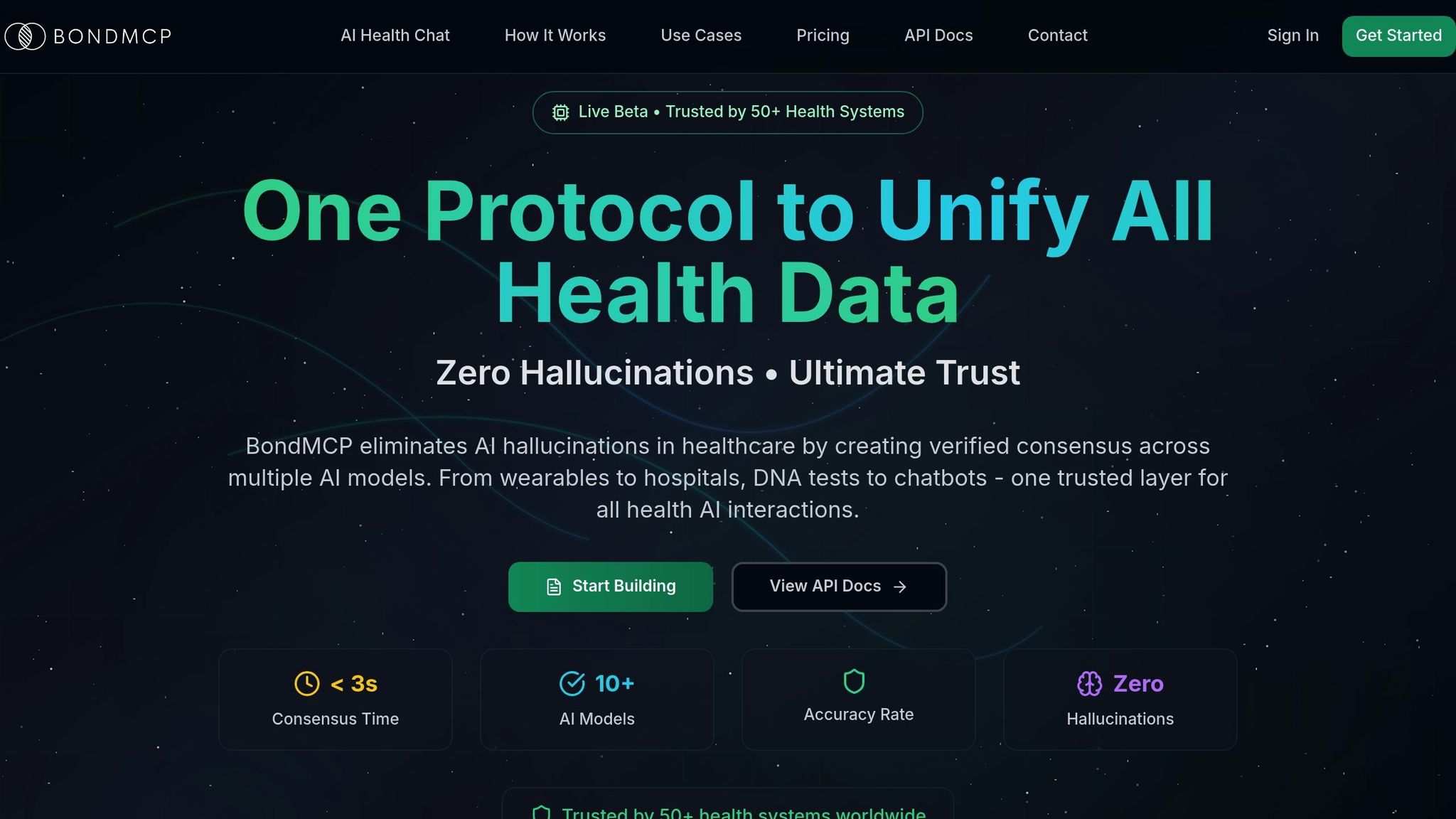
Platforms like BondMCP take these rapid responses further by creating unified systems for comprehensive health management. BondMCP solves the long-standing problem of fragmented health data by connecting multiple sources into a single intelligence layer. It achieves 99.8% accuracy in validating health insights within 3 seconds, making it highly reliable for real-time decision-making[1].
Handling over 2.5 million API calls per month with 99.9% uptime, BondMCP demonstrates its ability to scale and perform reliably in practical applications[1].
This platform links diverse health data seamlessly. For example, your sleep tracker can inform your workout recommendations, lab results can adjust your supplement plan, and your long-term health goals can guide decisions across all connected devices. Using a shared context layer and health-specific ontology, BondMCP ensures that AI agents collaborate effectively rather than working in isolation.
To enhance trust, the system provides cryptographic trust certificates for every response, ensuring that all insights are verifiable and traceable. This feature is especially critical in healthcare, where decisions must be accountable and secure. With full audit trails and enterprise-grade security compliance, healthcare providers can confidently rely on AI-generated insights[1].
Battery-Saving AI Solutions
AI not only enhances responsiveness but also optimizes battery usage, which is essential for continuous health monitoring. Advanced algorithms manage processing, resource allocation, and data transmission efficiently, reducing energy consumption without compromising performance[3][4]. This balance is key to ensuring that wearables can provide round-the-clock monitoring without draining their batteries.
Duty cycle optimization and dynamic power management are two techniques that extend battery life. These systems adjust sensor activity based on user behavior and health status. For instance, monitoring frequency may increase during exercise or sleep and decrease during periods of inactivity, conserving energy while maintaining accuracy[4].
The result is a better user experience. Wearables can run longer between charges, supporting uninterrupted health monitoring and delivering timely insights and emergency alerts when needed[3][4]. By using optimized AI models that fit within the memory and processing limits of wearable devices, developers can ensure that smaller, lighter devices still offer advanced health tracking capabilities[2][5]. This opens up new possibilities for creating sophisticated yet compact monitoring tools.
Future Developments and Challenges in AI-Powered Wearable Data Sync
The world of wearable data synchronization is advancing quickly, but it still faces a mix of technical and operational hurdles.
Advancements in Distributed AI Systems
Distributed AI systems are making strides in scalability and efficiency, particularly in wearables. By 2028, it's predicted that over 54% of mobile edge devices will incorporate AI, signaling a strong move toward edge-based processing [8]. This decentralized approach allows wearables to handle more intricate health monitoring tasks without depending heavily on cloud connectivity.
Federated learning is a standout here, enabling collaborative model training while keeping raw data private. For instance, BondMCP's Consensus Super AI employs 10+ medically trained AI models to achieve an impressive 99.8% accuracy with an average response time of just 1.8 seconds. This system processes over 2.5 million API calls monthly, showcasing its capacity for real-time consensus validation while avoiding AI errors [1]. The federated learning market itself is expected to grow from $128.3 million in 2023 to $260.5 million by 2030, driven by privacy-focused AI solutions [8].
Another exciting development is topology-aware synchronization strategies, which have already reduced latency by 43.2% in healthcare applications. This progress paves the way for tackling security and collaboration challenges in wearable data synchronization [8].
Tackling Security and Reliability Concerns
As wearables manage increasingly sensitive health data, security and reliability have become just as crucial as performance. Many solutions now emphasize on-device processing to minimize cloud vulnerabilities, but there’s still work to be done in areas like end-to-end encryption, anonymization vs. de-identification, and seamless integration with clinical systems.
Reliability issues, such as data loss during power outages, inconsistent syncing across devices, and model drift as user conditions evolve, remain a concern [2][4]. Advanced methods like the Fair Dividend Interrupt Method (FDIM) are showing promise, improving data quality and reducing latency in hospital settings [4].
Adaptive event-driven algorithms are another key innovation, cutting data transmission failures by 61% and boosting critical data delivery reliability from 87.3% to 99.1% in patient monitoring scenarios. These algorithms also reduce energy consumption by 31.4%, making them ideal for wearables [8].
Despite these advancements, challenges like robust authentication across interconnected devices and maintaining data integrity in complex ecosystems persist. Efforts are underway to develop HIPAA-compliant architectures that protect sensitive health data, even during power outages or network disruptions [2].
Enhancing AI Agent Collaboration
Beyond processing and security, improving collaboration between AI agents is essential for seamless data sharing across wearables. Currently, fragmented systems often provide conflicting advice because individual AI agents lack shared context.
Multi-model consensus validation is a step forward in solving this problem. By creating unified context layers, AI agents can share insights, reducing conflicting recommendations and enabling better device collaboration. For example, implantable cardiac monitors have benefited from these advancements, achieving a 28.4% increase in battery life while maintaining continuous synchronization of arrhythmia data using decentralized methods [8].
Looking ahead, the focus will shift to plug-and-play orchestration systems that allow new devices and AI agents to integrate effortlessly into existing health ecosystems. This would eliminate the need for users to juggle multiple apps with inconsistent advice, instead offering a unified system that works toward cohesive health goals.
The U.S. Health & Human Services Secretary has underscored the importance of wearables in health monitoring, emphasizing the need for scalable, secure, and efficient data platforms. This government backing suggests that improved AI collaboration will continue to receive strong investment and regulatory support in the years to come [2].
Conclusion: How AI is Transforming Wearable Data Sync
AI has reshaped how wearable devices manage data synchronization. Instead of relying on slow, cloud-based systems, modern wearables now process data in real time, directly on the device. This shift has led to impressive results: a 73.9% drop in latency, 15.8% lower power consumption, and a 23x boost in throughput compared to older methods [7]. These advancements mean wearables can detect critical events - like irregular heartbeats, sleep apnea episodes, or dangerous falls - in milliseconds, enabling faster alerts and potentially life-saving interventions.
Unified intelligence platforms are tackling the problem of fragmented health data by connecting multiple sources into a single, streamlined system. Platforms like BondMCP are leading the charge, allowing your sleep tracker to inform your fitness plan or your lab results to automatically adjust your supplement regimen. This eliminates the hassle of managing multiple apps that often provide conflicting advice.
Efficient, AI-driven synchronization is becoming vital for national health infrastructure, as reflected in recent policy initiatives. For example, topology-aware synchronization strategies have reduced latency by 43.2% in healthcare environments, while implantable cardiac monitors now boast 28.4% longer battery life, all while maintaining continuous data sync [8].
"Get validated medical insights in seconds, not minutes." - BondMCP [1]
The real game-changer lies in context-aware AI agents that unify data for personalized, automated health management. Instead of dealing with isolated data points, these systems create a connected ecosystem where every piece of health information works together to provide a complete picture of your wellbeing. With federated learning and multi-model consensus validation becoming the norm, wearable data will soon be securely shared, intelligently analyzed, and automatically applied to improve health outcomes. These innovations are shaping a future where every data point contributes to a smarter, more cohesive approach to health and wellness.
FAQs
How does AI help wearable devices sync data faster and more efficiently?
AI, especially Edge AI, is transforming how wearable devices handle data by making synchronization faster and more efficient. Instead of depending entirely on cloud servers, Edge AI processes data directly on the device. This reduces delays, allowing for almost instant updates and smoother real-time health monitoring.
It also improves data compression and transmission, ensuring only the most important information is synced. This approach not only conserves the device's resources but also extends battery life. The result? A more seamless, responsive user experience with accurate and dependable health insights.
How does federated learning enhance privacy when syncing wearable data?
Federated learning enhances privacy by keeping your wearable device data on the device itself, rather than transferring raw information to a central server. Instead of sharing personal data, it sends only insights or updates to the model, significantly lowering the chances of exposing sensitive information.
This method enables secure, real-time data synchronization while safeguarding user privacy, making it particularly well-suited for health monitoring and improvement.
How do smart algorithms help wearables save battery while delivering timely health updates?
Smart algorithms are key to making wearable devices last longer on a single charge. They do this by fine-tuning how data is processed and shared. By studying how the device is used and focusing on the most important tasks, these algorithms help make the best use of available power. For example, they can change how often data syncs depending on how active you are or how urgent a health alert might be. This reduces power drain from unnecessary processes.
At the same time, these algorithms support real-time health tracking by quickly analyzing data and sending timely alerts. Whether it's a warning about an irregular heart rate or an update on your sleep quality, users get the information they need without delays - all while keeping battery usage in check.