
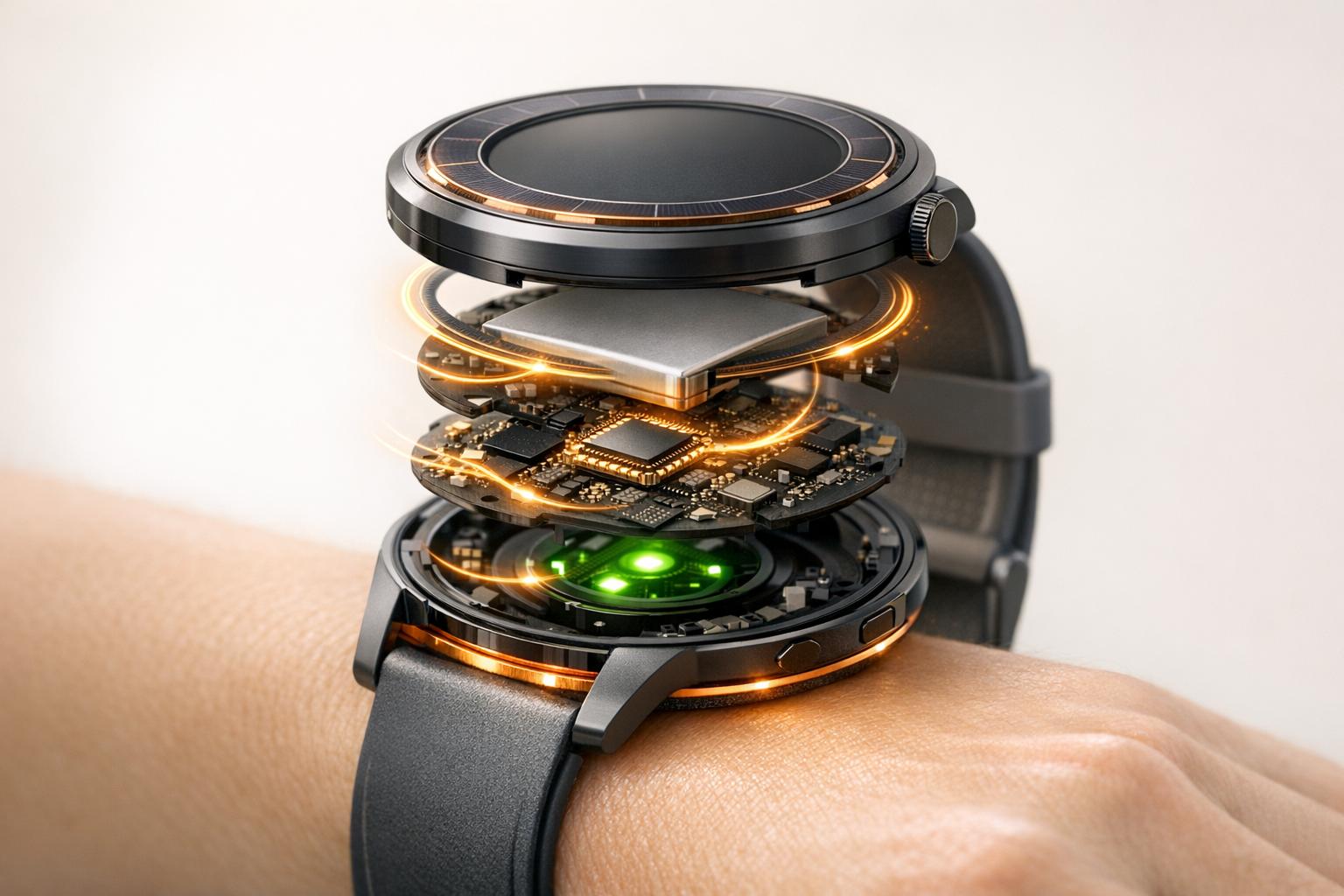
Health wearables like fitness trackers and smartwatches monitor metrics such as heart rate, SpO₂, and sleep patterns. But their small batteries - typically 130–400 mAh - struggle to support continuous tracking, network connectivity, and advanced features like GPS. Poor battery life leads to frequent recharging, disrupting the user experience and data accuracy.
Key Challenges:
- Battery Size: Limited capacity compared to smartphones (3,000–5,000 mAh).
- Power Drains: GPS, LTE/Wi-Fi, and continuous sensors consume significant energy.
- User Behavior: High-frequency tracking and active features reduce battery life drastically.
Solutions:
- Low-Power Processors: Chips like Renesas DA14699 conserve energy by staying dormant until needed.
- Efficient Sensors: Duty cycling and edge computing reduce sensor energy use.
- Optimized Wireless Communication: Bluetooth Low Energy (BLE) and data compression minimize transmission power.
- Energy Harvesting: Technologies using body heat, motion, and light can power devices without relying solely on batteries.
Example: JCVital Pro V8
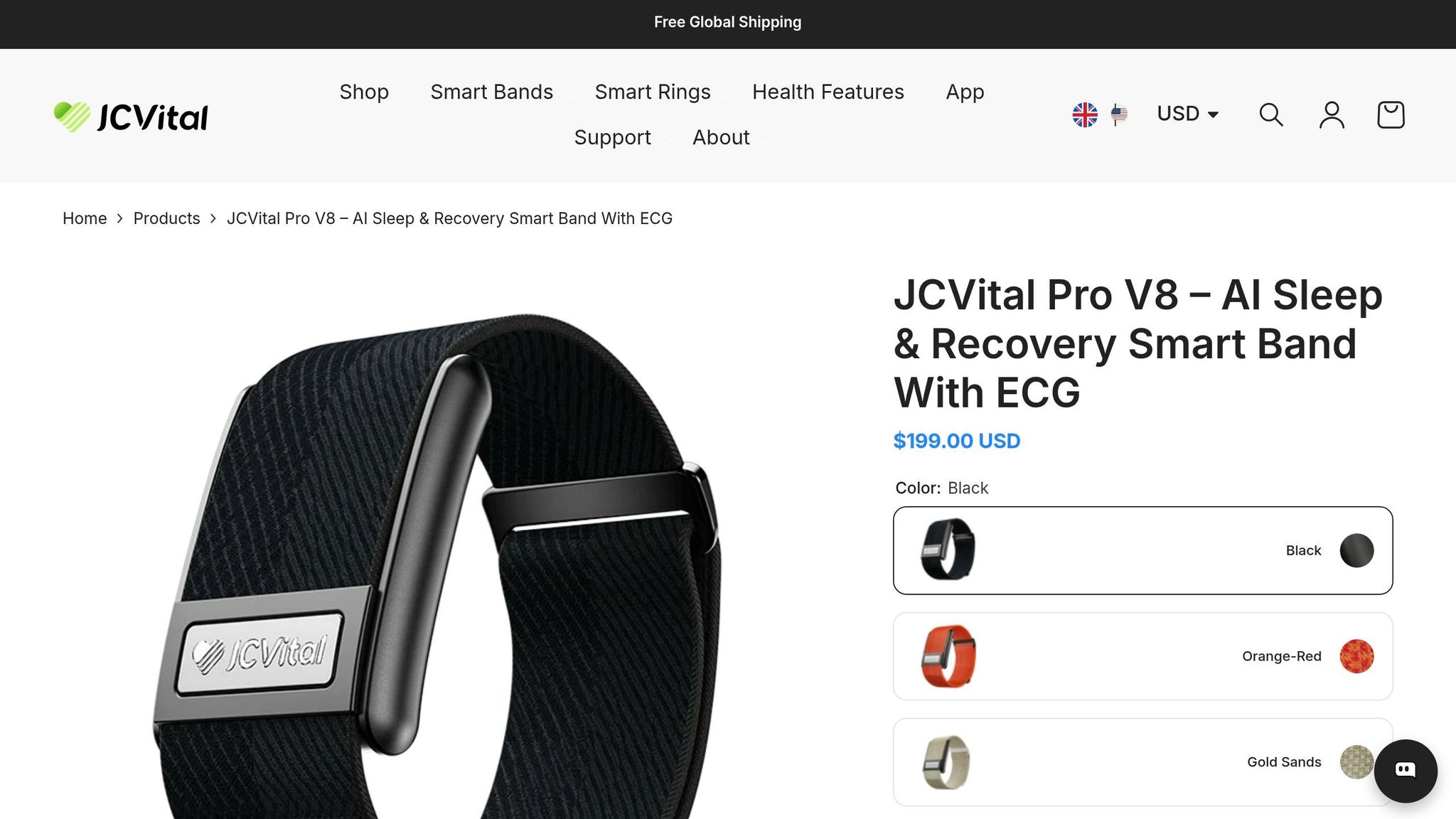
This screenless health band offers 15+ days of battery life using:
- A co-processor to keep the main chip in deep sleep.
- Adaptive LED algorithms for efficient biosensing.
- No display, focusing energy on health monitoring.
Future Trends:
- Combining solar, thermoelectric, and motion-based energy harvesting.
- AI for smarter energy management and predictive monitoring.
- Far-field wireless charging and biodegradable materials.
Energy efficiency in wearables is about smarter design - balancing hardware, software, and user needs to extend battery life and improve usability.
Designing a Hybrid Energy-Efficient Harvesting System for Head- or Wrist-Worn Healthcare Wearables
sbb-itb-f5765c6
How Wearable Health Devices Use Power
Wearable Battery Life: How Features Impact How Long Your Device Lasts
Key Power-Consuming Components in Wearables
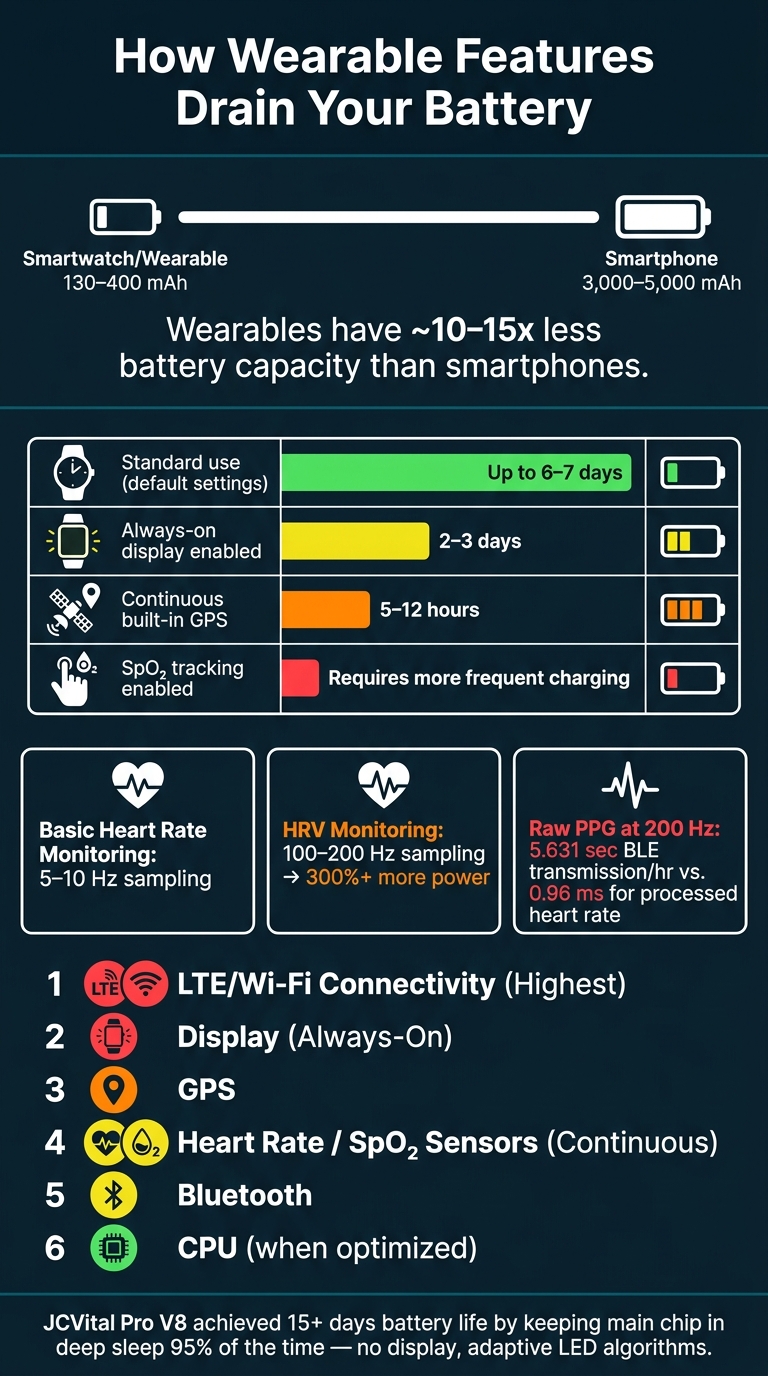
Not all components in a wearable device consume power equally - some draw significantly more than others. Network connectivity (like LTE or Wi-Fi) is the biggest battery drain, followed by the display and GPS. Features like heart rate sensors and Bluetooth fall somewhere in the middle, but their continuous operation can still lead to noticeable power loss over time. [2]
The CPU is another major factor. If it's kept active - often due to "wakelocks" - it can quickly deplete the battery. Specific operations, such as writing a flash memory page (which uses 12.4 mA) or transmitting Bluetooth Low Energy (BLE) advertising data (which spikes to 10.5–12 mA), also contribute to power drain. These activities can even cause voltage drops that destabilize the device. [4]
"Compared to larger mobile devices, Wear OS devices have smaller batteries, so any battery drain is more noticeable." - Android Developers [2]
How Usage Patterns Affect Battery Life
The way a user interacts with their device can have as much impact on battery life as the hardware itself. For example, a Fitbit Charge 6 can last up to 7 days with typical usage. However, enabling continuous GPS tracking slashes that to just 5 hours. [5]
Another key factor is the sensor sampling rate. For instance, basic heart rate tracking only requires 5–10 Hz, but measuring heart rate variability (HRV) accurately demands 100–200 Hz. This higher sampling rate can increase power consumption by over 300%. [3] Similarly, transmitting raw photoplethysmogram (PPG) data at 200 Hz requires 5.631 seconds of Bluetooth transmission time per hour, compared to just 0.96 milliseconds for sending a processed heart rate value. This difference can mean the difference between a device lasting several days or just a few hours.
| Feature/Mode | Battery Impact |
|---|---|
| Standard use (default settings) | Up to 6–7 days |
| Always-on display enabled | Reduced to 2–3 days |
| Continuous built-in GPS | Reduced to 5–12 hours |
| SpO₂ tracking enabled | Requires more frequent charging |
Battery Limitations in Compact Wearables
Wearable devices face a fundamental challenge: they need to be small and comfortable enough for daily use, which leaves little room for a large battery. Most smartwatches have batteries ranging from 130 mAh to 400 mAh, a far cry from the 3,000–5,000 mAh found in modern smartphones. [1][2] This size limitation means every design choice has a direct impact on battery life.
To address this, engineers are finding creative solutions. A standout example is the JCVital Pro V8, a screenless health band launched in May 2026 by J-Style Engineering. It achieved 15+ days of battery life while maintaining continuous 1-second PPG sampling. This was made possible through a three-pronged approach: a Smart Sensor Hub co-processor that kept the main chip in deep sleep 95% of the time, an adaptive LED algorithm that adjusted current based on skin tone and environmental conditions, and the removal of a display to allocate power solely to biosensing. [6]
"The more accurately and frequently a wearable measures your health, the faster its battery dies. This is not a marketing problem - it is a physics problem." - J-Style Engineering & Product Team [6]
These limitations have pushed the development of low-power hardware and energy-saving technologies, setting the stage for more efficient wearable devices in the future. These advancements allow for deeper integration with health AI apps that turn raw sensor data into personalized wellness plans.
Technologies That Improve Energy Efficiency in Wearables
To address the power challenges faced by wearable devices, engineers are turning to advanced technologies designed to make these devices more energy-efficient.
Low-Power Hardware and Processors
Modern wearable processors are designed to work only when necessary, conserving energy by staying dormant until activated. Take the Renesas DA14699, for instance - it combines an Arm Cortex-M33 processor with a Sensor Node Controller and a BLE MAC engine. This setup ensures that power-heavy cores remain inactive until absolutely needed[8].
One technique driving this efficiency is dynamic voltage scaling, which adjusts the chip's voltage to match the task's requirements. The processor completes tasks quickly and then returns to an idle state, saving energy in the process[14]. On the experimental front, RISC-V–based processors like the GAP9 SoC (used in ETH Zürich's BioGAP platform) push efficiency even further. By using eight cores simultaneously, these processors can handle neural network tasks 8.3 times faster than a single ARM Cortex-M4F, all while consuming significantly less energy[7][11].
These advancements in processors are also enabling smarter and more efficient sensor operations.
Optimized Sensor Performance
Energy-efficient sensors are just as critical as efficient processors. One effective method is duty cycling, where sensors are turned off between readings, instead of running continuously. This approach, combined with event-triggered sensing - where low-power accelerometers wake up higher-power sensors only when movement is detected - can drastically cut idle energy consumption[9].
STMicroelectronics' ST1VAFE3BX biosensor takes this concept further. It includes a Machine Learning Core (MLC) that processes data directly within the sensor. Instead of sending raw data to the main processor, it performs localized analysis, consuming only 48.1 µA in high-performance mode and just 2.6 µA in power-down mode[9]. This kind of in-sensor edge computing allows the main processor to stay in a low-power sleep mode for longer periods, saving even more energy.
Enhanced algorithms and smarter sensors work hand-in-hand with low-power chips to conserve energy.
Advances in Wireless Communication
Wireless communication can be a significant drain on wearable batteries. The adoption of Bluetooth Low Energy (BLE) has helped reduce this burden, but even greater efficiency comes from transmitting processed data instead of raw sensor outputs. Technologies like Ambiq's AI-powered compressionKit and BioGAP's onboard FFT can cut BLE airtime and bandwidth usage by up to 95% and 97%, respectively, extending battery life considerably[11][13].
These improvements in communication are critical steps toward creating wearables that require less frequent charging.
Energy Harvesting Technologies for Wearables
Energy harvesting is another exciting avenue for reducing or even eliminating reliance on traditional batteries. Researchers are exploring ways to harness power from body heat, motion, and ambient light.
- Body heat: Thermoelectric generators (TEGs) convert the temperature difference between skin and air into usable energy. For example, a forearm-worn band developed by Yonsei University in November 2024 generated 314 mJ of energy from body heat alone. It used just 43.2 mJ (around 7.2%) to monitor core temperature and pulse, with the excess energy stored for later use[12].
- Motion: Triboelectric nanogenerators (TENGs) capture mechanical energy from everyday movements, generating between 10 and 1,000 µW/cm² depending on activity level[16].
- Ambient light: Solar harvesting is advancing with ultra-flexible organic photovoltaics achieving 16.18% conversion efficiency. These photovoltaics maintain 80% efficiency even after 500 bending cycles at a 1 mm radius, making them suitable for integration into wearables like wristbands[17].
One particularly inventive solution is a light-adaptive PPG sensor. This sensor uses ambient light to reduce its reliance on built-in LEDs, cutting power consumption by up to 86.22% in bright environments. It even incorporates photoluminescent materials, enabling up to 2.5 minutes of sensing in complete darkness after prior light exposure[10].
"The integration of energy storage and harvesting technologies is essential for developing self-sustaining systems that minimize reliance on external power sources and enhance device longevity." - Springer Nature [15]
Integrating Energy-Efficient Wearables with Healify

All the advancements in hardware - like efficient processors, duty-cycled sensors, and compressed BLE transmissions - only make an impact if the apps managing that data are equally mindful of power use. That’s where Healify’s integration approach truly stands out. It seamlessly aligns with the next steps in power conservation.
How Healify Handles Wearable Data Integration
Healify operates on a power-conscious data model. Instead of continuously pulling raw sensor data from your wearable, it uses native services, such as Health Services on Wear OS, designed specifically for energy efficiency. These services handle the heavy lifting by calculating metrics like heart rate, step count, sleep stages, and distance directly on the device before transmitting the processed results.
"Conserves battery by using sensor configurations from Health Services that are optimized for power efficiency." - Android Developers [18]
This approach reduces the computational strain on both the wearable and the app. Healify also employs event-based triggers - known as Passive Goals - to receive updates only when significant milestones occur, such as hitting a step goal or entering a sleep state. This eliminates the need for constant data polling, which can drain battery life unnecessarily.
Healify doesn’t stop at efficient data handling. It goes a step further by incorporating AI for smarter, power-conscious monitoring.
AI-Driven Monitoring with Healify's Coach Anna
Healify’s AI health coach, Anna, is designed to work with periodic, summarized data rather than relying on a continuous live feed from your wearable. By analyzing trends across biometrics, bloodwork, sleep patterns, and lifestyle inputs, Anna provides tailored recommendations without requiring high-frequency sensor monitoring.
When users start an active session - like a workout or a real-time stress check - Healify temporarily increases the monitoring frequency. Once the session ends, it reverts to passive mode. As Android Developers explain:
"Try to minimize the time your app spends with a registered listener, because it increases the sensor sampling rate and thus increases power consumption." - Android Developers [18]
This method ensures high-frequency sampling is only used when absolutely necessary, balancing functionality with battery efficiency.
How Healify's Insights Reduce Wearable Power Use
By optimizing sensor output, Healify not only extends battery life but also enhances the overall efficiency of your device. One practical example: if the app detects consistent, healthy sleep patterns during the night, it reduces monitoring intensity during periods of low activity. This targeted approach means less strain on your wearable, ensuring it’s ready to perform when you need it most.
Conclusion and Future Trends in Wearable Energy Efficiency
Key Takeaways on Energy-Efficient Wearables
When it comes to wearables, energy efficiency isn't just a matter of convenience - it defines how well the device performs. The main takeaway here is that battery life is a system-wide achievement, not something that can be fixed by focusing on a single component. It’s about how hardware, sensors, software, and communication protocols all work together seamlessly.
One standout example is on-device processing, which cuts wireless data transmission drastically - from 400 B/s down to just 4 B/s, a 99% reduction [10]. Then there’s adaptive sensor control, like using ambient light to reduce LED intensity during PPG measurements, slashing power consumption by 86.22% compared to running without adjustments [10]. On the power management front, SIMO technology not only delivers multiple voltage outputs at 91% efficiency but also reduces the size of the power management system by 50% [19].
Devices like Healify are already taking advantage of these innovations by summarizing data on the device and switching to high-frequency monitoring only when the user is actively engaging with the wearable.
These examples underline an important point: the future of energy-efficient wearables will depend on combining cutting-edge technology with smarter system designs.
What's Next for Wearable Power Efficiency
The future of wearables isn’t about cramming in larger batteries - it’s about smarter systems. This means hardware and software that collaborate to manage energy use based on what the user is doing at any given moment [20].
"Seven-day wearables will not be built by optimizing parts - they will be built by designing systems where hardware and software think together." - Arvind Singh, GM and Global Horizontal Practice Leader, Quest Global [20]
Energy harvesting is set to play a huge role in this shift. By integrating solar, thermoelectric (body heat), and triboelectric (motion) energy sources, wearables could eventually achieve energy-neutral operation - where they generate as much power as they consume. In February 2026, researcher Wai Yie Leong showcased a hybrid system combining PV, TEG, and TENG technologies. This system sustained continuous ECG and PPG monitoring with a harvested power density of up to 220 µW·cm⁻² and was built using biodegradable materials designed to dissolve within 20 weeks [16].
AI is also stepping up as a key player - not just as a user-facing tool but as a real-time energy manager. It can predict low-priority sensing windows and adjust power usage accordingly [20]. Other advancements, like far-field wireless charging, smart textiles with built-in energy harvesters, and TinyML models capable of running atrial fibrillation detection with less than 1 mJ per inference [16], are all paving the way for wearables that are lighter, smarter, and less reliant on frequent charging.
All these developments point to one conclusion: the future of wearables lies in cohesive, system-level design. This approach ensures that every component - hardware, software, and energy harvesting - works together to create devices that are efficient, practical, and ready to meet the demands of tomorrow.
FAQs
What settings drain my wearable battery the most?
The main culprits behind battery drain include continuous LTE or Wi-Fi usage, GPS sensors, and keeping your screen brightness high or using an always-on display. Other factors like frequent data syncing and high CPU activity also take a toll on battery life. To conserve power, consider turning off the always-on display, minimizing GPS usage, and enabling bedtime modes. Healify tackles this issue by using AI to batch data processing and fine-tune sensor sensitivity. This approach not only saves power but also delivers tailored health insights without unnecessary energy loss.
How can wearables measure health data accurately without constant sampling?
Wearable devices rely on smart, context-sensitive AI to maintain accuracy without draining their batteries through constant data collection. These advanced algorithms can adjust how sensors operate based on your activity or condition. For instance, during deep sleep, the device might switch to low-power sensors, reserving high-power ones for detecting major changes. Platforms like Healify take this a step further by learning your individual habits. This allows their AI coach, Anna, to provide tailored insights while conserving energy with efficient, on-demand sensor use.
Can energy harvesting realistically eliminate charging in wearables?
Energy harvesting in wearables has made progress, but it hasn’t reached the point where charging is completely unnecessary. Methods like solar power, kinetic energy, thermal energy, and radio frequency harvesting can help stretch battery life. However, these technologies face hurdles, such as low energy output and reliance on inconsistent environmental conditions.
Healify steps in to enhance the user experience by turning complex health data into easy-to-understand insights. This not only reduces the need for tedious manual tracking but also helps improve battery efficiency, ensuring users get the most out of their devices.