

AI is reshaping stress management by creating personalized, real-time plans tailored to your body's needs. Using data from wearables like heart rate, respiratory patterns, and sleep quality, these systems detect stress with 97% accuracy and provide precise interventions. Tools like BondMCP unify fragmented health data - syncing wearables, calendars, and apps - to deliver actionable insights and automated adjustments. Whether it's suggesting breathing exercises during meetings or optimizing your schedule after poor sleep, AI transforms stress management into a dynamic and responsive process.
Key Takeaways:
- Real-Time Stress Detection: AI uses heart rate, HRV, and other metrics to identify stress triggers.
- Precision Interventions: Tailored solutions based on personal data, not generic advice.
- Integrated Systems: Platforms like BondMCP connect wearables, apps, and routines for a unified approach.
- Dynamic Updates: Plans adjust automatically based on new data like sleep quality or daily stressors.
- Proactive Alerts: Timely notifications prevent stress from escalating.
AI-driven systems are making stress management smarter, more efficient, and seamlessly integrated into daily life.
Track Your Mental Wellness with W The EEG Wearable for Your Brain | TechCrunch Battlefield Winner

sbb-itb-f5765c6
How AI Agents Analyze Stress Data
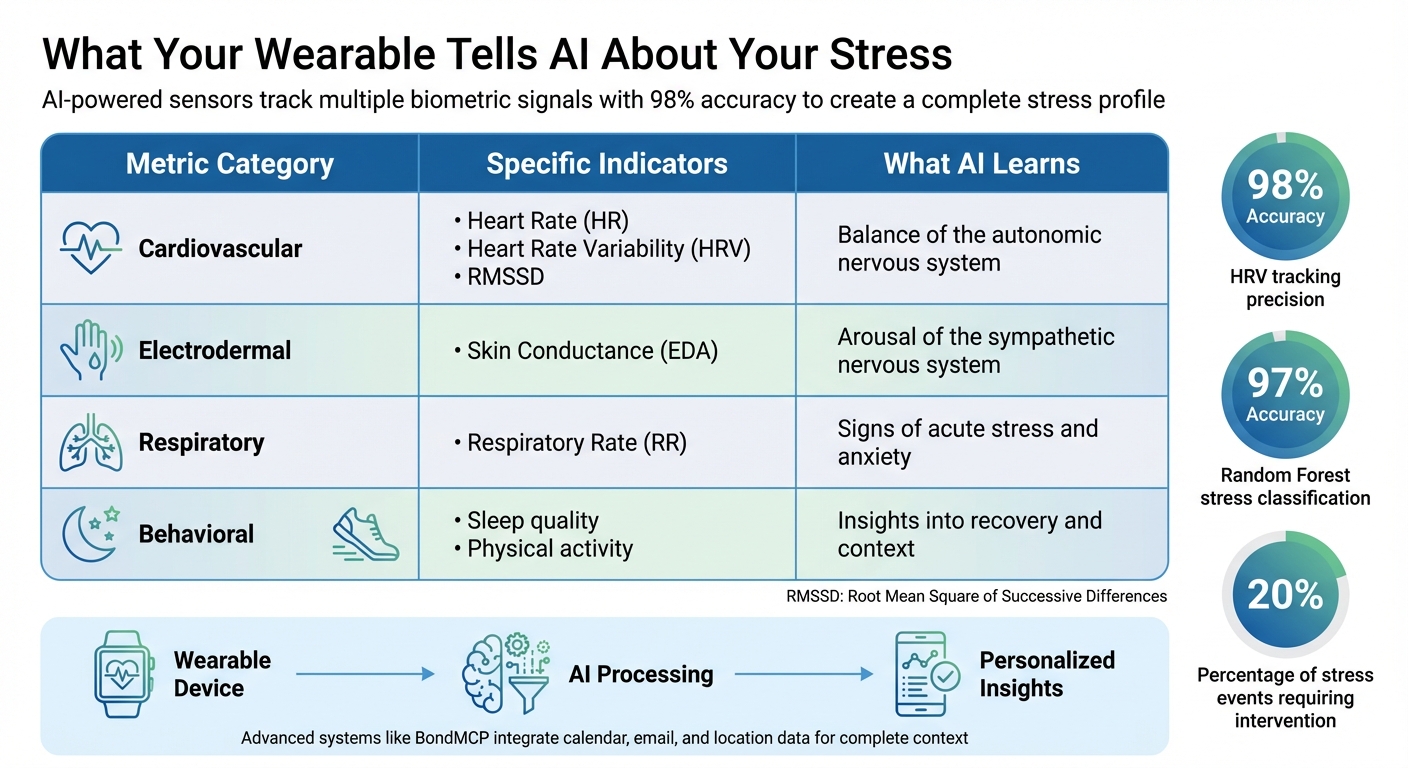
AI Stress Detection: Key Wearable Metrics and What They Reveal
AI agents do more than just collect numbers from your wearable devices - they interpret physiological signals to uncover your body's stress responses. Using sensors like Photoplethysmography (PPG) to track heart rate and Electrodermal Activity (EDA) to measure skin conductivity, these devices gather raw data that reflects how your nervous system reacts to everyday situations [6][8].
Once this data is collected, AI agents clean it up using techniques like Butterworth low-pass filters, Z-score normalization, and linear interpolation [6][8]. From there, they extract key insights, such as RMSSD (Root Mean Square of Successive Differences), which is a critical measure of your autonomic nervous system balance [6]. This cleaned and processed data allows for a deeper understanding of stress by analyzing multiple biometric signals.
Key Data Sources from Wearables
Wearables provide a range of signals that, when combined, paint a detailed picture of your stress levels. One standout metric is heart rate variability (HRV), which AI-powered sensors can track with 98% accuracy [9]. When paired with other factors like respiratory rate, sleep quality, and physical activity, these metrics allow AI agents to identify not just when you're stressed, but also why your body is responding in a particular way.
| Metric Category | Specific Indicators | What AI Learns |
|---|---|---|
| Cardiovascular | Heart Rate (HR), HRV, RMSSD | Balance of the autonomic nervous system |
| Electrodermal | Skin Conductance (EDA) | Arousal of the sympathetic nervous system |
| Respiratory | Respiratory Rate (RR) | Signs of acute stress and anxiety |
| Behavioral | Sleep quality, Physical activity | Insights into recovery and context |
Some advanced systems, like those using BondMCP, go beyond wearables by integrating contextual data from your calendar, emails, and even location. This helps correlate physiological changes with specific events. For example, Oleksandr Khirnyi, Chief Product Officer at Skyvia, highlights this capability:
"Enterprises want AI agents to have a secure, real-time access to business data with the ability take actions - not just generate answers." [3]
Imagine your AI noticing a heart rate spike during a tense 3 PM meeting. It could then suggest adjustments to your evening routine to help you recover. These precise insights enable AI systems to pinpoint specific stress triggers and provide tailored recommendations.
Pattern Recognition and Stress Triggers
Instead of relying on generic thresholds, modern AI agents create custom baselines for each individual. This personalized approach allows for more accurate detection of stress and intervention triggers [1].
Random Forest models are particularly effective in this area, achieving 97% accuracy in binary stress classification tasks. They outperform AdaBoost models, which reach only 82% accuracy [1]. These models excel at managing the messy, non-linear patterns often found in physiological data, avoiding the pitfalls of overfitting to noise.
Interestingly, research shows that while many stress markers are identified, only about 20% require personalized interventions [7]. The game-changer? Combining wearable data with "stressor journaling", where users document what occurred during a stress spike. This makes AI-generated interventions far more relevant than generic suggestions like mindfulness reminders [7].
Creating Personalized Stress Management Plans
Once your stress patterns are identified through physiological data, AI agents step in to craft a plan tailored just for you. These aren’t generic tips or one-size-fits-all solutions. Instead, they’re built around your unique triggers and recovery needs, using your personal baseline data to recommend targeted interventions.
Tailoring Interventions to Individual Needs
The key to effective stress management lies in aligning interventions with specific stressors. AI agents achieve this by analyzing both your physiological signals and the context surrounding them - like what you were doing when your heart rate spiked or your HRV dipped.
For instance, imagine your wearable detects a higher respiratory rate during a coding session. Instead of suggesting generic breathing exercises, the AI might recommend "structured debugging" techniques. Why? Because stress from cognitive overload demands a different approach than stress caused by interpersonal issues or physical strain[7]. This level of precision ensures that the solution fits the problem.
Modern systems also include factors that traditional apps often overlook, such as hormonal cycles, mood swings, or poor sleep quality[10][2]. For example, a Random Forest model analyzing layered data can classify stress states with 97% accuracy[1]. Based on this, the AI might suggest a lighter workout after a restless night or recommend rescheduling demanding tasks when your natural stress resilience is lower.
This blend of real-time stress monitoring and precise intervention is where AI truly shines. And with tools like BondMCP, personalization reaches a whole new level.
Customizing Plans with BondMCP
BondMCP eliminates the fragmentation that often comes with managing health data across multiple apps. Instead, it creates a unified intelligence layer, seamlessly connecting your wearables, lab results, calendar, and fitness routines.
This integration enables "context engineering" - a process that combines real-time data from trusted sources like USDA FoodData Central and ExerciseDB with your physiological data[4]. The result? AI agents that don’t just monitor your stress but actively take action across your health ecosystem. For example, they might log a stress-relief session to your Fitbit, update your recovery activities in Google Sheets, and even adjust your calendar to include buffer time - all triggered by a single voice command.
"The difference between a chatbot and an agent is simple: can it take action?" – Derick W Owens, AI Advocate[4]
This approach transforms stress management from passive observation to active intervention. Your sleep tracker informs your coach, your lab results update your supplement plan, and your long-term health goals guide your daily decisions - all thanks to BondMCP's interconnected system.
Real-Time Plan Adaptation and Monitoring
Dynamic Updates Based on New Data
Stress management plans aren’t carved in stone - they adapt as your needs change. AI agents continuously track your biometric data, identifying shifts in your stress levels and automatically adjusting your plan without requiring you to lift a finger.
Here’s how it works: Instead of relying on generic thresholds, these systems create a personalized baseline using your initial physiological data. Advanced classifiers then analyze deviations from this baseline with an impressive 97% accuracy rate[1].
For example, if your heart rate or respiratory rate stays above a dynamic threshold for more than 33% of the monitoring period, the AI recalibrates your plan[1]. It doesn’t stop there - contextual factors like poor sleep, injuries, mood changes, or a jam-packed schedule are also taken into account. Let’s say you had a rough night’s sleep and your heart rate variability (HRV) is low. The AI might suggest scaling back your workout intensity or rescheduling a high-pressure task for later in the week[2][11].
This approach moves stress management beyond static checklists, creating a system that adapts to your real-world needs. Whether you’re handling a looming deadline or coping with long-term stress, these dynamic adjustments ensure timely, actionable support.
Proactive Alerts and Recommendations
Building on these dynamic updates, AI doesn’t just wait for you to notice stress - it takes the initiative. Proactive notifications are sent the moment stress is detected, offering timely interventions that help you address the issue before it spirals out of control.
A 22-day study conducted in February 2025 by researchers from the University of Memphis and Virginia Tech tracked stress events using Samsung Galaxy Watch 6 devices. Out of 98 detected stress episodes, only 20% required intervention[7]. The takeaway? Real-time alerts are most effective when they’re precise and actionable.
"AI can be used to detect exacerbations of a mental health state that can lead to a harmful behavior, such as smoking or substance use, and intervene in a just-in-time way that can be more effective than what is done now without AI." – Peter Yiğitcan Washington, Assistant Professor, University of California, San Francisco[5]
These alerts go beyond simple notifications. For instance, if your wearable detects elevated stress and you’re about to head into a meeting, the AI might suggest a quick, personalized two-minute breathing exercise. It could also tweak your daily schedule - adding buffer time between appointments, recommending a recovery day, or logging stress-relief activities across your apps. With nearly 45% of Americans now using smartwatches or fitness trackers[5], these real-time interventions are becoming more accessible and practical than ever.
AI-Powered Techniques for Stress Relief
Guided Mindfulness and Breathing Exercises
AI tools are now capable of creating real-time breathing exercises tailored to your physiological state. Using photoplethysmography (PPG) sensors embedded in wearable devices, these systems monitor your heart rate and respiratory rate to detect stress signals as they occur[1].
These systems rely on your personal baseline to customize exercises. In a study published in February 2026 in the International Journal of Computational Intelligence Systems, researchers tracked 35 participants wearing Empatica E4 sensors. The AI used Random Forest and AdaBoost algorithms to classify stress with 97% accuracy. When participants' stress levels crossed a dynamic threshold, a Mistral-based agent generated actionable recommendations in real time[1].
This setup allows the AI to intervene autonomously whenever your heart rate surpasses your personal threshold. By logging each activity, the system refines future recommendations, ensuring that each intervention becomes more accurate over time.
In addition to breathing exercises, AI extends its support by optimizing your daily schedule to reduce stress triggers.
Smart Scheduling for Stress Reduction
AI systems can optimize your schedule to help manage stress proactively. By analyzing factors like sleep quality, physical condition, and mood changes, these tools generate wellness plans that adapt to your current needs in real time[2].
For instance, in December 2025, developer Derick W. Owens introduced an AI fitness hub powered by BondMCP and Claude. This system automated health tracking by enabling users to perform tasks like querying the USDA database for nutrition data, calculating dietary macros, and syncing information to Fitbit and Google Sheets - all through natural language commands[4].
This shift from passive advice to active intervention allows AI to restructure your calendar, introduce buffer times between meetings, and recommend breaks when your physiological data suggests they're needed.
AI doesn't stop at scheduling - it also tackles the mental side of stress.
Cognitive Reframing and Recovery Optimization
AI tools are also effective in addressing stress at a psychological level through cognitive stress recovery. Using natural language processing, these systems analyze your journal entries or chat messages to identify negative thought patterns, such as catastrophizing or overgeneralizing. They then provide prompts to help you challenge and reframe those thoughts.
A study on an AI chatbot employing cognitive behavioral therapy techniques found a reduction in anxiety symptoms by 21.15% during its initial phase and 20.42% in a follow-up phase[13]. The key lies in how AI acts as a "scaffold" rather than a "substitute", empowering users to build emotional resilience over time[14].
"The critical distinction, then, is whether AI operates as a scaffold or a substitute. Scaffolding is characterized by temporariness, adaptability, and empowerment: the goal is to strengthen internal capacities so that the technology becomes progressively less necessary."
- Ginto Chirayath, Department of Social Work, Bishop Appasamy College[14]
For recovery, advanced AI agents use Retrieval-Augmented Generation (RAG) to incorporate historical data. By recognizing recurring stress patterns, these tools offer reframing suggestions based on strategies that have worked for you in the past, making stress management increasingly personalized and effective.
Conclusion
AI-driven stress management is transforming how we approach wellness by shifting from reactive solutions to proactive care. Instead of relying solely on weekly therapy sessions or generalized meditation apps, continuous monitoring now detects stress patterns before they spiral into chronic health issues. With Random Forest models achieving a 97% accuracy rate in classifying stress levels, interventions are not only more precise but also perfectly timed to meet individual needs[1].
This precision is amplified through platforms like BondMCP, which address a long-standing issue in personal health: fragmented data. Traditionally, users had to juggle multiple apps for meditation, fitness, and nutrition, manually syncing their data across platforms. BondMCP changes the game by integrating inputs from sleep trackers, heart rate monitors, and activity logs into one cohesive system. Imagine this: your sleep tracker alerts your fitness coach, your heart rate variability triggers a guided breathing exercise, and your stress patterns automatically reshape your daily schedule. It’s a seamless way to manage stress without the hassle.
The benefits of this integration are measurable. By mid-2025, 79% of organizations had adopted AI agents, with 66% reporting clear productivity improvements[12]. When wearables, lab results, and supplement routines work together in context, users experience greater clarity, deeper personalization, and effortless automation. This level of personalization is made possible by advanced memory architecture for health agents, which allows the system to learn from past data. This interconnected approach, powered by AI, supports a unified and responsive personalized wellness ecosystem.
"The core insight driving the architecture is that wellness isn't three separate problems - fitness, nutrition, and mental health - happening to coexist in the same body. It's one system where everything connects."
- Pritha Saha, AI Practitioner[2]
The future lies in connected AI agents that take active steps rather than merely offering suggestions. With stress linked to the top six causes of death globally[1], the ability to detect, intervene, and adapt in real time isn't just a convenience - it's a critical step toward optimizing long-term health and well-being.
FAQs
What wearable data do I need for accurate stress detection?
To detect stress accurately, wearable devices play a crucial role by collecting data such as heart rate, heart rate variability, and other physiological signals. AI algorithms then analyze this information alongside contextual details, like your daily routines and activities, to improve precision. These biometric measurements and sensor inputs are the backbone of building a detailed stress profile.
How does an AI agent learn my personal stress baseline?
An AI agent works to figure out your stress baseline by examining data from wearables. This includes metrics like heart rate variability, sleep patterns, and activity levels. Over time, it learns how your body typically responds and adjusts as your habits or lifestyle evolve. By pulling information from various sources, the AI builds a personalized profile. This allows it to offer stress management strategies and interventions that are specifically designed to suit your needs.
How does BondMCP connect my wearables and calendar to reduce stress?
BondMCP brings everything together by combining data from your wearables and calendar to craft tailored stress management plans. It examines physiological signals, aligns them with your daily routines and schedules, and pinpoints potential stress triggers. From there, it offers actionable suggestions to address those triggers before they escalate. By connecting these elements, BondMCP minimizes the hassle of juggling separate tools, making stress management clearer and more streamlined.