
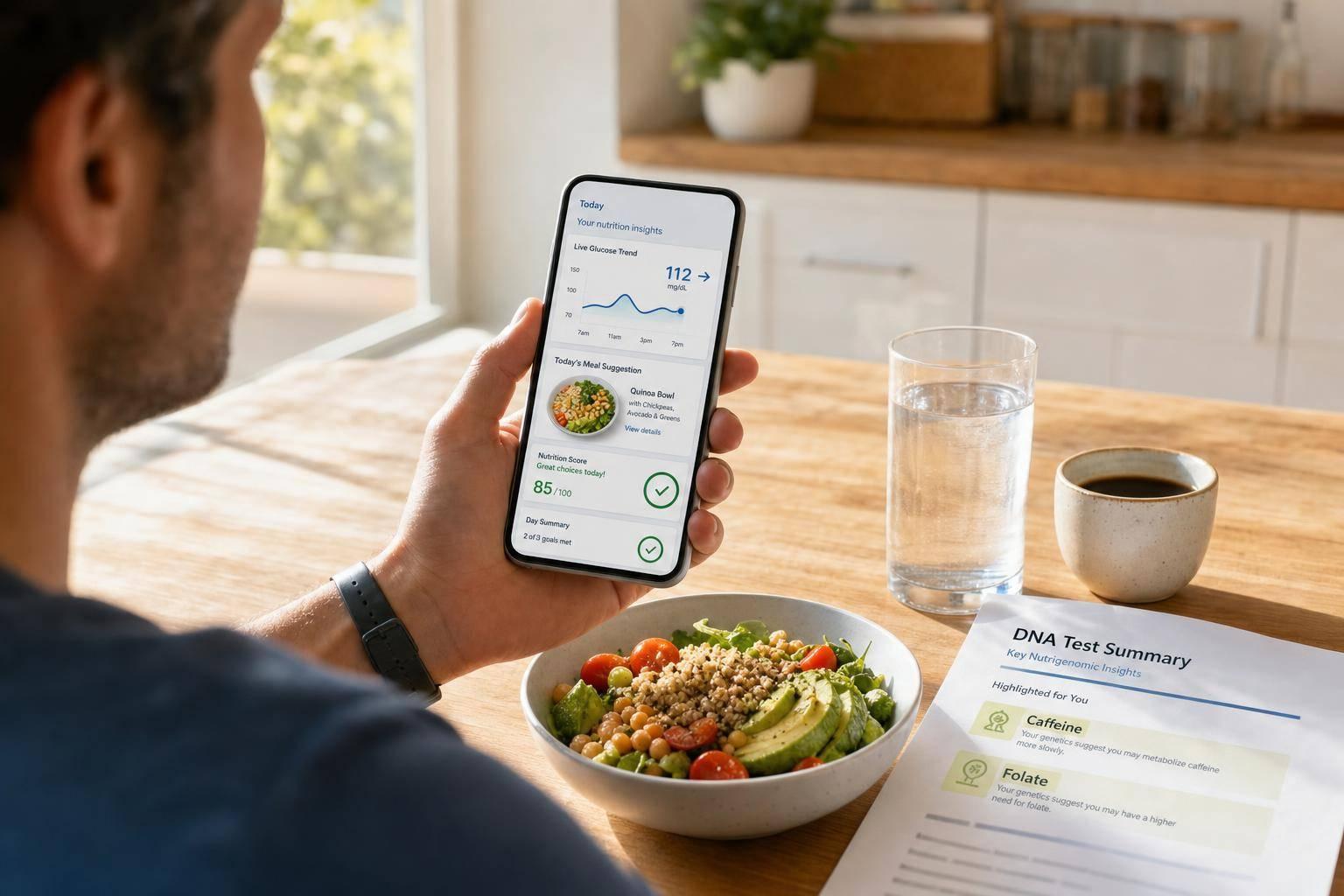
If I had to pick one for day-to-day food decisions, I’d pick AI. The main reason is simple: meal response is shaped by more than genes. In the article, genetics explained about 30% of differences in blood sugar response and only 4% of differences in triglyceride response. That means a lot of what happens after you eat depends on sleep, activity, meal timing, stress, and other changing inputs.
Here’s the short version:
-
AI health coaching is better for daily nutrition planning
- uses food logs, wearables, CGMs, weight trends, and lab data
- updates as your habits and body data change
- helps with calories, protein, meal timing, and pattern spotting
-
DNA is better for fixed traits
- useful for things like caffeine metabolism, folate processing, and lactose tolerance
- does not show what your body is doing today
- works better as a starting clue than a daily food guide
-
Results matter
- In the ZOE METHOD trial, people on an AI-based plan lost about 2.46 kg over 18 weeks, while the standard-advice group gained 0.30 kg
- In a 2026 genotype-guided weight-loss trial, both groups lost about 6.4% to 6.5% of body weight, with no meaningful gap
-
Cost and effort differ
- AI coaching often costs $30 to $100+ per month and needs steady tracking
- DNA tests often cost $149 to $699 one time and need only a saliva sample
If I boil it down to one line, it’s this: use DNA for fixed clues, but let AI and current body data drive the plan.
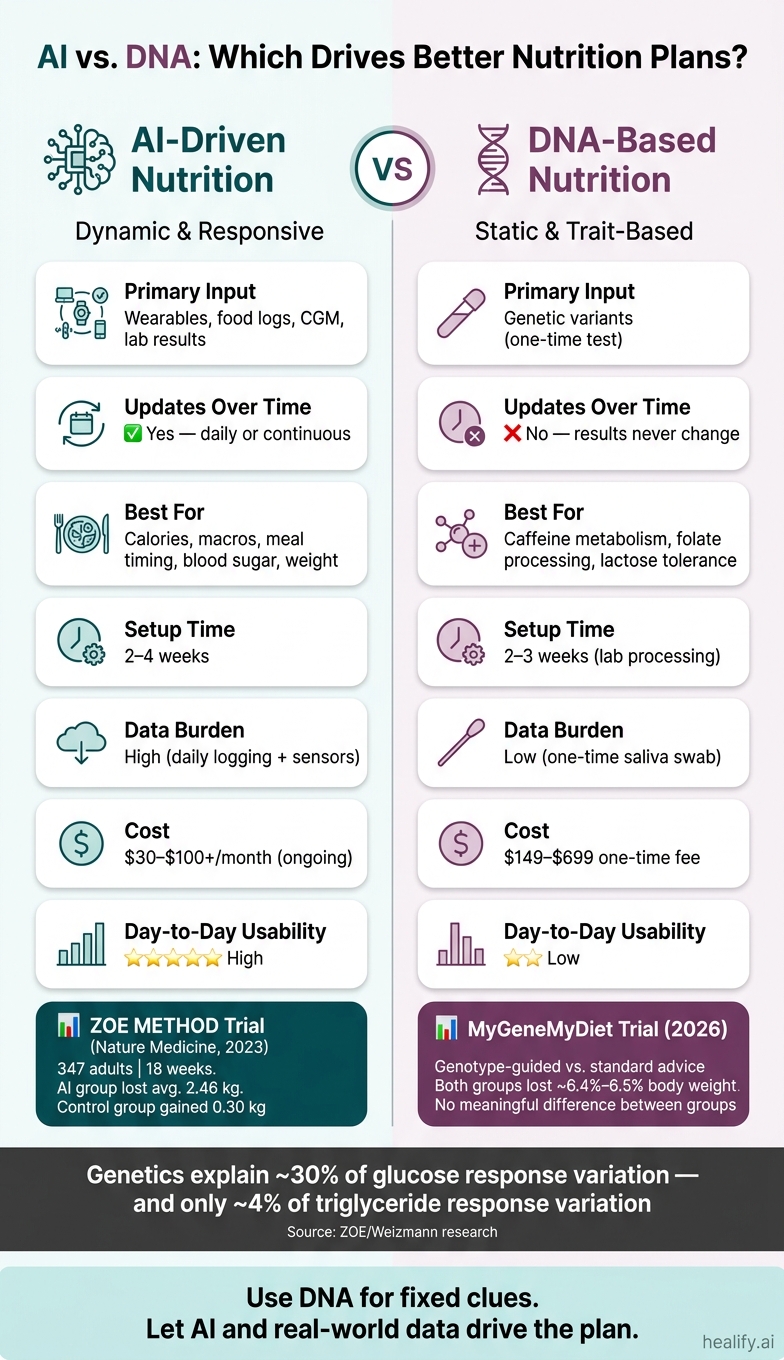
AI vs. DNA Nutrition Plans: Side-by-Side Comparison
Will AI Replace Your Dietitian? This PhD Says You're Asking the Wrong Question
sbb-itb-f5765c6
Quick Comparison
| Criteria | AI-Driven Nutrition | DNA-Based Nutrition |
|---|---|---|
| Main input | Wearables, food logs, CGM, labs | Genetic variants |
| Changes over time | Yes | No |
| Best for | Daily food choices, macros, timing, weight, blood sugar | Fixed traits like caffeine and folate response |
| Main downside | Needs steady data input | Low power for daily nutrition outcomes |
| Cost | $30 to $100+ / month | $149 to $699 one time |
| Best use | Primary tool | Background context |
My takeaway: for most people, AI should lead (using a personalized health AI app) and DNA should support.
How AI-driven nutrition plans work
AI turns day-to-day inputs into nutrition guidance that changes with you. Instead of handing you a static meal plan and calling it done, these systems learn from what you're doing now and update their recommendations as new data comes in.
What data AI uses: food logs, wearables, labs, and daily habits
AI nutrition systems can pull from several data sources at once, including meal logs, wearables, CGM data, body weight trends, and lab results. The better the data, the better the guidance.
That's the catch: data quality matters a lot. If food logs are incomplete or biometric benchmarks are missing, the model has less to work with. And when the input is messy, the output usually is too.
What AI does well today and where it still falls short
Right now, AI is good at connecting patterns that people often miss on their own. It can link sleep, activity, and meal timing to metabolic response. From there, it can fine-tune calorie and protein targets, shift meal timing, and help people stick with the plan.
In the 2023 ZOE METHOD trial published in Nature Medicine, 347 adults using an AI-personalized plan lost an average of 2.46 kg over 18 weeks, compared with a 0.30 kg gain in the standard-advice group [1].
Still, AI isn't magic. Manual food logging can be off, and training bias can shape results in ways that aren't always obvious. That doesn't mean the tools are useless. It means they work best when paired with steady habits and decent input data.
How Healify fits this model
Healify fits this setup. The iPhone app looks at wearables, bloodwork, biometrics, and lifestyle data, then turns that into a 24/7 action plan through its AI coach, Anna.
DNA stays the same. Your data doesn't. AI can keep updating as that data changes.
How DNA-based nutrition personalization works
DNA gives you the other half of the picture: stable traits, not changing habits. DNA-based nutrition, often called nutrigenomics, looks at small genetic variants that can shape how your body processes certain nutrients. Put simply, DNA shows your baseline predispositions, not your current nutrition status. And unlike AI inputs, DNA doesn't change.
What DNA tests measure and why those results never change
These fixed traits matter most when they tie to a small set of nutrition questions. For example, people with the CYP1A2 rs762551 variant can metabolize caffeine up to four times slower than fast metabolizers [1]. That helps explain why one person can drink coffee after dinner and sleep fine, while another feels wired for hours.
The same idea shows up with folate. MTHFR C677T carriers may need more folate than average [1]. In cases like these, DNA testing can point to built-in tendencies that stay the same over time.
Where the evidence is solid and where it is still mixed
The short version is pretty simple. The best-backed traits include:
- caffeine metabolism
- folate processing
- lactose tolerance
- some APOE-related fat responses
Other areas are a lot less settled. Findings on weight loss, macros, and salt sensitivity are still mixed.
Weight-loss genes, in particular, haven't held up that well. A 2026 randomized trial found no meaningful difference in weight-loss results between genotype-guided and standard plans [6].
That gets to the main point: DNA can flag predispositions, but it cannot show what's happening in your body today. So DNA works best as context, not as the main driver of day-to-day nutrition decisions.
AI vs. DNA: a side-by-side comparison for everyday nutrition planning
At this point, both approaches have clear strengths - and clear limits. What matters most is how they compare when you're making day-to-day food choices.
What each approach personalizes best
AI responds to change. DNA points to traits that stay the same.
That difference matters more than it might seem. AI is best at things that shift all the time: how many calories you need, how your blood sugar reacts after a meal, and how sleep, exercise, and how your body feels today can change your nutrition advice. DNA is better at spotting fixed traits - the stuff that doesn't change based on what you ate for lunch or how hard you trained this morning.
Put simply: AI updates with your data. DNA doesn't.
| Feature | AI-Driven Nutrition | DNA-Based Nutrition |
|---|---|---|
| Primary Data Source | CGM, food logs, wearables, and blood biomarkers | Static genetic variants |
| Update Frequency | Daily or continuous | One-time test |
| Best Personalization | Calorie targets, macros, meal timing, and habit changes | Baseline predispositions and specific nutrient-gene interactions |
| Evidence Strength | Strong for post-meal response prediction | Strong for specific gene-nutrient interactions; weak for weight loss |
| Key Limitation | Requires consistent logging and sensor use | Low predictive power for real-world outcomes |
Cost, setup time, and ease of use in the U.S.
Accuracy matters, but so do effort and cost.
DNA testing is easier at the start. You send in a saliva sample and usually get results back in about two to three weeks. Direct-to-consumer nutrigenetic tests often cost $149–$699, depending on how many genetic markers they check [1]. After that, you're done. That's part of the appeal - and part of the drawback.
AI-driven coaching asks more from you and costs more over time. Subscription plans usually run $30–$100+ per month [1]. The setup period can also take a bit of work. You may need to wear sensors, log meals, and sync data from wearables. In many cases, it takes two to four weeks before the system starts reflecting your own patterns in a useful way [1].
| Factor | AI-Driven Coaching | DNA Testing |
|---|---|---|
| Setup Time | 2–4 weeks | 2–3 weeks (lab processing) |
| Data Collection Burden | High - daily logging, sensors, wearables | Low - one-time saliva or cheek swab |
| Cost (USD) | $30–$100+ per month (ongoing) | $149–$699 one-time fee |
| Responsiveness | Adjusts in real time | Static - results never update |
| Day-to-Day Usability | High - app-based, actionable daily guidance | Low - static report, often generic advice |
Which approach delivers better results in practice
Right now, the evidence leans toward AI for most everyday nutrition goals [1].
In the ZOE METHOD trial, an 18-week randomized controlled trial published in Nature Medicine, 347 adults using an AI-personalized plan lost an average of 2.46 kg more than people following standard USDA guidelines. They also had meaningful drops in triglycerides [1].
DNA-only plans haven't shown the same kind of outcome. The 2026 MyGeneMyDiet study found no meaningful difference in weight loss between people getting genotype-informed advice and those getting standard counseling. Both groups lost about 6.4% to 6.5% of their body weight over 12 months [6].
DNA can still help with steady traits, like caffeine sensitivity and folate needs. But for weight, blood sugar, and day-to-day energy, real-time data does a better job. That leads straight into the next issue: when should AI take the lead, and when should DNA stay in the background?
When to lead with AI, when DNA helps, and the key takeaway
The practical rule is simple: match the tool to the question.
When AI should be the primary tool
Start with AI when you're dealing with things that can shift from one week to the next, like weight, blood sugar, sleep, or stress eating. That kind of day-to-day data often tells you more about metabolic response than genetics by itself. Genetics explain only about 30% of the variation in glucose responses between people [1][4].
So in most cases, AI is the better default, while DNA works better as background context.
When DNA adds useful context to a nutrition plan
Some genetic variants are worth paying attention to right now because they can lead to clear next steps.
The CYP1A2 variant affects caffeine metabolism, which means some people may need to stop caffeine earlier in the day to protect sleep. The MTHFR C677T variant may mean you need about 800 mcg of folate to maintain normal homocysteine levels [1][3]. And the LCT variant can help explain why dairy still leads to bloating for some people.
These signals are real, specific, and testable. But it makes more sense to treat them as things to test rather than fixed food rules. For example, if a DNA test points to carbohydrate sensitivity, a continuous glucose monitor (CGM) worn for one to two weeks can show whether that pattern shows up in your day-to-day numbers [2][7].
That’s why DNA should shape the starting point, not take the place of tracking over time.
Key takeaway: use static traits as clues, but let real-world data drive the plan
Use DNA for starting assumptions. Use AI to adjust the plan based on what’s happening in daily life.
For most people, the smart move is pretty simple: let DNA set a few early assumptions, then let ongoing data fine-tune the rest. Apps like Healify fit this model by pulling in wearable data, biometrics, and lab results to turn health data into a daily action plan [1][5].
FAQs
Can AI and DNA work together?
Yes. DNA gives you a steady picture of long-term genetic tendencies. AI adds day-to-day context, like your lifestyle, stress, and shifts in metabolic needs.
Put them together, and you get a more personal nutrition plan. The idea is simple: combine genetic data with real-time inputs like wearables, lab results, and food logs.
Healify uses this approach to deliver guidance that can adjust to your body’s responses and daily patterns.
Who benefits most from DNA-based nutrition?
DNA-based nutrition tends to help most when a person has a specific, well-studied genetic variant that clearly changes how their body handles certain nutrients.
That includes cases like lactase non-persistence, MTHFR variants, or certain APOE genotypes.
For those people, genetic results can point to more targeted diet changes instead of guesswork. But for broader goals like weight loss or general health, the research is less clear. So it makes more sense to use DNA-based nutrition as one part of a bigger health plan, not the whole plan.
How much tracking does an AI nutrition plan need?
It depends on the system.
Basic AI nutrition plans often need you to enter things by hand, like your weight, height, activity level, and food logs. You might log meals by voice, photo, or plain text.
More advanced platforms like Healify cut down on that work. They can pull in data from wearables, bloodwork, and lifestyle trackers automatically, so the plan can adjust without so much constant logging.