
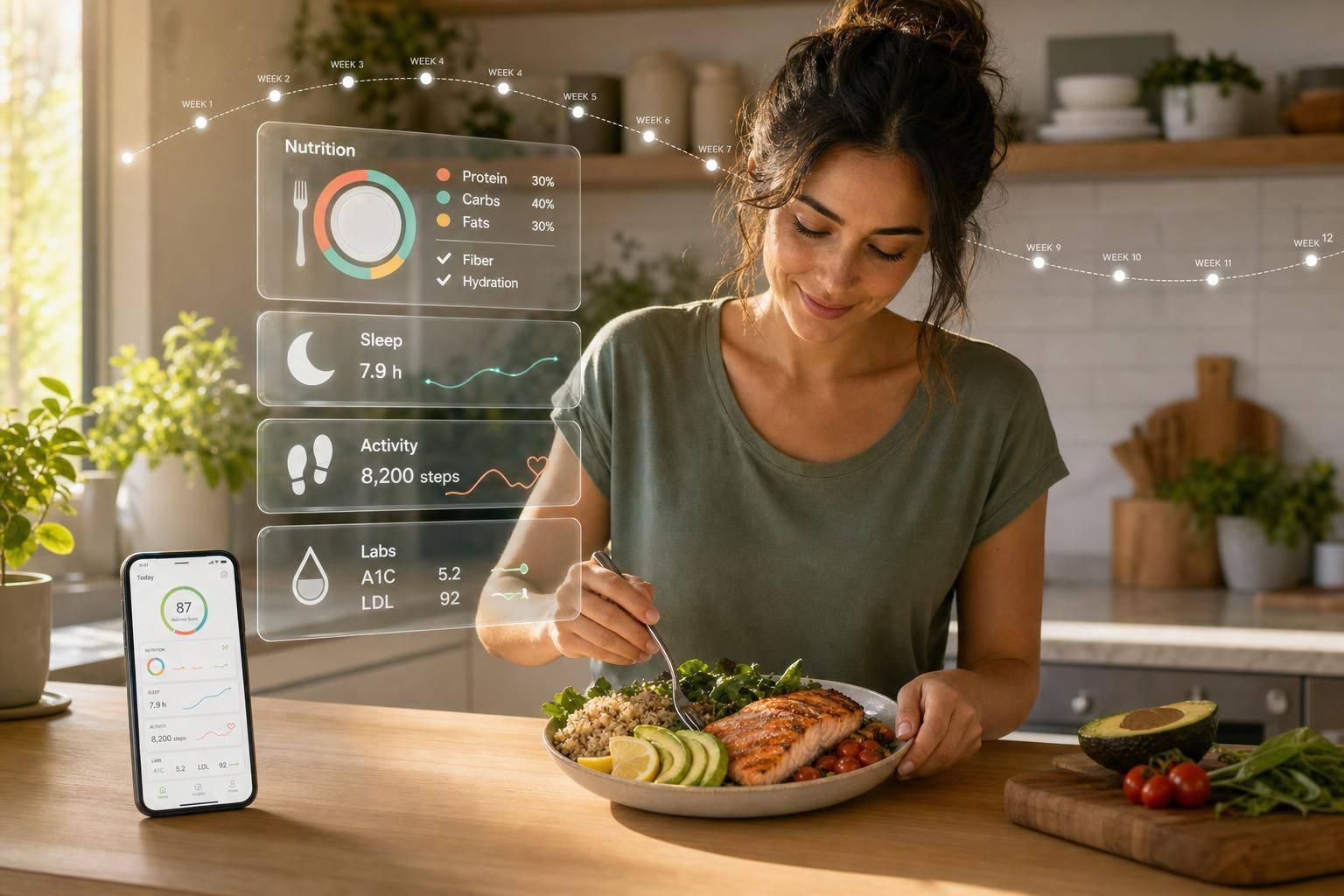
AI nutrition works best when it learns from your habits over time, not from a one-time diet plan. Over weeks and months, it can link food, sleep, activity, weight, and lab data to adjust your plan as your life changes.
Here’s the short version:
- Short-term logging sets the baseline. The first 2 to 4 weeks help the system learn how you eat, sleep, and move.
- Long-term tracking shows patterns. A 7-day view shows day-to-day habits, 30 days shows trends, and 90 days shows deeper changes like glucose or body composition shifts.
- Results depend on follow-through. In one review, diet apps were tied to about 5.4 lb weight loss and about 1 inch off waist size.
- Sleep matters more than most people think. Sleeping 5.5 hours or less has been linked to eating 204 extra calories the next day.
- AI is support, not medical care. It can flag patterns, but a doctor or dietitian should handle diagnosis and treatment.
My main takeaway: the long-term value of AI nutrition is not a perfect meal plan. It’s the feedback loop. The system watches what you do, checks what changes, and updates your guidance before small slips turn into bigger problems.
Quick Comparison
| Area | One-Time Diet Advice | AI Nutrition Over Time |
|---|---|---|
| Data used | Single snapshot | Food, wearables, labs, habits |
| Updates | Manual | Based on new inputs |
| Pattern spotting | Limited | 7-, 30-, and 90-day trends |
| Support style | Fixed plan | Behavior-based coaching |
| Best use | Starting point | Long-term habit change |
If you want a simple way to think about it, it’s this: static plans give you rules, while AI coaching provides dynamic course correction.
sbb-itb-f5765c6
How AI Builds Your Personalized Nutrition Plan
The First 2 to 4 Weeks: Logging and Calibration
With food logs, wearables, and labs in place, AI uses the first 2 to 4 weeks to learn your baseline. This stage is about calibration, not perfection.
You only need to log at least two eating occasions a day to give the system enough signal to work with, and that level of logging predicts weight loss better than spotty tracking [2]. Wearable data fills in the other half of the picture by showing activity, sleep, and recovery patterns [1][2].
There’s a catch, though: people often underreport calories by 20% to 50% [2]. So it helps to treat AI logs as a first pass, then fix mistakes while they’re still easy to spot. The good news is that logging tools have gotten much better. Photo-recognition tools now reach 92% to 97% accuracy, and conversational text or voice logging is now over 95% accurate [1][2].
Once that baseline is in place, AI can start adjusting targets based on what you actually do, not what a formula assumes.
How AI Adjusts Recommendations Based on Real Behavior
A static plan looks fine on paper. In practice, context-based coaching works better.
If your weight trend, activity level, or training load shifts, AI can recalibrate calorie and macro targets from observed behavior instead of leaning on a generic equation [2]. And if sleep or HRV trends start moving in the wrong direction, guidance can shift toward recovery-focused nutrition before fatigue starts pulling eating habits off course [1].
That means your plan stays tied to training load, sleep, and recovery rather than sitting on fixed targets that may no longer fit.
Spotting Trends Across 7-Day, 30-Day, and 90-Day Windows
Single-day data can be messy. Rolling averages are where the pattern starts to show.
AI checks different time windows to tell the difference between normal ups and downs and changes that call for action:
| Time Window | What AI Looks For |
|---|---|
| 7-Day | Immediate adherence patterns, post-meal responses, and training-day fueling gaps [1][2] |
| 30-Day | Adherence patterns, food preference learning, and whether weight changes reflect real fat loss or water fluctuation [1][2] |
| 90-Day | Metabolic adaptation, fasting glucose trends, body composition shifts, and HbA1c direction [1][2] |
These windows help separate noise from actual change and make it easier to see whether the plan is doing its job.
Those longer windows feed the health and performance outcomes in the next section.
AI's Long-Term Effects on Health and Performance
Weight Management, Body Composition, and Diet Adherence
Over longer time frames, the big question is simple: does AI change your weight, lab results, and day-to-day performance?
The data suggests it can help, especially when people stick with the plan. In a year-long study of 874 participants using genetics-based personalized nutrition, people who changed their habits saw a -0.5% weight change, while those who did not change gained +1.5%[4]. That gap matters. It shows that the plan alone is not enough; the day-to-day follow-through is what moves the needle.
This is where AI can help in a practical way. When weight loss starts to flatten out, AI can spot the plateau early and adjust calories, macros, or meal timing before progress stalls[1][5]. Instead of waiting weeks to realize something is off, the system can react while there is still room to course-correct.
Diet follow-through also tends to hold up better than many people assume. In a 12-week digital personalized nutrition study, 64% of participants kept following the dietary advice during long-term follow-up[3]. That matters because the best plan in the world does nothing if people abandon it after two weeks. And while body weight gets most of the attention, it is often just the most visible sign. Blood work is often where the next changes show up.
Metabolic Health, Heart Markers, and Disease Risk
The long-term picture gets more interesting once you look past the scale.
In a 3-month randomized trial of 127 older adults with overweight or obesity, precision nutrition led to bigger reductions in weight, BMI, blood pressure, and HbA1c than standard advice[3]. That means the effects were not limited to body weight alone. Markers tied to blood sugar control and cardiovascular health moved too.
Lipid markers can improve as well. Tailored advice has been shown to lower total cholesterol and LDL, especially when fiber and nut intake targets are matched to the individual[5][3]. That kind of personalization is the whole point. Two people can eat what looks like a “healthy” diet on paper, yet one sees better lab changes because the plan fits their habits, responses, and starting point.
There is one line worth keeping clear: AI can spot early risk patterns in your data, but diagnosis and treatment decisions still belong with a licensed clinician[5]. A better way to think about it is as an early-warning system, not your doctor. It can wave a flag when trends start heading in the wrong direction, which gives you and your care team more time to act.
These health changes do not stay trapped inside a lab report either. They often spill into how you sleep, how steady your mood feels, and how well you can focus through the day.
Sleep, Stress, Mood, and Mental Sharpness
Food does not just affect your waistline. It shapes recovery, attention, mood, and sleep in ways people often feel before they ever see a lab result.
Late-night eating and irregular meal timing have been linked to disrupted circadian rhythms and poorer sleep quality, which can set off a messy cycle that hurts recovery and appetite control[1]. You sleep worse, feel hungrier, make rougher food choices, and the pattern keeps feeding itself.
Machine learning models can also help predict how a given meal may affect a person's blood-sugar response, which can help flag meals that are more likely to hurt concentration[1]. That is useful because the issue is not always “eat less” or “eat better.” Sometimes it is this meal, at this time, for this person.
Among long-term users of personalized nutrition programs, 18% reported more energy, 10% reported better sleep, 8% reported improved mood, and 6% reported better focus or mental clarity[4]. Those numbers are not huge, but they point to something people care about every day: feeling better, thinking more clearly, and not dragging through the afternoon.
Healify can surface these sleep and HRV patterns in one coaching loop, linking nutrition data with recovery metrics to spot what is cutting into energy, focus, and sleep quality.
A Practical Framework for Using AI Nutrition Coaching over Months and Years
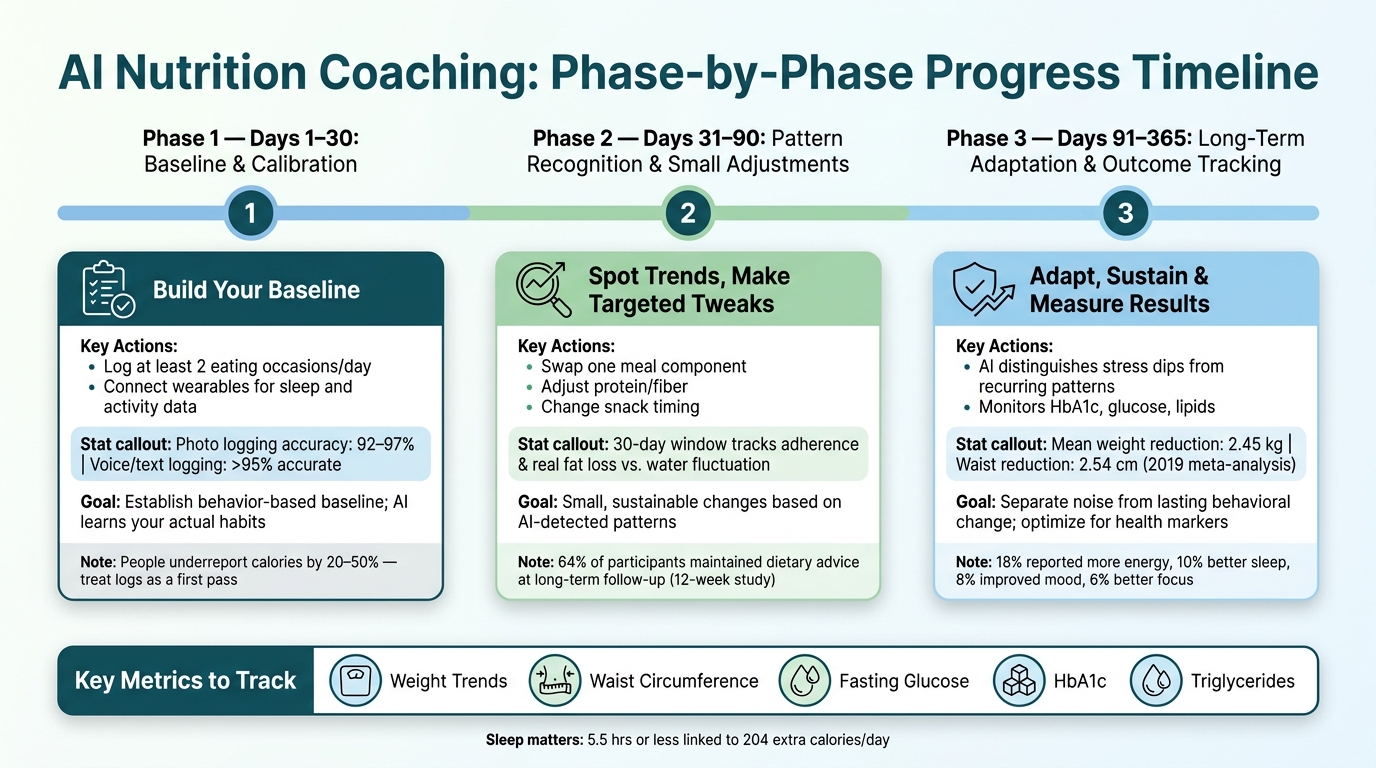
AI Nutrition Coaching: Phase-by-Phase Progress Timeline
Build Habits in Phases Instead of Overhauling Your Diet at Once
AI coaching tends to work better when you change one thing at a time instead of trying to redo your whole diet overnight. The point, especially early on, is to work from your actual eating patterns, not some perfect plan on paper.
In the first 30 days, the job is pretty simple: build a steady logging habit and give the AI enough input to set a behavior-based baseline. Photo and voice logging help cut friction, which makes it easier to stay consistent. From there, the system looks at your food intake and weight trends to estimate your maintenance needs.
From days 31 to 90, the focus shifts. At that stage, it’s less about logging for logging’s sake and more about making small, targeted changes. That might mean swapping one meal component, changing when you eat snacks, or adjusting protein and fiber based on fullness and blood sugar response. These tweaks may look minor, but that’s the point. Small changes are far easier to stick with, and they show which habits can last.
By days 91 to 365, the AI starts sorting short-term disruptions from repeated behavior. It can tell the difference between a brief dip - like two weeks of deadline stress - and a pattern such as weekend overeating that keeps showing up. Then it can push the suggestions you’re more likely to keep using over time.
The Metrics That Matter Most for Long-Term Progress
For long-term progress, it helps to watch a small group of metrics instead of reacting to day-to-day swings. The main ones are:
- weight trends
- waist circumference
- fasting glucose
- HbA1c
- lipid panels, especially triglycerides
A 2019 meta-analysis found that app-based dietary interventions were linked to a mean weight reduction of 2.45 kg and a waist circumference reduction of 2.54 cm [1]. That’s the kind of slow, steady change trend tracking is built to catch.
Wearable data can add context too. Sleep is a good example. Partial sleep restriction of 5.5 hours or less per night has been shown to increase daily energy intake by an average of 204 kcal [1].
Static Meal Plans vs. AI-Guided Coaching: A Side-by-Side Comparison
The gap between a static meal plan and AI-guided coaching isn’t just about software. It comes down to whether the plan can move with your life or stays frozen while everything else changes.
| Feature | Static Meal Plans | AI-Guided Coaching |
|---|---|---|
| Data Basis | One-time snapshot (age, sex, height, weight) | Ongoing intake logs, weight trends, biometrics |
| Adaptability | Fixed; requires manual updates | Self-correcting based on observed behavior |
| Trend Analysis | User must spot patterns manually | AI distinguishes noise, like stress, from lasting habits |
| User Effort | High - rigid plans demand constant discipline | Low friction; adapts to preferences, budget, and social context |
| Sustainability | Higher risk of drop-off after a setback | Respects cultural and personal preferences |
| Health Impact | One-size-fits-all averages | Targeted changes in HbA1c, triglycerides, and daily energy [1] |
Static plans stay the same unless someone updates them by hand. AI coaching changes with your intake, routines, and results. That’s a big shift - and it’s also where privacy, safety, and clinical boundaries start to matter.
Limits, Privacy, and Where AI Nutrition Is Headed
Privacy, Safety, and When to See a Doctor Instead
As nutrition tools get more personal, the data behind them gets more sensitive too. These systems may pull from food logs, wearable data streams, bloodwork, and sometimes even genetic test results. Before you stick with any platform for the long haul, read its privacy policy. Make sure it explains how data is handled, limits collection to what it needs, and lets you export or delete your information [8].
It also helps to be clear about what AI coaching is for. It's decision support, not medical care. It can help you spot patterns and build better habits over time. But it can't diagnose a condition, change medications, or take over care for a medical issue. If you have an eating disorder, diabetes, or another condition that needs clinical oversight, bring in a registered dietitian or physician.
Accuracy is still a weak spot. Even strong image-recognition systems can misread mixed dishes and meals from different food backgrounds, and small logging mistakes add up over time [1]. That matters. If the input is off, the advice can drift too.
These limits are a big reason AI nutrition is moving toward richer, multimodal input.
What the Next Generation of AI Nutrition Will Do Better
Once AI has enough longitudinal data, the next step isn't just cleaner logging. It's better prediction.
The next wave is multimodal analysis: one system that pulls together meal photos, voice input, wearable data, lab results, and long-term behavior. Instead of reacting only to today's food log, newer tools will connect sleep debt, training load, and nutrition follow-through across months. The goal is more forward-looking recommendations, not just after-the-fact feedback.
Voice-first logging is part of that shift too. Future systems should be able to handle context-rich inputs like "same as yesterday but swap the rice for quinoa" without making you type everything out by hand.
The bigger jump - Tier 3 personalization based on genetics, microbiome data, and continuous glucose monitoring - still needs stronger clinical validation [6]. A 2024 randomized controlled trial published in Nature Medicine found that a personalized nutrition program using microbiome data and glucose monitoring led to 2.5 kg more weight loss and larger reductions in HbA1c over 18 weeks than standard dietary advice [1][7]. That's a strong signal, but it's not standard practice yet.
Key Takeaways
Personalized nutrition tends to work best when it adapts, learns from data, and tracks change over time, not when it's treated like a one-and-done fix. The steadiest long-term results usually come from focusing on a small set of useful metrics, building habits in stages, and letting the system learn from what you actually do instead of what the plan says you should do.
AI does its best work as a pattern-detection layer on top of human judgment. It can turn messy, scattered health data into clear next steps. Where it falls short - and can become risky - is when people treat it like a stand-in for clinical judgment. Behavior-responsive personalization delivers measurable value today, while more individualized approaches based on biomarker data are still maturing [6]. Use what's been validated, stay consistent, and bring in a professional when the situation calls for one.
FAQs
How long before AI nutrition feels personalized?
AI-driven nutrition tends to feel personalized after several weeks to a few months of steady data collection and analysis.
At the start, the guidance is often more general. Then, over time, tools like Healify look at patterns in sleep, nutrient intake, activity, and other long-term signals. As those patterns become clearer, the recommendations get more tailored.
In many cases, meaningful personalization develops within 3 to 6 months.
What should I track for the best results?
Track a mix of health, behavior, and adherence metrics. Focus on indicators like blood glucose, lipid levels, blood pressure, weight, nutrient sufficiency, meal plan adherence, food logging accuracy, and overall engagement.
Wearables can also help track activity, sleep, and energy expenditure. Over time, that data helps shape changes based on your personal response and long-term goals.
When should I involve a doctor or dietitian?
Bring in a doctor or dietitian when the situation gets into medical nutrition therapy, diagnosis, or advice tied to a health condition.
AI works best as a decision-support tool. It should support judgment, not diagnose or treat health problems.