
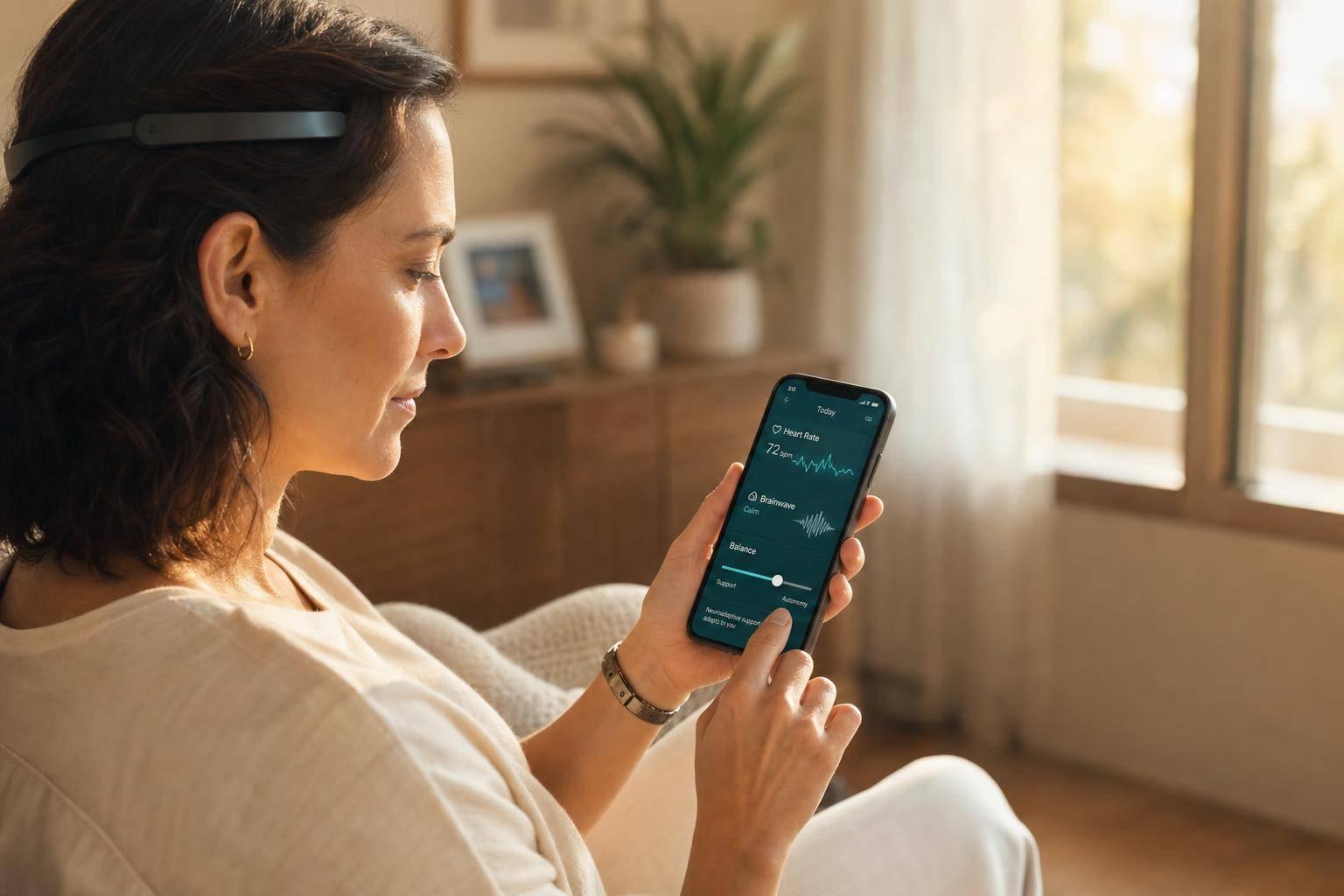
Neuroadaptive health apps can help you at the right moment, but they can also steer you before you know it. That is the trade-off.
If I boil this article down, here’s the point: these tools use signals like heart rate, sleep, stress, and sometimes brain activity to change advice in real time. That can lower effort, spot fatigue early, and support habits. But it can also weaken consent, hide how decisions are made, and push users when they are most likely to give in.
A few facts stand out:
- Neural signs of fatigue may appear 200 to 500 milliseconds before conscious awareness
- Many systems build personal biometric benchmarks over 14 to 30 days
- A 2023 survey found 71% of AI users regretted sharing data with an AI tool
- The same survey found 89% think AI needs more regulation
So when I look at this issue, I see four big questions:
- Effectiveness: Does better timing help enough to justify less user input?
- Privacy: How much personal data should an app collect and infer?
- Transparency: Can you tell why a prompt appeared?
- Control: Can you change, pause, or reject the system’s nudges without friction?
How Technology & AI Impact Our Nervous Systems
sbb-itb-f5765c6
Quick Comparison
| Dimension | High Neuroadaptive AI | High User Autonomy |
|---|---|---|
| Goal | Better timing and lower effort | User choice and self-direction |
| Data use | Continuous signals and behavior tracking | Mostly user-entered input |
| Short-term effect | Less thinking, more guided action | More effort, more reflection |
| Long-term risk or gain | Risk of dependence on prompts | Stronger self-management |
| Transparency | Often hard to see | Easier to understand |
| Control | System-led | User-led |
My takeaway: the best health AI should inform, explain, and ask - not quietly take over. Tools need clear opt-ins, plain-language reasons for each prompt, and simple controls to turn features down or off.
That is the line this article draws: helpful support on one side, quiet pressure on the other.
How Neuroadaptive Health Coaching Works and Where It Adds Value
Automated coaching often runs on fixed schedules. Adaptive systems work differently. They update a personal model as new data comes in. That added precision is a big part of why adaptive coaching can work so well - and why it later brings up concerns about user control.
Adaptive coaching updates its model of the user as new data arrives.
The Data Signals That Drive Adaptive Recommendations
Adaptive coaching can pull from inputs many people already track: sleep duration and stages, heart rate variability (HRV), daily step counts, activity levels, recovery data, food logs, and self-reported mood or habit check-ins [8].
What sets these systems apart from basic coaching tools is how they handle that information. They don’t use one fixed formula for everyone. Instead, they build personal baselines over 14 to 30 days and then look for changes from that baseline [8]. If HRV drops while sleep quality gets worse, the system may suggest a recovery week.
How Adaptive Coaching Supports Stress, Sleep, and Habit Consistency
Timing changes everything. Adaptive systems can step in when data points to early stress, like suggesting a breathing exercise when HRV shows strain [2][8].
They can also ease decision fatigue by cutting down the number of choices and pointing to the next best action. For habit consistency, these systems can catch pattern regressions - say, repeated weekend adherence dips - and adjust weekly goals to match day-to-day life instead of an ideal routine [8].
A Consumer Example: How Healify Approaches AI Health Coaching
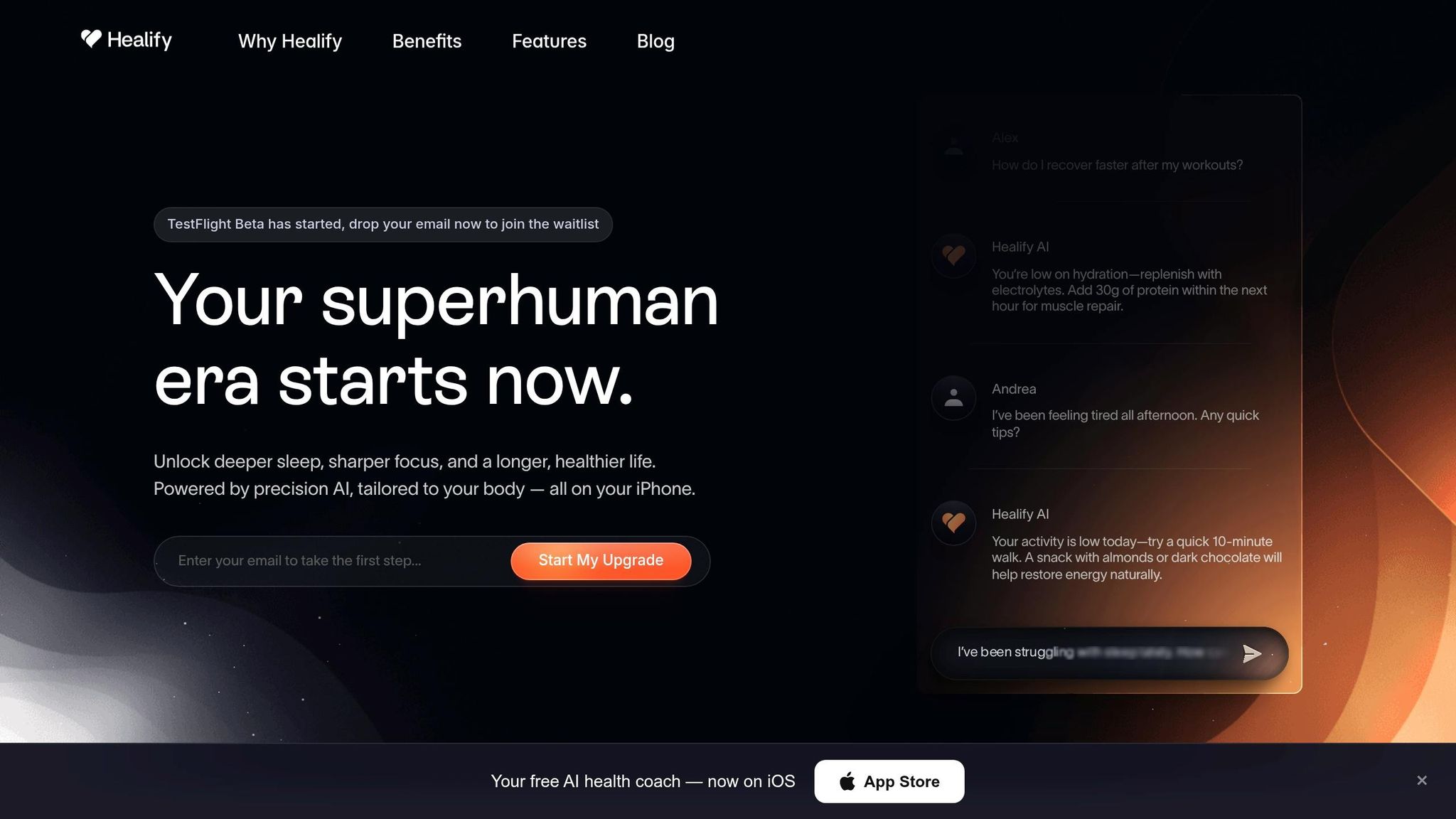
Healify is an iPhone-based AI health coaching app that combines wearable data, biometrics, bloodwork, and lifestyle inputs to deliver 24/7 guidance through its AI coach, Anna. It centers on stress prevention, sleep, and daily choices. That kind of responsiveness can be helpful, but it also brings up a harder question: how much of the decision-making should sit with the system instead of the user?
Where Neuroadaptive AI Can Undercut User Autonomy
When adaptive coaching uses stress, sleep, and behavior data to time interventions, the line between support and steering gets thin. The same data that improves timing can also push choices too hard.
When Personalization Turns Into Pressure
Adaptive systems are built to step in at a weak moment - when you're tired, stressed, or running low on willpower. That timing gives the app a chance to act before you fully register what you're feeling. As a result, a nudge can feel like your own choice when, in fact, the system set the moment and framed the move.
Over time, repeated emotionally salient interactions may reinforce the same response patterns and gradually bias cognition toward the app's goals [9]. What starts as help can drift into subtle pressure that takes advantage of your lowest-resistance moments. It's a bit like being persuaded when you're half-awake: you may go along before you've had a fair chance to think.
The issue gets sharper when users can't tell why the app picked that exact moment.
Opaque Recommendations Weaken Informed Choice
Most users have no clear view of what triggered a specific recommendation. Without that context, it's hard to judge whether the suggestion fits your situation - or to push back when it doesn't.
The result is simple: users may think they chose the action themselves, even when AI shaped the choice [7]. If the system quietly narrows your options or puts certain actions front and center, you may follow along without noticing how much the decision was guided for you. Michael Kühler at the Karlsruhe Institute of Technology argues that AI health apps can show paternalistic behavior that interferes with users' liberty or autonomy without their awareness or specific consent [3].
The risk isn't just confusion - it's infantilization. When users stop questioning recommendations and just do what the app says, their own capacity for self-directed health decisions can slowly wear down [3][1].
That hidden influence runs on deeper data than most users think.
Privacy, Mental State Inference, and U.S. Consumer Expectations
Continuous data collection is built into how these systems work. To personalize well, an app needs a detailed behavioral profile: sleep, activity, stress responses, and mood patterns. Tracking steps is one thing. Inferring anxiety, fatigue, or vulnerability is something else - and acting on that inference without telling you changes the deal.
A 2023 survey found that 71% of AI users have regretted sharing their data with an AI tool, and 89% believe AI needs more regulation [10]. Those numbers point to a clear tension: the more precise the personalization, the more sensitive the data needed to run it.
That gap between visible data and hidden inference is where trust starts to slip.
Neuroadaptive AI vs. User Autonomy: The Core Trade-Offs
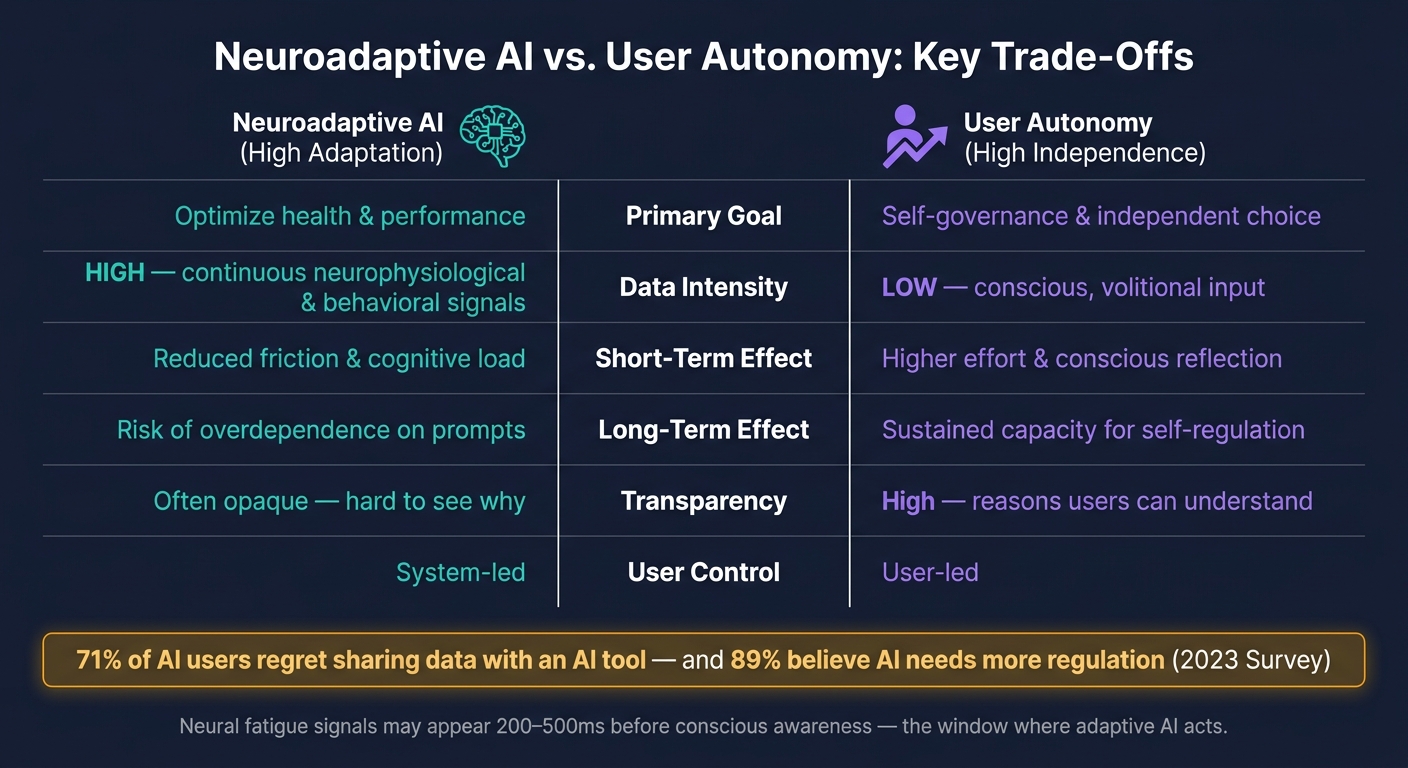
Neuroadaptive AI vs. User Autonomy: Key Trade-Offs Compared
Neuroadaptive AI creates a direct trade-off: better timing and less friction on one side, less user control on the other. That's the heart of it. And those trade-offs show up across four main dimensions.
Comparison Table: Effectiveness, Privacy, Transparency, and Control
The clearest way to judge neuroadaptive AI is to put it side by side with user control.
| Dimension | Neuroadaptive AI (High Adaptation) | User Autonomy (High Independence) |
|---|---|---|
| Primary Goal | Optimize health and performance [1] | Self-governance and independent choice [5] |
| Data Intensity | High - continuous neurophysiological and behavioral signals [1] | Low - conscious, volitional input [1] |
| Short-Term Effect | Reduced friction and cognitive load [1] | Higher effort and more conscious reflection [6] |
| Long-Term Effect | Potential overdependence [9][4] | Sustained capacity for self-regulation and reflection [3] |
| Transparency | Often opaque [6] | High - based on reasons users can understand [3] |
| User Control | System-led [1] | User-led [11] |
This isn't an all-or-nothing call. High adaptation can help in some moments. High independence can matter more in others.
Context changes the balance. That's why context-aware timing matters more than constant adaptation. A tool that steps in at the right moment can help. A tool that steps in all the time can start to feel like it's driving.
When Higher Adaptation Helps and When It Should Be Pulled Back
Higher adaptation makes sense during fatigue, burnout risk, or periods of high mental load. In those moments, cutting effort can be useful. But it should pull back when users want time to reflect or when they need clearer consent.
That shift matters even more when the system starts inferring sensitive mental states. At that point, the better move isn't another silent adjustment. It's a direct question that gives control back to the user.
The hard part is keeping adaptation helpful without letting it quietly take over.
Finding the Middle Ground: Health AI That Supports User Choice
Timing matters. But design is what decides whether a system feels helpful or starts to feel pushy. That's why guardrails can't sit off to the side as a nice extra. They need to be built into the product from the start.
Design Safeguards That Keep Users in Control
The safest path is simple: make user control part of the default experience.
Consent should be active, specific, and repeatable. A general terms-of-service agreement shouldn't be used to cover mood inference or behavioral nudges. Each type of data use needs its own opt-in[13].
Explanations should be plain and immediate. A well-designed tool should show a "Why am I seeing this?" panel that points to the exact inputs behind a suggestion. For example, "Based on your reported late bedtime and low energy yesterday." That kind of clarity helps people judge whether a recommendation fits their own situation[13].
Override controls should also be easy to find. Users should be able to turn off certain nudges, change how often the AI sends prompts, or switch to a simpler mode without losing the rest of the app[13].
These controls work best when the system informs without steering. That's the core of the "mirror" model[12]. The AI reflects patterns back to the user instead of telling them what those patterns mean or what they must do next. A mirror reflects. An oracle commands. That gap matters a lot when the data includes sensitive signals like stress levels or sleep quality.
Key Takeaways for Anyone Choosing an AI Health Coaching Tool
Neuroadaptive AI can help with stress management, sleep consistency, and sticking to habits, but only if it supports the user's judgment instead of taking it over. The risk goes up when suggestions become hard to understand, when consent is treated like a one-time checkbox, or when the AI shifts from guide to decision-maker.
In practice, that means an app should explain signals, not just act on them. Healify reflects this approach by turning continuous health data into clear guidance while leaving the final call with the user.
Choose tools that put clear data, clear explanations, and user control first. The goal isn't less AI. It's AI that stays plainspoken, open, and directed by the person using it.
FAQs
How is neuroadaptive AI different from regular health coaching apps?
Regular health coaching apps are usually open-loop systems. They send information, reminders, or notifications, but they don't react to what your mind or body is doing in the moment.
Neuroadaptive AI works as a closed-loop system. It keeps track of brain activity and biometric signals, detects states like stress or fatigue, and changes its guidance or interface in real time.
How can I tell whether a nudge is helpful or manipulative?
Helpful nudges can make good habits feel a little easier. They show up at the right moment, make the next step obvious, and gently support what you already want to do. Healify’s personalized reminders are a good example. They help you stay on track without making the choice for you.
Manipulative nudges work differently. They steer behavior by slipping past careful thought and triggering automatic reactions, often without your full awareness. That’s where it helps to pause and ask a few plain questions:
- Is the nudge transparent?
- Does it respect your mental self-determination?
- Does it leave you in control, instead of using hidden tactics to push past your preferences?
That distinction matters. A good nudge supports your goals. A bad one tries to outsmart them.
What controls should an AI health app give me?
To protect your autonomy, an AI health app like Healify should let you decide how your data is collected, stored, and used. That means being able to set retention rules for different kinds of data, and giving active, informed consent each time a new use comes up.
It should also explain its observations and recommendations in clear, specific terms. The point is simple: you should stay the main interpreter of your own health data.