
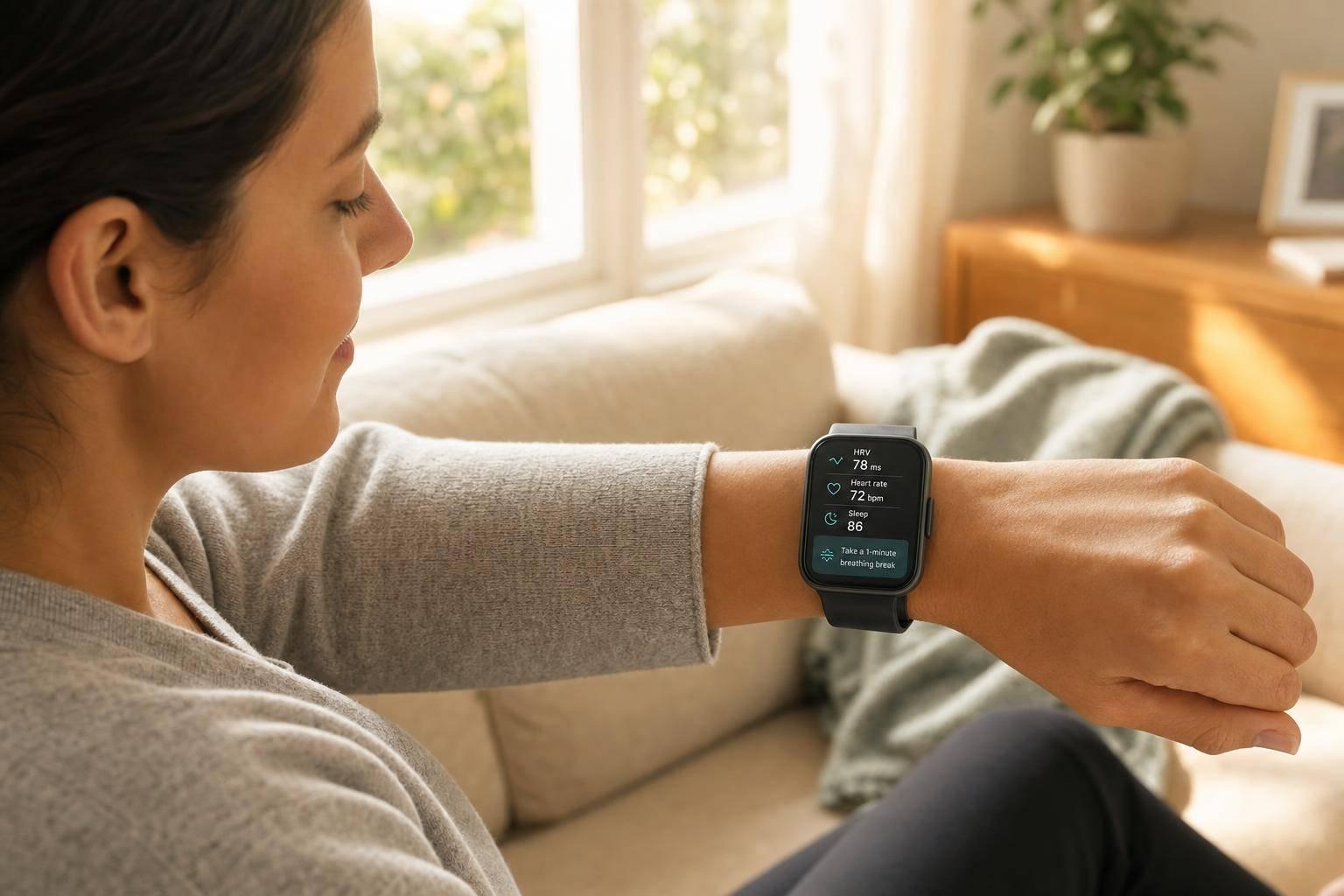
Your body can show stress signs hours before you feel stressed. If I use live data like HRV, resting heart rate, sleep, breathing, and activity, AI can spot a stress pattern early and suggest a simple next step, like 5 minutes of slow breathing, a short walk, or a screen break.
Here’s the main idea in plain English:
- Stress often starts quietly
- One data point alone can be misleading
- AI works better when it reads signals together
- Personal baselines matter more than generic averages
- Fast prompts can help me act before stress spills into sleep, focus, and mood
A few numbers show why this matters:
- The APA’s 2024 survey found average self-reported stress at 5 out of 10
- The American Academy of Sleep Medicine says 74% of Americans deal with stress-related sleep disruption at least sometimes
- In one breathing study, 5 minutes of slow-paced breathing 3 times a day lowered perceived stress and improved HRV
- In a 100-day smartwatch study, 122 participants got better at spotting their own stress patterns
What I take from this is simple: AI is not there to guess my mood. It reads my body data in context, compares it with my normal, and helps me respond while the problem is still small.
That shift matters because early action is easier than late recovery.
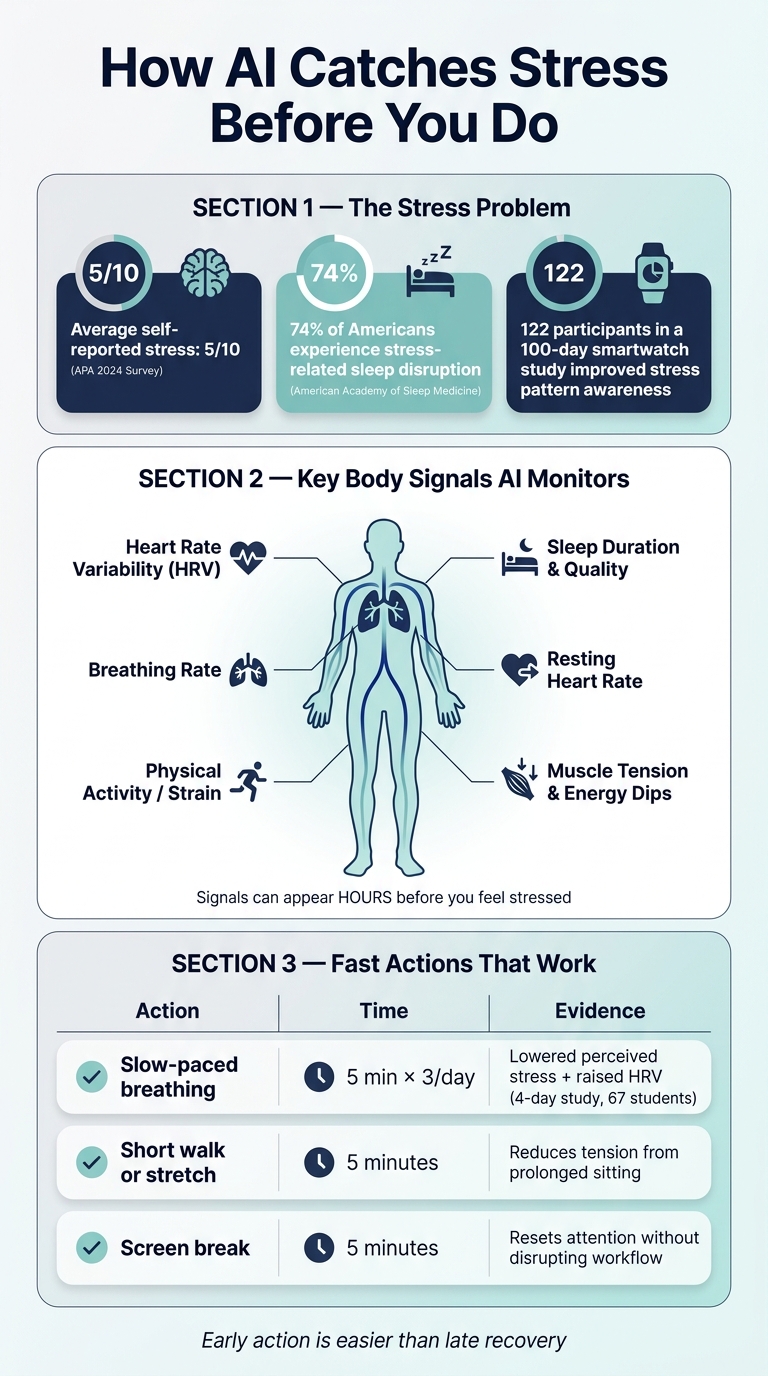
AI Stress Relief: Key Stats & Signals at a Glance
HRV Explained: What Your Nervous System Is Trying to Tell You
sbb-itb-f5765c6
Why stress is hard to catch in real time
Stress tends to stack up across the day, which makes the early signs easy to brush off. It can build through work deadlines, commutes, exercise recovery, childcare, and late-night screen time. That gray area is where AI can help.
Stress signals often appear before you feel overwhelmed
Your body often reacts to stress before your mind puts a name on it. Early physical signs - reduced heart rate variability (HRV), a slightly elevated resting heart rate, shallow or faster breathing, muscle tension, sleep disruption, and energy dips - can show up hours before someone consciously feels overwhelmed. A wearable-based study of college students found that decreased total sleep time, higher resting heart rate, lower HRV, and higher nightly respiratory rate were associated with self-reported stress [2].
That matters because these signals don’t always show up in the same way. On one day, stress might feel like tension. On another, it might look more like fatigue or broken sleep. AI helps by turning those scattered clues into something readable in the moment.
Why guesswork leads to slow or wrong responses
When people don’t have the full picture, they often misread the cause and pick the wrong fix - like reaching for more coffee when the real problem is sleep debt. A single metric usually doesn’t say much on its own. But when you look at signals together, the pattern gets a lot clearer.
AI helps by reading those signals side by side in real time.
How AI reads live health data to detect stress
What data AI pulls from wearables and daily habits
AI can spot stress by looking at live body signals next to your day-to-day habits. The goal is simple: catch stress before it snowballs.
It does that by reading several data streams at the same time. The main body signals include heart rate, heart rate variability (HRV), breathing patterns, sleep duration and quality, resting heart rate shifts, and recent exercise or strain. The clearest read comes from combining those signals, not from betting on just one number.
Habits add context. Things like caffeine, alcohol, sleep timing, workload, and mood can help explain why your body looks the way it does.
Here’s the difference. One high heart rate reading on its own might just mean you finished a run. But if that same high heart rate shows up with low HRV, poor sleep, and a mostly sedentary day, it tells a different story. That mix of signals is much more likely to point to stress-related strain than exercise recovery.
How AI connects a signal to a pattern in the moment
The signal alone isn’t the main thing. What matters is what that signal means for you, compared with your usual baseline.
That’s where AI becomes useful. It doesn’t just flag a number as “high” or “low.” It links that number to a likely cause. Say someone slept five hours, woke up with a resting heart rate above their usual level, and has HRV below their personal baseline. That pattern points more clearly to poor recovery, not just stress in a generic sense. And that matters, because it gives you something more specific to act on.
Personalization is doing a lot of the heavy lifting here. Over time, AI systems learn each user’s baseline ranges, so the question shifts from “Is this HRV low?” to “Is this lower than this person’s normal range, and does it match the other signals showing up today?”
Apps like Healify push this further by blending wearables, biometrics, bloodwork, and lifestyle data. That gives its AI coach, Anna, enough context for real-time monitoring and personalized guidance. As Healify puts it: "Your body's signals, decoded instantly." [1]
That’s when detection stops being just a warning and starts becoming something you can use right away.
What to do when AI flags rising stress
Once stress starts to climb, the next step should be simple and fast. A stress alert only helps if it leads to something you can do right away.
Short actions that lower stress in minutes
Match the action to the signal. If your heart rate and breathing rate are rising, try guided breathing. If you've been sitting too long, take a 5-minute walk or do a short stretch break. If the stress seems tied to long screen time, step away from your monitor for a few minutes.
The best-supported fast option is guided breathing. In a 4-day study of 67 moderately stressed students, 5 minutes of slow-paced breathing, three times a day, lowered perceived stress and raised HRV [3].
Other signals call for other moves. If the issue looks more like long sitting or muscle tension, a 5-minute walk, a few shoulder rolls, or gentle neck stretches may work better. If stress is linked to nonstop screen use or late evening work, taking 5 minutes away from your screen and looking outside or into the distance can help reset attention without throwing off your whole workday. And if fatigue shows up alongside long gaps between drinks, a water break may help.
How personalized coaching helps people follow through
Timing makes a big difference. Prompts that show up as stress is rising - and explain why - are often easier to follow than generic reminders.
Healify's 24/7 coach Anna uses wearables, biometrics, bloodwork, and lifestyle data to deliver timely, personalized next steps - whether that's a breathing exercise when HRV drops, a movement prompt after long sitting, or a wind-down routine when late-night stress puts sleep at risk [1].
When stress is caught early, it's often much easier to turn around before it starts affecting sleep and daily routine.
What changes when stress is caught early
Better self-regulation, sleep, and daily consistency
When AI spots stress early, the upside is pretty simple: you get a chance to step in before the day goes off the rails.
That small heads-up creates a pause before stress hits its high point. And that pause matters. Instead of snapping into reaction mode, you can choose a response. Over time, those early course-corrections can lead to steadier focus, better self-control, and sharper decisions when pressure builds. In plain terms, stress spikes tend to be shorter, and work slowdowns happen less often.
There’s another big payoff too: sleep.
Stress that lingers through the day can leave your body too keyed up to fall asleep, stay asleep, or recover well overnight. But when you deal with it earlier - even with a short reset - you give your system more time to settle before bed. AI can also spot patterns that are easy to miss on your own, like late-afternoon strain on meeting-heavy days or broken sleep after high-stress days.
Early awareness also helps with consistency. A few small recovery breaks during the day usually work better than waiting for one big reset later. In a 100-day smartwatch study, 122 participants became more aware of their stress patterns and found practical ways to reduce stress [4].
Once you can see the pattern, the next step gets a lot more specific. Say your AI shows that your HRV drops between 3:00 and 5:00 p.m. on back-to-back meeting days. Now the fix isn’t vague. It might be:
- adding a buffer between calls
- stopping email earlier
- doing a short wind-down routine before the late-day push
That kind of precision makes change easier to stick with. Personalized coaching tools, such as Healify's AI coach Anna, can also reinforce those next steps and adjust over time based on what you actually do.
Conclusion: Real-time insight makes stress relief more actionable
Stress is hard to catch by yourself because it builds quietly. Your body often shows signs through physiological signals long before you feel overloaded. By the time you notice it, you may already be playing catch-up.
AI changes that timing. It reads live data from wearables and daily habits, links signals to patterns as they happen, and gives you specific actions at the right moment instead of broad advice. The aim is early, steady action that stops stress from staying high. Real-time insight makes stress easier to spot and easier to act on.
FAQs
How does AI know I’m stressed?
AI can pick up on stress by tracking your body's signals in real time through wearables. That includes heart rate variability, electrodermal activity, skin temperature, and breathing patterns.
Healify takes that a step further. It uses your biometrics, sleep, bloodwork, and lifestyle data to build a personal baseline.
That baseline gives Anna a clearer read on what’s normal for you. From there, she can spot subtle shifts and likely triggers, then offer personalized guidance before stress starts to feel overwhelming.
Which signals matter most for stress?
The most important stress signals include HRV, electrodermal activity (EDA), and cortisol levels. Changes in skin temperature, breathing patterns, and sleep quality also help show how your body reacts under stress.
When these signals are looked at together, AI can build a personal baseline. That makes it easier to spot when your body starts moving away from its usual pattern and may need support.
How accurate are stress alerts?
AI-powered stress alerts can be highly accurate. Some advanced models reach 92% to 94% accuracy by combining multiple physiological signals instead of relying on just one.
Here’s why that matters: a single signal, like a higher heart rate, can be misleading. You might be stressed, sure. Or you might’ve just climbed a flight of stairs.
To sort that out, these systems look at biometrics such as:
- heart rate variability
- skin temperature
- electrodermal activity
By reading those signals together, they can cut down on false alarms, including exercise-related heart rate spikes.
Accuracy may also improve over time as the model learns your personal baseline. In plain English, the system gets better at telling the difference between your normal and a stress response.