
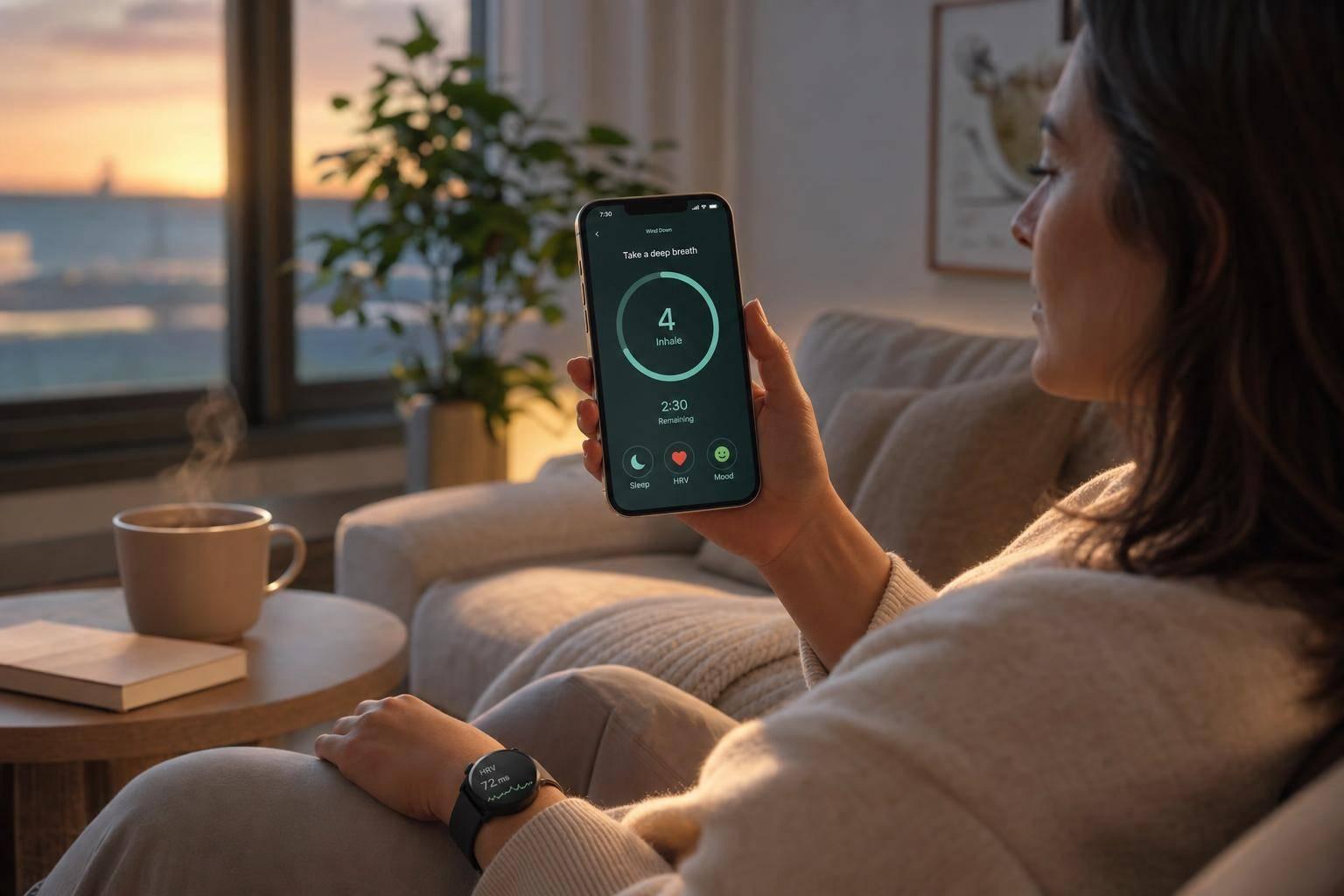
Stress help works better when it fits you, not some average person. In the U.S., adults report average stress at 4.8 out of 10, and 44% say it has increased over the past five years. My main takeaway is simple: AI can use your sleep, heart rate, HRV, activity, and mood check-ins to suggest the right reset at the right time - and keep changing those suggestions based on what helps.
Here’s the short version:
- Generic stress advice often misses because stress shows up differently from person to person.
- AI uses personal data from phones, wearables, sleep trackers, and check-ins.
- It can spot patterns in stress, recovery, and bedtime habits.
- It can suggest in-the-moment tools like breathing, mindfulness, micro-breaks, or muscle relaxation.
- It should support, not replace, medical care - especially if stress is severe or long-lasting.
What this means for me as a reader: I’m not looking for more generic advice like “just meditate.” I’m looking for a plan that matches my body, my day, and my stress patterns.
Arianna Huffington on #AI as your 24/7 health coach | Pioneers of AI
sbb-itb-f5765c6
Quick comparison
| Area | Standard stress advice | AI-personalized relaxation |
|---|---|---|
| What it uses | General tips | My biometrics, sleep, and check-ins |
| Timing | Fixed routine | Prompts based on my current state |
| Method choice | Same tool for many situations | Tool matched to physical or mental stress |
| Learning over time | No feedback loop | Tracks what helps and updates suggestions |
| User work | I choose everything | The tool helps guide the next step |
Put another way: the article is about fit. When relaxation matches my stress type, schedule, and recovery data, it has a better chance of helping.
The Problem With One-Size-Fits-All Stress Advice
Most stress advice is built for some average person. Not for your sleep, your schedule, or the thing that sets you off. And it usually doesn't account for whether you're under short-term pressure or dealing with stress that just won't let up.
Stress Shows Up Differently Across Bodies and Routines
Two people can feel the same kind of stress and still need very different ways to reset. One person may need mental quiet. Another may need physical release.
Timing matters too. A breathing exercise that helps at one point in the day might do almost nothing in another moment. That's where generic routines fall short. They don't make those kinds of distinctions.
Static Recommendations Do Not Learn From Results
The deeper problem is pretty simple: standard advice has no feedback loop. It keeps serving up the same suggestion, even when that suggestion clearly isn't helping.
The Annals of the New York Academy of Sciences notes that "The effectiveness of mindfulness-based interventions varied significantly depending on the match between the specific intervention technique and the individual's current stress pattern." [1] Without that match, people can end up thinking the method failed, when the issue is the mismatch.
That's exactly where AI comes in. It tracks what helps, what doesn't, and adjusts the plan in real time.
How AI Builds a Personalized Relaxation Plan
AI builds a plan from your data, not average patterns. That matters because stress doesn’t look the same from one person to the next. Instead of leaning on broad averages, AI looks for patterns in how your body responds.
What Data AI Uses to Detect Stress and Recovery
AI relaxation tools look at signals like heart rate, HRV, sleep, activity, and resting heart rate trends. Some also use skin temperature. Lower HRV often points to higher stress and weaker recovery, so AI watches your HRV trends over time instead of treating one reading like the whole story.
Mood check-ins help fill in what sensors can’t see. That’s a big deal, because similar biometrics can mean different things on different days. A higher heart rate might mean stress, or it might just mean you climbed the stairs too fast. Your input helps AI tell the difference.
Those signals then turn into prompts right when your body needs a reset.
How AI Adjusts Recommendations in Real Time and Over Weeks
AI steps in when your data shows strain, not on some fixed schedule. If your heart rate stays high and stress levels are up, for example, AI may suggest a 2-minute breathing break. Then it checks the before-and-after data and updates your plan based on what happened.
Over time, it starts to spot links you’d probably miss on your own. Maybe your sleep runs 45 minutes longer on nights when you stop screens by 9:30 p.m. and do a short breathing exercise first. AI leans into what helps and drops what doesn’t.
Healify uses this kind of coaching loop. Its AI health coach, Anna, combines wearable data, biometrics, bloodwork, and lifestyle inputs to build a stress and recovery plan that updates as your patterns change.
That data turns into daily guidance: when to breathe, pause, or wind down.
What AI-Personalized Relaxation Looks Like Day to Day
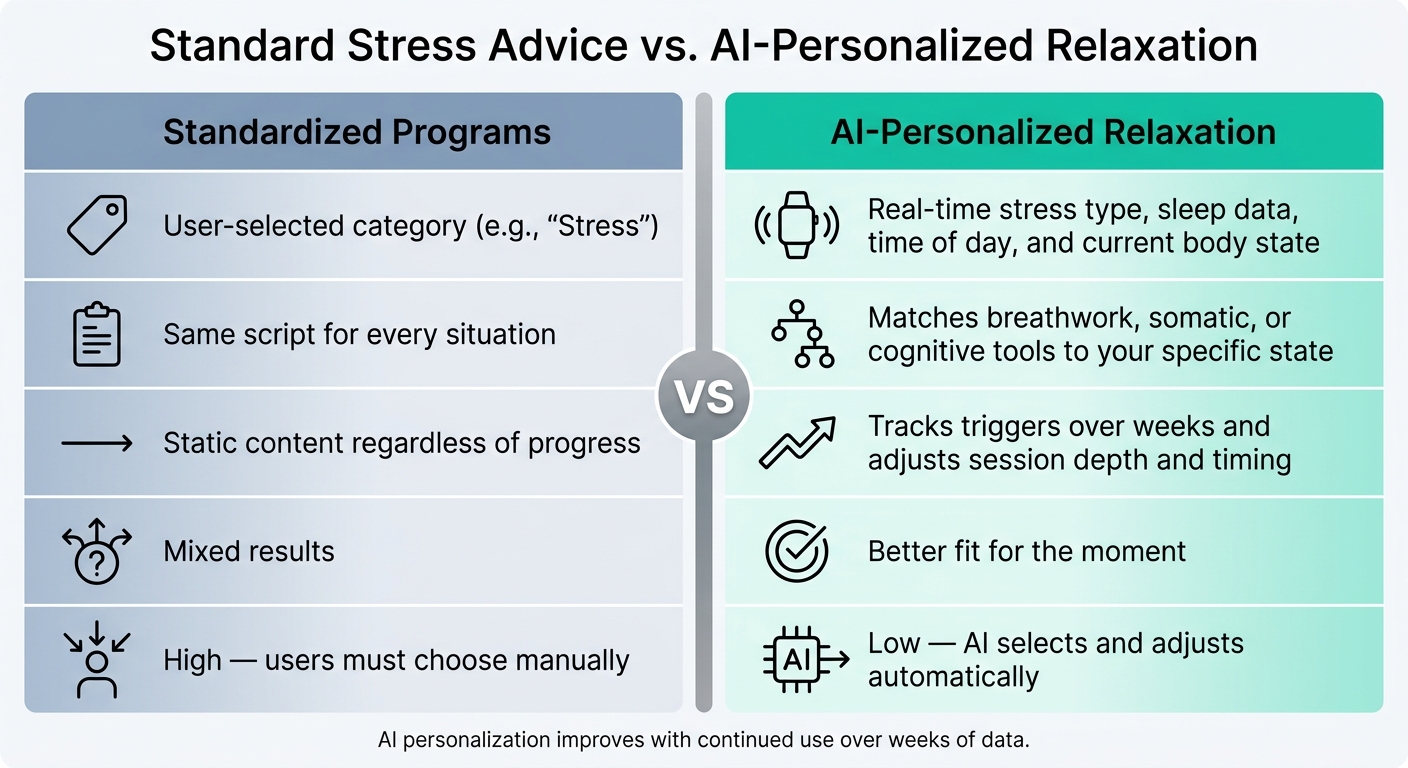
Standard Stress Advice vs. AI-Personalized Relaxation: Key Differences
Here’s what that kind of personalization looks like in everyday life.
Biometric-Triggered Breathing, Mindfulness, and Micro-Breaks
AI can read real-time signals like sleep quality, time of day, and your current body state to suggest the right reset at the right moment. If stress spikes, a 3–5 minute 4-7-8 breathing session can help lower arousal fast. If your mind feels overloaded, AI might point you to open monitoring meditation to help you get your focus back. The point is simple: the method matches the type of stress, not just the fact that stress is there.
That turns stress data into prompts you can use right away.
The same idea carries into the evening.
Sleep-Focused Wind-Down Routines Based on Your Actual Data
Your nighttime routine shouldn’t look the same every day, because your stress doesn’t show up the same way every day. AI looks at your sleep patterns, evening stress signals, and how rested you felt the night before. Then it builds a wind-down plan for tonight, not for some made-up average day.
If your data shows higher stress late in the day, AI may move you toward a calmer routine before bed. It might suggest Progressive Muscle Relaxation - tensing each muscle group for 5 seconds, then releasing for 10 - to ease physical tension before sleep. That recommendation comes from your sleep and evening stress data, not from a generic script.
Standardized Routines vs. AI-Personalized Relaxation: A Side-by-Side Look
The main difference comes down to fit. One-size-fits-all tools make you do the adjusting. AI does the adjusting for you.
| Feature | Standardized Programs | AI-Personalized Relaxation |
|---|---|---|
| Data used | User-selected category, like "Stress" | Real-time stress type, sleep data, time of day, and current stress state |
| Technique selection | Same script for every situation | Matches breathwork, somatic, or cognitive tools to your specific state |
| Adaptability over time | Static content regardless of progress | Tracks triggers over weeks and adjusts session depth and timing |
| Likely outcomes | Mixed results | Better fit for the moment |
| User effort | High - users must choose manually | Low - AI selects and adjusts automatically |
How to Use AI Relaxation Tools Safely and Effectively
Personalization helps only when the advice is safe, well-timed, and fits how you feel right now.
What to Check Before Trusting AI Recommendations
Before you try an AI relaxation suggestion, make sure it lines up with your current stress level. The best tools look at your current stress and sleep data before they suggest a method.
Stress-response changes that matter usually take weeks of steady practice [1]. So if you test a tool once and expect a clear answer, you're probably judging it too soon.
Use this quick check to tell the difference between useful personalization and plain automation:
- Does it tell acute stress apart from chronic stress? If not, it isn't giving you personal guidance.
- Is it based on established techniques? Stick with methods that come from known, tested approaches.
- Are the suggestions there to support you, not direct your care? A tool should help with health choices, not take the place of a licensed clinician.
Conclusion: Better Relaxation Starts With a Better Fit
When a tool clears those checks, it can become a practical part of your routine.
Better relaxation starts with a better fit. The most useful systems track how you respond over time, adjust the approach, and become more precise the longer you use them. Healify turns biometrics, wearables, bloodwork, and lifestyle data into a simple action plan for stress and sleep. AI works best when it adjusts to the person, the moment, and the pattern over time.
FAQs
How does AI know which relaxation method fits me?
AI builds a personal stress baseline over 14 to 30 days using data from your wearables. It tracks signals like heart rate variability, skin temperature, breathing patterns, and sleep quality to separate emotional stress from physical activity.
When stress shows up, Healify’s AI coach, Anna, looks at your current context and known triggers to suggest techniques that fit the moment, like breathing exercises or cognitive strategies. The guidance shifts in real time based on your feedback and results.
What data should I share for personalized stress support?
For more personal stress support, Healify pulls in data from a few different sources to build a clearer picture of your health.
That can include wearable biometric data like heart rate, heart rate variability, respiratory rate, sleep quality, and activity levels.
It also helps to share details about your daily habits, such as nutrition, exercise, and mindfulness. On top of that, context like calendar events, location, and lab results can help spot stress triggers and figure out what kind of recovery you may need.
Can AI relaxation tools help with chronic stress?
Yes. AI relaxation tools can help manage chronic stress because they do more than offer a quick calm-down moment. They can support longer-term recovery, which is what many people need when stress keeps showing up day after day.
By tracking your physiological data and personal patterns over time, tools like Healify can spot your stress triggers and give you personalized, real-time support. That steady, data-led approach can help you build daily habits that stick and handle stress with more control.