
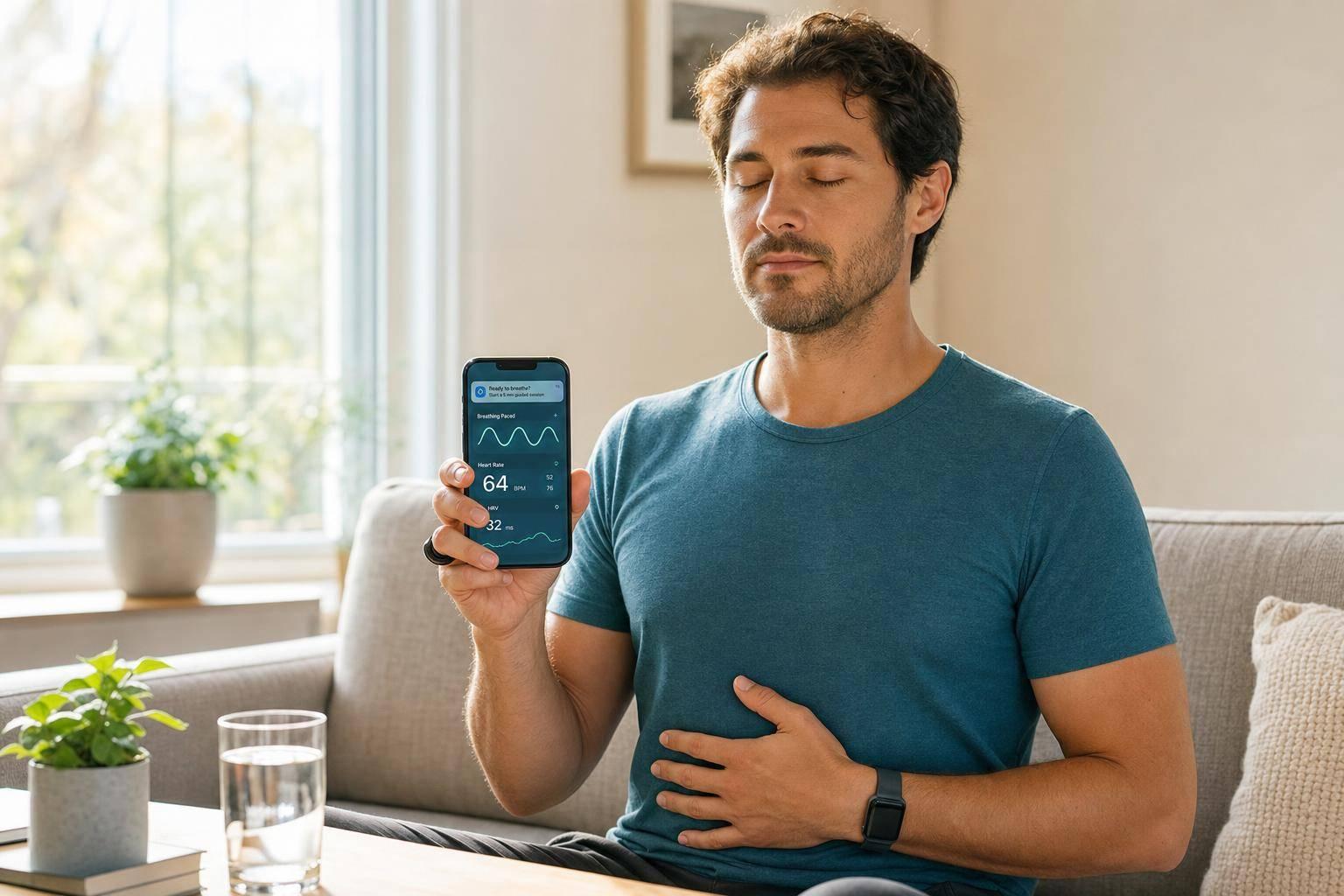
AI biofeedback can help you catch stress earlier, calm your body sooner, and build better control over anxiety with practice. In studies, HRV biofeedback showed a large effect on stress and anxiety, and wearable AI systems reached about 81% accuracy for anxiety detection, with 92% specificity for ruling out anxiety in some research.
Here’s the short version:
- It spots stress in real time through signals like heart rate, HRV, breathing, sleep, and skin conductance.
- It learns your baseline and can prompt a reset with AI-driven nudges when your data starts to shift.
- It supports HRV breathing practice, often around 5 to 6 breaths per minute, which is one of the most studied biofeedback methods for anxiety.
- It works through devices many people already use, like smartwatches, fitness trackers, and phones.
- It may help lower anxious days and stress episodes, especially when used often for 4 to 8 weeks.
- It is support, not treatment by itself, so it makes the most sense as part of a larger care plan when anxiety is severe or long-lasting.
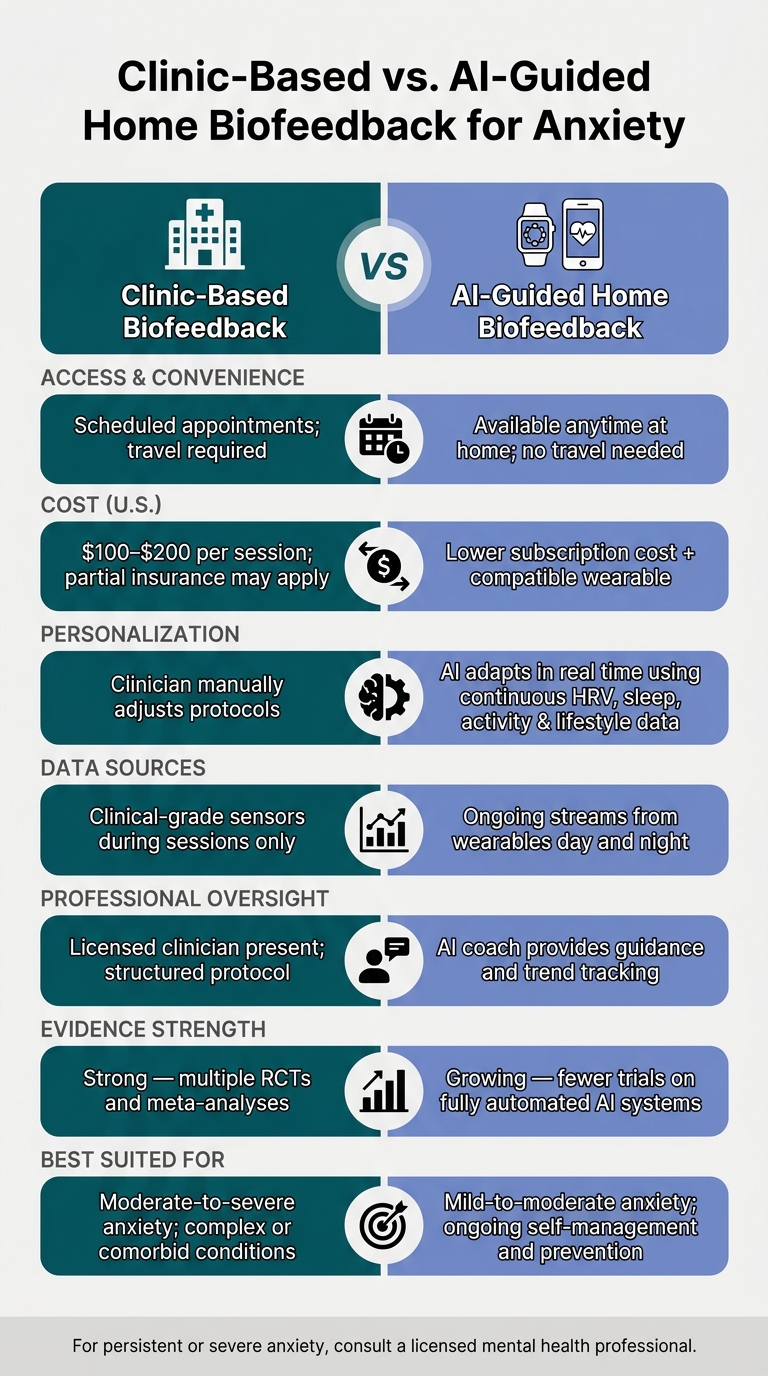
Clinic-Based vs. AI-Guided Home Biofeedback for Anxiety
AI-Driven Stress Detection: Your New Wellness Companion!
sbb-itb-f5765c6
Quick Comparison
| Area | What AI Biofeedback Does | What That May Mean for You |
|---|---|---|
| Stress awareness | Watches body signals all day | You may notice anxiety sooner |
| Personal coaching | Uses your own baseline and patterns | Prompts can feel more timely |
| HRV training | Guides paced breathing with live feedback | You may recover from stress faster |
| User-friendly wearables and apps | Brings support to your phone or watch | Practice is easier to fit into daily life |
| Long-term skill building | Repeats feedback and resets over time | You may build more self-awareness |
| Limits | Not a diagnosis or full mental health treatment | Severe anxiety still calls for licensed care |
If I had to sum it up in one line: AI biofeedback is best for helping you notice stress early and practice calming skills more often.
Why AI Biofeedback Is Getting Attention for Anxiety Relief
Digital biofeedback brings anxiety support into wearables and mobile apps, which makes day-to-day practice a lot easier. That matters because anxiety support tends to work best when people can stick with it over time.
The appeal is pretty simple: software takes sensor data and turns it into immediate feedback people can use at home. In plain English, it lowers the barrier to regular practice.
HRV biofeedback has the strongest research base for anxiety and stress reduction. A 2021 meta-analysis found a large effect on both outcomes.[10] Most HRV protocols use resonance breathing - slowing breathing to about 5 to 6 breaths per minute - to help nudge the autonomic nervous system toward a calmer state.[8] That research support is a big reason HRV biofeedback sits at the center of most discussions about AI-assisted anxiety relief.
VR-supported and app-based formats also look promising, but HRV biofeedback is still the most studied option.[4][5][7] Both use the same self-regulation model, which the "New Formats" section covers in more detail.
Even with that support, these tools still belong in the self-regulation bucket. They tend to work best alongside broader mental health care, not in place of professional treatment when anxiety is severe or sticks around.[3][6]
1. Real-Time Awareness of Stress Signals
The first benefit is straightforward: AI biofeedback turns faint stress signals into an instant cue to do something about them.
Physiological Signals Tracked
Your body usually shows stress before anxiety hits full force. The problem is, those signals are easy to overlook in day-to-day life. AI biofeedback tools help by watching key body markers all the time.
One of the main signals is HRV in wearables (heart rate variability). HRV reflects autonomic balance and stress load, and low HRV is a well-known marker of chronic stress and anxiety.[20] Most tools also track heart rate, breathing, and EDA.[1][11][10][15][18] Systems that combine several signals tend to spot stress better than setups that rely on just one.[12][17]
How AI Personalizes the Feedback
Raw numbers alone don't help much. What sets AI-powered tools apart is that they learn your usual baseline over days or weeks, then flag changes that matter.[12][17][18] That means the system can tell the difference between a workout and a stress response, which cuts down on false alerts. When it detects a real stress pattern, it can send a prompt, like paced breathing, that fits the signal pattern.[1][11][18]
That personalization makes the feedback useful in the moment, not just something you look at later in an app.
The Anxiety-Related Benefit
The main upside is earlier action. Real-time awareness creates a chance for small interventions, like a 5-minute breathing session when HRV drops or a short check-in when stress markers jump, before anxiety builds into something harder to manage.[1][11][13][15][16]
Research backs this up. Studies using wearable biofeedback have found that real-time feedback lowers self-reported stress and improves HRV in a single session.[1][15]
Strength of Current Evidence
The day-to-day value is easy to see, and the research is starting to line up with that. A systematic review and meta-analysis of wearable AI for anxiety detection found that these systems identified anxiety with 81% accuracy, with especially strong results for identifying non-anxious people at 92% specificity.[19] That said, many studies are still small and short, and they often focus on narrow groups such as students or short-term stress samples.[1][11][13][15][16] HRV-based real-time feedback still stands as an evidence-supported tool for anxiety management, especially in structured programs that run for several weeks.[1][11][10]
2. Personalized Coaching Based on Your Physiology
Generic relaxation advice often misses what your body is doing right now. That matters, because good coaching should shift with your physiology, not just follow a preset schedule.
Physiological Signals Tracked
AI-guided tools track HRV trends across daily life and can surface your stress patterns.[23][14][24]
How AI Personalizes the Feedback
Instead of sticking to one fixed protocol, AI-guided systems adjust breathing guidance based on your HRV history and live readings through HRV autodosing.[23][27] In a 16-week randomized study, this personalized approach reduced anxiety and depressive symptoms.[25]
The Anxiety-Related Benefit
The main upside is timing. When HRV drops, the system can prompt a short breathing session before anxiety starts to build. In one pilot study using a discreet wearable HRV biofeedback device, participants increased their HRV (RMSSD) by an average of +11.4 ms after low-dose sessions, along with measurable drops in both anxiety and depression symptoms.[1]
Strength of Current Evidence
Clinic-based biofeedback still has the stronger evidence base. Home-based AI systems are newer, though the research is building.[11][10][1][22]
That’s the key difference between AI biofeedback and more standard coaching: it brings personalized support outside the clinic and into daily life. There’s a clear trade-off. Clinic care has stronger research behind it, while home use makes it easier to practice more often and with less friction.
| Feature | Clinic-Based Biofeedback | Home-Based AI-Guided Biofeedback |
|---|---|---|
| Cost | Often $100+ per session; insurance coverage varies | Subscription-based app fee plus a consumer wearable; lower ongoing cost |
| Access | Requires scheduling, travel, and a trained clinician | Available anytime via smartphone or wearable |
| Personalization | Therapist manually interprets signals and adjusts the protocol | AI automates signal interpretation and adjusts in real time[23][27] |
| Data richness | High within sessions; limited between visits | More continuous monitoring across daily life |
| Evidence strength | Strong - multiple RCTs and meta-analyses[11][10] | Growing - fewer trials on fully automated AI systems[1][22] |
In day-to-day use, home biofeedback can help support regular practice, while HRV exports can help inform broader care.[26]
The next step is making that support available through wearables and mobile apps throughout the day.
3. Better Autonomic Regulation Through HRV Training
Once AI spots stress, HRV training can help the body settle down faster.
Physiological Signal Tracked
HRV shows how fast the nervous system moves between stress and recovery.[28]
How AI Personalizes the Feedback
AI changes the breathing pace and session difficulty based on your HRV response.[28] If your body responds fast, the app can make the session harder. If not, it keeps things simple.[30][32]
The Anxiety-Related Benefit
The research here is encouraging. A major meta-analysis found that HRV biofeedback led to a large drop in self-reported stress and anxiety, with a between-groups effect size of g = 0.83 compared with control conditions.[34][35][36]
A separate RCT in 113 university students also found clear drops in anxiety (F = 10.43, p < 0.01, η² = 0.21). The strongest results showed up in participants who paired in-lab sessions with home practice.[39]
Strength of Current Evidence
The evidence leans positive, but the long-term picture is still limited. HRV biofeedback has been studied in several groups, including students, athletes, and pregnant women.[37][39][41] One RCT found that it worked about as well as mindfulness and physical activity for reducing stress and anxiety, with no significant difference between the three.[42]
At the same time, most trials are short. Some studies also show that autonomic measures do not always change by the same amount, even when mood gets better.[7][10][38]
| Factor | Pros | Limits |
|---|---|---|
| Noninvasive use | No medications or procedures required; relies on breathing and wearable sensors.[28][31] | Requires steady device use and user engagement. |
| Home-based sessions | Can be done outside clinics; wearable and smartphone delivery has shown effectiveness.[39][40] | Adherence can drop after early anxiety relief, and gains may fade without steady practice.[32][33][7][10] |
| Real-time feedback | Lets users see how breathing changes HRV in the moment.[28][29] | Feedback depends on device accuracy and steady use.[32][33] |
| Long-term outcomes | Short- and medium-term anxiety reductions are well supported.[34][36] | Long-term durability is still unclear, and effect sizes differ by population.[10][21][32] |
That benefit becomes easier to use when HRV training is built into wearables and mobile apps.
4. Day-to-Day Anxiety Support Through Wearables and Mobile Apps
This is where biofeedback shifts from something you do in a set session to something that runs quietly in the background.
What It Tracks
In wearables and mobile apps, HRV training becomes part of daily life through passive monitoring and well-timed prompts. These tools track heart rate, HRV, sleep metrics, respiratory rate, activity, and sometimes electrodermal activity across the day. The sleep side matters a lot. Low HRV during sleep has been linked to higher mental stress and anxiety symptoms the next day, which makes overnight tracking a useful early warning sign.[45]
How AI Personalizes the Feedback
When HRV drops and resting heart rate goes up, the app can step in with a just-in-time prompt: a short breathing exercise, a mindfulness cue, or another simple behavior to help dial stress down right as it starts to climb.[43] Healify uses this model. It turns wearable data, biometrics, bloodwork, and lifestyle data into daily stress guidance through its 24/7 AI coach, Anna.
The Anxiety-Related Benefit
The research points in the same direction. In a randomized controlled trial using a respiration and heart-rate sensor paired with a stress-and-anxiety app, participants had 15.8% fewer stress episodes, 13% fewer distress symptoms, and 28.2% fewer anxious days than a waitlist control group.[49] A systematic review and meta-analysis of smartphone apps for anxiety and depression found a moderate overall effect size, with Hedges' g at about 0.29 across randomized controlled trials. HRV-based biofeedback through wearables shows stronger outcomes, with multiple meta-analyses reporting moderate to large drops in anxiety.[1][45][14][48]
Put simply, this kind of setup can offer more useful support during the day and help catch stress spikes that might otherwise slip by.
| Factor | Benefit | Limitation |
|---|---|---|
| Continuous HRV & HR monitoring | Spots stress signals early, including during sleep.[45] | Sensor accuracy differs across consumer devices.[44][46] |
| Just-in-time interventions | Sends breathing or mindfulness prompts when stress is detected.[43][49] | Heavy tracking can make some users fixate on symptoms.[46] |
| App-based delivery | Helps with daily stress management from almost anywhere.[47][48] | Average effect sizes are modest (g ≈ 0.29).[48] |
| Multimodal data integration | Pulls together HRV, sleep, activity, and lifestyle data for a fuller view.[45][1] | AI detection is still developing; it is not a standalone diagnostic tool.[19][46] |
Those repeated signals can also make it easier to notice emotional patterns over time.
5. Stronger Emotional Regulation and Self-Awareness Over Time
The Physiological Signal That Matters
Catching stress early is part of the story. The other part is what happens after that. AI biofeedback can help train calmer responses over time.
A big signal here is HRV, or heart rate variability. It shows how flexibly your autonomic nervous system shifts between stress and recovery. Higher resting HRV is linked with better stress resilience, lower anxiety, and calmer, less reactive responses[50][54][56]. Over time, that can help people spot stress sooner and react with a little more control instead of getting swept up in it.
How AI Personalizes the Feedback
This is where AI starts to feel less generic and more personal. Over time, biofeedback tools can learn your baseline physiology, your day-to-day patterns, and the moments when your HRV tends to dip.
Maybe that drop shows up before a work presentation. Maybe during a hard conversation. Maybe when you're lying in bed trying to fall asleep and your mind won't let go.
Instead of giving the same advice to everyone, the system can prompt a short breathing reset when your data points to rising arousal. Used often over several weeks, this kind of practice is linked with lower anxiety and less negative emotion[50][54][56].
The Anxiety-Related Benefit
The main payoff is better emotional control: more self-awareness, faster recovery, and less reactivity.
In an 8-week HRV biofeedback program, changes in resting HRV significantly mediated reductions in negative emotion, which suggests that better autonomic regulation predicts emotional improvement[50]. Put more simply, people got better at noticing what was happening in their bodies and adjusting before stress took over.
That usually shows up as:
- earlier detection
- slower reactions
- steadier coping
This kind of change doesn't come from one session. It builds through repetition. Clinicians generally see biofeedback as a skill-building tool, not a cure-all, because the gains come from learning to notice physiological cues and respond sooner.
Strength of the Evidence
The evidence looks promising, but it's still developing. Meta-analyses show meaningful reductions in anxiety, though trial quality remains uneven[55][9]. That same feedback loop is also moving into more immersive formats, including VR-guided biofeedback.
6. New Formats: VR-Guided Biofeedback
The Physiological Signal Tracked
VR uses the same core biofeedback idea, but puts it inside a more immersive setting. Most VR-guided biofeedback systems track heart rate and HRV. Some also measure EDA or frontal alpha asymmetry, a brain activity pattern tied to emotion.[58][59][64]
The data usually comes from chest straps or wrist wearables, then streams into the VR scene in real time. That means the virtual setting can respond as your body changes. In some setups, the scene shifts with your breathing, so you can see your progress instead of just reading a number on a screen.[53][4][61]
How AI Personalizes the Feedback
Inside VR, AI can adjust the experience moment by moment as stress levels change. It keeps reading your physiological signals and changes the scene to match. For example, it might slow a breathing cue if heart rate jumps, or add a graded exposure scene if HRV starts to improve.[53][4][52]
In VR exposure therapy for social anxiety, AI-driven systems have used both heart rate and frontal alpha asymmetry to keep anxiety at a manageable level while still moving treatment forward.[59]
The Anxiety-Related Benefit
One reason VR stands out is that it can help people stay focused and stick with the session.[63][14] A 2022 systematic review and meta-analysis of seven VR biofeedback studies found that VR biofeedback significantly reduced self-reported anxiety with an effect size of g = −0.28, and also reduced heart rate with an effect size of g = −0.45, compared with controls.[58][60]
When researchers compared it directly with a waiting-list control, the drop in heart rate was even larger: g = −0.52.[58]
There’s also some evidence that adding biofeedback to VR exposure therapy works better than using VR alone. In one comparison, the biofeedback group showed a steadier drop in arousal and a bigger reduction in self-reported anxiety across sessions.[59]
Strength of the Evidence
The early findings look promising, but the research base is still small and uneven. The same meta-analysis found no consistent gain in HRV across pooled studies. It also pointed out big differences between studies in session length, equipment, and sample size.[58][60]
That matters. Most studies use small groups, often made up of university students, so it’s hard to know how well the results carry over to other people. Sessions also tend to be short - usually 5 to 20 minutes - and many of the systems tested are still research prototypes, not tools people can easily get and use today.[53][4]
3 Comparison Tables at a Glance
The tables below boil the main trade-offs and likely outcomes down into one quick scan. The first two show how the tools differ in practice. The last one shows the changes people tend to notice over time.
HRV Biofeedback: Pros and Limits
| Pros | Limits |
|---|---|
| Tracks stress and recovery through HRV metrics like RMSSD and SDNN | Requires steady daily practice, about 10–20 minutes, to see lasting results |
| Builds early awareness of stress signals before they spiral | Readings can shift after caffeine, alcohol, poor sleep, or hard exercise |
| Backed by research: a 58-study meta-analysis found large effect sizes for anxiety reduction [9] | Consumer wearables vary in sensor accuracy and signal quality |
| Works with everyday wearables and smartphone apps | Not suitable as a standalone treatment for severe anxiety disorders |
| Relatively low ongoing cost after the first equipment purchase | People with certain cardiac arrhythmias should talk with a doctor before starting |
| Helpful during high-stress moments like pre-presentation nerves, work deadlines, or falling asleep | Data can be tough to read without guidance |
| Not a substitute for psychotherapy or medication when clinically indicated |
Clinic-Based vs. AI-Guided Home Biofeedback
| Aspect | Clinic-Based Biofeedback | AI-Guided Home Biofeedback |
|---|---|---|
| Access & Convenience | Scheduled appointments; commuting required | Available anytime at home; no travel needed |
| Cost (U.S.) | Usually $100–$200 per session; partial insurance coverage may apply | Lower recurring subscription cost; requires a compatible smartphone and wearable |
| Personalization | Clinician adjusts protocols manually based on history and individual response | Algorithm adapts in real time using continuous HRV, sleep, activity, and lifestyle data |
| Data Sources | Clinical-grade sensors used during sessions only | Ongoing streams from wearables throughout the day and night |
| Professional Oversight | Licensed clinician present; structured treatment protocol | No in-person clinician; AI coach provides guidance and trend tracking |
| Best Suited For | Moderate-to-severe anxiety; complex or comorbid conditions - professional care is also warranted for severe or worsening anxiety, frequent panic attacks, or major functional impairment | Mild-to-moderate anxiety; ongoing self-management and prevention |
Emotional Gains and Practical Outcomes
| Emotional Gain | Practical Outcome | Typical Timeline |
|---|---|---|
| Reduced baseline anxiety | Fewer anxiety spikes during busy workdays or commutes | 4–6 weeks of regular practice |
| Faster recovery after stress | Heart rate and breathing return to normal more quickly after a tense meeting or heavy traffic | 4–8 weeks (3–5 sessions/week, 10–20 min each) |
| Greater distress tolerance | Able to stay present in hard conversations without shutting down | 6–8 weeks |
| Improved emotional awareness | Better communication with colleagues and family; fewer stress-driven misunderstandings | Ongoing, builds over months |
| Increased sense of control | More confidence managing physical anxiety symptoms | Noticeable within the first few weeks of steady use |
| Coping skills become more automatic | Breathing or grounding techniques kick in under pressure without conscious effort | 6–12 weeks of steady training |
These gains usually come from repeated practice. Over time, that repetition strengthens body awareness and coping skills.
Next comes how Healify applies these ideas in daily use.
Where Healify Fits In
Healify is one example of the app-based AI biofeedback model described above.
It’s an AI-powered health coaching app for iPhone users that connects with Apple Health and can sync 150+ health metrics from wearables, bloodwork, sleep, and lifestyle data.[65] Then it turns that information into daily guidance for sleep, movement, nutrition, and tracking stress levels.[57]
Its 24/7 AI coach, Anna, helps users make sense of what changed in their data and what to do next.[66][67]
Healify is a wellness coaching tool, not a medical device. It does not diagnose, treat, cure, or prevent disease, so it should support professional care rather than replace it. People dealing with persistent or severe anxiety should seek care from a licensed professional.
Conclusion
AI biofeedback can help people spot stress earlier, calm down faster, and build more steady self-control over time. That matters when stress is coming from work, family, and the nonstop buzz of notifications.
Those day-to-day gains line up with the early research. A meta-analysis of 24 studies involving 484 participants found HRV biofeedback helpful for reducing self-reported stress and anxiety.[68] VR-based formats also showed reductions in self-reported anxiety and heart rate.[62] These findings align with broader mobile biofeedback trends in digital health.
At the same time, the research is still in its early stages. Long-term evidence is limited, especially for fully AI-guided tools, and many studies are small or short.[68][69][2]
The clearest takeaway is simple: AI biofeedback works best as support, not as a stand-alone solution. Regular practice over about eight weeks tends to make the effects easier to see.[51] That makes AI biofeedback a useful tool for daily anxiety management, not a standalone fix. For persistent or severe anxiety, use it as part of a broader care plan with a licensed mental health professional.
FAQs
How does AI biofeedback detect anxiety?
AI biofeedback can spot anxiety by watching real-time stress signals in the body. One of the main signals is heart rate variability (HRV), which often goes down when your body moves into fight-or-flight mode.
It can also track electrodermal activity, shifts in breathing, skin temperature, and sometimes cortisol in sweat. The AI compares those signals with your personal baseline, then marks changes that matter while filtering out non-stress causes like exercise.
How long does it take to see results?
You may feel some relief right away in stressful moments, even from sessions that last just 2 to 10 minutes.
The bigger shifts, like better emotional regulation and improved recovery after stress, tend to show up after a few weeks of steady practice. Most structured plans use 1 to 2 sessions per week for 4 to 10 weeks. And AI platforms like Healify often need 14 to 30 days to build your personal baseline.
Can AI biofeedback replace therapy or medication?
No. AI-powered biofeedback tools are not meant to replace therapy or medication.
They can support stress management and emotional well-being with personalized, data-driven insights and real-time interventions. But they should work alongside professional mental health care, not instead of it.
If anxiety or stress feels overwhelming, seek help from a licensed healthcare provider.