
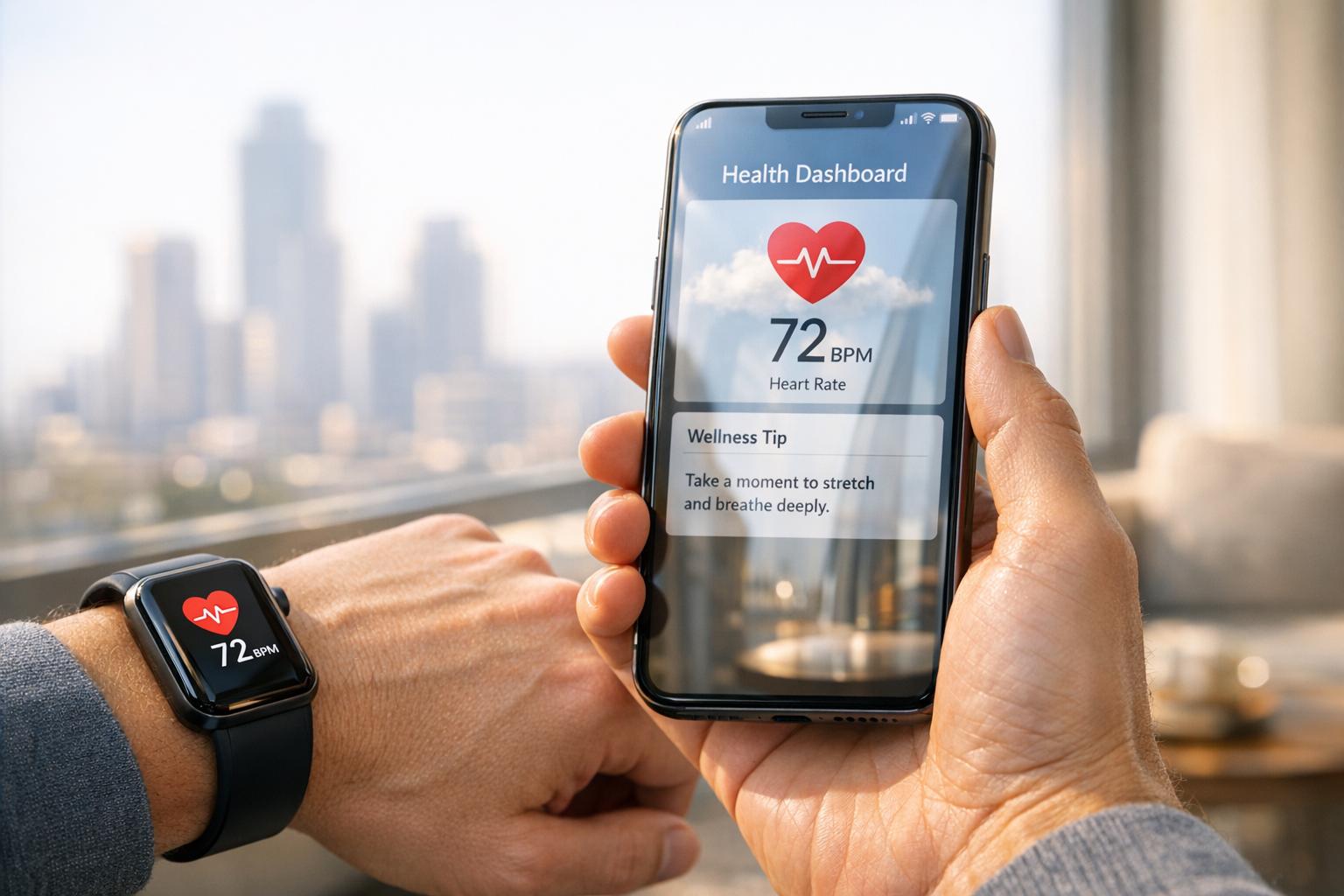
Wearable devices and cloud platforms are transforming health monitoring by working together to provide real-time data analysis and actionable insights. Wearables collect physiological data like heart rate, ECG, and sleep patterns, while cloud platforms process this information using AI and machine learning. This collaboration enables early detection of health issues, personalized recommendations, and proactive care.
Key points:
- Wearables: Collect real-time health data and process it locally for immediate feedback.
- Cloud Platforms: Analyze large-scale data, identify patterns, and provide long-term insights. This includes establishing biometric benchmarks for personalized health tracking.
- Privacy & Security: Both systems use encryption and secure protocols to protect sensitive health data.
- Applications: Tools like Healify combine wearable data with lifestyle metrics to offer tailored health advice.
This synergy is reshaping how we manage health, making it more predictive and user-focused.
1. Wearable Devices
Data Processing
Modern wearable devices are powerhouses when it comes to processing health data. Thanks to on-device AI, these gadgets can analyze data directly without needing to rely on cloud servers. For instance, inertial sensors in wearables can generate readings at a frequency of 50–200 Hz, and with a user base of 1 million, that adds up to a staggering 43 billion data samples per day [4]. By handling this data locally, wearables reduce delays, making the system more responsive. This is especially critical for real-time alerts, such as detecting falls or irregular heart rhythms.
This real-time processing capability also paves the way for context-aware AI that provides more tailored and immediate insights.
Personalization
Wearables don't just collect data - they learn from it. On-device AI uses baseline learning to understand your personal metrics, such as your resting heart rate, sleep patterns, and body temperature. Once these "normal" baselines are established, the device can identify deviations and provide insights tailored specifically to you [5].
"Edge AI allows your wearable device to provide you with feedback without first consulting the cloud server for instructions. It already has what it needs." [5]
Apps like Healify take this a step further by combining wearable data with other health metrics. Their AI coach, Anna, delivers personalized action plans based on your unique health profile.
Health Monitoring Capabilities
Today’s wearables do much more than count steps. They monitor a wide range of metrics like heart rate, ECG, oxygen saturation (SpO₂), respiratory rate, skin temperature, and sleep cycles. Cutting-edge devices are even equipped with EEG sensors to track brain activity and detect neurological issues such as epilepsy [2].
In a practical example, the UK's NHS has adopted smartwatches to monitor atrial fibrillation and heart failure in elderly patients, demonstrating how wearables are now playing a role in clinical care [2].
Data collected by these devices is transferred to smartphones via Bluetooth Low Energy (BLE) and then uploaded to the cloud using secure protocols like MQTT or HTTPS [4][6]. This seamless data pipeline supports continuous, real-time health monitoring, enabling proactive interventions instead of waiting for issues to arise.
Privacy and Security
With such sensitive data at stake, wearables are designed with robust security measures to protect your information. Data in transit is encrypted using AES-256 and TLS 1.3 protocols [4][7]. Additionally, secure boot processes and firmware signing ensure that only verified software can run on the device, preventing unauthorized modifications [1][4].
On the AI side, federated learning ensures that models are trained across devices without needing to centralize raw data, offering a privacy-first approach [2]. When choosing a wearable, users should prioritize devices and apps that clearly explain what data they collect, how long they keep it, and ensure that only clinically relevant information is shared [1].
sbb-itb-f5765c6
Healthcare IoT: Wearables & Remote Patient Monitoring Explained | Internet of Things
2. Cloud Platforms
Wearables may collect vital data on the go, but it's the cloud platforms that bring this information to life by analyzing it for deeper insights.
Data Processing
Wearable devices handle immediate tasks, but the heavy lifting happens in the cloud. Platforms like Microsoft Azure and Amazon Web Services (AWS) - which together dominate about 80% of the cloud market [11] - receive data from wearables through IoT hubs and gateways using secure protocols like MQTT and HTTPS. Once the data is in the cloud, it flows into streaming pipelines for real-time data analysis and batch pipelines for historical evaluations. Advanced AI and machine learning services work to filter out irrelevant data and identify meaningful patterns, such as early indicators of heart failure or irregular heart rhythms [10].
"The question isn't 'do we have data?' It's 'can we turn it into safe, actionable insight at the point of care?'" - Shailendra Singh, Master Principal Cloud Architect, Oracle [10]
This seamless collaboration between wearables and the cloud transforms raw data into actionable insights in real time.
Personalization
The cloud excels at piecing together information that individual devices can't. By combining data on sleep, heart rate, and physical activity, these platforms create a detailed view of a person’s health over time [9]. Apps like Healify use this aggregated data to offer tailored advice. For instance, its AI health coach, Anna, interprets raw data into daily action plans that align with how your body functions. These personalized insights empower users to take proactive steps to manage their health before problems arise.
"Think of the cloud as the reflective layer and the edge as the immediate support layer." - Maya Thornton, Senior Health Tech Editor, Emphasis.life [9]
Health Monitoring Capabilities
Cloud platforms are built to handle the massive data loads generated by millions of devices. Using microservices and container orchestration tools like Kubernetes, they can scale services automatically to adapt to fluctuating data volumes [11]. Real-time analytics can trigger alerts instantly if a vital sign crosses a critical threshold [10]. Additionally, cloud systems integrate wearable data with Electronic Health Records (EHRs) using standards like FHIR and HL7, providing a unified view of patient health [2].
Privacy and Security
When it comes to health data, cloud platforms offer a multi-layered approach to security:
- Data Plane: AES-256 encryption ensures data is protected both at rest and in transit.
- Control Plane: Zero Trust access controls limit who can access sensitive information.
- Evidence Plane: Immutable audit logs track all activities for accountability [12][8].
Device authentication relies on X.509 digital certificates and mutual TLS (mTLS), ensuring only verified devices can transmit data [11][1]. Platforms also adhere to HIPAA standards by enforcing strict access controls, encryption, detailed audit logs, and regular backups [11]. For users, practical tips include auditing app permissions and choosing platforms that clearly outline their data retention policies, offering easy options for exporting or deleting information [9].
Pros and Cons
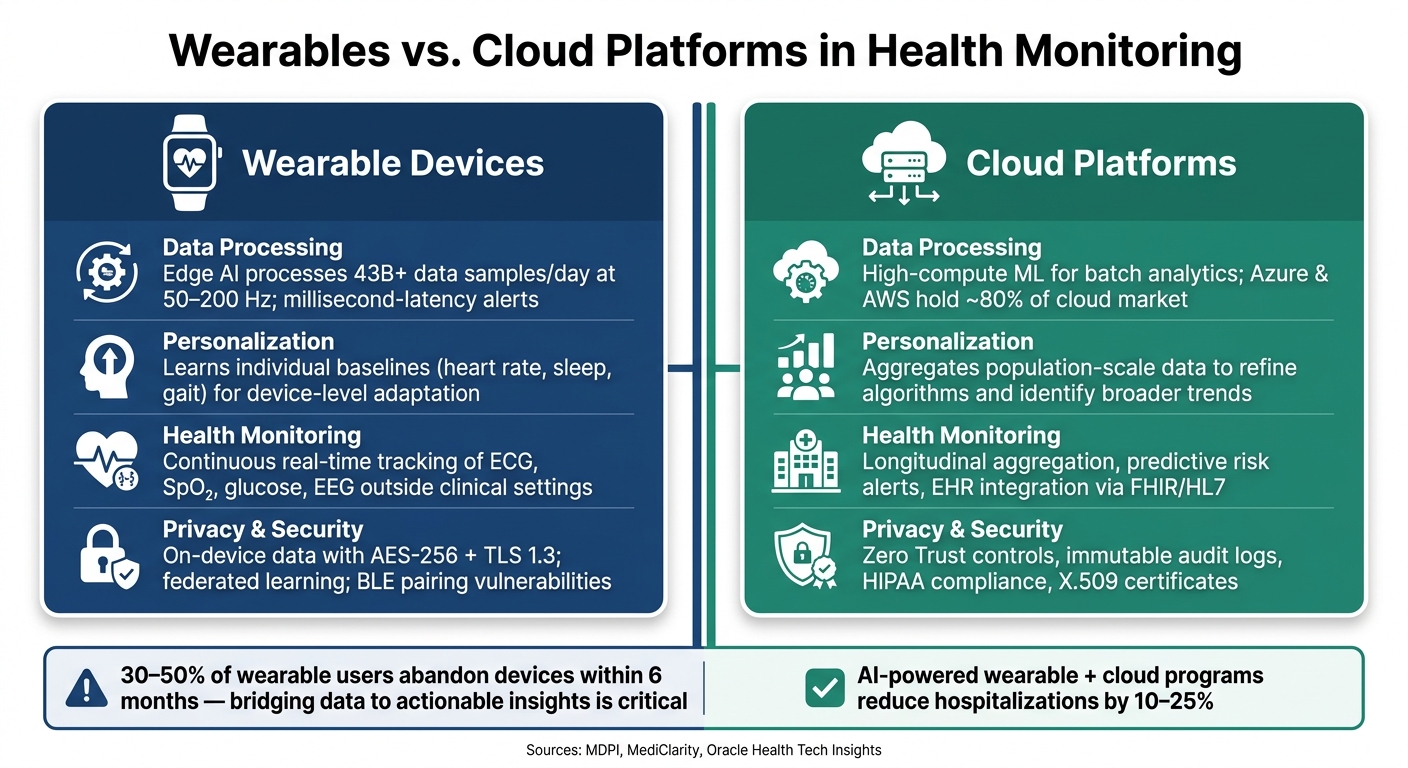
Wearables vs. Cloud Platforms: Health Monitoring Capabilities Compared
Wearable devices and cloud platforms each bring distinct advantages and challenges to the table when it comes to health monitoring and data processing. Let's break down their key features:
| Feature | Wearable Devices | Cloud Platforms |
|---|---|---|
| Data Processing | Handles low-latency edge processing for real-time tasks like artifact filtering and event triage [14] | Offers high-compute machine learning (ML) capabilities for batch analytics and population-level modeling [1] |
| Personalization | Adapts to individual baselines, such as resting heart rate, gait, and sleep patterns [14] | Leverages aggregated data from large populations to refine algorithms and identify broader trends [14] |
| Health Monitoring | Provides continuous, real-time tracking of vitals like ECG, SpO₂, and glucose, even outside clinical settings [2] | Excels in longitudinal data aggregation, predictive risk alerts, and centralized clinician dashboards [13] |
| Privacy & Security | Keeps data on-device but is susceptible to threats like Bluetooth Low Energy (BLE) pairing vulnerabilities [14] | Implements robust encryption, HIPAA compliance, and centralized audit trails, though data transmission over networks poses risks [13] |
Strengths and Limitations
Wearable devices shine in speed and personalization. Thanks to local edge AI, they can process signals in milliseconds, delivering immediate alerts when needed [14]. These devices also adapt to your unique baseline, making them more accurate for individual monitoring compared to population-based averages [14]. However, they come with some drawbacks, including variability in optical sensor accuracy (which can be affected by skin tone), algorithmic biases, and limited battery life that can hinder continuous tracking [14].
On the other hand, cloud platforms excel in their ability to analyze data on a larger scale. They provide insights into long-term trends and population-wide patterns, making them essential for predictive analytics and risk management. However, challenges like data siloing and a lack of interoperability between devices and electronic health records (EHRs) remain significant obstacles [3].
"Current digital health solutions remain fragmented. Data silos, lack of interoperability, and minimal integration of patient-reported outcomes (PROs) have limited their utility in holistic decision-making." - MDPI [3]
One promising solution lies in a hybrid approach that combines the strengths of both systems. For example, devices can handle real-time triage while cloud platforms manage long-term analysis. Apps like Healify illustrate this concept by turning wearable and biometric data into actionable, personalized health plans. This kind of integration bridges the gap between raw data collection and meaningful health insights, offering a more comprehensive approach to digital health.
Conclusion
Wearables become truly impactful when the data they collect is processed and interpreted through cloud platforms. While wearables gather continuous, real-time signals from your body, the cloud transforms this raw data into meaningful insights like long-term trends, predictive alerts, and personalized recommendations tailored specifically to you - not just general averages.
This approach is already delivering real-world results. Early adopters of AI-powered monitoring systems paired with care coordination have seen hospitalizations drop by 10% to 25% in chronic care programs [16]. In one pilot initiative, multimodal monitoring combined with AI-driven outreach cut hospital admissions by 18% within its first year [16]. These outcomes highlight a shift toward proactive, personalized healthcare, moving away from the traditional reactive model.
But for wearables to reach their full potential, raw data alone isn't enough. The gap between data collection and actionable guidance is significant, with 30% to 50% of wearable users ditching their devices within six months because the data doesn’t provide clear direction on what to do [15]. Bridging this gap demands systems that link biometric data to clinical insights and translate it into practical, easy-to-follow steps.
"The value isn't simply having more data - it's the wearable data analytics that emerge when biometric trends are interpreted alongside a patient's clinical history." - MediClarity [15]
FAQs
What should be processed on my wearable vs. in the cloud?
Wearable devices rely on a balance of speed, battery efficiency, and privacy to perform their tasks effectively. For real-time, critical operations - like detecting irregular heart rhythms - these devices use on-device Edge AI. This allows them to deliver immediate responses without delays.
Additionally, processing sensitive data locally on the device minimizes the need to transmit raw data, enhancing privacy. Meanwhile, more demanding tasks, such as long-term data storage, advanced machine learning, population-wide analysis, and tracking historical trends, are handled by cloud systems that offer greater processing power. This division ensures wearables remain efficient while meeting both performance and security needs.
How private is my health data when it’s synced to the cloud?
Your health data's privacy hinges on robust security measures. Opt for platforms that implement encryption (both at rest and in transit), maintain audit logs, and use role-based access controls to restrict access. Many modern systems handle sensitive tasks directly on your device, ensuring only necessary insights are shared with the cloud. Advanced methods like federated learning allow AI models to be trained without raw data ever leaving your device. Prioritize platforms that give you control over what you share, enabling you to disclose specific metrics while safeguarding your most sensitive information.
How can I turn wearable stats into clear daily actions?
To make sense of wearable data and turn it into practical advice, you need a system that goes beyond just numbers. Healify steps in by taking your biometrics, wearable data, and lifestyle habits and identifying meaningful patterns. With the help of AI, it compares your data to your personal health baseline. Then, through its always-available AI coach, Anna, it delivers straightforward, daily plans to help you improve areas like sleep, stress management, and fitness.