
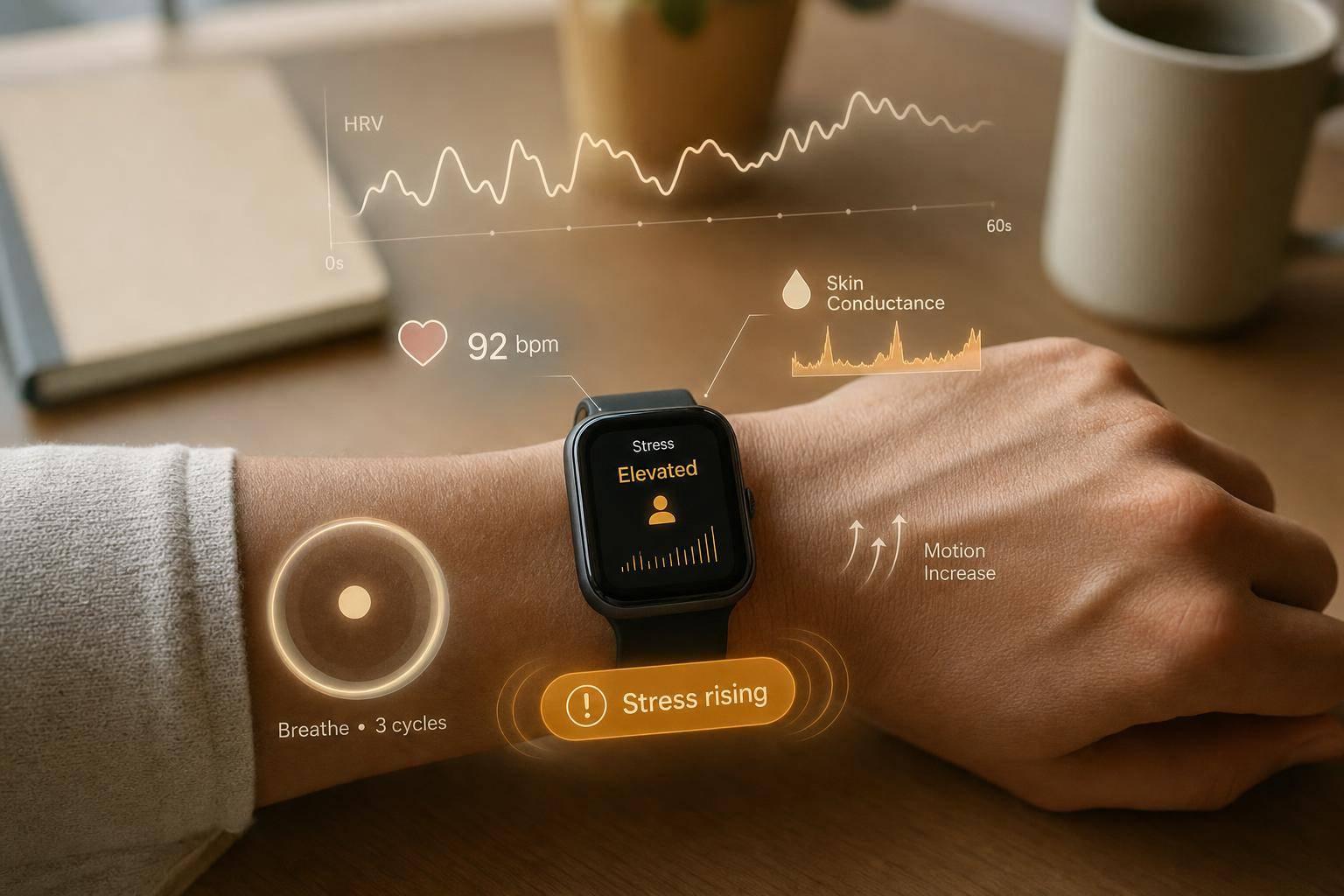
Stress alerts do one job: they tell me when my body looks strained before I fully notice it. They usually rely on heart rate, HRV, sleep, motion, and sometimes skin signals to spot a pattern that stays off long enough to matter.
Here’s the short version:
- Wearables collect body data all day
- The app checks that data against my normal range
- It waits for a pattern, not one random blip
- Then it sends a prompt so I can pause and reset
That matters because a short alert can stop a bad chain reaction: tense morning → low energy afternoon → poor sleep at night.
A few points stood out to me:
- Systems often use more than one signal at once, because no single metric can confirm stress by itself
- In studies, multi-signal systems have shown about 76% to 95% accuracy in controlled settings
- One study cited 84% accuracy when skin conductance and skin temperature were combined
- Some wearable models reported about 97% classification accuracy in research, though daily life is much messier
- Outside controlled settings, alerts are better at spotting a body-state shift than naming the cause
So I’d think about these alerts like this: they are an early warning, not a diagnosis.
When an alert shows up, my best move is simple:
- Pause for 1 to 3 minutes
- Check what I’m doing
- Use a short calming action, like slower breathing
- Look for patterns across the week, not just one alert
The main idea is simple: if I wear the device often, give it time to learn my baseline, and add a bit of context when alerts pop up, the alerts tend to become more useful over time.
Startup: Moment real-time stress detection from voice + HRV | NLP, wearables, just-in-time prompts
sbb-itb-f5765c6
What Signals a Stress Detection System Tracks
Stress Detection Signals: What Wearables Track & Why
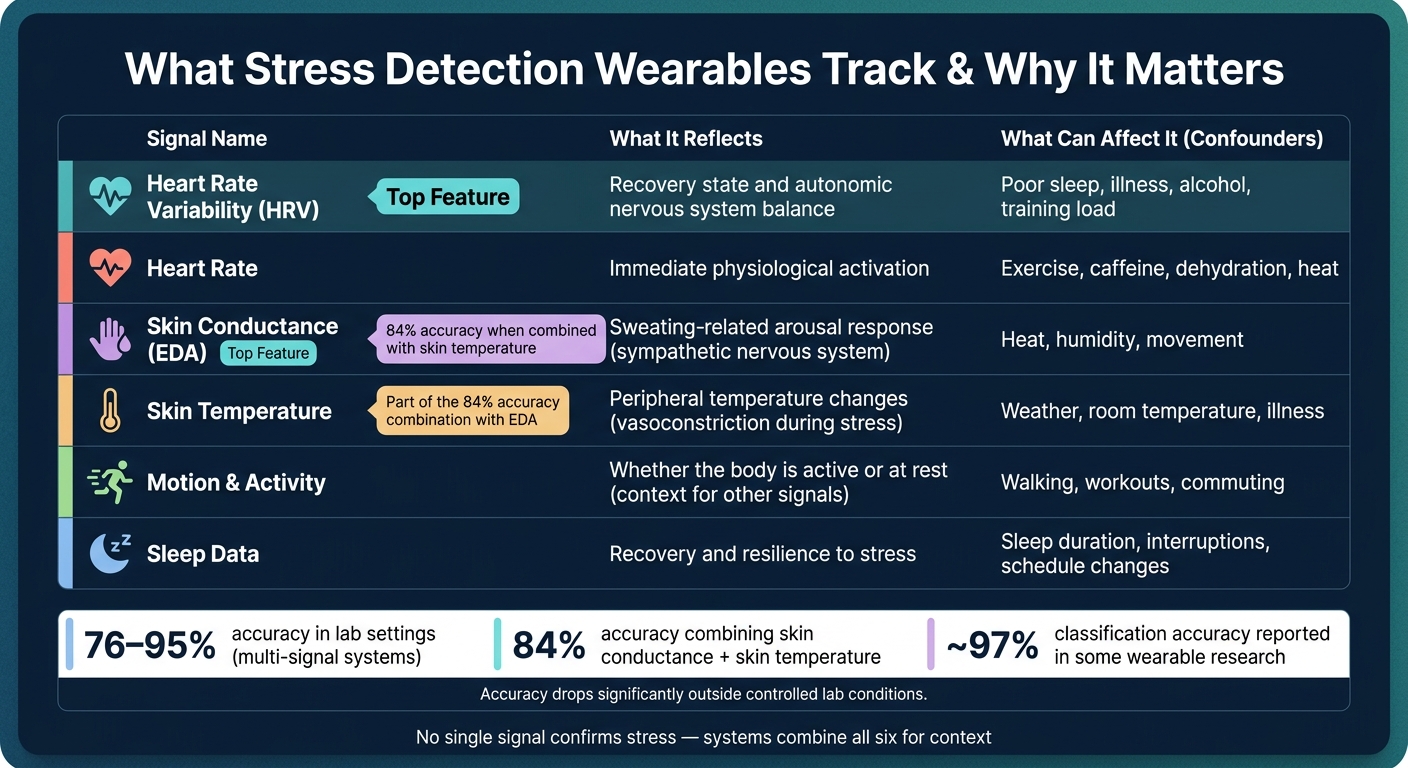
No single metric can prove stress on its own. Real-time systems look at several signals at once so they can read the situation with more context. That matters because each signal can shift for a different reason.
| Signal | What it reflects | What can affect it |
|---|---|---|
| Heart rate variability (HRV) | Recovery state and autonomic nervous system balance | Poor sleep, illness, alcohol, training load |
| Heart rate | Immediate physiological activation | Exercise, caffeine, dehydration, heat |
| Skin conductance | Sweating-related arousal response | Stress, heat, humidity, movement |
| Skin temperature | Peripheral temperature changes | Weather, room temperature, illness |
| Motion and activity | Whether the body is active or at rest | Walking, workouts, commuting |
| Sleep data | Recovery and resilience to stress | Sleep duration, interruptions, schedule changes |
Heart Rate Variability, Heart Rate, and Recovery Patterns
HRV in wearables measures the tiny changes in time between heartbeats. In plain English, it helps show how well your body is bouncing back. Higher HRV often points to better recovery. Lower HRV over several days can hint at poor sleep, illness, alcohol, or heavy training.
Heart rate adds another piece of the puzzle. It works with HRV as a real-time signal of physiological activation. If your resting heart rate is running higher than usual and your HRV is lower than normal, that tends to mean more than either number by itself. Patterns over time matter more than one random spike.
Skin Conductance, Skin Temperature, Motion, and Sleep Data
HRV is more about recovery. EDA is more about immediate arousal. Skin conductance, also called electrodermal activity (EDA), tracks sweat gland activity, which is directly controlled by the sympathetic nervous system. Sharp EDA peaks while you're at rest - especially when heart rate is also up - often point to acute stress or anxiety.[3][5] One wrist-device study found that combining skin conductance and skin temperature detected stress episodes with 84% accuracy.[7] But there's a catch: heat, humidity, and physical movement can all increase sweating too. So EDA only makes sense when the system reads it alongside other signals.
That’s where motion and skin temperature come in. Accelerometer data shows whether you're sitting still, walking, or in the middle of a workout. And that changes how the system should read everything else. A jump in heart rate means one thing on the couch and something else during a commute or training session.
Skin temperature adds another layer. During acute stress, peripheral vasoconstriction can lead to a slight temperature drop. On the other hand, a warm room or illness can push skin temperature higher. Sleep data helps frame all of this. Short sleep, frequent wake-ups, and irregular sleep schedules are consistently tied to lower HRV and stronger physiological reactivity the next day, which can lead to more alerts.[1][2]
How Raw Data Becomes a Real-Time Stress Alert
After the wearable collects the data, it cleans the signal, checks it against your usual pattern, and sends an alert if the pattern points to stress. These AI nudges for better health might arrive as a vibration, a sound, or a notification on the screen.
Signal Processing and Feature Extraction
Before the system can judge stress, it has to remove sensor noise. A sudden wrist movement, a loose strap, or weak sensor contact can distort heart rate or skin conductance readings even when stress has nothing to do with it. To deal with that, the system uses filtering and smoothing, then passes along only the readings that clear quality checks.[8][9] In short, only clean signals move on.
From there, the device pulls out features from the cleaned data. These are summary measures that show what’s changing. For HRV, that might be a short-term measure like RMSSD or SDNN over a recent window. For heart rate, it looks at how far the current reading sits above your resting baseline. For skin conductance, it may track the overall level plus the number or size of quick response peaks. The goal is simple: spot a stress pattern that lasts long enough to matter.
Personal Baselines, Thresholds, and Time Windows
Once the signal is clean, the system compares it with your normal pattern. Fixed cutoffs like HRV below 40 ms don’t work very well, because one person’s usual HRV can look like another person’s stress state. So instead of relying on one hard number, these systems compare current readings with your own baseline across days and weeks. Then they flag meaningful changes, like a clear drop in HRV paired with a rise in heart rate above your normal range.[8][9][10]
Time matters too. The system usually looks for change that holds over a set period instead of reacting to a single jump.[8][9] For example, if you stand up fast or get startled, your heart rate can spike and HRV can dip for a moment. But that fades quickly. That’s why many systems wait for several signals to stay off at the same time. It’s one of the main ways they cut down on false alarms.
Machine Learning and Rule-Based Detection
If the pattern is still murky, the model makes the final call. Rule-based systems use clear conditions set by experts. For example, if HRV is below baseline, heart rate is above baseline, and motion stays low for several minutes, the system may flag probable stress. The big upside is that these rules are easy to explain.
Machine learning models look at the data in a broader way. They’re trained on labeled data from stress studies and user feedback, so they can spot more complicated signal patterns, including cases simple rules might miss. Research using gradient boosting classifiers on wearable data has reported accuracy around 97% for stress vs. non-stress classification, with HRV and EDA identified as the top contributing features.[4] In practice, many systems mix both methods. Rule-based filters screen out obvious cases like hard exercise, while a machine learning layer handles the gray area in the middle. That setup helps reduce false alarms during exercise and improves detection of lower-level stress.
What Happens After an Alert and How to Respond
Once a stress pattern is flagged, the goal is simple: break the pattern fast without piling on more strain. The alert is there to interrupt your routine for a moment and push you to check what’s going on.
Notifications, Vibration, and Event Logging
When the system detects a stress pattern, it sends a prompt meant to cut into the moment and trigger a response. Some tools use a short vibration with an on-screen warning. Low alerts stay quiet, moderate alerts add vibration, and high alerts repeat or intensify the warning.
Many systems also log the event on their own, saving the timestamp, heart rate, HRV for resilience, activity state, and surrounding context.[12][15][17][18] When you look back at a week of alerts, patterns often start to show up. Maybe it’s the same time each day, the same kind of meeting, or the same commute route. Those logs also make later alerts easier to read.
How to Act on an Alert Right Away
Pause for 1 to 3 minutes. Then check the context. Were you in a tense meeting? Stuck in traffic? That quick check helps you tell the difference between a meaningful signal and a false alarm caused by movement or exercise.
From there, the response depends on where you are. The flow is straightforward: pause → check context → breathe or cut stimulation → resume.
- Work: slow your breathing, relax your shoulders, and mute nonurgent notifications for 10 to 15 minutes.[13][16][17]
- Driving: lengthen your exhale and keep your attention on the road.
- Home: step into a quieter space and drink water.[13][14][16]
For moderate and high alerts, slow diaphragmatic breathing has the strongest support as an immediate response. A set pattern, like a 4-second inhale, 7-second hold, and 8-second exhale, can help settle the stress response.[11][13] In many cases, 2 to 5 minutes of this kind of breathing is enough to shift your physiology in a measurable way.[11][17]
Using Healify to Turn Alerts into Action
Healify turns alert data into a next step, with Anna helping you read the signal and pick a fast recovery action. That makes it easier to spot which alerts are useful and which ones need more context.
Accuracy Limits, Best Practices, and Key Takeaways
What Affects Accuracy in Daily Life
After an alert goes off, the obvious question is: how much should you trust it?
In lab settings, systems that combine several signals land at about 76–95% accuracy[22][26]. But day-to-day life is messier, and performance tends to drop outside controlled conditions. In a 657-person Garmin study, HRV tracked stress less well in daily use, and a 2025 commentary found that wearable HRV explained only about 1–2% of daily self-reported stress[23][25].
That doesn't mean alerts are useless. It means they work best as support signals, not final answers.
Part of the issue is that the same body signals can show up for many reasons. Exercise, heat, illness, caffeine, excitement, and motion artifacts can all push the data in a similar direction[23][24][27].
So in plain English: these alerts are usually better at noticing shifts in your body state than telling you why it happened.
| More reliable detection | Still needs human interpretation |
|---|---|
| Sustained elevated heart rate versus personal baseline | Whether the cause is emotional stress, exercise, or illness |
| Reduced HRV trends over time | How severe the stress feels to the person |
| Repeated spikes at rest | What specific event triggered the response |
| Poor recovery signals after short or fragmented sleep | What action is best in that moment |
How to Get More Useful Alerts Over Time
If you want better alerts, feed the system better data. The biggest driver here is consistent wear.
Stress detection models build a personal baseline from resting heart rate, HRV, and sleep patterns. If you wear the device most of the day and night for several weeks, it has a much better shot at learning what normal looks like for you and spotting changes tied to stress[19][21].
It also helps to keep sleep and activity data synced. That gives the app more context, so it's less likely to confuse a workout with a stress spike.
When an alert pops up, take about 30 seconds and jot down what was happening: a meeting, a commute, a cup of coffee. It sounds small, but those notes can add up fast. After a few weeks, patterns often start to show. You may notice that certain situations push your physiology in the same direction again and again.
Weekly trend reviews also tend to be more useful than reacting to every single alert[20][6]. One alert can be noise. A repeated pattern is where things start to get interesting.
Conclusion: The Simplest Way to Think About Stress Alerts
Real-time stress alerts track body signals, compare them with your baseline, and nudge you when that pattern shifts. The simplest way to use them is to treat them as an early warning cue, not a diagnosis.
FAQs
How long does it take to learn my baseline?
Healify usually needs about one month of steady wearable data to learn your physiological baseline. It looks at signals like heart rate, skin temperature, and sweat levels to map out what’s normal for your body.
During that period, the system keeps fine-tuning that baseline. That way, later stress alerts and insights feel more personal and land with better accuracy.
Why do I get stress alerts when I don’t feel stressed?
Stress alerts can pop up even when you feel calm. That’s because your body often reacts before your mind catches up.
For example, Healify may pick up small shifts in HRV or skin conductivity that point to stress before you consciously notice anything.
At the same time, not every alert means emotional stress. Some signals can look the same physically, including:
- Exercise
- Illness
- Caffeine
- Excitement
Over time, Healify learns your personal baseline. It also uses movement and sleep data to cut down on false alarms and improve accuracy.
What should I do if I get frequent alerts?
If you get stress alerts often, don’t brush them off. They can be helpful signs that point to what’s setting you off. When an alert shows up, try the guided breathing or mindfulness session your device suggests. It can help take the edge off in the moment.
Since these systems rely on your personal baseline, repeated alerts can signal that your stress levels are landing outside your usual range on a regular basis. Check your long-term trends in the app, then use your AI coach to fine-tune your recovery plan.