

Chronic diseases like diabetes, heart disease, and obesity are killing over a million Americans every year. Poor diets, driven by limited access to nutritious foods, are a major cause. Many people live in areas where healthy options are either unavailable or unaffordable, leading to reliance on processed, unhealthy foods. These issues are worse in low-income and minority communities, where historical factors like redlining have created "food deserts" and "food swamps."
Key points:
- Food deserts: Areas with no access to grocery stores within 1 mile (urban) or 10 miles (rural).
- Food swamps: Areas with an oversupply of fast food and convenience stores.
- Health impact: Poor food access increases rates of cardiovascular disease, diabetes, and obesity.
Solutions include expanding federal programs like SNAP, creating local food initiatives, and integrating nutrition into healthcare through programs like produce prescriptions. On a personal level, small changes - like choosing nutrient-rich staples at dollar stores or using apps for meal planning or AI nutrition tools - can make a difference. Fixing food access requires action from policymakers, healthcare providers, and communities to reduce health disparities and improve outcomes through exercise.
Food Deserts and Metabolic Disease : Tackling Structural Health Inequality in Modern Communities
sbb-itb-f5765c6
The Problem: Why Healthy Food Is Hard to Access
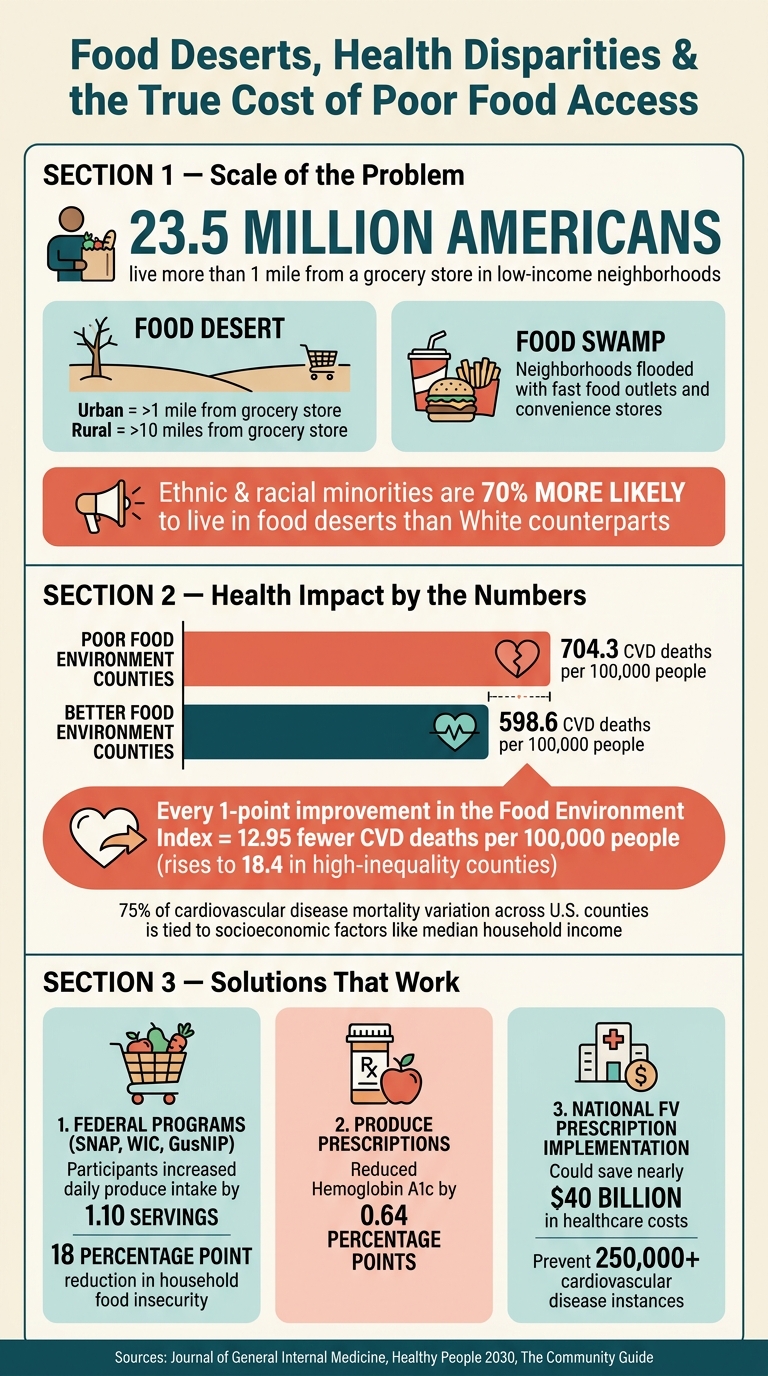
Food Deserts, Health Disparities & the True Cost of Poor Food Access
Millions of Americans face challenges in maintaining a healthy diet - not because they lack the willpower, but because nutritious food simply isn't available where they live. To truly grasp this issue, we need to shift focus from individual choices to the broader environment. This is where terms like food deserts and food swamps come into play.
Food Deserts and Food Swamps
The problem of food access boils down to two critical concepts: food deserts and food swamps.
- A food desert refers to low-income areas where residents live more than 1 mile from a grocery store in urban areas or more than 10 miles away in rural settings [2].
- On the other hand, a food swamp describes neighborhoods that are flooded with fast-food outlets and convenience stores, making healthy options scarce by comparison [1].
In the U.S., about 23.5 million people in low-income neighborhoods live more than a mile from a full-service grocery store [1]. And the issue is far from evenly distributed - ethnic and racial minorities are 70% more likely to live in food deserts than their White counterparts [4]. This disparity is rooted in historical factors like redlining and segregation, which have left predominantly Black and Hispanic communities with fewer supermarkets and more limited access to affordable, nutritious food options [1][4].
How Poor Food Access Harms Health
The lack of healthy food options has a direct and devastating impact on health. A 2023 study of 2,615 U.S. counties revealed that counties with the least healthy food environments reported 704.3 cardiovascular disease (CVD) deaths per 100,000 people, compared to just 598.6 per 100,000 in areas with better food environments [2].
Even small improvements in food access can save lives. For example, every one-point increase in the Food Environment Index correlates with 12.95 fewer CVD deaths per 100,000 people - a number that rises to 18.4 in counties with high income inequality [2].
"Food insecurity may increase CVD risk by activating the stress response, triggering harmful coping behaviors, medication nonadherence, and reduced ability to manage chronic conditions through adherence monitoring." - Journal of General Internal Medicine [2]
Communities already struggling economically bear the brunt of this health crisis, underscoring the deep connection between food access and health equity [2].
Daily Struggles for Families in Underserved Areas
For families in underserved neighborhoods, the struggle to access healthy food is both constant and exhausting. Without reliable transportation, a trip to a full-service grocery store can turn into an hours-long ordeal - something that’s nearly impossible to manage during a busy weekday. In these areas, corner stores and dollar stores often become the only nearby options, forcing families to pay a "poverty premium" - spending more money on less nutritious food [1].
Even when fresh produce is available in smaller markets, it’s often priced higher than at large chain supermarkets. This leaves families with little choice but to rely on inexpensive, calorie-dense, nutrient-poor foods.
"Residents of neighborhoods with fewer fresh produce sources and plentiful fast-food restaurants and convenience stores were at a higher risk of obesity and diabetes." - Healthy People 2030 [1]
The daily reality for these families is a stark reminder of how a lack of access to healthy food perpetuates cycles of poor health and economic hardship.
System-Level Solutions: Fixing Food Access Inequality
Addressing food access inequality goes beyond individual efforts - it requires tackling systemic barriers that limit access to healthy food. Solutions need to focus on federal policies, local initiatives, and healthcare strategies that make nutritious food both affordable and accessible. By combining these approaches, communities can take meaningful steps toward better food access for everyone.
Federal Nutrition Programs and Local Food Initiatives
Programs like SNAP, WIC, and GusNIP play a critical role in improving food access. These initiatives offer funding for produce prescriptions and incentives, helping low-income families afford fresh fruits and vegetables. Research shows that participants in these programs increased their daily produce intake by 1.10 servings and saw an 18 percentage point reduction in household food insecurity [6].
"The Community Preventive Services Task Force (CPSTF) recommends fruit and vegetable incentive (FVI) programs for households with lower incomes based on strong evidence of effectiveness in reducing household food insecurity and increasing household fruit and vegetable consumption." - The Community Guide [6]
Incentive programs use various models, such as point-of-sale discounts, dollar-for-dollar matches, or cash-back rebates. While the methods differ, the objective is clear: making healthy food choices more affordable [6].
Building Healthier Food Environments at the Community Level
Federal programs are most effective when paired with local solutions. Community-driven efforts like mobile markets, school-based food distribution, and farmers markets with built-in incentive programs address both financial and geographical access issues. Food Policy Councils also bring together stakeholders from food banks, local governments, and community organizations to create environments where healthier food options are within reach.
Connecting Healthcare to Food Access
Healthcare systems can play a pivotal role in addressing food access challenges. The Food is Medicine movement, for instance, integrates food insecurity screenings into healthcare, linking patients to free or low-cost produce. "Closed-loop" referral systems ensure patients not only receive recommendations but also access the resources they need, with support from Registered Dietitian Nutritionists (RDNs) and Community Health Workers (CHWs) [5]. Produce prescription programs are particularly impactful, reducing Hemoglobin A1c levels by 0.64 percentage points [6].
"National implementation of FV prescriptions could save nearly 40 billion dollars in healthcare costs and prevent over 250,000 cardiovascular disease instances." - Journal of General Internal Medicine [5]
Practical Steps for Eating Healthier with Limited Food Access
While addressing systemic issues takes time, there are immediate steps you can take to improve your diet, even if you don't have access to a full-service grocery store. These personal strategies work alongside broader efforts to expand food access.
Smarter Choices at Convenience and Dollar Stores
Convenience and dollar stores often stock items that can support a balanced diet. Look for staples like canned beans, peanut butter, oatmeal, canned tuna, and low-sodium, shelf-stable soups. Frozen vegetables are another excellent option - they retain most of their nutrients and are just as beneficial as fresh produce. When shopping, check labels for shorter ingredient lists and lower sodium levels. Opt for water or unsweetened drinks instead of sugary sodas.
If you’re a SNAP recipient, programs such as Double Up Food Bucks can stretch your budget further by matching your fruit and vegetable purchases dollar-for-dollar at participating retailers [7]. Check if your local store or farmers market is part of this program.
Eating Well Without Overspending
You can create nutritious meals on a tight budget by focusing on affordable, nutrient-rich staples. Dried or canned beans, lentils, brown rice, oats, and frozen vegetables provide essential nutrients without breaking the bank. Cooking in batches - soups, grain salads, or bean stews, for example - saves both time and money.
When selecting packaged foods, pay attention to fiber, protein, and sodium content. Some low-calorie options are loaded with sodium or added sugars, which can increase the risk of chronic illnesses. Aim for products with simpler ingredient lists to make healthier choices.
Leveraging Technology for Personalized Nutrition Support
Technology can be a powerful ally in making healthier food choices, especially when fresh options are limited. Tools powered by AI can help you create meal plans tailored to your health needs, dietary restrictions, and budget. Registered Dietitian Liz Weiss, MS, RDN, explains it well:
"Think of AI as your kitchen assistant: fast, creative, and handy for brainstorming. But when you need precision... nutrition apps and professional guidance are essential." [8]
Apps like Healify go a step further by integrating your health data into their recommendations. Its AI health coach, Anna, analyzes wearables, biometrics, and lifestyle habits to provide personalized advice. For those managing conditions like diabetes or high blood pressure, this real-time, data-driven support can make daily food choices much easier and more effective.
Conclusion: Collaborative Action to Prevent Chronic Disease
Chronic disease stems from a mix of systemic and environmental factors. For example, nearly 75% of the variation in cardiovascular disease mortality across U.S. counties is tied to socioeconomic factors like median household income [2]. This stark statistic underscores the need for bold, multi-layered solutions.
Real change starts with action across various levels. Policymakers can expand programs like SNAP and GusNIP, incentivize supermarkets to open in underserved areas, and fund "Food Is Medicine" initiatives through Medicaid. Healthcare providers play a critical role by screening patients for food insecurity and connecting them to local resources. Meanwhile, community leaders can establish farmers' markets, build community gardens, and involve individuals with lived experience when designing food programs. This ensures that practical barriers - such as transportation or lack of cooking tools - are addressed [3].
"The toll of diet-related chronic conditions is not distributed equally and is a result of a complex web of factors that also contribute to differences in health outcomes." - ODPHP [3]
Beyond systemic reforms, personal actions also make a difference. Simple steps like choosing nutrient-rich foods, using incentive programs, or engaging in community support networks can lead to measurable health benefits. As highlighted throughout this article, AI health coaching offers powerful tools to bridge gaps in food access and health outcomes. Digital platforms like Healify use AI-driven health coaching to turn personal data into practical strategies, seamlessly connecting individual efforts with broader systemic changes.
"Addressing both income inequalities and food environments is crucial for promoting health equity and reducing health disparities." - Journal of General Internal Medicine [2]
Improving food access and reducing chronic disease risk is a long-term challenge. But each step - whether it’s a new policy, a community initiative, or a smarter personal decision - moves us closer to better health outcomes. An integrated approach is the only way to create lasting change.
FAQs
Am I in a food desert or a food swamp?
A food desert refers to a place where affordable and nutritious food is hard to come by, usually because grocery stores or supermarkets are too far away. On the other hand, a food swamp is an area where healthy food is available, but it’s outnumbered by fast-food restaurants and convenience stores. To figure out which one applies to your neighborhood, think about whether healthy food options are simply unavailable or if they’re drowned out by less healthy choices nearby.
What’s the fastest way to eat healthier with only dollar stores nearby?
To make healthier choices at dollar stores, prioritize affordable and nutritious options like low-sodium canned vegetables, dried beans, whole grains, and milk or plant-based alternatives. If fresh produce is available, add it to your cart. Stay away from overly processed snacks and sugary drinks. Plan simple meals, such as vegetable stir-fries, bean soups, or oatmeal topped with fruit. With dollar stores expanding their selections, crafting healthy and budget-friendly meals has become more convenient.
How can my doctor help with food access?
Your doctor can play a key role in improving your access to nutritious food. They might screen for food insecurity and connect you with helpful resources like food banks, local pantries, or community programs. Some doctors even prescribe fruits and vegetables, refer patients to nutritionists, or suggest medically tailored meal plans. With many healthcare systems now including nutrition services as part of their care, it’s becoming easier to address food access challenges and promote healthier eating habits.