
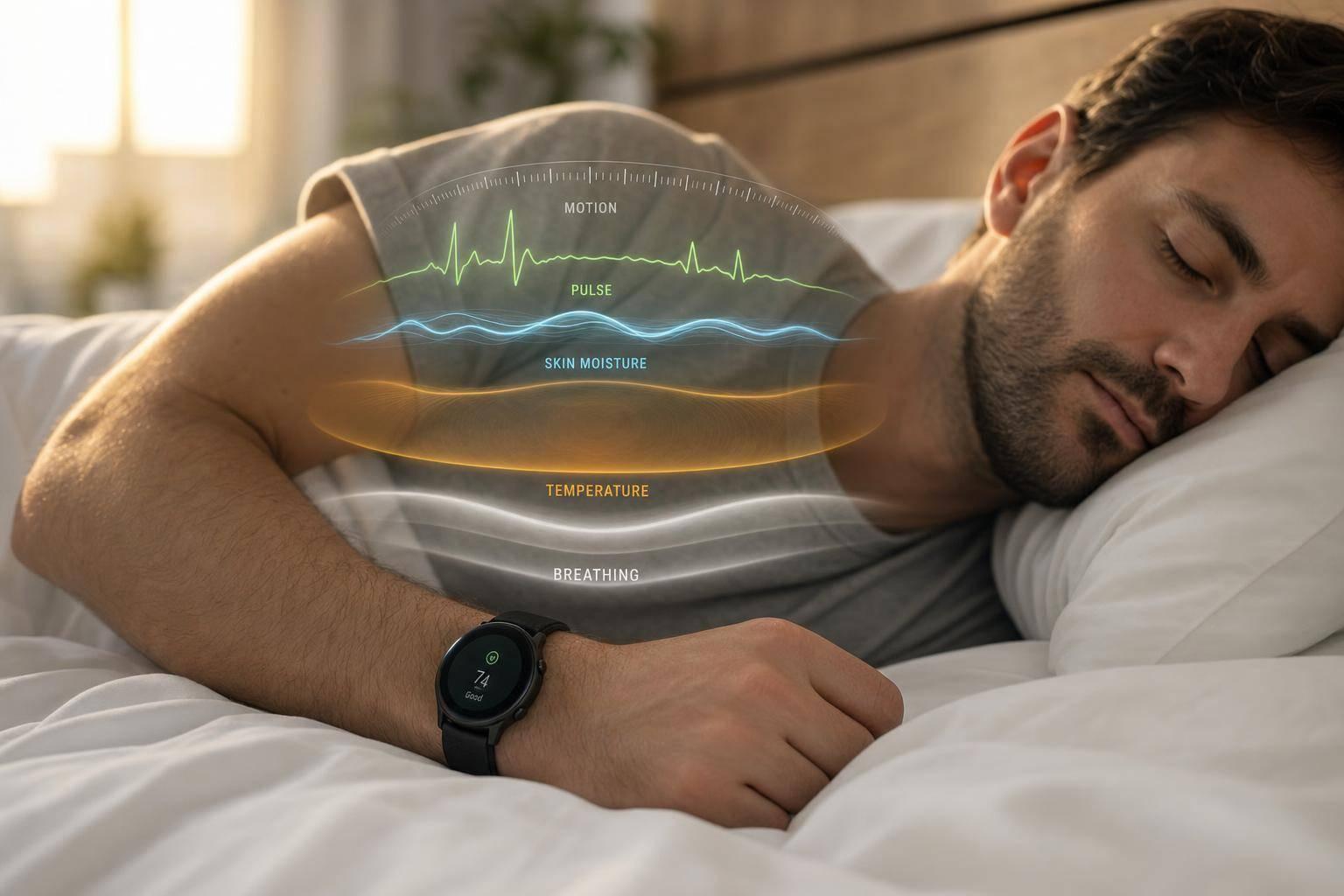
If you want better sleep and stress tracking, one sensor usually isn’t enough. In the article, I show that motion-only wearables often miss quiet wakefulness, heart-rate-only tools often confuse stress with exercise, and fused systems do a better job by checking one body signal against another.
Here’s the short version:
- Accelerometer-only devices are fine for basic sleep/wake timing, but they often miss wake periods and can overcount sleep compared to polysomnography accuracy.
- Heart rate and HRV alone can show body strain, but they don’t explain whether the cause is stress, movement, or recovery.
- ACC + PPG helps separate low-motion stress from high-motion exercise and improves sleep staging more than motion alone.
- EDA + HRV improves stress detection because sweat response and autonomic changes often move in opposite directions during stress.
- Temperature + respiration add slower body changes that help sort sleep stages and stress patterns.
- Fused data + self-reports make coaching more useful because the system can compare body signals with how you say you feel.
A few numbers from the article make the point fast:
- Accelerometer-only sleep/wake models can hit 94% accuracy, but wake specificity may be just 34% to 63%.
- For 4-stage sleep classification, accelerometer-only models reached 57%, versus 79% when more body features were added.
- HRV-only stress models were reported at about 91.79% accuracy, while EDA + HRV reached up to 98.6%.
- A multimodal stress setup using more sensor channels improved F1 score from 0.308 to 0.767.
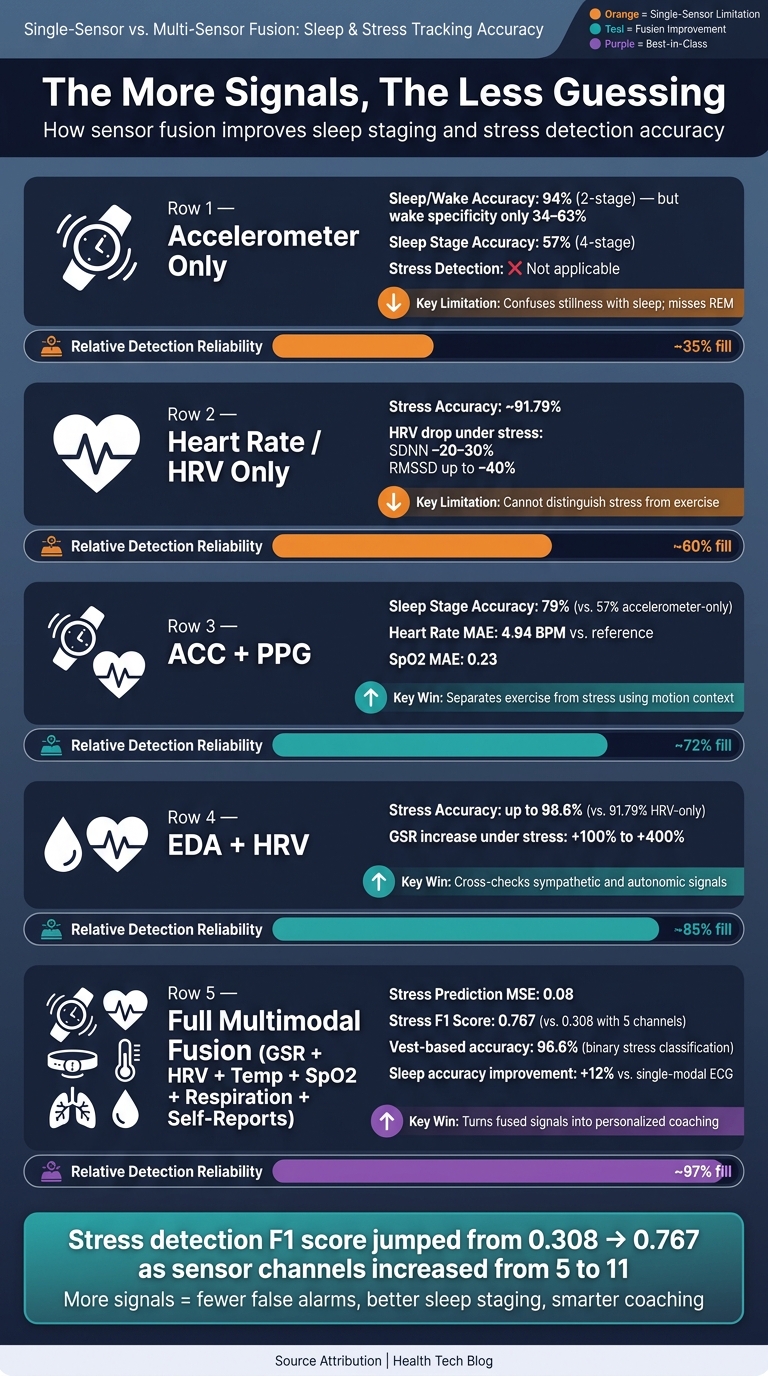
Single-Sensor vs. Multi-Sensor Fusion: Sleep & Stress Tracking Accuracy
Quick Comparison
| System | Main Use | Main Limitation | What Fusion Fixes |
|---|---|---|---|
| Accelerometer-only | Sleep/wake timing | Confuses stillness with sleep | Adds body-state context |
| Heart rate / HRV-only | Recovery and strain tracking | Can’t tell stress from movement | Adds motion, sweat, temp, breathing |
| ACC + PPG | Sleep + motion-aware stress | Limited sleep-stage detail | Filters noisy pulse data |
| EDA + HRV | Stress detection | Motion noise, no cause by itself | Cross-checks sympathetic and autonomic signals |
| Temp + respiration + other signals | Sleep staging and stress context | More setup and battery use | Adds slower body changes and breathing patterns |
| Fused data + coaching | Next-step guidance | Needs user input and data quality checks | Turns signals into advice |
So if I boil the whole article down to one idea, it’s this: the more body signals a wearable combines, the less it has to guess. That leads to fewer false stress flags, better sleep readouts, and coaching that is more useful in daily life.
sbb-itb-f5765c6
1. Single-sensor accelerometer-only sleep tracking
Accelerometer-only devices, often called actigraphs, use piezoelectric or MEMS accelerometers to turn movement into activity counts and then estimate sleep or wake states [4]. Devices like the Actiwatch Spectrum and ActiGraph GT3X+ work this way. It’s a useful starting point, but there are some hard limits.
Physiological limits
An accelerometer can detect stillness. It cannot measure sleep physiology.
So while it may estimate when someone fell asleep and when they woke up, it can’t tell light sleep from deep sleep or REM sleep. That gap matters. Motion by itself doesn’t show what the body is doing during sleep.
Accuracy limits
For basic sleep/wake detection, accelerometer-only models do fairly well on the surface, with about 94% accuracy for 2-stage classification [5]. But that top-line number needs context. A simple model that marks every epoch as sleep can still hit 88% accuracy because most of a sleep record is, in fact, sleep [4].
The bigger issue is wake detection. Specificity ranges from 34% to 63% across validated devices [4]. In plain English, these devices are much better at finding sleep than spotting wake. That high sensitivity can hide weak wake detection, which means total sleep time often gets overestimated [4].
The gap gets even clearer with 4-stage sleep classification. Accelerometer-only models reach 57% accuracy, compared with 79% when autonomic and circadian features are added [5].
The same problem shows up outside the lab too.
Common failure modes
Quiet wakefulness often gets marked as sleep. Restless sleep can get marked as wakefulness. If you’ve ever lain still in bed, fully awake, you can see the problem.
That usually leads to two errors [4]:
- Total sleep time is overestimated
- Sleep onset latency is underestimated
What it can and cannot tell you
For basic sleep timing, accelerometer data is a fair place to start. But without heart rate or respiration data, it cannot reliably identify REM sleep [6].
That’s why sleep coaching gets better when motion data is paired with body signals. Next, heart-rate data adds the autonomic context that motion alone misses.
2. Single-sensor heart-rate-only stress tracking
After motion-only sleep tracking, heart rate adds autonomic context. But on its own, it still doesn't tell the whole story. Heart rate shows that the body is reacting. It does not show what caused that reaction. BPM tells you the rate, not the reason.
For stress tracking, BPM alone is thin context. HRV is the stronger signal. That's why stress tracking gets better when heart rate is paired with other inputs.
Signal depth
HRV reflects autonomic balance and tends to drop under stress. Acute stress can reduce SDNN by 20–30% and RMSSD by up to 40% [1]. Chronic stress can also lead to steady HRV reductions of more than 25% [1].
Those changes matter. They can point to strain in the system. But without other signals, they still don't explain why the change happened.
Monitoring accuracy
In validation testing, wrist PPG measured heart rate within 4.94 BPM of reference devices. Even so, HRV and skin temperature showed a stronger link with stress than heart rate alone [1].
That difference is the whole point of adding more sensors. One signal can hint at strain. Multiple signals help sort out what's stress and what's something else.
Motion sensitivity
PPG heart-rate sensors are sensitive to motion, light, and noise. So accuracy drops during activity, which is exactly when stress is hardest to separate from physical effort.
A spike in heart rate could mean stress. It could also mean you climbed a flight of stairs, rushed to catch a train, or just stood up too fast. That's the problem with relying on heart rate alone.
Best use case
Overnight HRV is usually the cleanest heart-rate signal because there are fewer movement artifacts and recovery trends are easier to follow. In plain English, sleep gives the sensor a quieter window.
For that reason, heart-rate data works best inside a fused model, not as a standalone stress score.
On its own, heart rate can flag strain. Fused sensors are needed to separate stress from motion and recovery.
3. Accelerometer + PPG wearable models
Pairing an accelerometer with a PPG sensor is the practical step up from motion-only sleep tracking and heart-rate-only stress tracking. One sensor fills in what the other misses. The accelerometer tracks movement and posture, while PPG adds heart rate, HRV, and blood oxygen data. Put them together, and you get motion context plus body-state signals. This is the first sensor combo that improves both sleep staging and stress detection at the same time.
What the pair adds
Motion context makes PPG data easier to trust. The accelerometer gives the physical context needed to interpret those biomarkers [7][6].
This combo also helps with sleep staging. An accelerometer can show that someone is still, but stillness by itself doesn't prove sleep. Adding PPG-derived HRV helps the system spot REM sleep, which has a distinct autonomic signature even when the body stays quiet [6].
Monitoring accuracy
In fused wrist-worn systems, heart-rate MAE was 4.94 BPM and SpO2 MAE was 0.23 versus reference devices [1]. For a wrist sensor, those results are strong.
Motion filtering
This is where sensor fusion does a lot of the heavy lifting. If the accelerometer picks up major movement, the system can flag or remove noisy PPG segments before they skew the final reading [7].
That matters because noisy signals can trigger false alarms and lead to alarm fatigue.
Signal Quality Indices (SQIs) help the system decide, in real time, whether a PPG reading is reliable enough to use [7].
Actionable insights
The biggest day-to-day win from fusing these two sensors is the ability to separate exercise from stress. High motion plus high heart rate usually points to exercise. Low motion plus high heart rate is more likely to point to stress [2]. That's a much more useful distinction than heart rate alone.
Even so, ACC + PPG still has trouble separating N1, N2, and N3 without EEG, and recovery scores can miss factors like caffeine, mood, and workload [6][1]. For finer sleep-stage separation and a fuller picture of stress, more biosignals are still needed.
4. EDA + HRV stress monitoring systems
ACC + PPG helps with motion-aware tracking. But EDA adds a piece that motion and pulse data can miss: the body's sympathetic response. EDA, measured as galvanic skin response (GSR), directly reflects sympathetic nervous system activity through sweat gland activation [1].
Complementary signals
EDA and HRV tend to move in opposite directions during stress. That's why combining them works so well.
Under stress, GSR can increase by 100% to 400% compared with resting levels. At the same time, SDNN can drop by 20% to 30%, and RMSSD can fall by up to 40% [1]. That contrast helps systems tell the difference between actual stress and plain signal noise better than either signal can on its own.
Monitoring accuracy
Comparative studies report about 91.79% accuracy for HRV-only models and up to 98.6% for EDA + HRV fusion [8]. Wrist-worn prototypes that also include skin temperature and SpO2 push stress prediction further [1].
The hard part isn't just detecting stress. It's keeping the signals clean when the person is moving.
Noise handling
Fusion can help filter out motion noise, especially in PPG-derived HRV [1]. That's a big deal for wearables, where walking, typing, or even small wrist movements can throw off the reading.
Actionable insights
A stress score by itself doesn't tell you what caused the stress [1][10]. That's the catch.
Passive signals tend to work better when they're paired with self-reports, because physiology alone can't explain why stress changed. In practice, fused stress data is most useful when it leads to some kind of coaching action instead of just showing a number on a screen.
Adding temperature and respiration takes these models past autonomic signals alone.
5. Multimodal wearables with temperature and respiration
EDA and HRV already say a lot about the autonomic nervous system. But when you add skin temperature and respiration, the picture gets much clearer. Those two signals fill in gaps that heart rate and sweat response can miss.
After EDA and HRV, temperature and respiration bring in slower, complementary signals that improve both stress context and sleep staging.
Signal depth
Skin temperature adds a slower, steadier stress signal that works well alongside HRV and respiration. During an acute stress event, wrist temperature can drop by 1 to 3 °C (about 2 to 5 °F) [1]. Respiration gives a more direct read on breathing rate and depth, both of which often shift under stress [1].
A study from Toronto Metropolitan University found that wrist temperature (r = −0.43) and HRV (r = 0.36) were the strongest stress features [1].
For sleep, respiration is especially helpful when separating NREM from REM sleep. That matters because accelerometers often struggle with that job [6].
Monitoring accuracy
When GSR, HRV, temperature, and SpO2 are fused, stress prediction reaches 0.08 MSE [1]. On the sleep side, combining ECG and respiratory signals improved overall accuracy by 12% compared with single-modal ECG methods alone [12].
That bump in performance depends on one thing: keeping those slower signals clean during movement.
Artifact resilience
Temperature is one of the more motion-resistant signals in a multimodal stack because it changes slowly. It is less sensitive to high-frequency motion jitter than PPG [1].
Respiration is more sensitive to movement, so it needs band-pass filtering and motion flags. IMU data from accelerometers and gyroscopes helps spot motion events, which lets the system filter out noisy windows instead of treating them like physiological shifts [9].
Actionable insights
Adding temperature to HRV sharpens stress detection by separating slow thermal change from short-term autonomic spikes [1]. Shallow breathing can point to anxiety-related stress that heart rate alone may miss [1][9]. Temperature can also run at low power and add context for intermittently sampled PPG or GSR [1].
That’s the edge over single-sensor tracking: the system can read stress and sleep context, not just isolated signals.
6. AI coaching platforms using fused wearable data, including Healify
Multimodal wearables can collect a lot of body data. But data by itself doesn't tell someone what to do next. That's where AI coaching platforms come in. They sit on top of wearable inputs and turn fused signals into advice a person can use. And that's the whole point: fusion only matters when it leads to a clear next step.
Signal depth
Mid-level fusion combines GSR, HRV, skin temperature, and SpO2 into a single stress score. Late fusion adds self-reports like PSS, GAD-7, and PHQ-9 [1]. That mix tends to improve stress estimates because it connects body signals with how people say they feel.
Healify uses that same basic idea. It combines wearable data, bloodwork, and lifestyle inputs so Anna can tailor stress and sleep guidance to the person in front of her.
Monitoring accuracy
One wrist-based system fused GSR, HRV, wrist temperature, and SpO2 with self-reported labels and reached an MSE of 0.08 for stress prediction with a 15-minute alignment window [1]. In that setup, wrist temperature and HRV carried the most weight. SpO2 helped less when looked at by itself [1].
That sounds good on paper. The harder question is whether those gains hold up during noisy day-to-day use, when people move around, forget devices, or wear them inconsistently.
Artifact resilience
Coaching systems used in daily life have to deal with missing or degraded data. Some frameworks can tolerate missing modality segments [11]. Others use self-consistency checks to steady predictions when signals shift around [13].
That matters for a simple reason: bad data leads to bad advice. So resilience isn't just an engineering issue. It's part of whether the coaching system can be trusted at all.
Power use matters too. Variable duty cycling can help save battery without losing useful data. For example, skin temperature can be sampled at 1 Hz during rest, while PPG and GSR sampling can increase during active survey completion [1].
Actionable insights
When passive sensor data is fused with active user input, predictions can line up more closely with how the user feels [1]. Healify puts that into practice by combining wearable data, bloodwork, and lifestyle patterns to deliver personalized stress-prevention and better-sleep guidance.
That's the shift that makes fused wearables matter in daily life: moving from sensing what's happening to giving guidance people can actually use.
Accuracy, Robustness, and Coaching: How the Methods Stack Up
The main gaps come down to accuracy, resistance to noise, and how well each setup helps with coaching.
On the WESAD dataset, a multimodal vest using ECG, EDA, EMG, respiration, and skin temperature reached 96.6% accuracy for binary stress classification [2]. A decision-level fusion of GSR and speech signals reached 92.47% accuracy for stress detection [2]. The trend is pretty clear: when systems combine more signals that measure different parts of the body or behavior, they tend to perform better and hold up better when one signal gets messy.
You can see that tradeoff more clearly here:
| Method | Sensors | Accuracy / Metric | Artifact Resilience | Actionability |
|---|---|---|---|---|
| Accelerometer + PPG | ACC + PPG | Improved motion filtering [3] | Activity gating reduces heart-rate errors [3] | Moderate - adds movement context |
| Fused stress | GSR + speech | 92.47% accuracy [2] | Combines physiological and behavioral cues [2] | High - more context-aware |
| Multimodal (wrist-worn) | GSR, HRV, temperature, SpO2 | 0.08 MSE for stress prediction [1] | Cross-references temperature and HRV to separate stress from exercise [14] | High - supports personalized thresholds [1] |
| Multimodal (vest) | ECG, EDA, EMG, respiration, temperature | 96.6% accuracy [2] | Redundant channels maintain signal integrity [6] | Very high - broad physiological coverage |
| AI coaching | Wearables + self-reports | Context-aware guidance [1] | Handles missing modalities [11] | Very high - matches user-reported stress more closely [1][11] |
Why does this matter in day-to-day use? Because fused systems don’t rely on a single shaky signal. They cross-check one stream against another. That’s how stress detection F1 score rose from 0.308 to 0.767 as sensor channels increased from 5 to 11 [3]. And when you add personalized thresholds, platforms like Healify can time sleep and stress interventions with better precision [1][11].
Pros and Cons
The tradeoff across these methods is pretty straightforward: more sensing gives you more context, but it also brings more cost and complexity. Wearable monitoring sits right in the middle of that tradeoff. A single sensor is cheaper and easier to wear day to day. A fused system can read the situation better, but it needs more power, more calibration work, and more processing.
Actigraphy works best for sleep/wake timing, not sleep staging. HRV adds a stronger signal for stress tracking, but it still doesn't tell you why the body is reacting that way. Fusion helps with interpretation, though it comes with extra calibration needs and higher power use.
The table below shows where each approach makes the most sense.
| Approach | Pros | Cons | Best Fit |
|---|---|---|---|
| Accelerometer-only | Low power, easy to wear | Poor REM/deep sleep precision; no stress context | Basic sleep/wake detection |
| Heart-rate-only (HRV) | Objective autonomic signal | Motion artifacts; missing cause context | Basic fitness and recovery |
| Multi-sensor fusion (wrist-worn) | High accuracy (MSE of 0.08 for stress) [1]; context-aware | Higher power draw; requires calibration | Sleep screening and chronic stress management |
| Multimodal (bio + self-reports) | Aligns objective data with subjective perception; reduces underreporting bias [1] | Requires active user input; higher complexity | Chronic stress management |
Conclusion
The comparison points to a simple pattern: more signals lead to more dependable sleep and stress insight. A single-sensor system misses part of the picture. A fused system fills in more of it. More sensors mean better context, and better context leads to fewer misclassifications.
That matters because single-sensor systems have to infer complex states - like REM or NREM sleep and acute stress - from just one signal. That’s a tough ask. Multi-sensor fusion cuts down that guesswork by combining movement, autonomic activity, skin temperature, and respiratory patterns, so each signal can check the others.
The same pattern shows up in stress detection. Fusion keeps beating single-sensor tracking. Single-sensor tracking is more likely to get thrown off by motion noise and false positives, especially in day-to-day use.
When you pair fused biometrics with self-reports, coaching becomes more aware of context. That’s the point where coaching starts to help instead of just describing what happened. Healify closes that gap by turning fused data into guidance - combining wearable, biomarker, and lifestyle data into personalized guidance through its AI coach, Anna.
So the practical choice comes down to what you want the wearable to do:
- Use single-sensor devices for basic sleep or step tracking.
- Use multimodal wearables for chronic stress or poor sleep.
- Use AI coaching when you want data turned into action.
The best system matches the depth of signal you need and turns that signal into action. The part many tools still miss is turning sensor data into clear next steps.
FAQs
Why does one sensor miss so much?
One sensor on its own can miss the bigger picture. A jump in heart rate, for example, doesn’t tell you much by itself. It could come from a workout, stress, or just a bad reading.
That’s where Healify comes in. By looking at multiple signals together, Healify can screen out glitches, patch missing data, and connect biomarker patterns to give you a clearer view of sleep, stress, and overall well-being.
Which sensor mix is best for stress?
The most effective sensor mix for stress monitoring uses more than one signal, not just a single data source. A solid starting point includes EDA, heart rate or HRV, and skin temperature.
That core setup gives you a better read on what’s going on in the body. For extra context, accelerometer data can track movement, which helps separate stress signals from physical activity. More advanced setups may also include ECG or EEG.
Healify brings these multimodal inputs together to deliver personalized, actionable stress insights.
Do I still need self-reports?
Self-reported questionnaires still have a place when you want to assess perceived stress. They help capture how a person feels in their own words, which matters.
The problem is simple: they can be burdensome and hard to use for continuous, real-time monitoring. Most people aren't going to stop throughout the day to fill out a questionnaire every time stress shifts.
That’s where multi-sensor fusion comes in. Tools like Healify use a non-invasive approach that looks at signals such as heart rate variability, skin temperature, and sleep patterns. Instead of depending on manual check-ins alone, the system reads patterns from the body as they happen.
When sensor data is combined with self-reports, the results can line up more closely with a person’s own sense of stress. At the same time, AI-driven systems can still deliver accurate, actionable insights without leaning only on manual input.