
If you eat late, your sleep is more likely to get broken up. Across the studies in this article, the clearest pattern is that eating close to bed is linked more with nighttime wake-ups, lower sleep efficiency, and longer time to fall asleep than with sleeping fewer total hours.
Here’s the short version:
- Eating within 3 hours of bedtime was linked to about 61% higher odds of nighttime awakenings
- Late-night snacking after 10:00 p.m. was tied to more than 2x the odds of low sleep efficiency
- People who skipped breakfast and ate at night had sleep efficiency around 77%, versus about 84%–85% in people who ate breakfast and avoided nighttime eating
- A common starting point is to finish dinner 2–3 hours before bed
- Earlier 8- to 10-hour eating windows may help sleep more than late eating windows, but results are mixed
- The evidence mostly shows links, not proof, because many studies are surveys or cross-sectional snapshots
In other words: if your sleep feels light, restless, or fragmented, meal timing is one of the first things I’d look at. Not just what you eat, but how late you eat, whether you skip breakfast, and whether a lot of your calories slide into the evening.
A few groups may need a different setup, including shift workers, athletes, people with GERD, and people managing blood sugar. But for most people, the simplest test is clear: eat earlier for 1–2 weeks, track your sleep with health data, and see what changes.
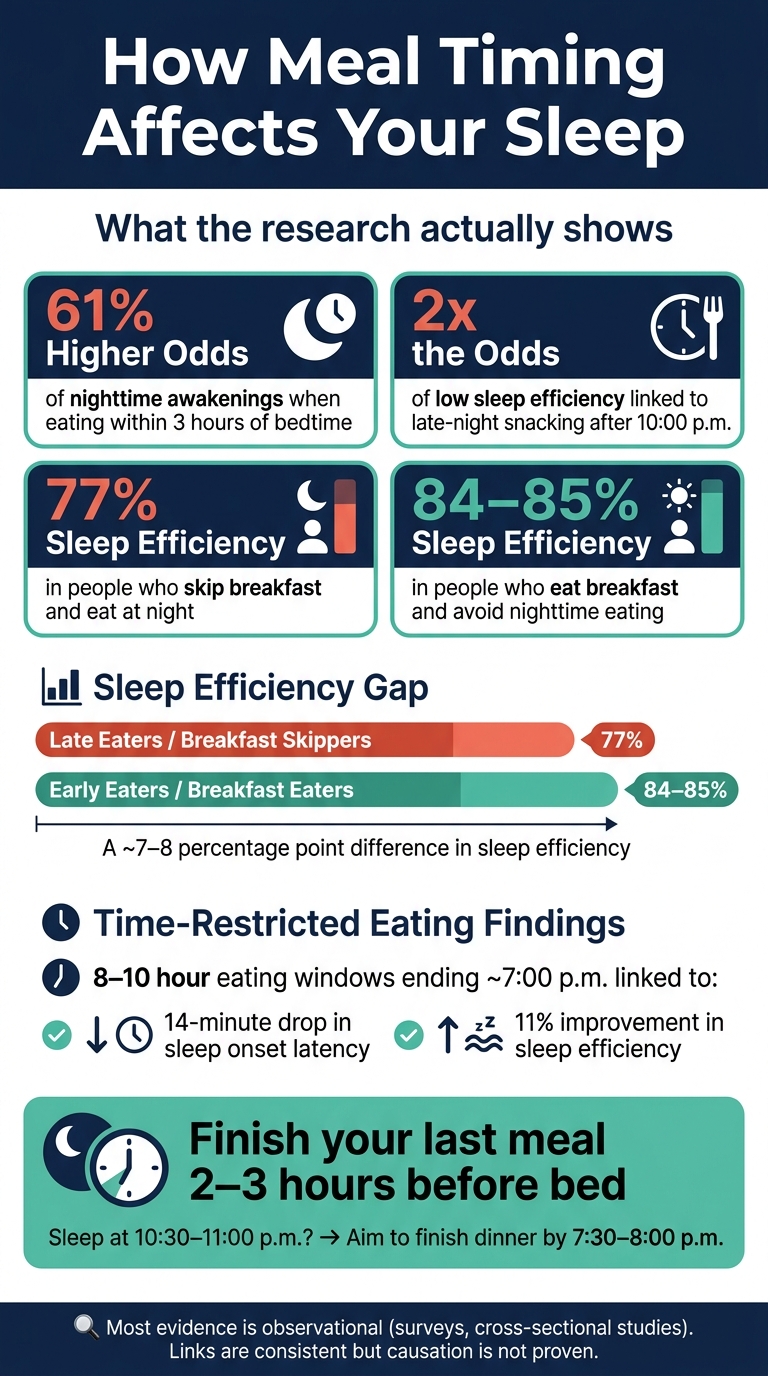
Meal Timing & Sleep Quality: Key Statistics at a Glance
What Studies Show About Late Eating and Sleep Quality
Later Meals and More Frequent Evening Eating
Study after study points in the same direction: people who eat later tend to sleep worse.
A 2024 analysis found that adults who pushed back their first meal, the midpoint of their daily calorie intake, and their last meal of the day also had higher Pittsburgh Sleep Quality Index (PSQI) scores than earlier eaters.[1] The link held even after researchers adjusted for age, sex, BMI, and lifestyle habits.[1]
This isn’t limited to one group, either. The same pattern shows up in adults with type 1 diabetes, midlife women, healthy adults, shift workers, and adults with obesity.[1][6][7]
Which Sleep Measures Are Most Affected
Late eating seems to hurt sleep continuity more than total sleep time.
In one study, late-night snacking after 10:00 p.m. was tied to more than double the odds of reduced sleep efficiency (OR 2.10; 95% CI 1.23–3.58). It was also linked to higher odds of longer sleep latency, compared with not having a late-night snack.[10]
Another finding makes the pattern even clearer. Adults who skipped breakfast and also ate at night had mean sleep efficiency of 77%. That compares with about 84% to 85% in people who ate breakfast and stayed away from nighttime eating.[2]
So even when people don’t sleep much less overall, late eating can still wear down sleep quality by leading to more wake-ups, lower efficiency, and a longer time to fall asleep.
Meal Timing Patterns and Their Reported Sleep Effects
Here’s the pattern across common meal-timing habits:
| Meal Timing Pattern | Sleep Quality (PSQI) | Awakenings / Fragmentation | Sleep Latency | Sleep Timing |
|---|---|---|---|---|
| Early dinner (before about 7:00 p.m.) | Lower PSQI scores in several cohorts[1][6] | Fewer awakenings and higher sleep efficiency[6][7] | Neutral or slightly shorter[6][7] | Better aligned with daytime circadian phase[1] |
| Late dinner (after about 8:00–9:00 p.m.) | Higher PSQI scores[1][6] | More awakenings, more time awake after sleep onset, and reduced efficiency[3][7] | May be longer, especially with heavy meals[7] | Linked with later sleep timing[1][7] |
| Eating within 1–3 hours of bedtime | Poorer self-reported sleep quality in some groups[3][5] | Linked with more nocturnal awakenings and poorer subjective sleep[3] | Small or variable effects[3] | Can disrupt the normal sleep-fasting rhythm[5] |
| Breakfast skipping | Mixed; often part of a broader evening-type pattern[1] | Indirectly may encourage more evening intake and late snacks[1] | May contribute to delayed sleep timing[1] | Linked to later body-clock timing, delayed sleep schedules, and weekday-weekend sleep mismatch[1] |
| Nighttime eating (during usual sleep hours) | Clear negative correlation; higher PSQI and disturbed patterns[7] | Marked increase in awakenings, more time awake after sleep onset, and reduced efficiency[7] | Longer sleep latency and altered REM latency[7] | Misaligned with circadian rhythms and linked to irregular sleep timing[7] |
That leads to the next part: how close to bedtime eating starts to interfere with sleep.
sbb-itb-f5765c6
Bedtime Proximity, Eating Windows, and Circadian Timing
Eating Within 1 to 3 Hours of Bedtime
Looking at how late you eat is only part of the picture. The other part is how close that meal is to sleep and whether it lines up with your body clock.
Eating closer to bedtime is linked more often with broken sleep than with less sleep overall. Eating within 3 hours of bedtime is tied to about 60% higher odds of nocturnal awakenings (OR ≈ 1.61; 95% CI 1.15–2.27), while total sleep duration was not much different between later and earlier eaters.[9] In plain terms, late eating seems to disrupt sleep continuity more than sleep length.
Large late dinners can make that worse, especially when they include caffeine or sugar after 6:00 p.m. Those meals are linked to poorer sleep and insomnia symptoms.[11] Even so, timing isn’t one-size-fits-all. In young athletes, a 1.5-hour gap improved sleep efficiency and reduced awakenings more than a 3.5-hour gap, which shows that the “best” gap can vary by person.[8][14]
One reason may be simple body mechanics. Late eating can delay the usual drop in body temperature and make reflux more likely, and both can interrupt sleep.[21] For that reason, a common rule of thumb is to finish your last substantial meal 2 to 3 hours before bedtime.[18][19][20]
Breakfast Skipping, Nighttime Eating, and Sleep Schedule Shifts
This helps explain why meal timing can shape not only sleep quality, but also your sleep schedule.
Skipping breakfast tends to push more calories later into the day. That shift can move peripheral clocks in the liver, gut, and other metabolic tissues toward a later rhythm.[12][13][16] Meanwhile, the brain’s master clock still follows light. When those systems stop lining up, your rhythm can drift.
That mismatch often shows up in ways people can feel:
- Later bedtimes
- Later wake-up times
- More social jetlag, meaning a gap between your body clock and your daily schedule[16]
Night Eating Syndrome (NES) is a clinical example of this pattern. It’s defined by taking in most calories in the evening and overnight, and it’s linked to a delayed circadian pattern of food intake along with poorer sleep quality.[22]
Time-Restricted Eating and Sleep-Wake Alignment
Researchers see a similar pattern when they look at the full daily eating window.
Earlier and shorter eating windows may help support a steadier circadian rhythm. A systematic review of time-restricted eating (TRE) found that 8- to 10-hour eating windows, especially those ending around 7:00 p.m., were linked to better sleep scores, a drop in sleep onset latency of about 14 minutes, and an 11% improvement in sleep efficiency.[23]
But the clock time of that window matters just as much as the window itself. Late TRE schedules, such as noon to 8:00 p.m., can lower sleep efficiency and increase sleep onset latency in some groups.[4][17] On top of that, longer trials lasting 12 months in adults with obesity found no meaningful difference in sleep quality between TRE and standard calorie restriction.[15]
Who gets the most out of an earlier eating window can depend on the person. Athletic training, obesity, sleep apnea, and preexisting circadian rhythm issues can all shape the response.
How Strong Is the Evidence?
Cross-Sectional and Survey Findings
Most of the evidence comes from observational research, like surveys and cross-sectional snapshots. That kind of research can show a link, but it can’t prove cause and effect.
So what do these studies tell us? They consistently connect later meals and nighttime eating with worse sleep. That makes the pattern worth paying attention to, but not something we should treat as settled fact.
There’s another issue too: self-report data is messy. People often misremember when they ate, and late-night eating tends to be underreported.
Controlled Dinner-Timing Experiments
Controlled trials work differently. They assign meal timing and measure sleep more directly, which makes cause-and-effect questions easier to test.
Some of these trials found that later dinners did not make sleep worse and, in some groups, may even have helped it.[8][24] That’s a good reminder that meal timing is better seen as a flexible lever, not a hard rule.
Still, experiments have limits of their own. Sample sizes are usually small. The groups studied are often very specific. And most trials last only a few days or weeks. On top of that, lab meals don’t always look like everyday dinners, which often lack personalized nutrition for fitness. In daily life, meals are often bigger, higher in fat, and paired with caffeine or alcohol. That could lead to very different outcomes than a tightly controlled dinner in a study.
Study Design and Evidence Strength at a Glance
The table below is a guide for reading the findings above, not a second recap.
| Study Type | What It Can Show | Key Strengths | Common Limitations |
|---|---|---|---|
| Cross-sectional / survey | Associations between meal timing and self-reported sleep quality | Large samples, everyday eating patterns | Self-report bias, no causation, inconsistent definitions of "late" eating |
| Experimental (controlled trials) | Whether changing meal timing causes sleep changes | Stronger causal inference, objective sleep measures | Small samples, short duration, highly controlled conditions that don't reflect everyday life |
| Time-restricted eating (TRE) trials | Effects of eating window length and timing on sleep | Tests a practical behavior change | Mixed results, varies by window timing, population, and duration |
Because the evidence is mixed, the practical question isn’t whether there’s one perfect dinner time for everyone. It’s which timing changes are most worth trying in normal daily life. The next section turns that mixed evidence into simple routine changes.
Practical Takeaways and Summary
Where to Start in Your Daily Routine
The research points to one simple place to begin: move more of your calories earlier in the evening.
A good starting target is to finish your main evening meal 2–3 hours before bed. So if you usually go to sleep around 10:30–11:00 p.m., dinner will often land best at about 7:30–8:00 p.m. Try to treat eating after 9:00–9:30 p.m. as an occasional thing, not part of the nightly routine.
If you want to know whether this is making a difference, test it for 1–2 weeks. Track:
- dinner end time
- any late snacks
- bedtime
- wake time
- how many times you woke up
- total sleep time
- how rested you feel in the morning
Then compare nights with earlier dinners to nights when you ate late. The goal is simple: look for a steady pattern in nighttime wake-ups or how refreshed you feel the next morning. Healify can pull together wearable and lifestyle data to help spot that pattern.
That rule is just a starting point, not a fixed cutoff for every person.
Who Needs a Different Timing Plan
A 3-hour cutoff won’t work for everyone. Shift workers, athletes, people with GERD, and people managing blood sugar may need a different plan.
- Shift workers sleep at unusual hours, so meal timing has to match that schedule.
- Athletes may need post-workout nutrition later in the evening to help with recovery.
- Medical conditions: GERD often means leaving a 3–4 hour gap before lying down.[28][29][30] People with diabetes or prediabetes should make meal-timing changes with help from a clinician.[26][4][25]
If you’re in one of those groups, the general advice here still gives you a useful baseline. But your best schedule will probably look different from the average person’s.
Key Points to Remember
Across the studies, the same pattern keeps showing up even if the exact cutoff varies.
- Later eating is linked to more broken-up sleep. Eating within 3 hours of bedtime is tied to 61% higher odds of nighttime awakenings.[9][27]
- How close you eat to bedtime matters most. The gap between your last meal and when you fall asleep has the clearest link to awakenings, sleep efficiency, and sleep onset.
- Skipping breakfast and eating at night go along with worse sleep efficiency. These patterns are linked with sleep efficiency of about 77%, compared with about 85% in people who eat breakfast and avoid late-night food.[2]
- Try it on yourself. A 1–2 week tracking test is a practical way to see whether earlier dinners and fewer late snacks help your own sleep.
The Truth About Eating Before Bed | Dr. Michael Snyder & Dr. Andrew Huberman
FAQs
Does eating late reduce sleep quality more than sleep duration?
Yes. Eating late tends to affect sleep quality more than total sleep time. A meal too close to bed can cut into deep sleep and lead to more wake-ups during the night.
For better rest, try to finish dinner 2 to 3 hours before bed. Healify can help you spot how your meal timing affects your sleep quality and recovery over time.
How long before bed should I stop eating?
For better sleep, most guidance suggests eating your last meal 2 to 3 hours before bed. Giving your body that bit of space before you lie down may help cut down on nighttime wake-ups and other sleep issues.
If you want more tailored support, Healify can help line up your nutrition and sleep habits with your biometrics and daily routine.
Who may need a different meal timing plan?
People with irregular work schedules, like night shift workers, often need a different approach to meal timing. Their body clocks don’t line up with the usual breakfast-lunch-dinner pattern, so their hunger cues and metabolism can work differently too. Frequent travelers can run into the same issue, especially when they’re jumping across time zones and trying to eat on a schedule that suddenly feels off.
High stress and poor sleep can also change the equation. In those cases, shifting meal timing may help with stress management, support nutrient absorption, and make it easier to get better rest. Healify’s AI coach, Anna, can help tailor these plans to fit the person, not just the schedule.