

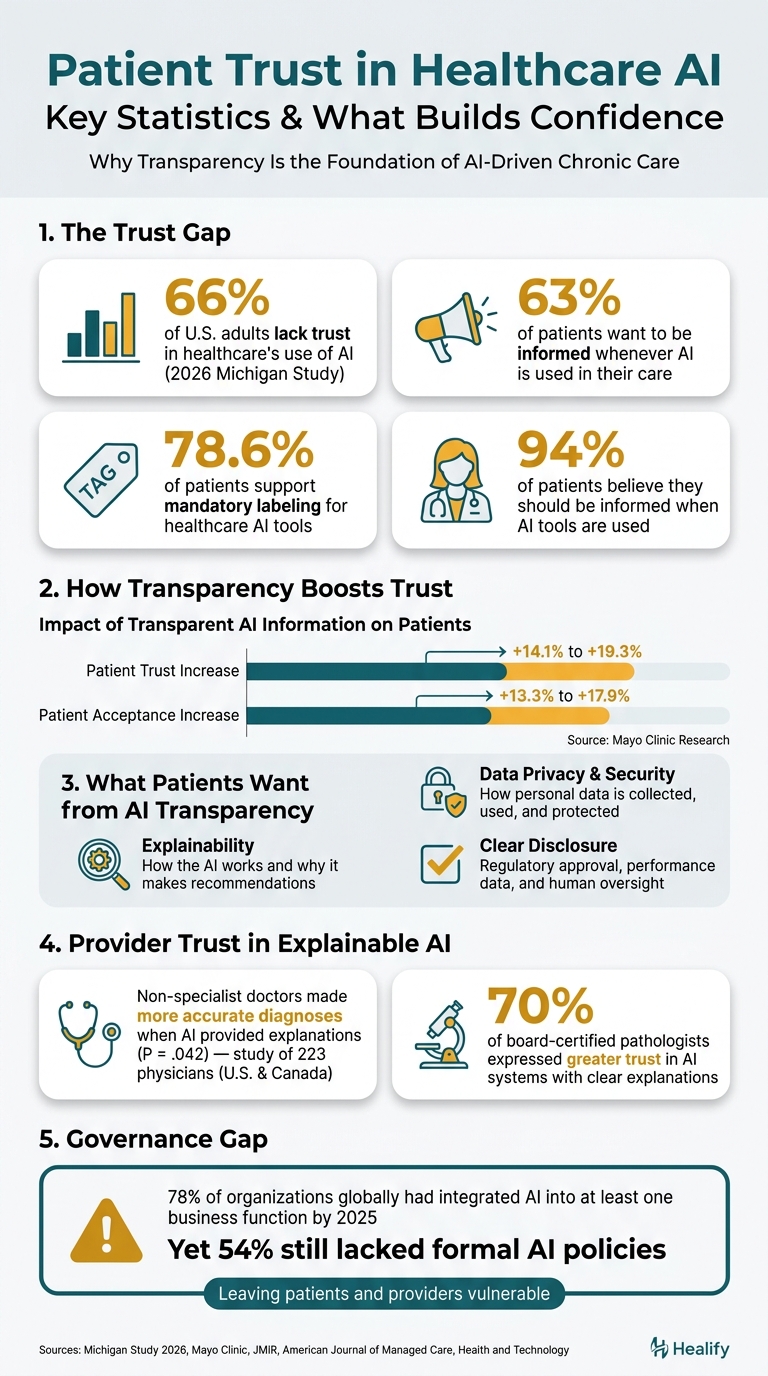
AI in healthcare can only succeed if patients trust it. But here's the problem: most patients don't fully understand how AI works in their care. A 2026 Michigan study found that 66% of U.S. adults lack trust in healthcare's use of AI, and 63% want to be informed whenever it's used. For people managing chronic conditions like diabetes or heart disease, this trust gap can undermine their confidence in treatment plans and medication adherence.
Key Takeaways:
- Transparency matters: Patients want clear explanations about how AI tools work, what data they use, and how decisions are made.
- What builds trust: Explainability, privacy safeguards, and clear disclosure are top priorities for patients.
- Why it’s critical: Without trust, even the best AI tools can fail to improve care, as patients may disengage or ignore recommendations.
To bridge the gap, healthcare providers should focus on clear communication, patient feedback, and transparent governance of AI systems. Tools like Healify’s AI health coach, Anna, show how simplifying complex health data into actionable advice can empower patients and build confidence in AI-driven care.
Patient Trust in Healthcare AI: Key Statistics & What Builds Confidence
Navigating Transparency and Trust With AI in Health Care
sbb-itb-f5765c6
How Transparency Builds Patient Trust in Chronic Care
Building trust starts with clear and honest communication. In the realm of chronic care, trust isn't just important - it’s the bedrock for everything else. Let’s explore how transparency plays a central role in fostering that trust.
Key Elements of Transparency in AI Systems
When it comes to making AI tools trustworthy, three factors stand out: explainability, data privacy, and clear disclosure. Patients need to understand how the AI works, why it makes certain recommendations, and what safeguards are in place. A 2023 study involving 42 patients revealed that they wanted detailed information about an AI tool’s performance, oversight, and its direct impact on their care [1]. Without this information, uncertainty takes over.
Another factor often underestimated by developers is the importance of the organization behind the AI. Research shows that patients’ trust in the reliability and accuracy of AI tools is closely tied to their trust in the company providing them [1]. One way to address this is by labeling AI tools clearly - similar to nutrition or drug labels. This idea resonates with patients: 78.6% of participants in a 2026 study supported mandatory labeling for healthcare AI tools to enhance understanding and trust [2].
How AI Supports Chronic Disease Management
AI shines when it turns complex data into actionable insights. Take Healify, for example. It processes data from wearables, blood tests, and other biometrics, such as AI-driven glucose monitoring, to deliver personalized advice and dynamic treatment adjustments through its AI health coach, Anna. By breaking down what these numbers mean for daily decisions, it empowers patients. This kind of clarity aligns with the goals of Explainable AI (XAI), which focuses on making AI systems easy to understand.
One standout example is the XAI4Diabetes platform. It provides interpretable insights into diabetes risk predictions, helping healthcare professionals better understand and trust the AI’s outputs. In fact, after using this tool, providers reported greater trust and comprehension of the system’s predictions [5]. When AI systems clearly explain their reasoning, both patients and providers are more likely to act on the insights with confidence.
This ability to demystify data interpretation strengthens trust, which is a cornerstone of effective chronic care.
Why Trust Is Critical in Chronic Care
Without trust, even the most accurate AI tools fall short. Patients managing chronic conditions make dozens of decisions daily - what to eat, when to take medication, how much to exercise. If they don’t trust the system guiding them, they’re likely to disengage. Research backs this up: providing transparent information about regulatory approval, tool performance, and oversight boosted patient trust by 14.1% to 19.3% and acceptance by 13.3% to 17.9% [4].
"Providing transparent, easily understandable information about these aspects is critical to support patient determinations of trust and acceptance of AI-enabled health care." - Xuan Zhu, PhD, Mayo Clinic [4]
This is especially critical for conditions like hypertension or Type 2 diabetes, where poor adherence can lead to severe complications. In these cases, transparency isn’t just a feature - it’s essential for effective care.
Best Practices for Building Transparent AI Systems
Creating AI systems that prioritize transparency is no small task, but it's a necessary step toward earning and maintaining trust.
Human-Centered Design Principles
The best AI systems are developed with users like patients and clinicians, rather than simply for them. Incorporating participatory design - where patients and clinicians actively contribute during development - ensures the system aligns with real-world needs. A study published in May 2026 in the Journal of Medical Internet Research introduced a participatory framework for explainable AI in mobile health, highlighting the importance of collaboration between humans and AI, as well as clinical validation, to foster trust [6].
Patients’ health literacy can vary widely, which directly impacts how they interpret AI-generated insights [6]. This makes it essential to communicate in language that’s clear and easy to understand, accommodating a broad spectrum of health literacy levels.
"Effective explanations must not only inform but also empower users to make safe, contextually appropriate health decisions while maintaining trust." - Farzana Islam, Researcher, Journal of Medical Internet Research [6]
These human-focused principles naturally tie into the need for transparent and ethical data practices, addressing common challenges with AI health apps.
Data Transparency and Privacy
Patients expect clear explanations about how their data is collected, why it’s being used, and how it’s protected. While adhering to HIPAA regulations is required, going beyond compliance can help build deeper trust.
A noteworthy example is the Model Privacy Notice (MPN) developed by the Office of the National Coordinator for Health Information Technology (ONC). Think of it like a nutrition label for apps - it provides a straightforward summary of an app’s privacy practices, enabling users to make informed decisions [7]. This kind of transparency demonstrates a genuine commitment to safeguarding patient data.
Making AI Outputs Easy to Understand
Even if data handling is transparent, AI systems won’t succeed if their outputs are confusing. Clarity is key. Using plain language instead of technical jargon ensures that users can confidently interpret results and take meaningful action.
Take Healify, for example. Their AI health coach, Anna, doesn’t just spit out raw data or cryptic scores. Instead, it translates biometric data, bloodwork results, and lifestyle information into practical, everyday advice. This approach makes health recommendations not only understandable but also directly applicable to patients’ lives [1].
Focus groups have consistently emphasized the importance of simple, clear labels for AI tools. Transparency in communication builds trust, and actionable insights help patients feel more confident in their care [1]. By simplifying complex data into relatable guidance, AI systems can strengthen the trust they aim to foster.
How to Communicate AI Use Clearly to Patients
Clear communication is more than just good practice - it’s a cornerstone of building trust. Research shows that most patients expect to be informed whenever AI plays a role in their care [2]. Here’s how healthcare providers can explain AI’s involvement effectively, ensuring transparency and maintaining trust in chronic care settings.
Disclosing AI's Role in Care
Patients should know when and how AI is part of their treatment process. This means explaining, in straightforward terms, what the AI tool does, how it’s been tested, whether it has regulatory approval, and who oversees its use. All of this should happen in a single, upfront conversation. The goal? To make it clear that AI supports, rather than replaces, the expertise of healthcare professionals.
Turning AI Insights into Actionable Guidance
For most patients, raw data or algorithm-generated outputs are overwhelming and unhelpful. What matters is turning those results into meaningful, practical advice. This is where context comes in - explaining what the data means and what steps the patient should take next.
Take Healify's AI health coach, Anna, as an example. Instead of bombarding patients with raw health metrics, Anna translates complex information into simple, actionable guidance tailored to daily life. This approach is especially crucial for chronic care, where managing conditions like diabetes requires sustained effort over months or years. A study on diabetes care highlighted that patients preferred tools like visual aids and simplified documentation to help them better understand and act on their health data [1].
Providing clear, actionable guidance isn’t just helpful - it’s a way to show patients that AI can truly support their health journey.
Addressing Patient Concerns About AI
Patients often worry about issues like data privacy, human oversight, and the limitations of AI tools. A January 2026 study in Michigan revealed that participants wanted transparency on three key aspects of AI tools: privacy and security, fairness in care, and safety and effectiveness [2].
"Patients want transparency when artificial intelligence (AI) tools are used in their health care." - American Journal of Managed Care [2]
These concerns can be addressed with simple, honest explanations. For example, clarify how patient data is securely stored, confirm that licensed providers review AI-driven recommendations, and openly acknowledge the limitations of the tool. Patients don’t expect AI to be flawless - they just want clarity and honesty about its role in their care.
Governance and Ongoing Improvement of AI Transparency
Earning and maintaining patient trust requires constant oversight and improvement. While transparency in design and communication is key, structured governance ensures AI systems stay on track with patient needs. Without it, even the best-designed AI tools can stray from their purpose, introduce bias, or fail to adapt to changing requirements.
Setting Up Clear Governance Practices
Strong governance begins with a multidisciplinary team guiding the AI's journey from start to finish. The FUTURE-AI framework, a global guideline shaped by 117 experts from 50 countries, emphasizes the importance of including voices from various fields - clinicians, data scientists, ethicists, social scientists, and patient representatives [8]. This diversity ensures balanced decision-making that prioritizes patient care.
To strengthen governance, expert panels of 10–20 specialists from fields like clinical care, cybersecurity, and engineering should conduct ethical reviews for clinical AI [10]. These reviews go beyond checking accuracy - they assess whether AI outputs are clear, equitable, and traceable. Despite the growing use of AI - 78% of organizations globally had integrated AI into at least one business function by 2025 - 54% still lacked formal AI policies [10]. This gap leaves both patients and providers vulnerable.
These governance strategies establish a foundation for consistent monitoring and timely updates.
Monitoring and Updating AI Systems
AI systems evolve as they learn, which can lead to performance shifts or new biases, especially when patient demographics or data change. Regular reviews are essential to identify and address biases across factors like age, gender, and ethnicity. Stakeholders must be promptly informed of any updates [8].
Transparency during updates is critical. Clinicians and patients should be notified immediately when changes occur. The FDA's Predetermined Change Control Plans (PCCPs) framework offers a helpful model, allowing for pre-approved, continuous updates to AI algorithms while ensuring they remain safe and effective [3]. Keeping AI "nutrition labels" or documentation current is equally important, so patients always have access to accurate and updated information.
"The high-stakes nature of clinical decisions and cybersecurity responses requires AI systems that are not only accurate but also transparent, ethically grounded, and accountable." - Parul Naib, Centre for Decision Support Systems [10]
Using Patient Feedback to Improve AI Systems
Patient feedback plays a vital role in refining AI transparency. Patients are more than end users - they provide critical insights that can improve AI systems. Co-design sessions involving patients and families can uncover overlooked concerns [11]. Feedback on confusing or overly technical documentation should lead to immediate improvements.
Studies show that 94% of patients believe they should be informed when AI tools are used in their care [2]. Creating formal feedback channels - like patient portals, surveys, or steering committees - transforms this expectation into actionable insights.
At Healify, transparency is central to everything we do. By embedding these governance practices into our AI systems, we ensure they remain fair, reliable, and responsive to patient needs. This continuous feedback loop strengthens the trust that is essential for effective chronic care management.
Conclusion: The Path to Transparent and Trustworthy AI in Chronic Care
Transparency forms the backbone of any reliable AI system. When patients can see how AI reaches its conclusions, who is responsible for oversight, and how their data is safeguarded, they’re better equipped to decide whether to follow its advice. This concept, often referred to as calibrated trust, means using AI wisely and knowing when to question its recommendations [1].
A study involving 223 physicians across the United States and Canada revealed that non-specialist doctors made more accurate diagnoses when AI provided explanations (P = .042) [12]. Similarly, 70% of board-certified pathologists expressed greater trust in AI systems that included clear explanations alongside their predictions [12]. These findings underscore the critical role of transparency in fostering trust and improving outcomes.
"Achieving a balance between explainability, fairness, and performance is fundamental to ethical, responsible AI in healthcare, ensuring improved patient outcomes." - Health and Technology [9]
Healify exemplifies this commitment to transparency through its AI health coach, Anna. By transforming complex wearable and biometric data into simple, actionable insights, Healify ensures that patients can easily understand and act on their health information. As one beta user shared:
"The chat feels like a doctor, dietician, and sleep expert in one place - but tuned to my body. The first product that turns my wearable data into something I actually act on." - Beta User, Healify TestFlight cohort [13]
Building AI systems that patients can trust requires a focus on explainability, diverse oversight teams, and continuous improvement through patient feedback. This approach empowers individuals to understand, rely on, and make informed decisions based on AI-driven insights in chronic care.
FAQs
How can I tell if an AI recommendation is safe to follow?
To determine if an AI recommendation is safe, look for transparency about its purpose, limitations, and data sources. Reliable tools will clearly state they’re not meant to replace medical care and will avoid making unsupported claims like being “science-backed” without providing evidence.
AI can be helpful for general health insights, but it shouldn’t be used for diagnosis. Always double-check any advice with your healthcare provider or clinical care team.
What health data does the AI use, and who can access it?
Healify collects your Personal Wellness Data, such as mood scores, journal entries (covering areas like eating, sleeping, exercise, and self-care), and insights about your overall life satisfaction. By default, this information is private and accessible only to you. However, you have the option to share it with a therapist. If you choose to do so, they can view your data through their dashboard. You retain full control and can stop sharing at any time, immediately revoking their access through the platform.
Who is accountable if the AI gets something wrong?
When it comes to AI outcomes in healthcare, the responsibility ultimately rests with human providers. Tools like Healify are designed to assist, not replace, clinical judgment. Healthcare professionals remain at the center of care, interpreting AI-generated insights and making critical decisions, including when to override AI recommendations.
To maintain safety and clarity, many organizations establish clear guidelines for documenting AI-influenced decisions and defining roles in the event of adverse outcomes. By keeping a human in the loop, the integration of AI into healthcare ensures that patient safety remains the top priority while leveraging these tools within professional practice.