
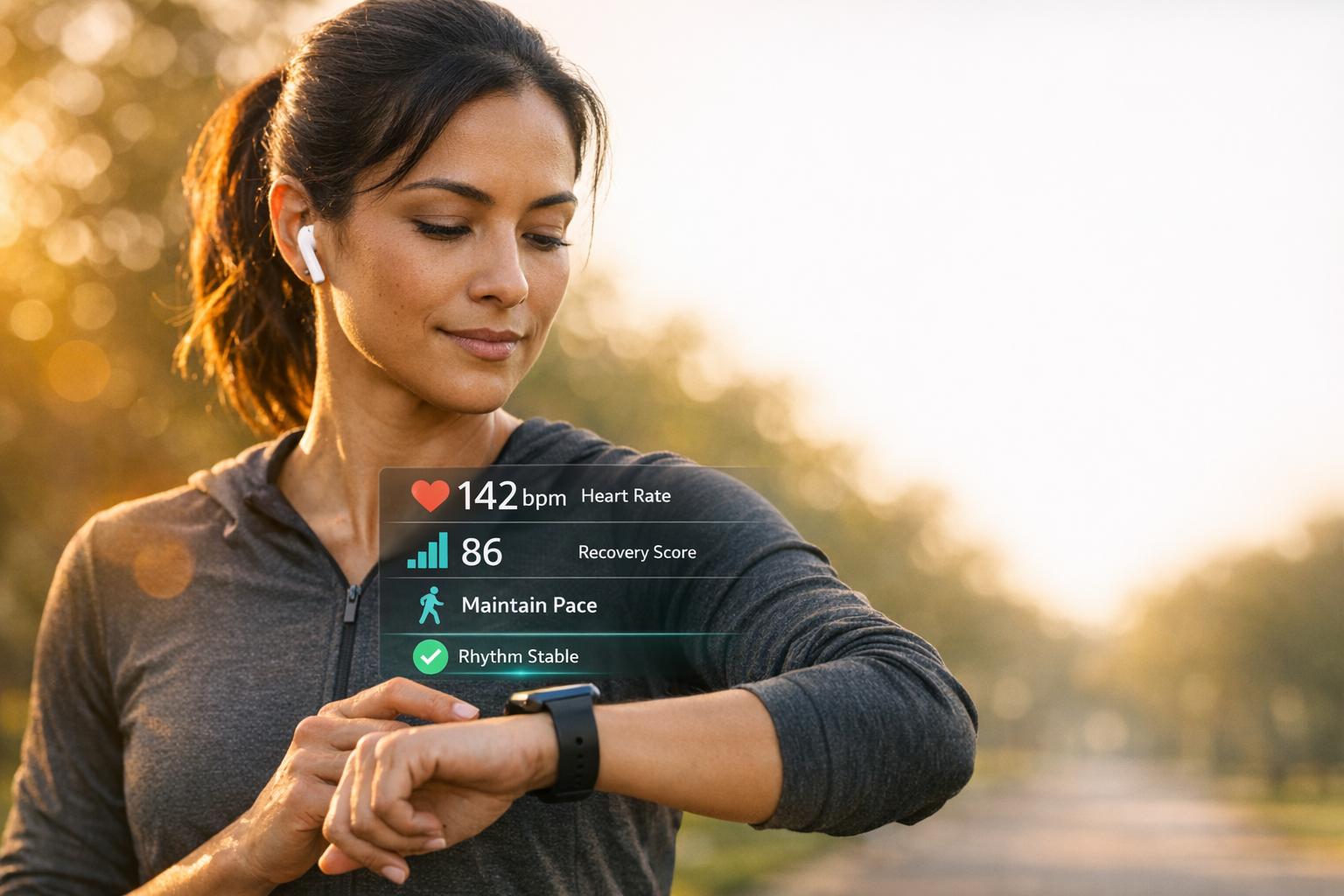
AI has transformed fitness tracking from simple step counters into advanced health tools. Today’s wearables analyze heart rate, sleep, and recovery in real time, offering personalized insights and actionable feedback based on your unique data. By combining machine learning, generative AI, and sensor fusion, these devices provide tailored coaching to improve workouts, recovery, and overall health.
Key takeaways:
- AI-powered wearables monitor metrics like heart rate variability (HRV), sleep stages, and body temperature.
- Platforms like Healify integrate wearable data with lifestyle habits for 24/7 personalized health coaching.
- AI enhances accuracy by distinguishing activities (e.g., walking vs. running) and adjusting recommendations in real time.
- Popular devices like Apple Watch, Fitbit, and Oura Ring use advanced sensors for detailed health tracking.
- Challenges include data fragmentation and the need for more clinical validation, but advancements continue to improve AI’s effectiveness.
AI fitness tracking is reshaping how we approach health, turning raw data into practical guidance for better results and early detection of potential issues.
How AI Powers Real-Time Fitness Tracking
Core AI Technologies Used in Fitness Tracking
Modern AI fitness tracking relies on three main technologies: machine learning (ML), generative AI (GenAI), and sensor fusion. Each plays a distinct role in delivering accurate and actionable insights.
Machine learning excels at recognizing patterns. It can identify workout types using accelerometer data, flag unusual heart rate patterns, and create a tailored baseline for each user. Generative AI, on the other hand, translates raw numbers into easy-to-understand coaching tips, making the data more approachable. Then there’s sensor fusion, which combines various data streams - like heart rate variability (HRV), sleep stages, skin temperature, and training load - into a single, comprehensive health score. These scores, such as "Recovery" or "Readiness", provide a clearer picture of your overall health than any single metric could on its own.
Adding to this mix is the use of agentic AI frameworks, which introduce a self-correcting loop to the analysis process. For example, systems like the Personal Health Insights Agent (PHIA) use a "Thought-Action-Observation" cycle. This means the AI plans its analysis, executes it, evaluates the results, and adjusts if needed. Research published in Nature Communications highlights the effectiveness of this approach, showing it achieves 84% accuracy on health-related queries, compared to just 22% for standard numerical reasoning models [1].
"Deriving personalized insights from popular wearable trackers requires complex numerical reasoning that challenges standard LLMs, necessitating tool-based approaches like code generation." - Nature Communications [1]
These advanced technologies are fueled by reliable data sources, which are essential for their success.
Data Sources AI Relies On
The effectiveness of AI in fitness tracking depends heavily on the quality and variety of the data it processes. Most systems rely on a combination of biometric sensors and aggregation platforms.
Key biometric sensors include:
- Photoplethysmography (PPG) for tracking heart rate
- ECG sensors for measuring HRV
- Accelerometers for detecting movement
- Skin temperature sensors for monitoring body temperature
These sensors capture different aspects of your physiology, creating a detailed picture of your health. Platforms like Apple HealthKit and Google Health Connect then act as central repositories, combining data from multiple devices and apps into a single, long-term record. This unified data allows AI to analyze trends over time and deliver more meaningful insights.
Here’s how some popular platforms utilize these data sources to create actionable health scores:
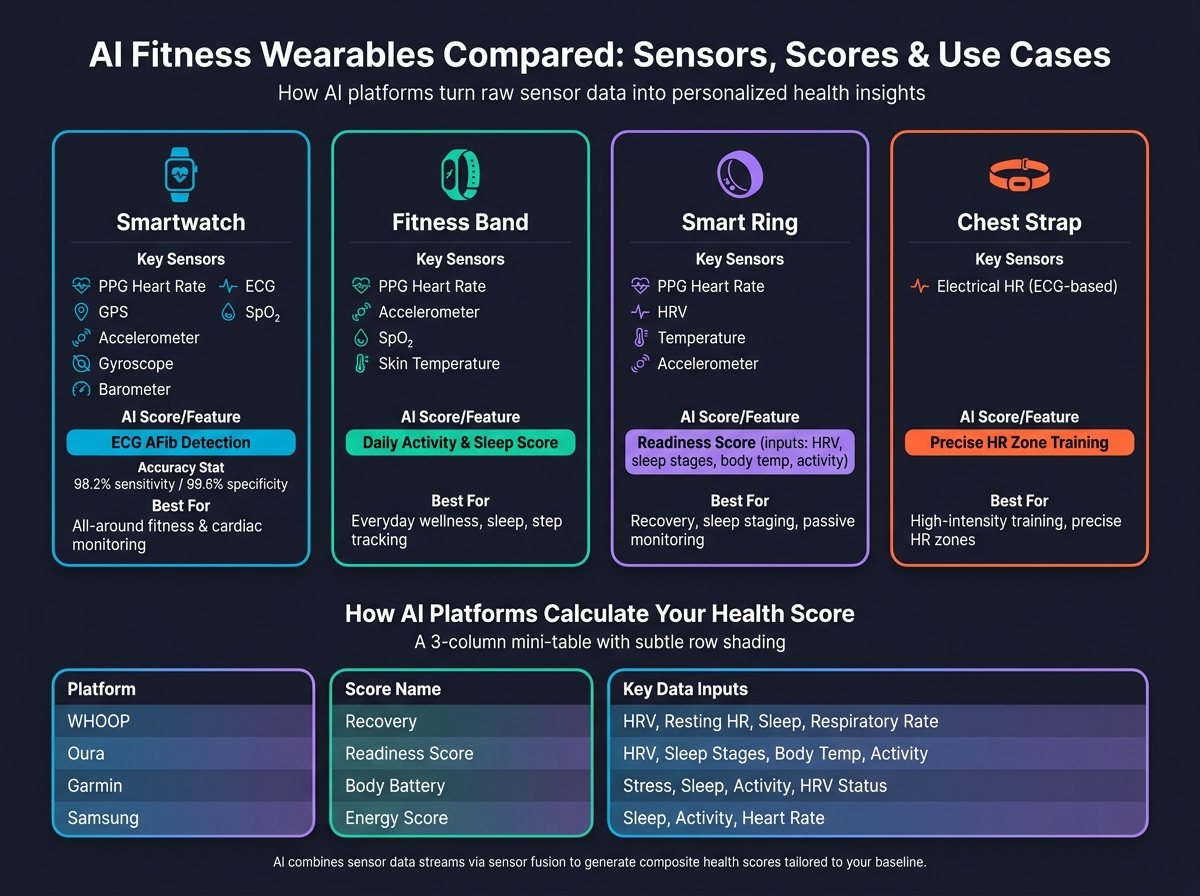
| Platform | Score Name | Key Data Inputs |
|---|---|---|
| Whoop | Recovery | HRV, resting HR, sleep, respiratory rate |
| Oura | Readiness Score | HRV, sleep stages, body temperature, activity |
| Garmin | Body Battery | Stress, sleep, activity, HRV status |
| Samsung | Energy Score | Sleep, activity, heart rate |
The value of this data grows over time. Platforms that track your health history for years can better identify what’s normal for you and spot anomalies more accurately. This long-term perspective is key to delivering sharper and more personalized insights.
sbb-itb-f5765c6
How AI Improves Accuracy and Personalization
Real-Time Activity and Metric Detection
Thanks to advanced sensor fusion and machine learning, AI now processes live data to fine-tune activity detection. Old systems might have just shown a 30-day average and left it at that. Today, AI dives into raw, high-resolution data streams, analyzing your physiology and behavior as it happens - not hours later.
Take the difference between a brisk walk and a tempo run, for example. These activities vary in heart rate zones, energy use, and recovery needs. AI uses pattern recognition on accelerometer and heart rate data to automatically distinguish between them. It then calculates metrics like calorie burn and workout intensity with much greater accuracy. This leap in precision comes from how AI handles the calculations: instead of traditional methods, it uses Python scripts and libraries like Pandas to process raw time-series data, significantly cutting down error rates [1]. With these precise metrics, AI delivers coaching tailored to your performance in real-time.
Personalized Coaching and Feedback
AI doesn’t just stop at accurate data - it uses that data to create feedback tailored to your unique history and health goals. Accurate numbers are only helpful if they’re meaningful to you, and this is where AI goes far beyond static fitness plans.
By comparing your current performance to both your historical data and health benchmarks, AI ensures its feedback feels relevant and specific. Research shows users view AI feedback as personalized when it refers directly to their own numbers rather than offering generic tips [1].
"As long as there are numerical insights, that would be a 'Yes' on personalization." - Rater 2, PHIA Study [1]
Apps like Healify push this even further by integrating data from wearables, biometrics, bloodwork, and lifestyle habits into one cohesive picture. Its AI coach, Anna, uses this combined data to provide guidance tailored to your current state - not a one-size-fits-all suggestion. The result? Fitness tracking transforms from a simple data display into a coach that truly understands your history and goals.
Fitbit Air: The $99 Future of Fitbit (WHOOP alternative)
AI-Enabled Wearables and What They Can Do
AI Fitness Wearables Compared: Sensors, Scores & Use Cases
Common Wearable Devices and Their Sensors
AI-enabled wearables take fitness tracking to the next level by combining multiple sensors in compact, user-friendly designs. These devices go far beyond counting steps, offering real-time health insights through advanced sensor technology.
Smartwatches, like the Apple Watch, pack a range of sensors, including an optical heart-rate (PPG) sensor, accelerometer, gyroscope, GPS, barometer, SpO₂ sensor, and even an ECG electrode in some models. The Apple Watch has FDA clearance for its ECG app, which uses AI to detect atrial fibrillation with impressive accuracy - 98.2% sensitivity and 99.6% specificity compared to traditional ECGs [1]. Fitness bands, such as the Fitbit Charge, focus on tracking sleep, steps, and heart rate. Smart rings, like the Oura Ring, specialize in overnight monitoring, capturing metrics like temperature, heart rate variability (HRV), and respiratory rate, making them ideal for recovery and sleep analysis. Advanced AI sleep coaches then use this data to suggest specific lifestyle adjustments. For high-intensity workouts, chest straps provide unmatched heart-rate accuracy, unaffected by body movement.
Here’s a quick comparison of popular wearables and their key features:
| Device Type | Key Sensors | Best For |
|---|---|---|
| Smartwatch (e.g., Apple Watch) | PPG HR, ECG, GPS, SpO₂, accelerometer, gyroscope, barometer | All-around fitness, cardiac monitoring |
| Fitness Band (e.g., Fitbit Charge) | PPG HR, accelerometer, SpO₂, skin temperature | Everyday wellness, sleep, step tracking |
| Smart Ring (e.g., Oura Ring) | PPG HR, HRV, temperature, accelerometer | Recovery, sleep staging, passive monitoring |
| Chest Strap | Electrical HR (ECG-based) | High-intensity training, precise HR zones |
Each device shines in specific areas, and when their sensor data is combined with AI, the results are even more impactful.
How Wearables Work with AI Platforms
Wearables gather data, but it’s AI platforms that turn those numbers into meaningful insights. The process is straightforward: sensors collect raw data, send it to your smartphone via Bluetooth, and an AI system analyzes it to provide insights, alerts, or trends.
Take Garmin’s Body Battery score, for example. It combines heart rate variability (HRV), stress levels, and activity history to estimate your energy reserves, helping you decide whether to push through a tough workout or take a rest day. Similarly, WHOOP uses heart rate, HRV, respiratory rate, and sleep data to calculate personalized Strain and Recovery scores tailored to your baseline.
Platforms like Healify take it a step further by integrating wearable data with biometrics, bloodwork, and lifestyle information. Instead of overwhelming you with a dashboard full of numbers, Healify’s AI coach Anna synthesizes everything into actionable recommendations - offering clear guidance based on your current health status. This evolution transforms wearables from passive trackers into active, real-time health coaches.
The real magic of AI lies in its ability to spot patterns over time. A single elevated resting heart rate might not mean much, but if it’s paired with poor sleep and declining HRV over several days, AI can flag potential recovery issues before they become noticeable. By putting wearable data into context, AI enhances health tracking, turning raw metrics into actionable advice tailored to your needs.
Benefits, Challenges, and What's Next for AI Fitness Tracking
Key Benefits of AI in Fitness Tracking
AI-powered fitness tracking can help you stay more active. Research shows that personalized AI coaching can boost adherence to physical activity by 20–30% compared to static plans. Conversational AI tools, which adapt to your data in real time, improve healthy behavior adherence by an average of 27% [2].
It also delivers measurable performance improvements. For example, a study by Javaloyes et al. found that trained cyclists using heart rate variability (HRV)-guided training increased their peak power output by 3.7% over eight weeks, while those following traditional methods only saw a 0.8% gain [2]. Another 24-week study revealed that recreational endurance athletes using HRV-guided protocols improved their VO₂ max by 4.6% more than those on fixed plans [2]. By letting AI tailor your training based on recovery data, you can achieve better results.
Companies like Healify are taking this a step further by transforming wearable data into personalized, 24/7 health plans, making complex metrics easier to act on.
AI also acts as an early warning system. Wearables paired with AI can detect patterns like an increasing resting heart rate, declining HRV, or poor sleep quality - often before you notice any symptoms. This helps users avoid overtraining and spot potential health concerns early.
Current Limitations to Keep in Mind
Despite its benefits, AI fitness tracking has its challenges. For instance, standard AI models sometimes struggle to interpret the high-resolution time-series data from wearables, leading to inaccuracies. However, newer systems using code generation have made progress, achieving 84% accuracy on numerical health queries compared to 74% for older models [1]. While this is a step forward, there's still room to grow.
Data fragmentation is another hurdle. Platforms like Apple HealthKit, Garmin, WHOOP, and Oura use their own algorithms to calculate recovery scores, and there’s no universal standard for transferring historical health data between them [2]. This lack of integration can complicate efforts to get a complete picture of your health. Additionally, as of 2026, no randomized controlled trials have directly compared AI-plus-biometric coaching with human coaching for fitness outcomes [2]. This means some claims about AI's effectiveness still need independent validation.
Even with these limitations, innovation in the field continues to push boundaries.
What's Next: Future Trends in AI Fitness Tracking
The future of AI fitness tracking looks promising as current challenges are addressed. AI is evolving from simply reporting your health status to offering actionable, real-time insights. For instance, some systems can now detect low recovery scores or stress markers mid-workout and adjust a planned high-intensity session to a low-impact one on the fly [3].
Continuous Glucose Monitoring (CGM) is also moving beyond clinical settings into mainstream fitness. Advances in photonic crystal technology now allow for non-invasive glucose tracking with an accuracy of ±10 mg/dL [3]. When combined with HRV and sleep data, these tools provide AI coaches with a more detailed understanding of your body’s response to training and nutrition in real time.
Looking ahead, wearable-derived HRV and sleep data are expected to become standard tools in routine primary care by 2027 [2]. The wearable market itself is growing rapidly, with annual growth of about 14%, and it’s projected to exceed $100 billion by 2030 [2]. Clearly, AI fitness tracking is evolving from a niche gadget to an essential part of preventive healthcare.
Conclusion: What AI Means for Fitness Tracking Today
Fitness tracking has come a long way, evolving from simple step counters to tools that provide real-time, personalized health insights. This shift represents a major leap forward in how we approach wellness.
AI has redefined what fitness trackers can achieve. Instead of just tallying steps or calories, modern wearables adapt to your unique patterns - like your resting heart rate, recovery trends, and sleep cycles. They don’t just collect data; they interpret it, offering feedback that’s tailored specifically to you.
The most exciting change is the move from passive tracking to active guidance. Many people don’t fully tap into the potential of their data. The real breakthrough happens when AI links together factors like sleep, stress, activity, and recovery, translating them into actionable steps. For example, Healify excels at this by combining wearable data, biometrics, bloodwork, and lifestyle habits into a 24/7 personalized health plan. With its AI health coach Anna, you receive practical advice - like easing up on workouts after poor sleep or tweaking your bedtime to improve heart rate variability. It’s not just about tracking; it’s about taking meaningful action.
Of course, AI tracking isn’t perfect. Issues like data accuracy, fragmented information, and the lack of long-term clinical studies are challenges that still need to be addressed. However, ongoing advancements are steadily bridging these gaps, making the future of AI-driven fitness tracking even more promising.
The takeaway? Pairing your wearable data with an AI-powered platform like Healify is a smart move if you’re ready to go beyond basic metrics and take control of your health in a proactive, impactful way.
FAQs
Which wearable metrics matter most for recovery?
Key recovery metrics tracked by wearables include heart rate variability (HRV), sleep quality (like stages and efficiency), stress levels, and activity strain or readiness scores. Healify’s AI analyzes HRV and sleep data to assess how prepared you are for workouts. It also uses stress and readiness scores to suggest when you should dial back intensity or prioritize rest.
How does AI know what workout I’m doing?
AI tailors your workout by using data collected from wearable sensors, such as accelerometers and heart rate monitors. Through machine learning, this data is processed to identify movements and classify them as specific exercises. It factors in details like your heart rate, workout intensity, and motion patterns, while also referencing your fitness history for a personalized approach. In some cases, smartphone cameras are integrated for motion tracking, allowing the system to analyze your form, count reps, and even offer real-time corrections to improve accuracy.
How can I combine data from multiple wearables in Healify?
To bring together data from multiple wearables in Healify, start by syncing them to your iPhone via Apple Health. Healify’s AI employs data fusion to blend inputs such as heart rate, movement, and biosensor readings into a single, cohesive health profile. It smooths out any differences in formats, sampling rates, or units across devices. If there’s conflicting data for the same metric, Healify uses reconciliation logic to automatically sort it out once connectivity is restored.