
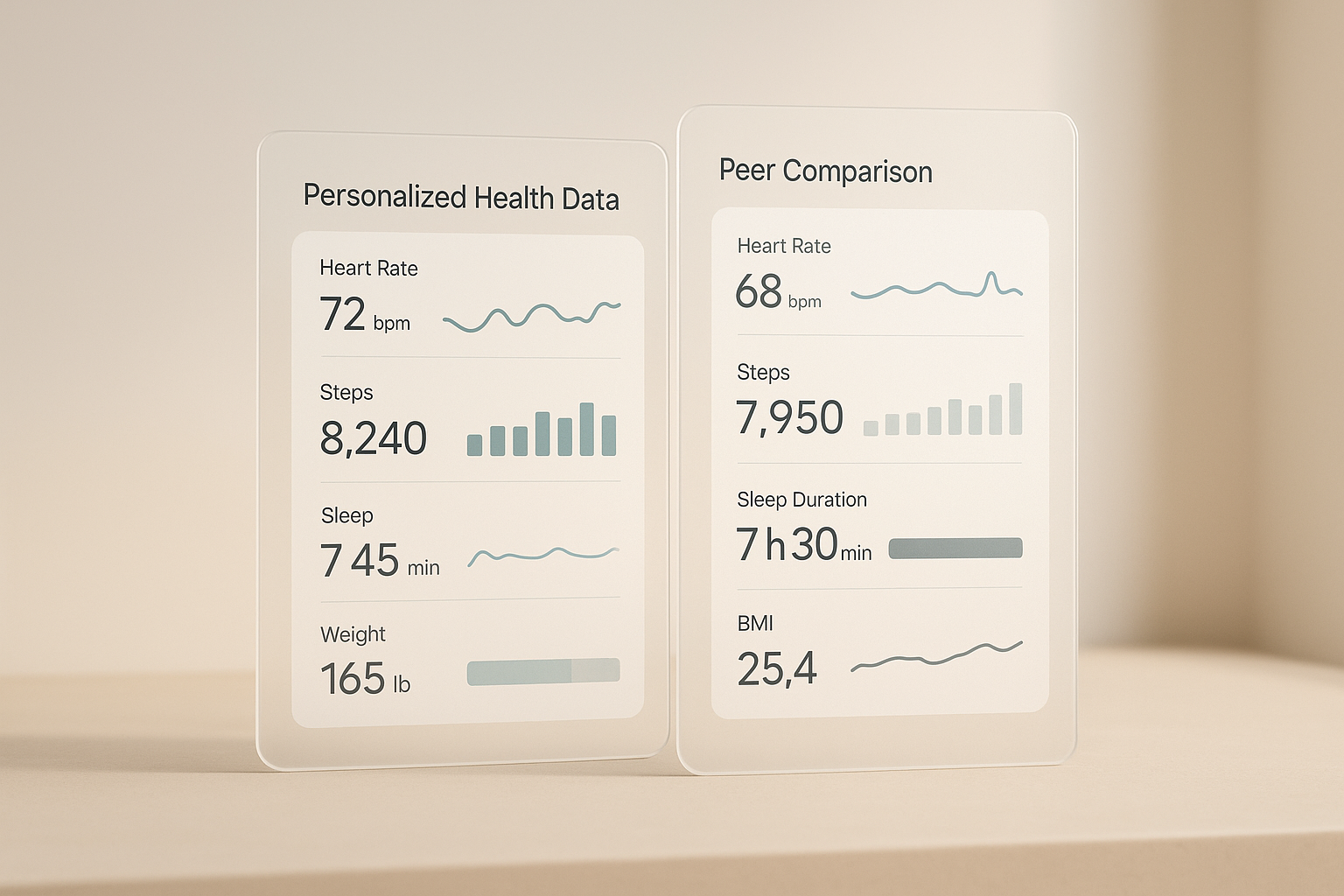
Want to make sense of your health data? Personalized and peer health benchmarks are two approaches that can help you understand your health metrics and take informed actions. One way to do this is to create a personal health dashboard to track your metrics. Here's a quick breakdown:
- Personalized Benchmarks: Focus on your unique health history, genetics, and lifestyle data. They track your progress over time and identify patterns specific to you. Great for early detection of health issues and tailoring interventions.
- Peer Benchmarks: Compare your health metrics to others with similar traits (age, gender, lifestyle). Useful for setting realistic goals and gaining perspective on where you stand among peers.
Quick Overview:
- Personalized: Highly specific to you, combining data from wearables, medical records, and genetics.
- Peer: Offers a community-based context by grouping similar individuals for comparison.
Why it matters: With tools like AI and wearables, combining these benchmarks can provide clearer insights into your health, helping you make better decisions and even catch risks early. Keep reading to learn how these approaches differ, when to use each, and how they can work together.
Personalized Health Benchmarks
How Personal Benchmarks Work
Personalized health benchmarks bring together multiple data sources to create a detailed picture of your health. It all begins with genomic data, which reveals your genetic predispositions and how your body might respond to different treatments.
In the U.S., certified EHR (Electronic Health Record) technology is widely used [2]. These systems store a wealth of patient information, including medical histories, past surgeries, allergies, medications, diagnoses, and clinical test results. This comprehensive data helps establish patterns in your health over time.
Another key component comes from wearable devices and lifestyle tracking tools. These devices and apps provide real-time insights into your daily habits and how your body reacts to factors like exercise, stress, sleep, and diet. This ongoing monitoring adds valuable context to your overall health profile.
Modern AI systems play a crucial role by integrating these diverse data streams. For instance, genetic markers might reveal a tendency toward high cholesterol, your EHR could show historical cholesterol test results, and wearable data might illustrate how different levels of exercise impact your cardiovascular health. Together, these sources provide a holistic view of your unique health profile.
Advanced analytics further enhance these benchmarks by identifying patterns, establishing baselines, and detecting deviations that could signal health changes [2]. These integrated insights lay the groundwork for personalized health benchmarks and their numerous advantages.
Benefits of Personal Benchmarks
When data is integrated effectively, personalized health benchmarks deliver actionable insights. For example, nearly 30% of prescriptions fail without individualized information [4]. By tailoring healthcare to your specific needs, clinical outcomes can improve by 30% [4].
One of the most impactful benefits is early disease detection. Instead of waiting for symptoms to become noticeable, personalized benchmarks can identify subtle changes - like shifts in biomarkers, sleep patterns, or activity levels - that might indicate developing health issues. For instance, prediabetic individuals who adopt evidence-based lifestyle changes can reduce their risk of progressing to type 2 diabetes by up to 50% [3].
This proactive approach to care offers significant advantages. As Jon-Michial Carter explains, "Personalized healthcare improves clinical outcomes, enhances quality of life, reduces healthcare costs and resource utilization, and fosters a deeper connection between patients and their healthcare providers" [3]. The focus shifts from treating illnesses after they occur to managing wellness before problems arise.
Personalized benchmarks also boost patient engagement. When healthcare recommendations are tailored to individual circumstances, patients are more likely to follow them, leading to higher satisfaction levels [4]. Additionally, by focusing on targeted, evidence-based interventions, personalized benchmarks can reduce unnecessary tests and appointments, saving both time and money.
By combining genetics, medical history, and lifestyle data, these benchmarks identify the most effective interventions for each person. What works for one individual may not work for another, and personalized benchmarks help pinpoint strategies that are most likely to succeed based on your unique profile.
Requirements and Challenges
Despite their potential, creating personalized benchmarks comes with significant challenges, particularly in integrating and managing diverse data sources. For these benchmarks to work, systems must seamlessly combine genomic information, EHR data, and real-time data from wearables. While over 55,000 clinical genetic tests are available [2], incorporating them into broader health records remains a complex task.
Data quality is another hurdle. EHRs often store genomic test results as summarized interpretations instead of raw data, and these are sometimes uploaded as scanned paper documents [2]. Additionally, traditional health records often lack crucial lifestyle information, such as diet, exercise habits, environmental exposures, and medication adherence.
To process all this data, advanced analytics infrastructure is essential. These systems must handle structured data, like lab results, alongside unstructured data from doctor’s notes. This requires sophisticated natural language processing tools to extract meaningful insights.
Long-term data collection also presents challenges. Personalized benchmarks become more accurate with sustained monitoring, but this demands consistent engagement from users across multiple devices and platforms. At the same time, healthcare providers need systems capable of handling and interpreting this continuous flow of information effectively.
Peer Health Benchmarks
How Peer Groups Are Created
Peer health benchmarks rely on advanced techniques to group individuals with similar characteristics, enabling meaningful health comparisons. This process starts by identifying factors that influence performance metrics, such as age, gender, medical conditions, lifestyle choices, and geographic location. Using tools like AI and clustering methods, these factors are analyzed to form peer groups. For instance, PINC AI's database includes information from over 4,400 hospitals and health systems across the U.S., covering 45% of the nation's hospital discharges [5]. This extensive dataset allows for precise grouping based on criteria like hospital bed size, procedure volume, practice type, and location [1].
The methodology focuses on selecting peers whose characteristics account for significant differences in performance metrics. Nearest-neighbor algorithms further refine these groupings by identifying similar health profiles [5]. Premier emphasizes this approach by stating:
"Peers should be chosen based on criteria that explains a significant amount of the variation in a particular performance metric" [5].
A notable example of this strategy involves a PINC AI study where an AI-generated peer group, which included non-academic hospitals, proved more effective for comparison than a group consisting solely of large academic medical centers. The non-academic peers displayed greater similarity in performance-related factors, whereas the academic-only group showed wider variation in productivity [6]. Michael Herron, Senior Data Scientist at Premier, highlights the value of this method:
"A data-driven approach provides a way to ensure that a peer group will allow for a meaningful comparison of the outcome of interest" [6].
These grouping techniques lay the foundation for understanding the unique benefits of peer benchmarks.
Benefits of Peer Benchmarks
Peer health benchmarks go beyond individual tracking by offering a broader context through social comparison. By comparing your health metrics to those of others with similar profiles, you gain a clearer understanding of your performance and what’s realistically achievable. Instead of aiming for idealized standards or extreme outliers, peer benchmarks provide attainable goals tailored to your circumstances.
Social comparisons help set practical health targets. As Alicia Nortje, Ph.D., explains:
"Social comparison is a normal behavior strategy where we seek to better understand our status relating to ability, opinion, emotional reaction, and more, by comparing ourselves to other people" [7].
Different types of comparisons have varying effects. Looking at higher-performing peers (upward comparison) can spark motivation, while comparing with peers on the same level (lateral comparison) offers a balanced perspective on your current status [10]. Additionally, shared health challenges within a peer group can create a unique support system. As Medvene notes:
"People who have a shared experience of a common problem have unique resources to offer one another" [9].
Peer benchmarks also help identify outliers. If your metrics are significantly below your peer group, it may highlight areas needing improvement. On the other hand, exceeding the group average can validate your current strategies and even provide insights that others might benefit from. This community-driven approach promotes accountability, self-improvement, and better decision-making - advantages that individual tracking alone might not achieve.
Important Considerations
While peer benchmarks offer valuable insights, their success depends on careful implementation. Accurate peer selection is crucial; mismatched groups can lead to misleading comparisons and poor decision-making. Healthcare systems must regularly evaluate and update their grouping criteria to reflect changes in health patterns, treatments, and demographics.
Reliable benchmarks also require high-quality, comprehensive data. Regular updates are essential to account for shifts in health trends, new medical advancements, and evolving lifestyles.
Psychological factors add another layer of complexity. While social comparisons can motivate, they can also have unintended effects. For example, research shows that 65% of Americans believe they are smarter than average [8], which illustrates the risk of unrealistic self-perceptions. Upward comparisons can inspire growth but may also lower self-esteem, while downward comparisons might boost confidence but risk encouraging complacency. Lateral comparisons generally provide a balanced view [7][10]. Presenting peer benchmark data thoughtfully is key to maximizing benefits while minimizing psychological risks.
Privacy and consent are equally important. Individuals need to understand how their data is used in peer benchmarks and have control over their participation. By combining peer benchmarks with personalized health insights, healthcare providers can deliver actionable guidance that blends social context with individual tracking for more effective health improvement.
Personalized vs Peer Benchmarks Comparison
Side-by-Side Comparison
Understanding the differences between personalized and peer benchmarks can guide you toward better health management. Each approach offers distinct benefits and serves unique purposes.
| Aspect | Personalized Benchmarks | Peer Benchmarks |
|---|---|---|
| Data Sources | Individual biomarkers, genetic testing, personal health history, lifestyle factors, and wearable device data | Aggregated data from population databases, hospital systems, demographic groups, and community health assessments |
| Customization Level | Highly tailored - focused on personal phenotype, genotype, and preferences | Standardized - based on shared traits within a demographic group |
| Goal Setting | Aligned with personal baselines and individual potential | Defined by comparing your performance to similar peer groups |
| Actionability | Enables specific interventions tailored to individual needs | Provides general recommendations based on population-level insights |
| Data Complexity | Requires advanced processing to transform intricate personal data into practical guidance | Relies on aggregated, standardized data that’s simpler to interpret |
| Measurement Focus | Tracks changes in nutrient markers, weight, body composition, and blood glucose control | Focuses on metrics that reflect performance relative to peers |
| Scientific Foundation | Built on evidence-based analysis of individual variations | Drawn from statistical analyses of population health research |
Personalized nutrition is defined as using individual-specific, evidence-based information to drive measurable dietary improvements [12]. This includes factors like behaviors, diet history, socioenvironmental influences, phenotype, and genetic testing results [12]. In contrast, peer benchmarks rely on community health assessments, which combine primary data - like surveys and interviews - with secondary data collected from other sources [11].
A key challenge for personalized approaches is the complexity of medical data. Research shows that this data often requires extensive processing to yield actionable insights [13]. Peer benchmarks, on the other hand, simplify this by using aggregated population data, making interpretation more straightforward.
Studies suggest that personalized approaches can lead to improved dietary behaviors and health outcomes. However, traditional statistical methods may miss subtle differences between individuals who respond well ("responders") and those who do not ("nonresponders") [12].
This comparison highlights the strengths of each approach and helps determine which is best suited to specific health goals.
When to Use Each Approach
Personalized benchmarks are ideal when detailed individual data is available, making them especially effective for managing specific conditions. By accounting for unique metabolic responses, genetic predispositions, and lifestyle factors, this approach enables highly targeted health interventions.
Peer benchmarks, on the other hand, are helpful for setting realistic, achievable goals. They are particularly useful for general health maintenance or when beginning a new health journey. Clinical interventions often benefit from peer benchmarks, as they leverage population-level research to establish treatment protocols and expected outcomes.
For a well-rounded strategy, combining both approaches can be highly effective. Platforms like BondMCP integrate personalized data with peer insights to provide tailored recommendations within a broader population context. This fusion of methods ensures a comprehensive approach to health optimization.
Combining Both Approaches
Why Integration Works
The best health strategies often come from blending personalized care with peer benchmarks. This combined approach bridges the gaps in each method while amplifying their strengths.
Personalized medicine zeroes in on an individual's unique traits - like molecular data, imaging, and lifestyle habits - to craft targeted treatments [14]. While powerful, it can lack the broader perspective that population data brings. Peer benchmarks step in to provide this context, offering realistic expectations and proven pathways based on the experiences of similar individuals.
When these two methods work together, they create a feedback loop. Personal data helps identify relevant peer groups, while peer insights validate whether personalized goals are achievable. This synergy makes patient-centered care more effective by respecting individual preferences and needs [14]. For instance, about 3%–5% of people carry genetic variants that require medical action [15]. For these individuals, personalized strategies are essential, but adding peer data offers practical ways to manage their conditions more effectively.
Unified Context Protocols
To make the most of this integration, unified context protocols streamline how data flows and connects. Modern health management demands systems that combine diverse data sources and benchmarking tools seamlessly. Enter BondMCP – Health Model Context Protocol, which tackles the problem of fragmented health data. This system acts as an intelligence layer, enabling smooth communication between different platforms.
Imagine a scenario where a sleep tracker informs a training coach, and lab results automatically update a supplement plan. This setup blends personal biomarkers with peer insights, ensuring recommendations are both reliable and actionable. For healthcare providers, it simplifies juggling multiple data streams. With 95% of US hospitals using certified Electronic Health Records [15], integrating these systems becomes much easier. BondMCP’s health-specific ontology ensures that data from various sources is properly contextualized, making comparisons meaningful. This unified approach paves the way for tailored and efficient health management.
Benefits for US Users
For Americans navigating a complex healthcare system, integrated benchmarking offers clarity. It harmonizes scattered health data, providing personalized guidance enhanced by peer insights. This is especially helpful in a system where financial and insurance-related hurdles can complicate decision-making.
Automation also plays a key role, reducing the need for manual updates. Recommendations adjust automatically as new lab results, wearable data, or peer updates come in. This is particularly valuable for those managing chronic conditions, where regular monitoring and timely adjustments are crucial. By easing the burden of health management, this approach empowers users to make informed, effective decisions about their well-being.
sbb-itb-f5765c6
Conclusion
Main Takeaways
Personalized and peer benchmarks each bring unique strengths to the table, offering a balanced approach to health management. Personalized benchmarks shine when it comes to tailoring interventions to your specific health data, lifestyle, and goals. They evolve with your circumstances, ensuring that recommendations stay relevant. On the other hand, peer benchmarks give you the bigger picture, helping you see where you stand compared to others and highlighting areas for growth.
Studies back this up: peer comparisons have been shown to improve clinical quality metrics [16], while personalized feedback enhances motivation and adherence to health interventions [5][17]. Together, they form a powerful feedback loop - your personal data helps identify meaningful peer groups, and peer benchmarks confirm what's achievable, keeping you on track.
Next Steps
The next logical step is to embrace health management solutions that combine both benchmarking methods. If you're juggling multiple apps and conflicting advice, consider platforms that unify these approaches into one seamless system. For instance, BondMCP - Health Model Context Protocol represents a new frontier in precision health, connecting scattered health data into one cohesive framework.
Take stock of your current tools - wearables, lab results, fitness apps, and supplement trackers - and look for platforms that integrate personalized and peer benchmarking. Imagine a setup where your sleep tracker informs your fitness coach, lab results automatically adjust your supplement plan, and your long-term health goals guide your daily decisions. This kind of integration not only simplifies health management but also delivers insights tailored to you, while providing the peer context you need to stay motivated.
For best results, work with healthcare professionals who can interpret this integrated data and recommend targeted interventions. By combining automated insights with expert guidance, you'll create a well-rounded, effective approach to optimizing your health.
EP 160 - Vadim Fedotov: Elevate Your Wellbeing: How Data-Driven Choices Create Peak Performance
FAQs
What’s the best way to combine personalized health data with peer benchmarks to improve my health?
How Personalized Data and Peer Benchmarks Work Together for Better Health
Blending your personal health data with peer benchmarks offers a well-rounded way to enhance your well-being. Start by focusing on your own metrics - things like sleep habits, lab results, or workout stats. These details allow you to create goals and strategies that are tailored specifically to your needs.
Once you have that foundation, comparing your progress with peer benchmarks can add valuable perspective. It helps you identify patterns, recognize where you might be lagging, and set goals that are both challenging and achievable.
Combining these two approaches gives you the best of both worlds: insights that are uniquely yours and a broader understanding of how you measure up. Tools like AI-powered health platforms make this easier by analyzing your data and offering practical advice. This way, you can stay informed, motivated, and consistently moving toward better health.
What are the biggest challenges in combining personalized health data from different sources, and how can they be addressed?
Integrating personalized health data from multiple sources comes with its fair share of hurdles. Issues like data silos, mismatched formats, outdated tech systems, and concerns about privacy and security often stand in the way. These challenges can make it tough for various platforms and tools to communicate effectively.
One way to tackle these obstacles is by adopting standardized data formats and upgrading the technology infrastructure. At the same time, prioritizing strong privacy protections and encouraging collaboration among key players - such as developers, healthcare providers, and users - can pave the way for a more connected and efficient approach to managing health data.
When should I focus on personalized health benchmarks instead of peer group comparisons, and vice versa?
Personalized health benchmarks are perfect for honing in on your specific health profile, daily habits, and personal goals. They allow you to customize strategies to address unique needs, whether that's managing a chronic condition, boosting fitness levels, or improving the quality of your sleep. By focusing on your own data and priorities, this method ensures your health decisions are truly tailored to you.
In contrast, peer group benchmarks are all about understanding how you stack up against others who share similar demographics or life circumstances. These benchmarks can highlight broader trends, point out areas where you might want to improve, and help you set achievable goals based on what’s typical within your community or peer group. Both approaches can work hand-in-hand to create a more balanced and effective health plan.