
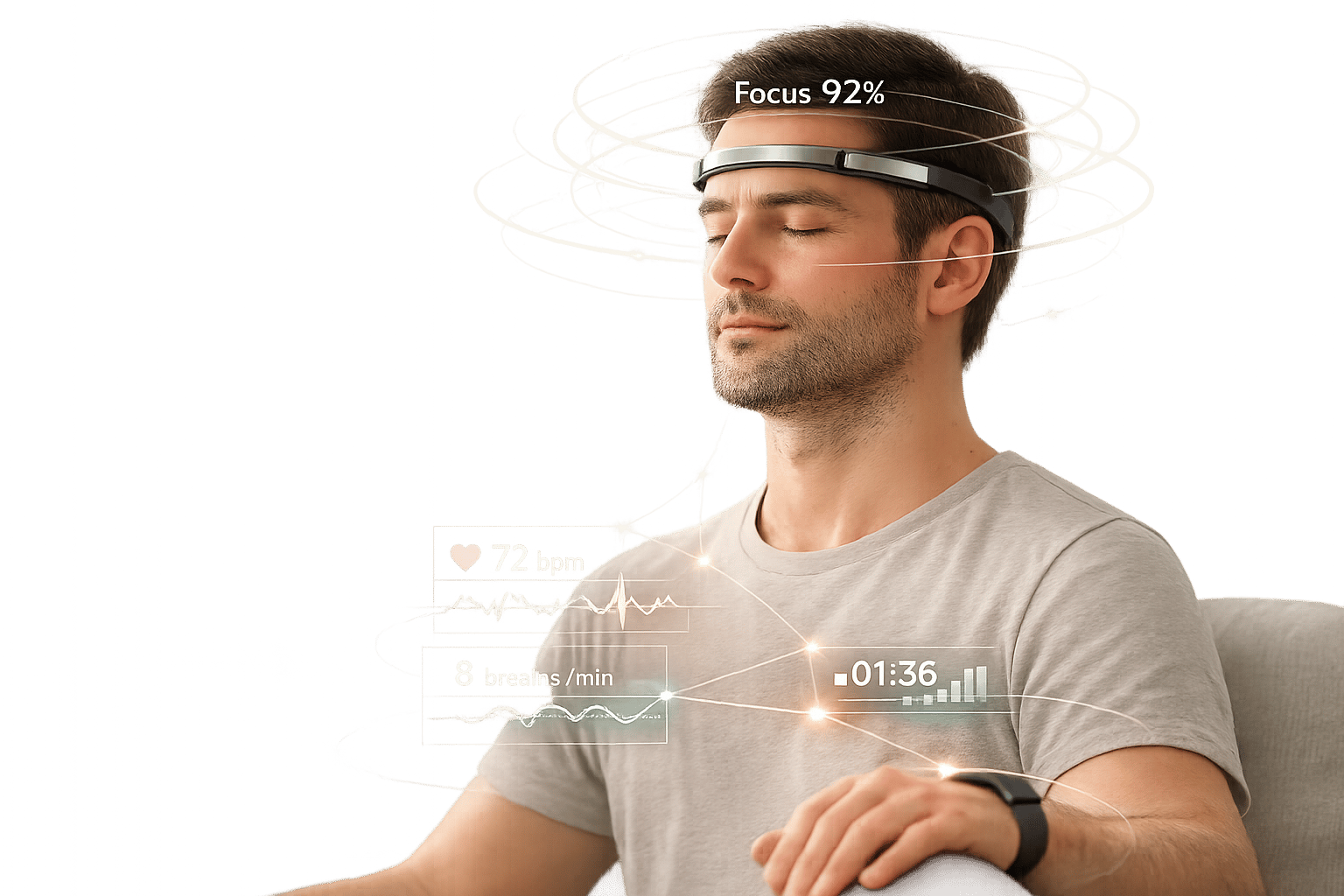
Neurofeedback meditation devices are reshaping mental wellness by providing real-time feedback on brain activity, making meditation more effective and accessible. These devices use EEG and fNIRS sensors to monitor brainwaves and blood flow, helping users improve focus and mindfulness in just weeks. With the market projected to grow from $709.2M in 2024 to $2.96B by 2034, 2026 marks a major turning point for this technology.
Key highlights:
- AI Personalization: Devices like Sens.ai and Neurosity Crown use advanced AI to tailor feedback, enabling faster meditation results.
- Improved Sensors: High-precision wired systems ensure accurate brainwave tracking, reducing interference.
- Health Integration: Platforms like BondMCP connect neurofeedback data with sleep, stress, and fitness metrics for holistic health insights.
- Affordability Options: Budget devices like Mendi ($299) and Muse S Athena ($475) offer quality features, while premium systems like NeurOptimal provide professional-grade solutions.
Despite progress, challenges include high costs, technical limitations, and regulatory confusion. However, with advancements in telehealth and wearable integration and emerging non-EEG technologies, neurofeedback is set to become a key part of home mental health care.
Best Brain Devices for 2026
sbb-itb-f5765c6
Key Trends in Neurofeedback Meditation Devices
In 2026, neurofeedback meditation devices are undergoing a transformation, shaped by three key trends: AI-powered personalization, advanced sensor technology, and integration with broader health ecosystems. These developments are turning standalone gadgets into intelligent tools that adapt to users in real time while aligning with overall health data.
AI-Driven Personalization
Neurofeedback devices are now leveraging advanced AI models like Long Short-Term Memory (LSTM) and Gated Recurrent Units (GRU) to predict cognitive states based on raw EEG data. These models can forecast meditation and attention states with impressive accuracy - LSTM models achieve a Root Mean Squared Error of 10.90, while GRU models reach 11.79. Even more impressive, these predictions occur in under 50 milliseconds, enabling real-time feedback [6].
Fernando Rivas from the University of Burgos highlights the significance of this advancement:
"The key contribution is in the ability to predict future states of attention and meditation. This extends the functionality of BCI systems, allowing them to anticipate user needs" [6].
Devices like Sens.ai (priced at $1,500) and Neurosity Crown (ranging from $899 to $1,199) use this "neuroadaptive" technology to customize feedback - whether through audio, light, or haptic signals - based on a user’s brain activity. This enables users to achieve a flow state in under 5 minutes, a significant improvement over the usual 25+ minutes [7][8].
Meanwhile, systems like NeurOptimal v3.5.0.28 employ adaptive algorithms that reflect the brain's micro-instabilities back to the central nervous system. Unlike traditional setups requiring manual adjustments or professional oversight, these devices evolve alongside the user, offering a seamless and personalized experience [3]. Such advancements rely heavily on precision sensors to deliver instant and accurate feedback.
Advances in Sensor Technology
Capturing brain activity at the millisecond level requires precision, and 2026 systems are prioritizing wired connections over wireless for reduced signal noise and faster feedback loops. As Natalie Baker, founder of Neurofeedback Training Co., explains:
"Wired systems reduce noise and deliver faster, more reliable feedback - important when working with millisecond-level brain activity" [4].
Modern devices also include automatic line-noise cancellation to eliminate interference from environmental electromagnetic sources. This ensures high-quality sessions, whether at home or in a clinic setting [3][4]. Additionally, professional-grade systems now come equipped with powerful hardware, like Intel i5 processors and 16 GB of RAM, to handle the real-time data processing required for dynamic feedback [3].
Unlike budget consumer headsets that average brainwave readings over time, professional systems detect and address maladaptive shifts as they occur. This immediate correction capability is crucial for effective neurofeedback sessions [4].
Integration with Health Ecosystems
With advancements in sensor technology, neurofeedback devices are becoming integral to broader health ecosystems. The trend toward multi-modal data integration allows meditation sessions to both influence and be influenced by other health metrics, such as sleep patterns, heart rate, and stress levels [9]. Saampras Ganesan envisions this as a step toward more accessible mental health tools:
"My long-term vision is to develop a scalable but personalized, science-backed brain-feedback tool that can reliably support meditation training and mental health at a population level... making it accessible in schools, clinics, and homes" [2].
Devices like NeurOptimal now offer hybrid home-training programs, enabling users to rent equipment for three months while receiving guidance from licensed clinicians. This model bridges the gap between consumer gadgets and clinical-grade care [3][4]. Additionally, mobile apps are tracking broader metrics - mood, stress, and mindful awareness - offering a more comprehensive view of emotional well-being [2].
For those seeking deeper integration, platforms like BondMCP (https://bondmcp.com) are leading the way. These platforms act as a unified intelligence layer, connecting neurofeedback data with wearables, lab results, supplement plans, and fitness routines. This eliminates the need for juggling multiple apps, as AI agents synchronize data across systems. For example, your meditation device can inform your sleep coach, while stress data adjusts your workout plan - creating a seamless, automated approach to health optimization.
Current Market Leaders and Their Features
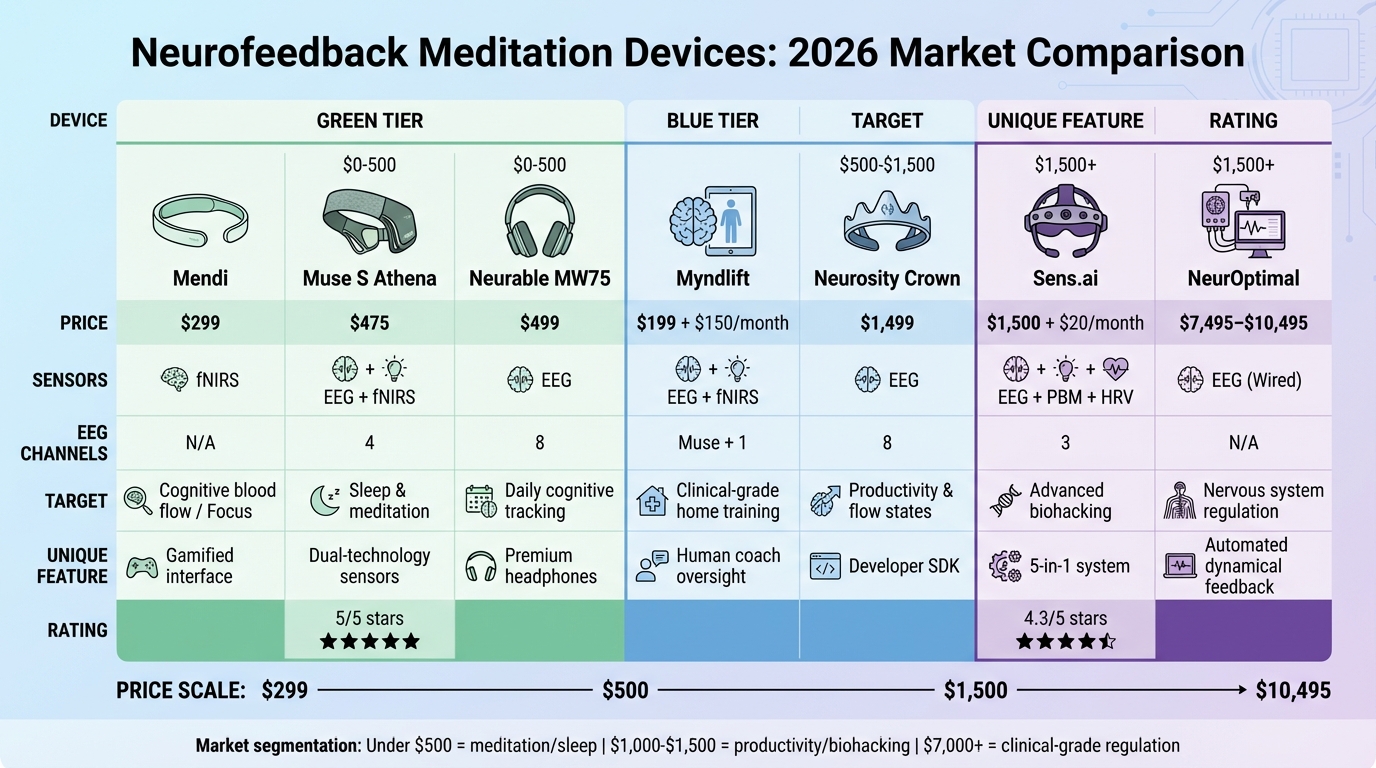
Neurofeedback Meditation Devices Comparison 2026: Features, Prices & Specifications
Top Devices of 2026
The neurofeedback meditation market in 2026 is thriving, offering devices that range in price from $199 to over $10,000. These options cater to a wide audience, from casual users to professionals, leveraging advancements in AI personalization and sensor technology.
Sens.ai is priced at $1,500 with an additional $20 monthly subscription. It combines EEG, HRV, PBM, meditation, and brain mapping. While rated 4.3/5, some users find its design a bit bulky [8].
For budget-conscious buyers, the Muse S Athena ($475) integrates EEG and fNIRS technologies, focusing on sleep tracking and mental recovery. It has earned a perfect 5/5 rating, praised for its well-designed app and high-quality sensors [8]. Another affordable option is Mendi ($299), which uses fNIRS to track prefrontal cortex blood flow in a gamified, subscription-free setup [1].
The Neurosity Crown ($1,499) stands out with its 8 EEG channels, designed to detect flow states and boost productivity. It also offers SDK access, making it a favorite among developers creating brain–computer interface applications [5]. Myndlift (starting at $199 plus $150 monthly) pairs Muse hardware with an additional electrode and provides guidance from human "Neuro Coaches" who create personalized protocols based on qEEG assessments [5].
At the high end, NeurOptimal ($7,495 to $10,495) dominates with its Dynamical Neurofeedback system, which reflects brain instabilities back to the central nervous system without requiring manual adjustments. Natalie Baker, LMHC from Neurofeedback Training Co., highlights its appeal:
"NeurOptimal® remains one of the most widely used systems - because it is the latest professional-grade system providing the brain with real-time information that helps it organize itself more efficiently" [3].
To make this technology more accessible, NeurOptimal offers 3-month rental programs, aligning with the brain's natural learning process [3]. These devices illustrate how cutting-edge tech and affordability are shaping the market landscape in 2026.
Feature and Price Comparison
Here’s a quick overview of the key features and pricing of some of the top devices:
| Device | Primary Sensors | EEG Channels | Target Application | Price | Unique Feature |
|---|---|---|---|---|---|
| Mendi | fNIRS | N/A | Cognitive blood flow / Focus | $299 | Gamified interface |
| Muse S Athena | EEG + fNIRS | 4 | Sleep & meditation | $475 | Dual-technology sensors |
| Neurable MW75 | EEG | 8 | Daily cognitive tracking | $499 | Premium headphones |
| Myndlift | EEG + fNIRS | Muse + 1 | Clinical-grade home training | $199 + $150/month | Human coach oversight |
| Neurosity Crown | EEG | 8 | Productivity & flow states | $1,499 | Developer SDK |
| Sens.ai | EEG + PBM + HRV | 3 | Advanced biohacking | $1,500 + $20/month | 5-in-1 system |
| NeurOptimal | EEG (Wired) | N/A | Nervous system regulation | $7,495–$10,495 | Automated dynamical feedback |
The market is clearly segmented by price and functionality. Devices under $500 focus on meditation and sleep, mid-range options around $1,000–$1,500 are aimed at productivity and biohacking, while premium systems exceeding $7,000 are tailored for specialized, long-term nervous system regulation. This shift reflects a broader trend: home systems now offer capabilities once restricted to clinical neurofeedback setups that used to cost upwards of $20,000 [8].
Challenges Facing the Industry
Despite advancements in technology, neurofeedback meditation devices face a number of hurdles that limit their reach and effectiveness.
Cost and Accessibility
The high price of neurofeedback meditation systems is a major barrier to widespread use. Professional systems like BrainMaster start at $8,290, while clinical sessions typically cost between $150 and $200 each [5]. Even consumer-focused devices often come with hidden expenses - many require subscriptions ranging from $29 to $150 per month. Over time, these costs can surpass the initial hardware investment, and users may find themselves needing costly upgrades to continue making progress [5][4].
Natalie Baker, LMHC and Founder of Neurofeedback Training Co., highlights a critical point:
"Comparing systems solely by price often overlooks value per session and long‑term effectiveness" [4].
Adding to the financial risk, the term "neurofeedback" is unregulated. This means consumers could spend hundreds or thousands of dollars on devices that vary greatly in quality and effectiveness [4].
To address these financial barriers, some companies offer rental programs. For example, NeurOptimal provides three-month training blocks, making professional-grade systems more accessible without requiring a large upfront investment [4]. Similarly, hybrid models like Myndlift combine a $199 starter kit with a monthly subscription to balance affordability with professional guidance [5]. However, cost isn't the only issue - technical limitations also impact usability and performance.
Technical and Usability Issues
Many neurofeedback devices struggle with signal quality and ease of use. Consumer-grade EEG sensors often have trouble distinguishing brain activity from electrical signals generated by eye movements or facial muscles [10]. Robert Thibault, an independent science consultant, explains:
"Consumer EEG devices may pick up the large electrical signals produced by eye movements and other facial muscles, rather than electrical brain activity" [10].
The debate between wireless and wired systems further complicates the picture. While wireless headsets offer convenience, they are prone to signal interference, data loss, and latency issues compared to professional wired systems [4]. Additionally, many consumer devices use lower sampling rates and provide averaged data instead of real-time processing, which can limit their effectiveness [4].
Scientific skepticism also poses a challenge. A 2018 review of over 3,000 neurofeedback studies found just 11 rigorous, double-blind, sham-controlled experiments. Of these, 10 showed no meaningful difference between real and fake neurofeedback [10]. Thibault underscores this point:
"The data from the best studies - double‑blind, placebo‑controlled studies - show that it doesn't matter if you give people real neurofeedback or fake neurofeedback" [10].
While advancements in technology have improved user experiences, tackling these technical and scientific challenges is essential for broader consumer trust and adoption. Integrating personalized wellness protocols can help bridge the gap between raw data and actionable health insights. Beyond usability issues, regulatory complexities add another layer of difficulty.
Regulatory Hurdles
The regulatory environment is a source of confusion for both manufacturers and consumers. Devices marketed for general wellness purposes, such as stress relief or relaxation, are classified as low-risk and largely avoid FDA oversight [10]. Anna Wexler, Assistant Professor of Medical Ethics at the University of Pennsylvania, explains:
"Consumer neurofeedback devices meet the FDA's definition of low‑risk, general wellness products. For this class of devices, the FDA has stated that it will exercise enforcement discretion, meaning that it will not take any further steps to regulate these devices" [10].
However, manufacturers making claims about treating medical conditions like ADHD or depression must go through the FDA's 510(k) clearance process. This process requires significant legal fees and extensive documentation [11]. Currently, the FDA only recognizes biofeedback for five specific purposes: general relaxation, stress management, muscle relaxation, muscle relaxation for pain management, and quality of life management [11].
This regulatory gray area allows devices ranging from basic meditation aids to professional-grade systems to carry the "neurofeedback" label, regardless of their technical precision or effectiveness [4]. Robert Thibault highlights the medical community's perspective:
"The profession of medicine generally does not acknowledge neurofeedback as an evidence‑based treatment. It has never passed U.S. Food and Drug Administration (FDA) approval, and it doesn't have robust clinical trials that support its effectiveness beyond placebo effects" [10].
Future Outlook for Neurofeedback Meditation Devices
Integration with Telemedicine and Remote Care
The world of neurofeedback is evolving quickly, especially as it becomes a vital part of remote mental health systems. Thanks to advancements in telemedicine and sensor technology, home-based neurofeedback is now more accessible than ever. Patients can connect their EEG devices at home with professional "Neuro Coaches" who create and adjust personalized protocols remotely [14] [15].
Dr. Robert Reiner, Executive Director & Founder of Behavioral Associates, shared the practical impact of this shift:
"Our patients love using Myndlift, either as a standalone intervention or as a complementary treatment to other forms of therapy" [14].
These telehealth capabilities are breaking down barriers for individuals who face challenges like distance, mobility limitations, or packed schedules. Systems like NeurOptimal are stepping up to meet this demand by offering flexible financing options - such as 36-month, 0% interest plans - and utilizing advanced hardware to ensure accurate feedback through high sampling rates [3]. With the home neurofeedback market projected to hit $1.8 billion by 2033, growing at a 15% annual rate, integrating telemedicine is quickly becoming the norm [8].
This trend also sets the stage for future innovations, particularly in non-EEG technologies, which promise to push the boundaries of what neurofeedback can achieve.
Emerging Non-EEG Technologies
A new generation of neurofeedback devices is moving beyond traditional EEG methods. Functional Near-Infrared Spectroscopy (fNIRS) is one such technology, measuring brain blood flow and oxygen levels to provide insights into cognitive workload and metabolic activity that EEG cannot [1]. Similarly, Hemoencephalography (HEG) and Photobiomodulation (PBM) are being incorporated into devices to measure and even influence brain activity more effectively. For example, Mendi (priced at $299) uses HEG technology, while the Sens.ai headset (around $1,500) combines multiple modalities into a single device [1] [13].
Meanwhile, researchers at Stanford Medicine are exploring cutting-edge techniques. Assistant Professor Raag Airan is working on combining focused ultrasound with nanotechnology to deliver drugs like ketamine to precise brain regions. This approach targets areas as small as a grain of rice, reducing side effects for conditions like chronic pain and epilepsy [12].
Dr. Fiona Baumer, Assistant Professor of Neurology at Stanford Medicine, highlighted the potential of these innovations:
"Non-invasive methods for studying these questions - and treating some of these problems - will be a game changer, particularly for children" [12].
These advancements hint at a future where neurofeedback devices are not only more powerful but also easier to use and less reliant on constant supervision.
A Unified Approach to Personal Health Optimization
As remote care and sensor technologies advance, a broader trend is emerging: the integration of neurofeedback into larger health ecosystems. By 2026 and beyond, these devices are expected to seamlessly connect with other wellness tools, offering a more complete picture of health. Already, platforms are enabling users to see how brainwave patterns respond to factors like caffeine, sleep, and medications [14].
For many, managing multiple wearables and apps can feel overwhelming, often leading to conflicting advice. This is where platforms like BondMCP come in. BondMCP acts as a central hub, allowing neurofeedback devices to sync with sleep trackers, lab results, supplement plans, and fitness routines. Instead of viewing brainwave data in isolation, users can link their meditation sessions to recovery metrics, stress levels, and cognitive performance. Developers benefit from structured tools to create smarter health applications, while clinics and biohackers can scale precision health solutions by unifying scattered data.
Natalie Baker, LMHC and Founder of Neurofeedback Training Co., summed up the vision perfectly:
"The most effective system is the one that matches the complexity of what your brain is navigating" [4].
As neurofeedback devices grow in sophistication, their real power will lie in how well they integrate with the rest of your health data - creating a system where every piece of information contributes to better outcomes.
Conclusion
Neurofeedback meditation devices have come a long way - from being specialized clinical tools to becoming AI-powered wearables that are transforming mental wellness in 2026. What once required bulky, expensive equipment is now accessible through sleek, affordable gadgets that provide real-time brain insights. This shift has opened up a fast-growing market.
The standout trend this year? Personalization. As Dubravka Rebic aptly put it:
"Neurofeedback isn't one thing anymore... the real shift [is] the fact that it's finally configurable to you" [1].
Today's devices are equipped with multiple sensors to offer a deeper understanding of brain activity and metabolic health. AI platforms and remote coaching services now deliver clinical-level guidance straight to your home, removing traditional barriers like high costs and limited access. This level of customization is setting the stage for a new era of health management.
But the true power of neurofeedback lies in its integration with broader health ecosystems. As these devices grow more advanced, their impact increases when combined with other health tools. Platforms like BondMCP are tackling the long-standing issue of fragmented health data. By connecting neurofeedback insights with sleep trackers, lab results, fitness plans, and supplement regimens, they turn isolated data points into actionable strategies. This makes meditation sessions more effective for improving recovery and managing stress.
FAQs
How do I know if a neurofeedback device is actually accurate?
To evaluate the accuracy of a neurofeedback device, start by checking if it provides real-time feedback with minimal delay - delays can undermine the reliability of the results. Look for published scientific studies that confirm the device's ability to detect brain signals, like EEG microstates, accurately. It's also important to ensure the device demonstrates consistent performance across multiple sessions. Devices that have been rigorously tested in controlled environments and produce reproducible results tend to be more dependable. Consistency and validated data are essential markers of a device's accuracy.
Are wired neurofeedback systems worth the extra hassle at home?
Wired neurofeedback systems might require more effort to set up and use, but they often deliver better signal quality and more accurate feedback. This can make them more effective for brain training, particularly when compared to wireless devices designed for general consumers. Think about your specific goals and whether the increased complexity is worth the potential advantages.
How does BondMCP connect neurofeedback with sleep and fitness data?
BondMCP brings together neurofeedback, sleep, and fitness data into a single, smart platform. It connects neurofeedback devices with sleep trackers and fitness wearables, creating a system where brain activity is analyzed alongside sleep patterns and physical activity. This integration provides tailored insights and can even automate changes - like fine-tuning sleep schedules or fitness routines based on neurofeedback results. The goal is to create a more connected and personalized way to improve overall health and well-being.