

Healthcare organizations handle highly sensitive patient data, making secure key management a critical component of compliance and data protection. Key management involves the lifecycle of cryptographic keys - generation, storage, distribution, rotation, and destruction - to ensure data security and restrict access. Poor practices can lead to data breaches, costly fines, and loss of trust.
Here’s why it matters:
- Compliance: Regulations like HIPAA and the HITECH Act mandate encryption and secure key handling to protect electronic protected health information (ePHI).
- Risk Reduction: Proper key management prevents breaches and exempts encrypted data from being classified as compromised under the Breach Notification Rule.
- Fines and Penalties: Violations can cost up to $2.19 million per category annually, as seen in past cases like the $3.2 million fine for Children's Medical Center of Dallas.
Key practices include:
- Following NIST Standards: Use FIPS 140-3 validated modules and algorithms like AES-256 for encryption.
- Secure Storage: Store keys in tamper-resistant environments like Hardware Security Modules (HSMs).
- Access Controls: Implement role-based access and multi-factor authentication.
- Key Rotation: Regularly update keys to limit exposure, with clear schedules for different key types.
- Monitoring and Auditing: Log all key access and maintain tamper-evident records.
Governance ensures consistency, with roles like Chief Information Security Officer (CISO) and Key Management Officer (KMO) overseeing policies, audits, and compliance. Organizations must document processes in a Key Management Plan (KMP), review them annually, and prepare for evolving regulations, like the mandatory encryption rule proposed for 2024.
Key management is not just a technical process but a safeguard against breaches, fines, and reputational harm. Strong governance and adherence to standards are essential for protecting patient data and maintaining compliance.
HIPAA Compliance Essentials: Key Requirements and FAQs
sbb-itb-f5765c6
Compliance and Regulatory Requirements
When it comes to secure key management, U.S. healthcare organizations must navigate a landscape shaped by federal laws. At the heart of this framework are two major regulations: the HIPAA Security Rule and the HITECH Act.
HIPAA Security Rule and Key Management
The HIPAA Security Rule requires healthcare entities and their business partners to safeguard electronic protected health information (ePHI) through a combination of administrative, physical, and technical measures. Among these, encryption is listed as an "addressable" specification. This means organizations must either implement encryption or provide a documented, risk-based justification explaining why they’ve chosen an alternative approach [4].
Most organizations opt for encryption, but the Security Rule goes further by requiring access controls, audit logging, and integrity checks - all of which are deeply connected to key management practices. Federal guidance directs organizations to follow NIST standards for managing key lifecycles and selecting approved algorithms. Additionally, cryptographic modules must meet FIPS 140-3 validation by September 22, 2026, as certifications under the earlier FIPS 140-2 standard will no longer be accepted for new deployments [5].
These technical safeguards are crucial for understanding how the HITECH Act handles breaches.
HITECH Act and Breach Notification
The HITECH Act introduced the Breach Notification Rule, which requires organizations to notify affected individuals, the Department of Health and Human Services (HHS), and sometimes the media if unsecured PHI is compromised.
Encryption offers a critical "safe harbor" under this rule. If ePHI is encrypted according to NIST standards and the encryption keys remain secure, the incident is not classified as a reportable breach. However, if both the encrypted data and the keys are accessed, safe harbor protections no longer apply:
"If an unauthorized individual accesses both encrypted PHI and the keys capable of decrypting it, the safe harbor does not apply." – Kiteworks [7]
The HHS emphasizes the importance of separating keys from the data they protect:
"To avoid a breach of the confidential process or key, these decryption tools should be stored on a device or at a location separate from the data they are used to encrypt or decrypt." – HHS.gov [6]
Failing to meet these standards can be costly. Data breaches involving improperly managed encryption and keys can result in average breach costs exceeding $10 million [7].
To maintain compliance, organizations must also focus on thorough documentation and auditing practices.
Documentation and Audit Expectations
The Office for Civil Rights (OCR) requires organizations to maintain detailed documentation to demonstrate compliance. This includes a formal Key Management Plan (KMP), architectural diagrams, and specifications for managing the entire key lifecycle [5]. Risk assessments tied to cryptographic controls must be updated at least every three years, or sooner if significant changes occur [5].
HIPAA also mandates tamper-evident audit logs for key access and requires organizations to retain documentation for at least six years [4]. Additionally, third-party vendors handling ePHI must operate under a signed Business Associate Agreement (BAA) [4].
| Documentation Type | Purpose | Required By |
|---|---|---|
| Key Management Plan (KMP) | Structured key lifecycle management | CMS / NIST [5] |
| Risk Assessment | Review of security controls and potential risks | FISMA / CMS (every 3 years) [5] |
| Business Associate Agreement (BAA) | Third-party responsibilities for protecting ePHI | HIPAA [4] |
| Audit Trails | Tamper-evident records of access, search, and export actions | HIPAA / OCR [4] |
| Key Rotation Policy | Key rotation intervals and procedures | NIST SP 800-57 / HIPAA [4] |
Looking ahead, healthcare organizations should prepare for potential changes. In December 2024, HHS proposed a rule that would eliminate encryption’s "addressable" status, making it mandatory for all covered entities. This proposal also includes a 72-hour deadline for notifying HHS after a security incident [4]. If finalized, these changes will significantly increase compliance requirements across the industry.
Technical Best Practices for Key Management
When it comes to healthcare, effective key management isn't just about meeting regulations - it's about building a system that keeps sensitive data safe from evolving threats.
Key Generation and Cryptographic Standards
The first step in key management is proper key generation. Any cryptographic keys safeguarding ePHI should be created within modules validated under FIPS 140-2 or FIPS 140-3 standards [8][5]. These keys must rely on random values generated by an internal, validated Random Bit Generator.
For encryption, AES-256 is the go-to choice for securing data at rest. For digital signatures and key establishment, use RSA with at least 2,048 bits or Elliptic Curve Cryptography (ECC) with curves like P-256 or P-384 [5]. It's critical to assign each key a single purpose to reduce potential damage if compromised. As OWASP emphasizes:
"A single key should be used for only one purpose... Limiting the use of a key limits the damage that could be done if the key is compromised." [8]
Healthcare organizations should also begin preparing for post-quantum cryptography (PQC). With NIST actively approving PQC algorithms, transitioning early ensures readiness for future threats [5].
Once keys are generated, maintaining their security through proper storage and access control is equally important.
Secure Storage and Access Controls
Keys must be stored as securely as they are created. Hardware Security Modules (HSMs) offer tamper-resistant environments that safeguard cryptographic operations, making it incredibly difficult for attackers to extract key material [8][5]. For organizations without on-premises resources, cloud-based Key Management Services (KMS), like AWS KMS, provide a viable alternative. These services often include automated workflows, reducing the risk of human error [2].
Access to keys should follow strict role-based access control (RBAC) and require multi-factor authentication (MFA). Adopting the principle of least privilege ensures that only those who absolutely need access to a key can obtain it. Limiting access to specific time frames further reduces risks if credentials are compromised.
Key Lifecycle Management and Rotation
Keys go through distinct phases: Pre-operational (generated but inactive), Operational (actively in use), Post-operational (deactivated or archived), and Destroyed (securely deleted, with metadata retained for audits) [3]. CMS policy mandates that cryptographic keys be rotated at least annually [2], though many organizations opt for shorter intervals based on the data's sensitivity:
| Key Type | Recommended Rotation Frequency |
|---|---|
| Data Encryption Keys (DEKs) | Every 90–180 days or based on data volume [9] |
| Key Encryption Keys (KEKs) | Every 6–12 months [9] |
| Master Keys | Every 12–24 months, or after major security events [9] |
| Session Keys | Short-lived; use ephemeral key exchange (e.g., TLS 1.3) [9] |
Automating key rotation through cloud-native tools or a Cryptographic Key Management System (CKMS) ensures consistency and reliability. When retiring a key, secure destruction is essential to prevent recovery. The CMS Key Management Handbook underscores this point:
"Data that has been encrypted with lost cryptographic keys will never be recovered. Therefore, it is essential that the application incorporate a secure key backup capability." [5]
Automated processes for rotation and destruction minimize vulnerabilities and set the stage for effective monitoring.
Monitoring and Incident Response
Even with strong key generation, storage, and lifecycle practices, continuous monitoring is vital. Every key access event should be logged, capturing details like identifier, timestamp, protected data, and purpose [8][5]. The CMS Key Management Handbook highlights the importance of accountability:
"Accountability involves clearly identifying and documenting individuals or systems that have access to or control over cryptographic keys throughout their entire lifecycle." [3]
Monitoring should happen in real-time and integrate with your organization's incident response plan. This plan must include steps for emergency key revocation and deploying replacement keys quickly if a breach occurs [3]. Additionally, separating duties is critical: the teams responsible for auditing key management should not overlap with those handling key generation or distribution [2].
These monitoring practices form the final layer of a secure key management system, essential for maintaining compliance and protecting sensitive healthcare data.
Key Management Models for Healthcare Organizations
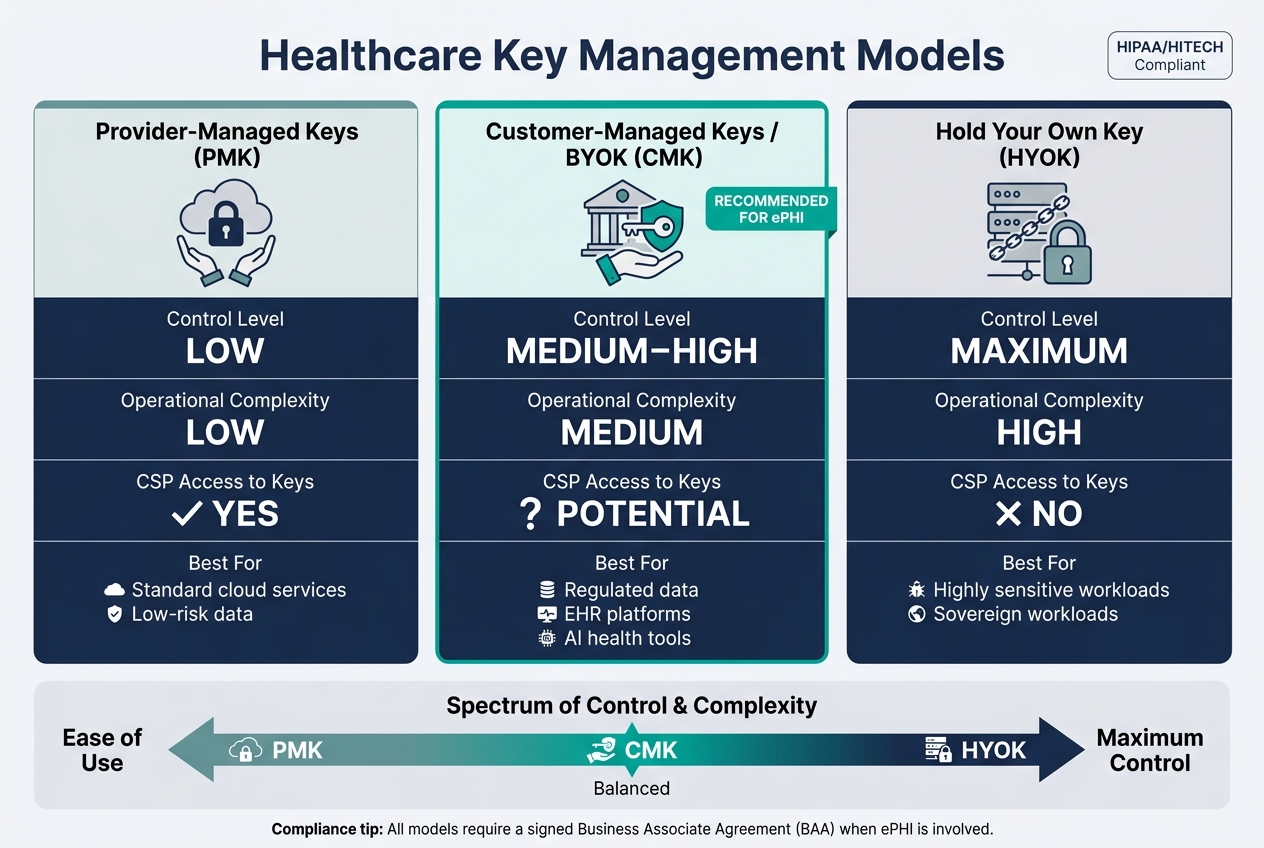
Healthcare Key Management Models: CMK vs PMK vs HYOK Compared
Healthcare organizations vary widely in their resources, risk tolerance, and operational needs. Selecting the right key management model depends on how much control, complexity, and compliance your organization can handle.
Customer-Managed Keys (CMK)
With CMK, your organization takes charge of the entire key lifecycle - generation, rotation, and destruction - while the cloud provider hosts the keys. As Microsoft Learn explains:
"By using customer-managed keys (CMK), you can protect and control access to your organization's data with keys that you create and manage." [10]
This model is particularly suited for high-risk systems like Electronic Health Records (EHR) platforms or AI-driven health apps. For example, tools like Healify, which handle sensitive biometric, bloodwork, and lifestyle data, benefit from CMK because your organization retains ultimate authority over data access.
In a technical setup like Azure FHIR services, CMK often involves RSA 2,048-bit or 3,072-bit keys stored in a validated Key Vault with features like soft delete and purge protection enabled [10]. Without these safeguards, accidental key deletion could render encrypted data permanently inaccessible, creating a serious operational risk.
Provider-Managed Keys (PMK)
PMK is the simplest option, where the cloud service provider (CSP) manages the entire key lifecycle - generation, storage, and rotation - under a shared responsibility model. This approach offers encryption without the burden of operational management, but it means the CSP technically has access to your keys [11].
For general cloud storage or less sensitive workloads, PMK is often enough. However, if electronic Protected Health Information (ePHI) is involved, it’s critical to review your Business Associate Agreement (BAA) to ensure the provider’s responsibilities regarding key security and breach notification are clearly defined. While PMK reduces the workload for your team, your organization is still responsible for meeting compliance standards.
Hybrid Key Management Solutions
Hybrid models often use Bring Your Own Key (BYOK), where key material is created in-house (using tools like an on-premises Hardware Security Module) and then imported into the cloud. This approach balances the scalability of cloud platforms with more control over key management. In some cases, organizations may adopt a Hold Your Own Key (HYOK) model, where keys remain entirely on-premises, and the CSP has no access. While HYOK provides maximum control, it introduces added complexity and potential latency.
Hybrid solutions are particularly appealing for organizations that must meet strict standards like FIPS 140-3 while using cloud-based EHR or AI platforms. However, managing keys across both cloud and on-premises environments requires clear procedures, and costs like monthly storage fees or API usage charges (e.g., AWS Customer Managed Keys) should be factored into the decision [2][12].
Here’s a quick comparison of the three models:
| Model | Control Level | Operational Complexity | CSP Access to Keys | Best For |
|---|---|---|---|---|
| PMK | Low | Low | Yes | Standard cloud services and low-risk data |
| CMK / BYOK | Medium–High | Medium | Potential | Regulated data, EHR platforms, AI tools |
| HYOK | Maximum | High | No | Highly sensitive or sovereign workloads |
Choosing the right model isn’t about aiming for the most secure option on paper - it’s about finding one your team can implement and maintain effectively without introducing new risks. A clear understanding of these models is essential for building a solid key management strategy.
Key Management Governance in Healthcare
While technical practices are crucial for securing and managing encryption keys, governance ensures these measures are applied consistently across the organization. Without clear ownership and accountability, even the best encryption setup can fail. Governance ensures that key management policies are not just created but actively enforced.
Defining Roles and Responsibilities
Successful key management starts with assigning clear responsibilities. At the executive level, leaders like the Chief Information Officer (CIO), Chief Information Security Officer (CISO), and Senior Official for Privacy (SOP) are tasked with developing and maintaining the organization's overall security and privacy policies [5]. Additionally, organizations should appoint a Key Management Officer (KMO) - often someone from the Information System Security Officer (ISSO) or DevSecOps team - to handle daily key lifecycle tasks such as generation, rotation, and destruction [2].
Another critical governance principle is the separation of duties. High-risk cryptographic actions like key creation, activation, and destruction should require dual control, ensuring no single person can complete these tasks alone [9]. This approach not only strengthens internal controls but also supports compliance with HIPAA and HITECH regulations.
| Role | Primary Responsibility |
|---|---|
| CIO / CISO / SOP | Policy development and overall security oversight |
| Key Management Officer | Day-to-day management of key lifecycle activities |
| ADO / DevSecOps | Technical implementation and creation of Key Management Plans |
| ISSO | Compliance review and audit monitoring |
| Key Administrator | Managing key files and access permissions |
Documenting Policies and Procedures
The CMS Key Management Handbook emphasizes this point:
"The security of the cryptosystem is dependent upon successful key management." [5]
Maintaining thorough documentation is essential. Every healthcare organization should have three key documents: a Key Management Policy, a Key Management Plan (KMP), and a Key Management Architecture [5]. The KMP, in particular, should be reviewed and updated annually - or sooner if significant system changes occur.
A simple yet effective starting point is to use a five-question framework for every key set:
- How are keys generated?
- Where are they stored?
- Who has access to them?
- How often are they rotated?
- How are they revoked?
If any of these questions can't be answered in writing, it highlights a gap that needs attention. Regular testing and updates to these policies ensure the organization is prepared for evolving challenges.
Testing and Continuous Improvement
Creating policies is only the beginning. Annual tabletop exercises simulating key compromise and recovery are critical for testing incident response protocols under pressure [2]. These simulations can reveal gaps, such as missing backup keys or unclear escalation procedures, before a real incident occurs.
Additionally, monthly audits of key usage logs can help identify anomalies early. Verifying the integrity of keys after rotation and automating key rotation processes further reduce risks tied to outdated or neglected keys [1][2].
Organizations like Healify, which manage sensitive health data, depend on these governance practices to safeguard patient information effectively.
Conclusion: Better Data Security Through Key Management
Encryption alone doesn't fully safeguard healthcare data. As the CMS Key Management Handbook puts it, "The security of the cryptosystem is dependent upon successful key management" [5]. This point is especially critical given that over 133 million healthcare records in the U.S. were exposed due to breaches in 2023 [1]. These numbers make it clear: practical and error-free key management isn't optional - it's essential.
Consider the 2017 breach at Children's Medical Center of Dallas, which illustrates how poor key management can lead to significant consequences, including costly fines and regulatory scrutiny [4]. With penalties exceeding $2,190,294 per violation, weak practices not only drain financial resources but also erode patient trust [4]. Strong key management, on the other hand, protects both an organization's reputation and its bottom line.
Key management isn't a one-time task; it's an ongoing discipline. As regulations evolve - like the proposed 2024 HHS rule and the September 22, 2026 FIPS 140-3 mandate [3] - the bar for compliance will only rise. Organizations that embed key management into their daily operations will be far better equipped to meet these challenges.
Platforms such as Healify, which handle sensitive personal health data, exemplify this approach. By adhering to robust key management principles, they ensure that patient information stays private, secure, and tightly controlled, safeguarding trust throughout the data's entire lifecycle.
FAQs
Does HIPAA require encryption for ePHI?
As of the 2026 update, HIPAA now mandates encryption for all electronic protected health information (ePHI). This applies to data both at rest and in transit. Unlike previous guidelines that allowed some flexibility, encryption is now a required safeguard. This change aims to ensure compliance and strengthen the protection of sensitive healthcare data.
When does encryption still count as a breach under HITECH?
Encryption is considered a breach under HITECH if unauthorized individuals access or obtain the data and it fails to meet safe harbor standards. This typically occurs when the encryption is either poorly implemented or compromised, which then activates the requirement for breach notifications.
How do we choose between PMK, CMK, and HYOK?
Choosing between PMK (Provider-Managed Keys), CMK (Customer-Managed Keys), and HYOK (Hold Your Own Key) comes down to how much control, security, and complexity your organization can handle.
- PMK: Ideal if you want a straightforward solution with minimal management effort, though it offers less control over encryption keys.
- CMK: A solid choice for organizations needing more control and the ability to meet specific compliance standards.
- HYOK: Offers the highest level of security since you maintain complete control of your keys, but it comes with added complexity and operational overhead.
The best option will depend on your organization's security priorities, compliance obligations, and ability to manage the associated workload.