
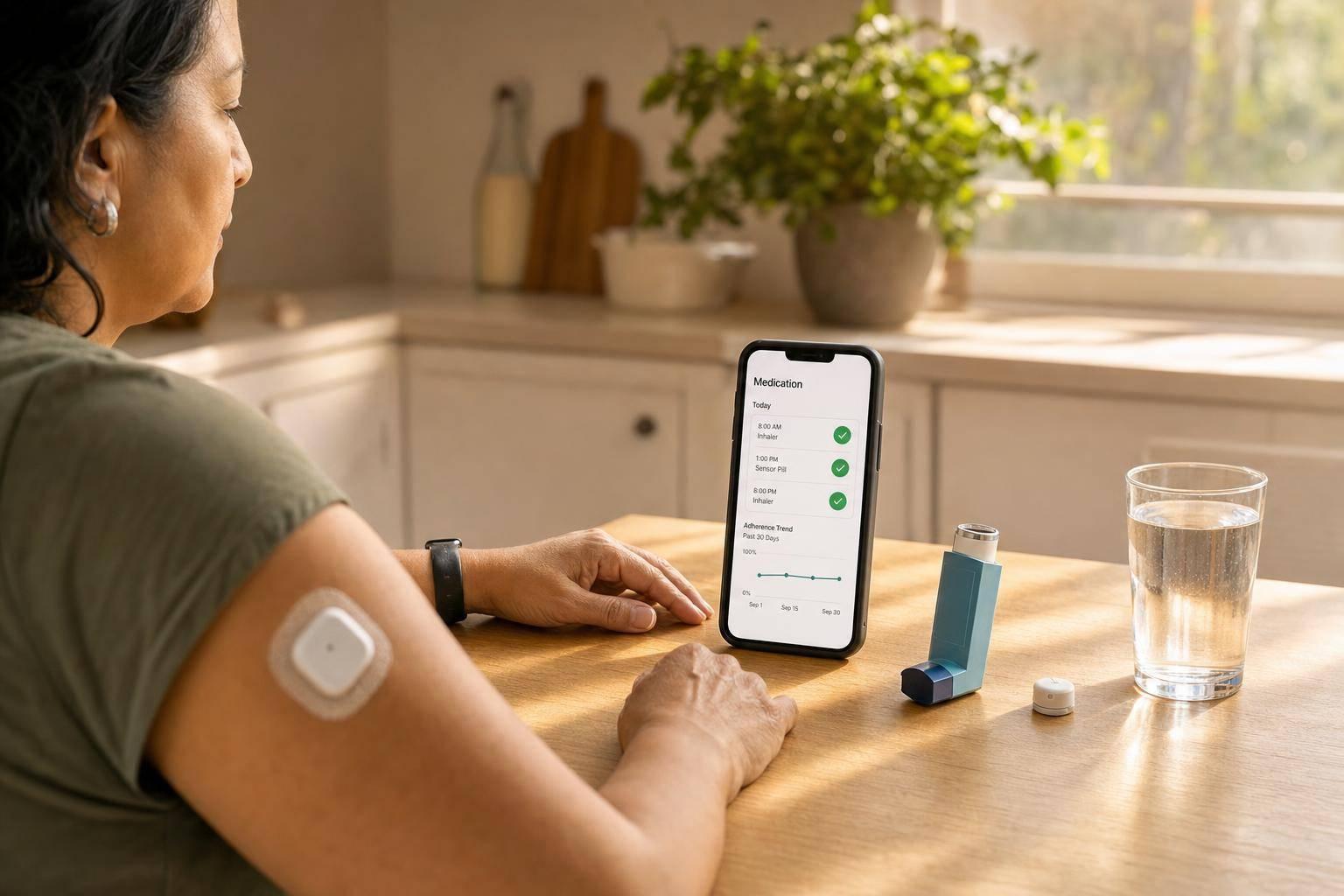
Here’s the short answer: AI wearables can help people take medicine more often, but the results depend a lot on the device. The strongest study results are for smart inhalers. Smartwatches and digital pills can track use well, but they still have a weaker link to better long-term health.
If you want the main takeaways fast, here they are:
- About 50% of people with chronic illness do not take medicine as directed.
- Nonadherence is linked to about 125,000 deaths per year in the U.S.
- The cost to the U.S. health system is estimated at $100 billion to $300 billion+ each year.
- Smart inhalers have the best study support, with adherence gains like 82% vs. 71% in one asthma trial.
- Ingestion sensors can log pill swallowing with about 96.6% to 99.3% detection in trials.
- Smartwatch systems can spot pill-taking gestures with high accuracy in test settings, but daily-life proof is still limited.
- Better tracking does not always mean better blood pressure, fewer hospital visits, or better disease control.
- Cost, setup, charging, Bluetooth issues, privacy concerns, and alert overload can limit use.
In other words: these tools are best at tracking and nudging, not guaranteeing health gains.
What the studies point to most often:
- Best-supported use case: asthma and COPD inhalers
- Best for direct pill confirmation: ingestion sensors
- Best for low-friction behavior tracking: wrist-worn devices
- Biggest gap in the research: long studies that show health outcomes, not just dose logs
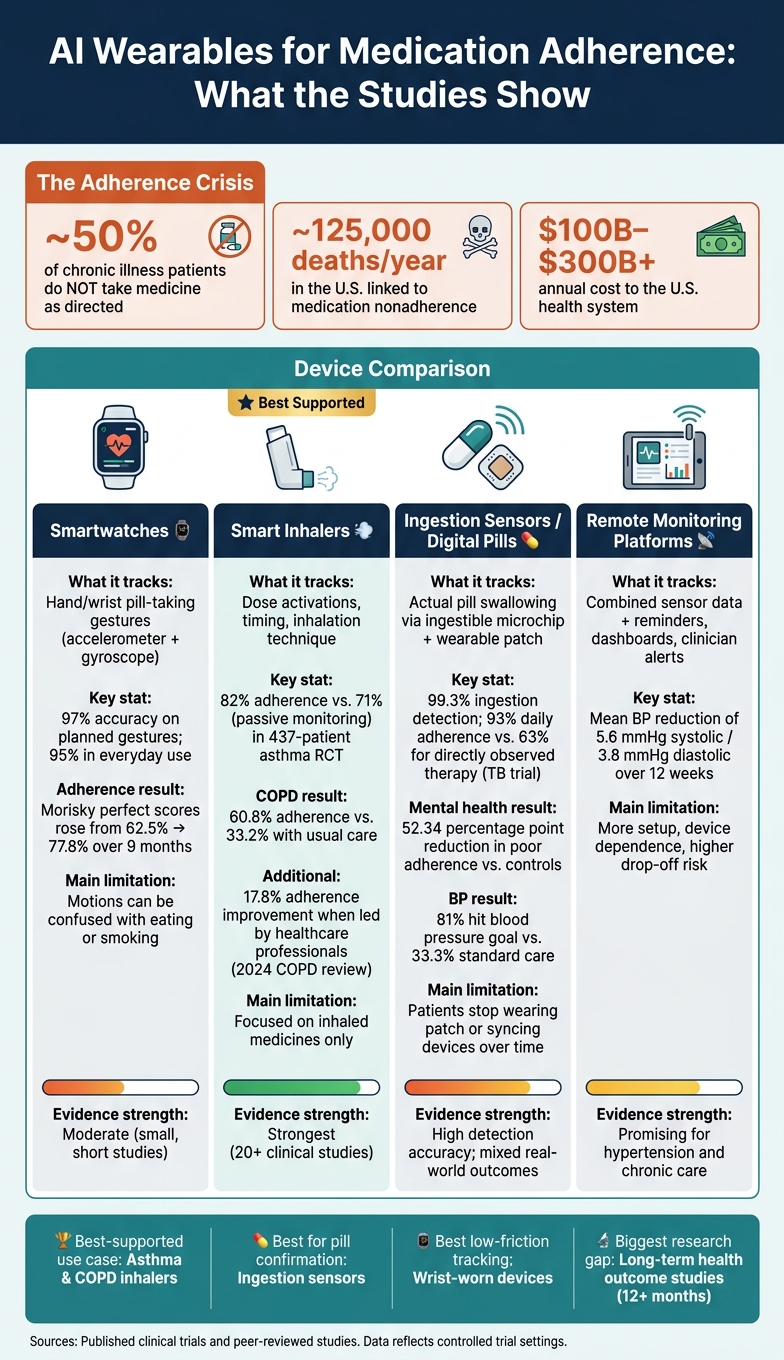
AI Wearables for Medication Adherence: Device Comparison & Key Stats
Medicine Without Walls: Wearables, AI, and the Future of Chronic (Inflammatory) Disease Monitoring
Quick Comparison
| Device type | What it tracks | What studies show | Main limitation |
|---|---|---|---|
| Smartwatches | Hand and wrist motions linked to pill-taking | Good detection accuracy in small studies; some adherence lift | Daily-life mix-ups with eating, smoking, and other motions |
| Smart inhalers | Inhaler actuations, timing, and sometimes technique | Best support for adherence gains and fewer flare-ups | Focused mostly on inhaled medicines |
| Ingestion sensors / digital pills | Actual pill ingestion signal | Very high detection in trials | Users may stop wearing patches or syncing devices |
| Remote monitoring platforms | Sensor data plus reminders, dashboards, and coaching | Can help in hypertension and other chronic care programs | More setup, more device dependence, and more drop-off risk |
So if you’re asking whether AI wearables for medication work, my take is simple: yes, some do help, especially when they track a clear daily action and pair that data with feedback for patients and care teams. But the field still needs more 12-month+ studies in day-to-day care to show whether those adherence gains turn into better health over time.
How AI wearables track medication use
Smartwatch gestures, inhaler sensors, and ingestion tracking
Published research tends to focus on three main sensor types. Each one tracks a different physical signal.
Smartwatches use accelerometers and gyroscopes to spot pill-taking motions, like opening a bottle or moving a hand to the mouth. In one study, MedSensor reached 97% accuracy on planned gestures and 95% in everyday use.[15] The big issue is simple: a pill-taking motion can look a lot like eating or smoking. Even so, one feasibility study reported 96.5% correct detection and 94.5% correct rejection.[19][21]
Smart inhalers use built-in sensors to log each dose activation with a timestamp. More advanced setups can also record inhalation duration and peak flow data.[5][13][16] That matters because it shows not just whether someone used the inhaler, but whether they used it the right way.
Ingestible sensors take a more direct route. A microelectronic chip inside the tablet activates when it touches stomach fluid, then sends a signal to a wearable patch that logs the exact ingestion time. In a tuberculosis trial, this system detected 99.3% of ingestions and recorded 93% daily adherence, compared with 63% for directly observed therapy.[9]
On top of these direct signals, general wearables can add indirect behavior data, such as step counts, sleep regularity, and heart rate patterns. Research on psychiatric medications found that people with steadier daily activity rhythms had significantly higher next-day medication adherence than people with irregular patterns.[11] These signals don't prove that a specific dose was taken. But they can help flag who may be more likely to miss one.
Those signals only matter once software turns them into adherence events.
How algorithms turn sensor signals into adherence data
Raw sensor data has to be classified before it becomes adherence data. Machine learning models, especially LSTM networks, convolutional neural networks, and artificial neural networks, are trained on labeled examples to decide whether a motion sequence or dose activation reflects a real medication event.[8][12][15] One AI adherence framework using LSTM models reported an AUC of up to 0.87 for predicting next-day adherence from IoT and wearable data.[22]
From there, adaptive systems can act on the pattern. They time reminders around a person's usual medication routine, cut back on nudges when adherence is already strong, and step up support when risk goes up. Some systems also alert clinicians when adherence falls below a set threshold.[10][14][1]
Where AI coaching platforms fit in
Once the data is classified, it can drive action. These platforms turn sensor data into reminders, trend alerts, or clinician flags.
sbb-itb-f5765c6
What studies show about adherence and health outcomes
Smartwatches and wearable reminders
The big issue is simple: does better tracking and feedback lead to better adherence and better health?
So far, smartwatch studies suggest small but real gains in adherence, but the long-term clinical picture is still thin. In one atrial fibrillation study, smartwatch reminders increased the share of patients with perfect Morisky scores (8/8) from 62.5% at one month to 77.8% at nine months. More than 90% of participants also stayed at or above 80% days covered.[20]
Still, most of this work is in the early stages. Many studies include only a few dozen people, last from a few days to a few weeks, and test patients in fairly controlled settings. That makes it hard to say how well these tools hold up across diverse, day-to-day populations over time. Right now, there is still limited proof that smartwatch systems lead to lasting clinical gains at scale.
Smart inhalers, remote monitoring, and chronic disease outcomes
This is the area where the data look more convincing.
A randomized controlled trial in 437 adults with uncontrolled asthma found that a digital inhaler plus smartphone feedback pushed adherence to 82% over 24 weeks, compared with 71% for passive monitoring alone. That was a statistically significant 12-percentage-point gap.[3][26] In a separate COPD trial, maintenance inhaler adherence reached 60.8% with electronic monitoring plus behavioral feedback, versus 33.2% with usual care.[3] Across more than 20 studies, digital inhalers improved adherence and often cut exacerbations.[3][26]
Remote monitoring for hypertension shows a similar pattern. In one real-world study of 141 adults with uncontrolled blood pressure using an AI-driven coaching program with wearable BP monitors, participants had mean reductions of 5.6 mmHg systolic and 3.8 mmHg diastolic over 12 weeks.[27] In another hypertension study using ingestible sensors, 81% of digital pill system users hit their blood pressure goal, compared with 33.3% in standard care over four weeks.[17][6]
Put plainly, when the tool is tied to a clear daily behavior, like using an inhaler or checking blood pressure, the results tend to look stronger.
Ingestion sensors and mixed results
Ingestion sensors are very good at recording whether a pill was taken. In controlled trials, detection accuracy ranges from 96.6% to 98.3%. And in 12-month randomized data involving serious mental disorders, a digital medication system reduced poor adherence by an adjusted risk difference of 52.34 percentage points compared with controls.[29][28]
But there’s a catch: accurate logging is not the same thing as better health.
Outside controlled settings, people may stop wearing the patch, forget to pair devices, or just lose interest over time.[18][23] That drop-off matters. The FDA labeling for the aripiprazole tablet with sensor, Abilify MyCite, states that claims of improved adherence have not been proven. It also warns that ingestion data should not be used in emergencies because detection may be delayed.[24][22][25]
That’s why this tech makes more sense as a monitoring and support tool than as proof that a patient will do better clinically.
Overall, digital inhalers and connected monitoring have the strongest evidence for better adherence and short-term outcomes. Smartwatch and ingestion-sensor findings are more mixed.
Limits, risks, and who may be left out
Why the evidence is still uneven
The evidence base is uneven. Study methods differ, researchers define adherence in different ways, and short follow-up periods make it hard to tell whether the gains stick.[16][33][10] That matters most when the goal is long-term support, not a short burst of tracking. And the people who may need the most help are often the hardest to study and the easiest to leave out.
Tracking itself can also change behavior. Some patients may take medication more consistently while they know they’re being monitored, then slip back once the tracking ends. That makes it tough to separate lasting behavior change from short-term reactivity.[16][10]
Privacy, usability, and alert fatigue
With digital pill systems, data usually travel from the sensor to a wearable receiver and then to cloud storage. If security is weak at any point, access risks go up.[37] But security isn’t the only issue. Day-to-day reliability can be just as big a problem.
And there are plenty of ways reliability can break down. Batteries die. Devices need charging. Bluetooth connections drop. Those gaps can leave holes in the record, and smart inhalers or motion-based pill detection systems can still label events the wrong way.[10][31][34][35] In plain terms, adherence logs can help, but they’re still estimates, not proof.
Then there’s alert fatigue. Too many nudges can backfire. Frequent push notifications, repeated refill reminders, and stacked prompts from several apps can wear people down until they start ignoring all of them. Research on clinical decision support shows that when alert volume gets too high, response rates fall over time. The same pattern shows up here.[30][32]
Cost, access, and equity in U.S. care
These systems can cost hundreds of dollars per year without insurance coverage, and coverage is still inconsistent.[31][10][36] For many patients in the United States, that price alone is enough to shut the door.
The access gap goes past cost. Across the country, 15% of adults age 65 and older have no internet access, and about two-thirds of that group say cost is the main reason.[38] So if a system depends on a smartphone, Bluetooth, and broadband, a lot of people are left out from the start.
Older adults and underserved patients often face the biggest setup burden. If the tech feels confusing, slow, or annoying to use, people stop using it. And when that happens, the medication problem doesn’t go away.[39][41][42][43][44]
The next challenge is showing that these tools can stay useful over time without piling on more work for patients. That leaves one key question: which systems can improve support while staying simple enough to use?
What comes next for AI wearables in medication support
More connected and personalized medication support
Current studies are often short and disconnected from day-to-day care. So the next move isn't piling on more alerts. It's making better use of data that's already there.
Reviews of wearable-based medication management point toward combining sensor signals with pharmacy refill patterns, biomarkers, and lifestyle data to explain missed doses, not just spot them after the fact.[10][46][7] Wearables can already pick up sleep, heart-rate, and activity changes tied to missed doses. The next generation of systems can use those patterns to predict high-risk moments and send support when it may matter most.[10][50][51]
In practice, this looks like linking wearables with medical record data, refill histories, and home-monitoring devices so care teams can step in before adherence starts to slip. The broader direction is clinically integrated support.[10][45][7]
What future studies need to prove
If this field wants to show real clinical value, future trials have to go past simple adherence counts. Right now, most studies are short and focus on whether people took their medication, not what happened to their health afterward. Experts are calling for longer randomized controlled trials - ideally 1 year or more - that follow patients in day-to-day settings and track outcomes such as hospitalizations, emergency visits, and disease progression.[3][40][4][7][47][2]
The top disease areas include hypertension, diabetes, asthma, COPD, cardiovascular disease, and mental health disorders. These are all areas where adherence gaps are well known and remote monitoring is already common.[3][45][46][7][47][2]
Researchers are also pushing for standardized adherence metrics. Right now, studies use different definitions and measures, which makes side-by-side comparison tough and makes it harder to plan programs at scale.[48][49][50] Future trials also need to make room for older adults and people managing many prescriptions at once. Those groups may have the most to gain, yet they're still underrepresented in the current evidence.[7][2]
Key takeaways from the current evidence
The current picture is encouraging, but the field is still finding its footing. AI wearables can improve medication tracking and, in some cases, adherence itself. But results vary a lot based on the device and how it's used.
The strongest evidence is for smart inhalers in asthma and COPD. More than 20 clinical studies have shown adherence gains and lower exacerbation risk when inhaler use is monitored and feedback is shared with both patients and clinicians.[3][40][4][47] Wearable reminders and behavior sensing also show promise, but they still need proof that they improve outcomes in day-to-day care.[10][5][50][52] Multi-signal approaches look like the most likely way to explain why adherence changes, though longer trials are still needed to show clinical value.[5][47][51][7][2]
Beyond inhaler monitoring, wearable reminders and remote chronic care programs look encouraging too. But the long-term health impact across different conditions and patient groups still needs stronger proof. A 2024 COPD review found that digital inhaler platforms improved adherence by about 17.8% when interventions were led by healthcare professionals, yet gains in clinical outcomes were less certain.[48] That's the gap the field still has to close: better tracking does not always mean better health.
The most dependable gains show up when accurate monitoring is paired with meaningful feedback loops for both patients and care teams, rather than passive data collection alone.[10][3][40][4][7][47]
FAQs
Which medication wearable works best?
There’s no one-size-fits-all medication wearable. The best pick depends on your health needs and the type of medication you need to track.
Your options can include smart pill bottles, electronic pill boxes, and ingestible sensors. Many of these tools connect to smartphone apps that send real-time alerts and track progress as you go.
On top of that, AI-powered coaching tools, including Healify, can help turn that stream of data into more personal treatment support.
Do AI wearables actually improve health outcomes?
Yes. Studies show that AI-powered wearables can improve health outcomes because they offer continuous, real-time monitoring in a way occasional clinic visits simply can't.
By tracking heart rate, activity, and sleep, these devices can help spot issues earlier and support more personalized care. Research also shows up to 30% better medication adherence and 30% fewer hospital readmissions, especially for people managing chronic conditions.
What are the biggest downsides of medication wearables?
AI-powered medication wearables come with a few clear downsides.
- Information overload can become a problem fast. If a device keeps sending alerts, reminders, and health updates all day, it can leave people feeling stressed instead of supported.
- Accuracy issues are still a concern. Results can vary from one device to another, and some wearables show higher error rates for people with darker skin tones.
- Practical problems matter too. Battery life can be limited, many devices cost a lot, and there are privacy risks tied to storing sensitive health data.
Healify helps cut through that noise by turning complex health data into a simpler action plan.