
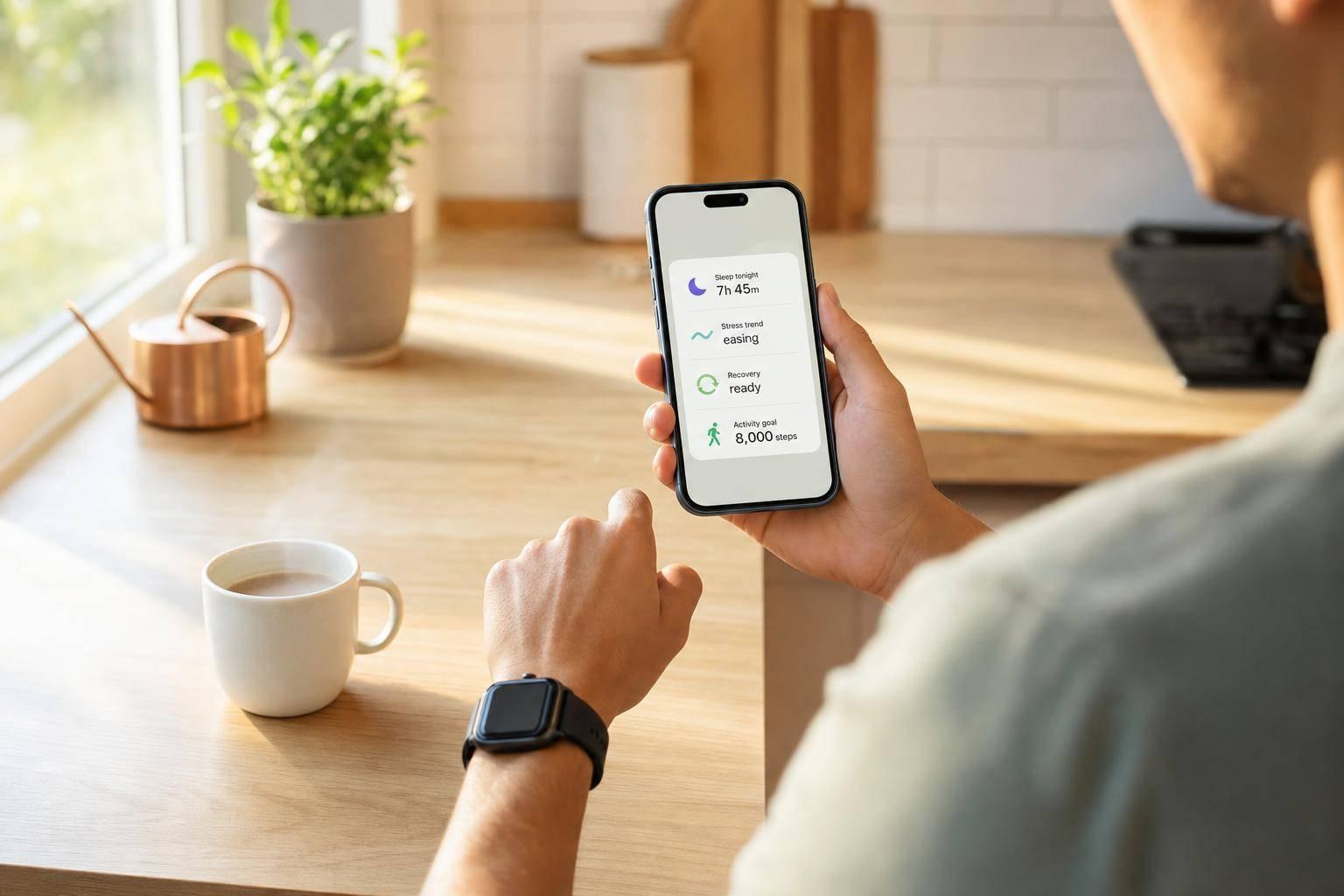
AI can turn your health data into simple daily nudges - but only if the data is steady, mixed, and personal. In short: wearables show day-to-day changes, lab work shows slower health shifts, and lifestyle logs explain why those changes happen. Put those together for 2–4 weeks, and AI can start estimating things like sleep trouble, stress load, recovery, and activity dips.
Here’s the main idea:
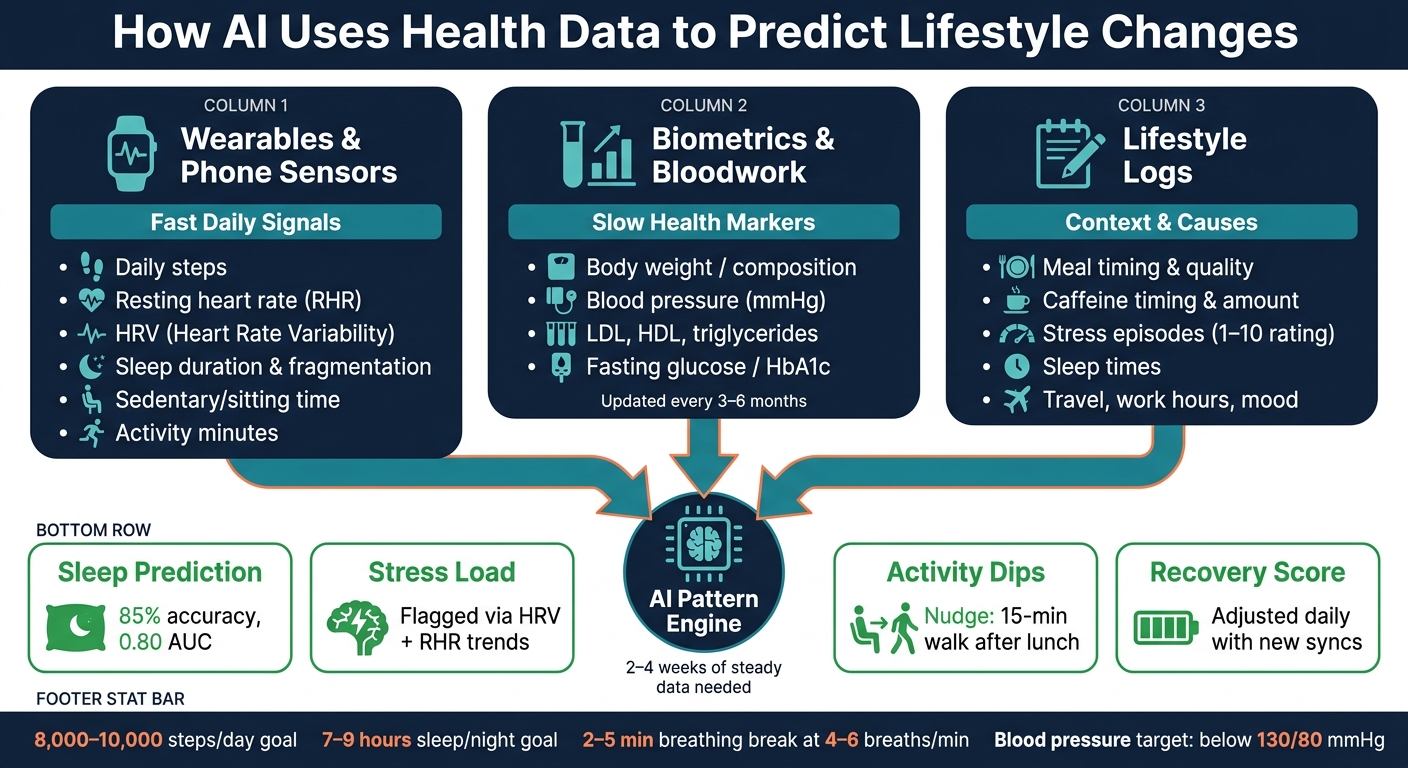
- Wearables track fast signals like steps, resting heart rate, HRV, sleep, and sitting time
- Biometrics and labs track slower shifts like weight, blood pressure, glucose, HbA1c, and cholesterol
- Lifestyle logs add context like meals, caffeine, stress, travel, and bedtime
- AI works from patterns and probabilities, not certainty
- The output should be small actions you can use that day, like a 15-minute walk, an earlier bedtime, or a short breathing break
A few numbers stand out:
- Sleep prediction models in one study reached 85% accuracy with 0.80 AUC
- Many systems need 2–4 weeks of steady data before patterns start to mean much
- Good daily goals often include 8,000–10,000 steps and 7–9 hours of sleep
- Short stress resets can be as little as 2–5 minutes at 4–6 breaths per minute
What I take from this article is simple: AI is best used as a coaching tool, not a medical one. It helps me spot links between my habits and my body faster than I could on my own - but I still need to log data, review trends, and use common sense.
Quick overview:
| Data type | What it helps predict | Example action |
|---|---|---|
| Wearables | Stress, sleep, recovery, activity dips | Walk after lunch |
| Labs and biometrics | Metabolic and heart-health trends | Check blood pressure or glucose routine |
| Lifestyle logs | Causes behind bad sleep or stress | Move caffeine earlier |
| Combined data | More personal forecasts | Shift bedtime, breaks, and workout load |
If I want useful AI guidance, I need to think less about one reading and more about patterns over time.
How AI Uses Health Data to Predict Lifestyle Changes
What Health Data AI Needs to Make Useful Predictions
AI needs weeks of steady data to spot patterns. A single bad night can be random. But if sleep keeps dropping on the same workdays, that starts to mean something.
The next three inputs work best as a group: fast signals, slow markers, and context.
Wearables and Phone Sensors: Steps, Heart Rate, HRV, Sleep, and Activity
Your Apple Watch or iPhone-connected wearable can feed AI coaching some of the most frequent inputs it gets. The most useful ones are daily steps, activity minutes, resting heart rate (RHR), HRV, sleep duration, sleep fragmentation, and time spent sitting.
HRV stands out here. It can reflect recovery, stress load, and sleep quality at the same time. Research shows that resting HRV measured by consumer wearables has modest links with HbA1c, depressive symptoms, and sleep difficulty.[1] In one sleep forecasting study, HRV data from the previous seven days helped predict next-day time awake after falling asleep.[4]
What matters most is the trend, not one isolated reading. If RHR keeps climbing or HRV keeps falling over a period of weeks, that can point to stress or overtraining before you even feel it. When you pair those shifts with biomarkers and logs, it's much easier to separate random noise from a real change.
Biometrics and Bloodwork: Weight, Blood Pressure, Cholesterol, and Glucose
Wearables show day-to-day movement. Biometrics and bloodwork show slower changes.
| Biometric | What It Adds |
|---|---|
| Body weight / composition | Tracks long-term metabolic trends |
| Blood pressure (mmHg) | Flags cardiovascular strain linked to stress and sleep patterns |
| LDL, HDL, triglycerides | Reflect long-term impact of activity and nutrition on cardiovascular risk |
| Glucose / HbA1c (mg/dL, %) | Shows how well your routine supports blood sugar control |
When AI links rising HbA1c with consistently low HRV and high time spent sitting, it can form a much more specific view of risk than any single data source on its own.[1][2] That's when general advice starts to get more concrete, like suggesting a 15-minute walk after dinner. But for that kind of coaching to land, AI still needs one more piece: context.
Lifestyle Logs: Meals, Stress, Mood, Schedule, and Environment
Physiology shows what changed. Logs help explain why.
If you log meals, alcohol intake, stress, mood, bedtime, work hours, or travel, AI can connect those entries to the HRV drop or broken-up sleep that came after.[1][3]
Without context like travel, overtime, or a heat wave, AI can misread a short-term disruption as a habit. That extra detail helps the model stay on track and makes the guidance a lot more useful.
Healify combines wearables, biometrics, bloodwork, and lifestyle logs into one coaching view.
sbb-itb-f5765c6
How AI Turns Raw Health Data Into Lifestyle Forecasts
Once your data is connected, AI starts turning those signals into forecasts.
How AI Models Sleep, Recovery, Stress, and Activity Patterns
The system begins by learning what normal looks like for you. That means your baseline: resting heart rate, HRV for resilience, sleep duration, and activity level.
Then it looks for shifts. Research shows a clear pattern: more sleep lowers stress risk, while higher resting heart rate and respiratory rate increase it.[5]
So when HRV drops and resting heart rate climbs, the system can flag a pattern tied to lower energy, less movement, or more stress. It’s not guessing out of thin air. It’s reading changes against your own baseline.
Why Combining Multiple Data Sources Improves Predictions
One metric on its own can point in the wrong direction. A higher heart rate means a lot more when it shows up alongside broken sleep, higher stress logs, and steps that fall below your usual range.
That’s why combining signals matters. In one study, a model using activity, light exposure, and HRV predicted sleep quality with 85% accuracy and 0.80 AUC.[6] And as new data keeps coming in, those forecasts get sharper.
When Healify pulls together biometrics, bloodwork, and wearable signals, it can estimate patterns like rising stress load, weaker workout consistency, or growing sleep debt.
Why Predictions Get Better With Continuous Data Updates
Each sync updates the forecast. AI forecasts aren’t fixed. They’re probabilities, not guarantees.
Every update recalibrates the model. If sleep improves, a fatigue warning may soften. If activity drops while stress climbs, the forecast shifts in that direction.
That’s why steady syncing matters before AI coaching can stay useful.
How to Set Up Your Data for Useful AI Coaching
Good predictions need a steady stream of data. If you already use an iPhone and a wearable, you’re most of the way there.
Connect Your Wearables and Sync Data Consistently
For U.S. iPhone users, Apple Health is the main hub. It pulls in steps, heart rate, HRV, sleep, blood oxygen, and workouts from your Apple Watch and many third-party devices, so your data sits in one place.[9][8]
Setup is pretty simple. Pair your wearable with Bluetooth, open the device’s companion app, and turn on data sharing with Apple Health in the app’s Health or Data settings. For Apple Watch, that’s the Watch app. For Fitbit, it’s the Fitbit app.[9][10]
Apple Watch sends key health data into Apple Health, including sleep, steps, resting heart rate, blood oxygen, respiratory rate, VO₂ max, and wrist temperature.[7] If you use a different recovery-focused wearable, pay close attention to HRV. Some devices don’t pass that metric into Apple Health, so a direct connection may work better for those readings.
Try to wear your device for most of the day and charge it once a day to cut down on gaps. Sync at least daily. One easy routine is to open your wearable app and Healify each morning while you check the previous night’s sleep and your step goal for the day. After 2–4 weeks of steady tracking, the AI has enough history to spot patterns that matter, like later bedtimes lining up with lower HRV the next morning.
Once your device data is coming in, the next step is to add slower-moving health markers that give those daily signals more context.
Add Biometrics, Lab Results, and Key Lifestyle Habits
Next, anchor your day-to-day data with biometrics and lab results.
A few biomarkers can tie short-term behavior to longer-term health. The top inputs here are weekly weight, blood pressure, and lab results such as fasting glucose, HbA1c, a lipid panel, and hs-CRP. Adding these every 3–6 months helps Healify connect your daily habits with longer-term trends and adjust its guidance.
For lifestyle logging, simple usually wins. A small set of steady inputs beats detailed tracking that happens only once in a while. Log these four habits each day:
- Sleep times
- Caffeine timing and amount
- Stress episodes with a 1–10 rating
- Meal timing with a simple quality tag
That’s enough context for the AI to spot links you’d probably miss on your own.
Set Clear Goals With Healify for Better Daily Guidance
Once everything is in one profile, set targets Anna can turn into day-to-day guidance.
A well-set-up Healify profile brings together synced wearable data, biometrics, lab results, and short daily logs in one place, which Anna uses for personalized guidance.
The best goals are specific and measurable. Common evidence-based targets for U.S. adults include 8,000–10,000 steps per day, 7–9 hours of sleep per night, and blood pressure below 130/80 mmHg for people with higher cardiovascular risk. Set those goals inside Healify, and Anna turns them into concrete actions. That might mean a suggested 15–20 minute walk after lunch if you’re behind on steps by midday, a 10:30 PM bedtime if your sleep is trending below 7 hours, or an earlier caffeine cutoff if your logs show evening coffee is hurting your HRV overnight.
Anna also adjusts its suggestions around your actual schedule. If your evenings are packed and long workouts just aren’t happening, she’ll shift the plan toward short movement breaks during the workday instead. The goal stays the same, but the path fits your life.
How to Act on AI Predictions to Change Daily Habits
Predictions only matter if they change what you do next. Once your wearable, biometric, and lifestyle data are in place, the app can turn patterns into clear next steps.
Use AI Insights to Adjust Sleep, Activity, and Stress Day to Day
When AI spots a pattern, use that forecast to make one small change that same day. That’s the idea behind real-time coaching: the app notices a stress spike, low activity, or poor sleep, then nudges you when action is most likely to help.[11][12][13]
The best responses are usually small and tied to the signal that changed:
- A 15-minute walk after lunch when your step count is behind. That can help flatten post-meal glucose spikes.[11][12][13]
- A 2- to 5-minute breathing break at 4 to 6 slow breaths per minute before a stressful moment. That can lower heart rate and improve HRV.[11][12][13]
- A 10:30 PM digital curfew if your data shows recovery drops when bedtime slips later than 11:30 PM.[11][12]
- Hydration reminders during long sitting periods, which can nudge you to stand up and reset.[11][12]
The app can also look at sedentary time, stress markers, and sleep debt together to pick the action that fits that day best.
Track Results and Let the AI Refine Your Plan Over Time
Check your results each week, then let the plan shift with your data. After your first change, the next sync can show whether it makes sense to push a bit more or back off. Over a few weeks, the AI should adjust your targets up, down, or sideways as it learns which habits improve sleep, energy, and recovery.[11][12]
Conclusion: Use AI Predictions as a Practical Guide, Not a Diagnosis
Use AI for day-to-day coaching, not for medical decisions. It can point out patterns and suggest behavior changes, but it cannot diagnose disease or replace clinical care. It also should never be the only reason to start, stop, or change medications. That includes conditions such as sleep apnea, hypertension, depression, or diabetes.[12][11][13]
If you notice warning signs like chest pain, shortness of breath, fainting, severe or worsening fatigue, unexplained rapid weight loss or gain, persistent high blood pressure, or thoughts of self-harm, contact a licensed healthcare professional promptly. AI data may give extra context for that visit, but treatment decisions need to come from a clinical evaluation.
Before using the app more deeply, review its privacy policy, turn on two-factor authentication, and share only the data you want used for coaching.
FAQs
How much data does AI need?
There’s no fixed amount. AI works best when it can learn from steady, varied data like wearables, health records, lab results, and lifestyle inputs.
What matters most isn’t just how much data you have. It’s the quality of that data and how well those inputs work together.
By comparing new information against your personal baseline over time, Healify turns day-to-day health data into an easy-to-follow action plan.
Which health metrics matter most?
The most important health metrics are the ones that give you a clear picture of how your body is doing day to day. That usually includes:
- Heart rate, resting heart rate (RHR), and heart rate variability (HRV)
- Blood glucose and creatinine
- Sleep stages and sleep quality
On their own, these numbers tell you a lot. But when you combine them with activity, bloodwork, and lifestyle data, you get a much better view of stress, recovery, metabolic health, and overall well-being.
Can AI health predictions replace a doctor?
No. AI health predictions can’t replace a doctor.
AI can review biometric data and lifestyle habits, flag early warning signs, and give personalized guidance. But it’s there to support medical care, not take the doctor’s place.
Think of it as a helpful layer of input. It can help you and your healthcare provider make better-informed choices, but you still need a medical professional for evaluation, diagnosis, and treatment decisions.