
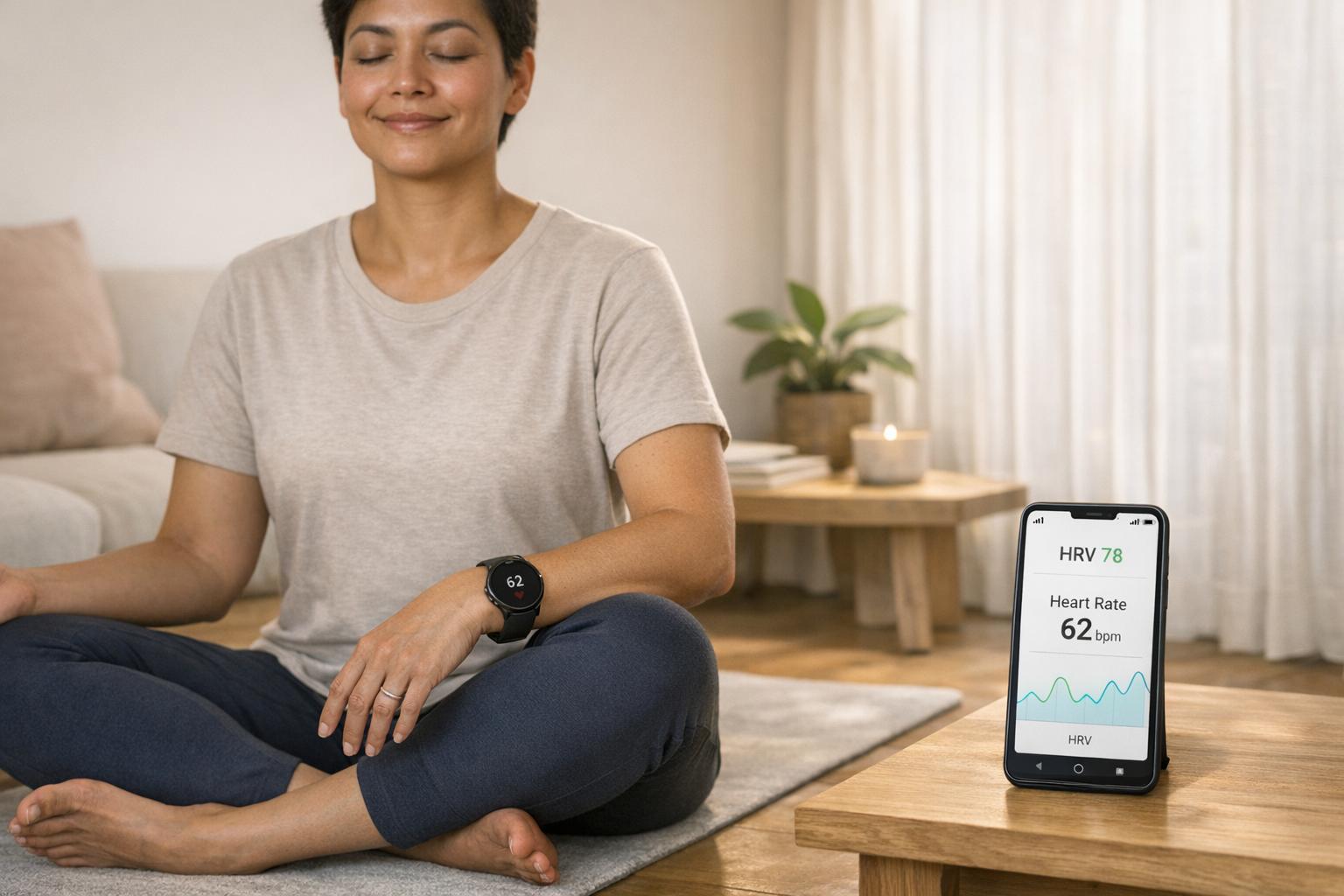
AI-guided meditation is changing how we manage stress by using real-time biometric feedback. These systems analyze your body’s signals - like heart rate variability (HRV), skin conductance, and cortisol levels - to create personalized meditation sessions. Unlike traditional apps, which rely on generic tracks, AI systems dynamically adjust breathing exercises and mindfulness techniques based on your physiological state. Research shows this approach can lower stress, improve HRV, and even enhance sleep quality with short, consistent practice.
Key takeaways:
- Biometric inputs: HRV, heart rate, respiratory rate, and cortisol help detect stress.
- AI’s role: Tailors meditation sessions using machine learning to match your body’s needs.
- Proven results: Studies show improved stress markers, reduced anxiety, and better adherence when biometric feedback is included.
This tech bridges the gap between passive meditation and active stress management, making meditation more effective and personalized for users.
The Science Behind Meditation and Stress Biomarkers
How Meditation Affects Stress and Anxiety Levels
Research shows that meditation can make a measurable difference - but the specifics matter. For example, a 3-week observational study analyzing 632 meditation sessions revealed that participants had a median perceived stress score (PSS) of 21, compared to 25 in a control group [5]. This difference holds weight in stress research. Another study focusing on an 8-week smartphone-based mindfulness program for working women demonstrated significant reductions in perceived stress (b = −2.00, P = .01) alongside decreases in anxiety and depressive symptoms (b = −1.24, P = .02) [8].
Interestingly, the length of meditation sessions may not be as important as consistency. A 10-day program involving just 10-minute daily sessions through the Ōura app and Headspace improved sleep efficiency and shortened the time needed to fall asleep [6]. This suggests that sticking to a regular meditation practice can yield meaningful benefits.
Meditation's Effect on HRV, Cortisol, and Other Biomarkers
Beyond subjective improvements in stress, researchers are now diving into how meditation affects physical stress markers. While meditation may not permanently increase baseline heart rate variability (HRV) like running does, it does cause immediate spikes in HRV during and shortly after practice. A 2026 study led by Atsushi Niida at the University of Tokyo tracked 90 participants using Garmin smartwatches. The findings showed an acute RMSSD (a key HRV measure) increase of +4.68 ms during meditation sessions, with effects lasting for at least 30 minutes afterward [5].
"The ability to increase HRV at arbitrary timings, along with the prolonged residual effect, may correlate with stress reduction." - Journal of Medical Internet Research [5]
In addition to HRV, regular mindfulness practice has been linked to lower blood pressure and reduced cortisol levels over time [7]. These two biomarkers offer complementary insights: HRV provides a near-instant snapshot of autonomic nervous system activity, while cortisol reflects the slower hormonal response of the HPA axis. Together, they offer a more comprehensive view of how meditation impacts stress in the body.
Where Traditional Meditation Apps Fall Short
Despite the growing evidence for meditation’s benefits, many people struggle to maintain the habit. Traditional meditation apps face challenges such as low adherence rates, limited personalization, and a lack of real-time physiological feedback. That last point is particularly critical [3].
A randomized controlled trial involving 163 participants tested two versions of a meditation app: one with heart rate biofeedback and one without. The biofeedback version led to a meaningful reduction in perceived stress (effect size d = 0.41), while the version without biofeedback showed no significant difference compared to the control group (d = 0.14) [3]. This highlights that guided content alone often falls short - real-time biometric feedback is a game-changer. It underscores the need for AI-driven systems that incorporate biometric data to provide tailored, effective meditation experiences.
Can Technology Teach You to Meditate? AI, Neurofeedback & VR - Steve Haberlin, PhD | FitMind Podcast
How AI Uses Biometrics to Personalize Meditation
Data is what separates a generic meditation session from one that truly resonates. AI bridges this gap by interpreting your body’s signals and tailoring the experience in real time.
Key Biometric Inputs and Their Role in Stress Detection
Different biometrics reveal varying aspects of stress, both acute and chronic. Here’s a breakdown of how these inputs work:
| Biometric Input | What It Reveals | How AI Uses It |
|---|---|---|
| HRV (rMSSD) | Autonomic balance and recovery capacity | Adjusts breathing patterns to achieve cardiac coherence [2] |
| Heart Rate (HR) | Immediate nervous system activity | Introduces micro-pauses or visual cues during HR spikes [2] |
| Respiratory Rate | Breathing depth and pace | Guides diaphragmatic breathing and longer exhales [2][4] |
| Sleep Metrics | Long-term recovery and accumulated strain | Suggests wind-down routines based on sleep debt [2] |
With these inputs, AI fine-tunes its interventions, adapting continuously based on real-time feedback.
How AI Detects Stress and Adjusts Interventions
AI doesn’t just compare your biometrics to general averages - it builds a baseline unique to you. Using dynamic thresholding, it identifies deviations from your personal norm [11].
Advanced algorithms like Random Forest classifiers and LSTM neural networks analyze HRV metrics such as RMSSD, pNN50, and the LF/HF ratio to gauge stress in real time [9][10]. For instance, if your normalized RMSSD dips below a specific threshold (e.g., 0.339 in one validated protocol), the system responds immediately. It might adjust your breathing cadence, suggest a short pause, or recommend switching from a focus session to a recovery one [9].
This creates a continuous biofeedback loop: the system monitors, detects, adjusts, and then monitors again [2].
"HRV-BfB can promote resilience by enhancing bodily stress tolerance, regeneration, and adaptability to physical, mental, and environmental demands." - Applied Psychophysiology and Biofeedback Journal [1]
Resonance breathing - typically between 4.5 and 6.5 breaths per minute - helps activate the vagus nerve, easing stress. AI systems customize this range for each user’s physiology rather than applying a one-size-fits-all approach [2][1].
Examples of AI-Guided Meditation in Practice
Real-world examples highlight how these adaptive interventions work. Take the NorthPeak Analytics pilot conducted in December 2025 using the PulseZen platform. Over 12 weeks, 92 participants followed HRV-adjusted breathing prompts. The results? Their rMSSD improved from 28 ms to 34 ms - a 21% increase - compared to just 4% in the control group. Resting heart rates dropped by 6 bpm, anxiety scores on the GAD-7 scale fell by 36%, and the program delivered an estimated 4.1x ROI by boosting productivity and reducing absenteeism [2].
"The biofeedback made invisible stressors visible, then actionable." - Aisha, Senior Data Engineering Manager, NorthPeak Analytics [2]
Another example comes from the 2025 replication study of the VR-based system Flowborne. This system didn’t rely on specialized medical equipment. Instead, it used standard VR hand controllers placed on the abdomen to track diaphragmatic breathing through motion data. Real-time visual feedback, like color changes and particle effects, guided users’ breathing rhythms. Across 45 participants, improvements in HRV and relaxation-related self-efficacy were still evident one month later [4].
sbb-itb-f5765c6
What the Research Says About AI Meditation and Biometrics
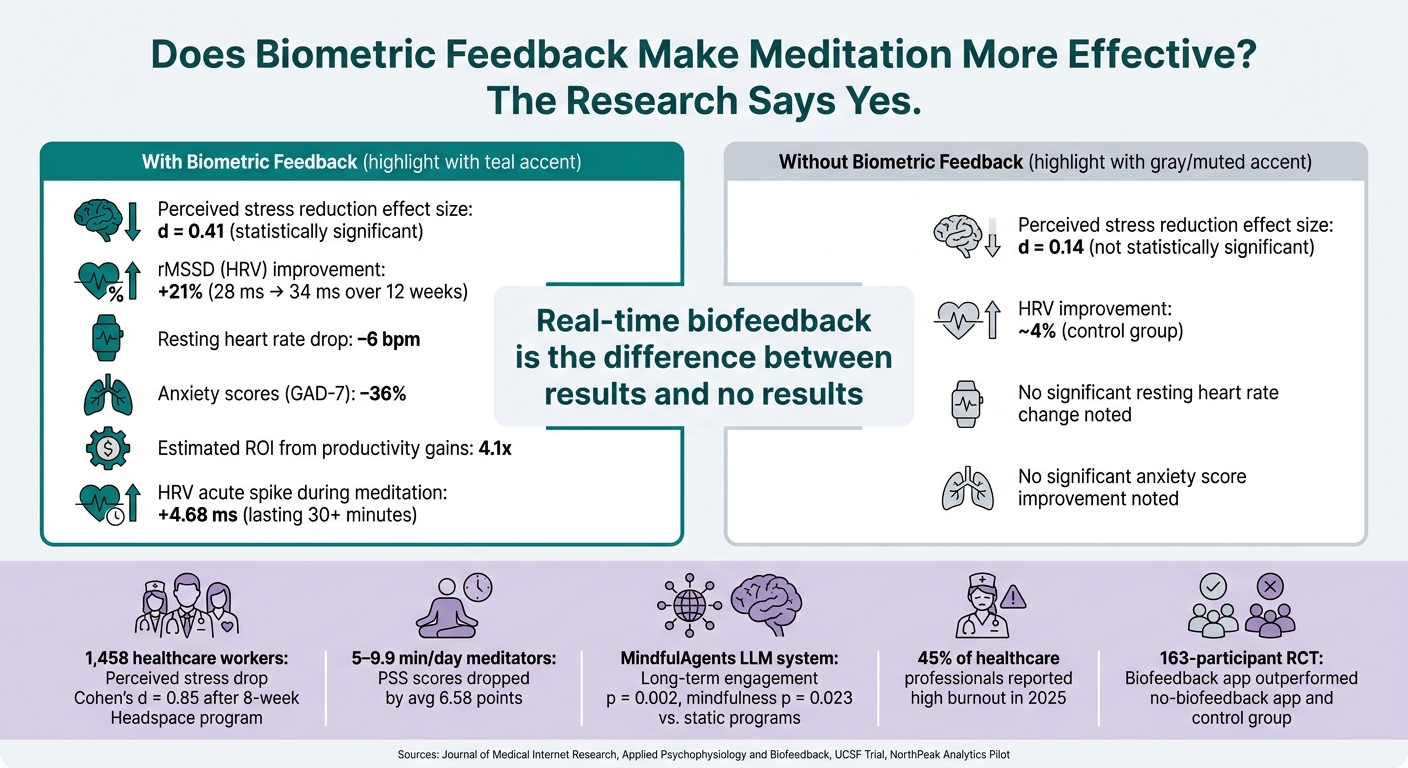
Biometric Feedback vs. No Feedback in AI Meditation: Key Research Stats
AI-Assisted Mindfulness for Healthcare and Other Professionals
In 2025, a striking 45% of healthcare professionals reported experiencing high levels of job burnout [12]. To address this, a UCSF trial conducted between May 2018 and September 2019 examined the effects of mindfulness on stress management. The study involved 1,458 healthcare workers using the Headspace app for daily 10-minute meditation sessions over an 8-week period. The results were promising: participants reported a notable decrease in perceived stress (Cohen's d = 0.85), reduced job strain (d = 0.34), and improved stress levels (d = 0.71) even at a 4-month follow-up. Interestingly, those who meditated for 5 to 9.9 minutes daily saw their Perceived Stress Scale scores drop by an average of 6.58 points [12].
"Digital mindfulness intervention uncoupled the relationship between cognitive performance and acute stress, meaning that participants who underwent mindfulness training were less affected by stress during cognitive performance." - Ulrich Kirk, PhD, University of Southern Denmark [7]
These results set the stage for further exploration into how integrating wearables can enhance the effectiveness of meditation programs.
Meditation Programs That Integrate Wearables
Research suggests that combining biometric sensors with meditation programs can lead to better stress management outcomes compared to static approaches. One study, a three-arm randomized controlled trial with 166 participants over 18 days, utilized smartphone accelerometers to provide real-time heart rate biofeedback during a CBT-based meditation program. The group receiving heart rate biofeedback showed a significant reduction in perceived stress (d = 0.41) at a 1-month follow-up. In contrast, the group without biofeedback (d = 0.14) showed no statistically significant improvement compared to the waitlist control [3].
"This study highlights that combining sensor data with targeted interventions enhances stress management outcomes." [3]
These findings suggest that wearable technology can play a pivotal role in improving meditation outcomes, but advancements don’t stop there - laboratory research is pushing the boundaries even further.
Lab-Based Neurofeedback Meditation Systems
Laboratory experiments are refining the personalization of meditation programs through neurofeedback techniques. A March 2026 study from Columbia University introduced "MindfulAgents", a system powered by large language models (LLMs). Over four weeks, 62 participants used this system, which featured a "Reflection Agent" to evaluate their emotional state before each session and a "Personalization Agent" to create custom-tailored meditation scripts. Led by Mengyuan "Millie" Wu, the study found significant increases in both long-term engagement (p = 0.002) and mindfulness (p = 0.023) compared to static meditation programs [13].
This research highlights the importance of personalization in meditation, showing that tailored approaches - beyond generic breathing exercises - can significantly improve outcomes.
What Comes Next for AI-Driven Meditation
Key Takeaways from Current Research
Research highlights one thing clearly: biometric feedback can make meditation much more effective. Short, consistent sessions - about 8 to 12 minutes, practiced 3 to 5 times a week - have been shown to improve heart rate variability (HRV), lower anxiety, and enhance sleep quality [2]. Personalization, especially when combined with wearable technology, outshines generic approaches. Platforms like Healify are already applying these insights to refine their methods.
How Platforms Like Healify Apply These Findings
Healify is a great example of how research can guide practical innovation. Instead of offering generic advice, Healify's AI health coach, Anna, uses real-time data from wearables, biometrics, and lifestyle inputs to provide personalized stress-reduction recommendations.
This means users don’t have to decode complex metrics like HRV or cortisol levels themselves. Instead, Anna translates the data into actionable steps - telling users exactly what to do and when to do it. This approach aligns with research that shows adaptive, timely nudges based on physiological signals are far more effective than static, one-size-fits-all content.
Gaps in the Research and Where to Go Next
While the progress is exciting, there are still hurdles to overcome. For instance, cortisol tracking - a direct biochemical marker of stress - is mostly limited to lab settings right now. But advancements are on the way. In January 2026, researchers at UC Irvine, led by Assistant Professor Rahim Esfandyarpour, introduced the SQC-SAS, a wrist-worn bioelectronic device. This device uses a multimodal patch to monitor sweat cortisol alongside other physiological signals, like heart rate and skin conductance [14].
"Stress is not a single signal; it's a dynamic physiological and biochemical response. By measuring both molecular biomarkers and physiological signals at the same time, we can reduce ambiguity." - Rahim Esfandyarpour, Assistant Professor, UC Irvine [14]
The future of AI-driven meditation will benefit from longer research studies, larger and more diverse participant groups, and standardized methods that combine biometric data with self-reported experiences. Addressing these gaps will improve the accuracy of AI-guided stress interventions, helping the technology evolve even further.
FAQs
Which biometrics matter most for stress?
Heart rate variability (HRV) is a crucial indicator when it comes to managing stress. It measures the balance and adaptability of your autonomic nervous system. Generally, a lower HRV suggests higher levels of stress.
Tools like Healify leverage HRV metrics - such as rMSSD (Root Mean Square of Successive Differences) and SDNN (Standard Deviation of NN intervals) - to provide real-time guidance for stress recovery. For example, they may recommend personalized breathing exercises tailored to your needs.
Additionally, cortisol, often referred to as the "stress hormone", is analyzed to understand the long-term impact of chronic stress on your overall well-being. This combination of HRV and cortisol tracking offers a comprehensive way to monitor and improve stress resilience.
Do I need a wearable to use AI meditation?
You don’t have to use a wearable device for AI-guided meditation, but it can make the experience much more personalized. Some platforms ask for manual inputs, like your current mood or meditation goals, while others take it a step further by using real-time biometric data - like heart rate variability - collected from wearables. For example, apps like Healify combine this data with lifestyle metrics to create customized, actionable health plans designed to boost your overall well-being.
How often should I meditate to see results?
Consistency is the key when it comes to improving mood and building resilience. Research suggests that practicing 4–7 days a week can lead to noticeable changes, even if the sessions are short. Just 10 minutes a day can make a lasting difference. Tools like Healify can take it a step further by analyzing your biometric data to provide tailored recommendations. This way, you can determine the best frequency and duration of sessions based on your unique stress patterns.